Imagine this: You lay your head on the pillow, but your mind is still racing. The emails you didn’t send, the bills due next week, the awkward conversation from earlier—it all floods in. We live in an era of “Revenge Bedtime Procrastination,” where we doom-scroll to reclaim our time. But 1,400 years ago, the Prophet Muhammad (ﷺ) gave us a “spiritual off-switch.” It’s not just a ritual; it’s a method to hand over your heavy burdens to the One who never sleeps.
Let’s unlock the transformative power of the Raat ko sone ki dua and the Prophetic sleep routine.
The Authentic Dua Before Sleeping (Raat Ko Sone Ki Dua)
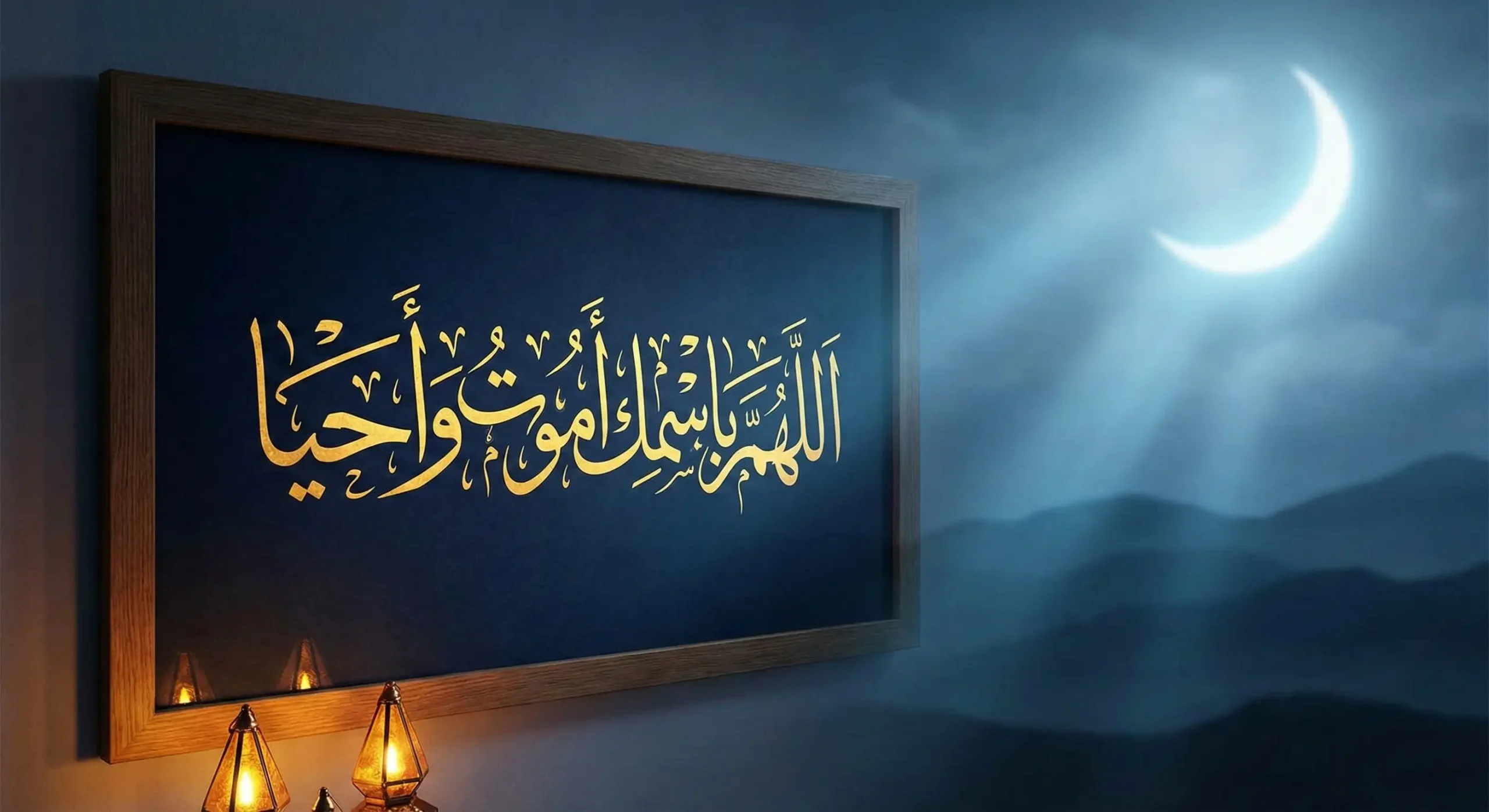
The most authentic dua before sleeping, recorded in Sahih al-Bukhari, is “Allahumma bismika amutu wa ahya.” This translates to “O Allah, in Your name I die and I live.” It signifies surrendering your soul to God for the night, acknowledging sleep as a temporary death, and trusting Him for the next day’s life.
When you recite this, you are effectively signing a contract of trust (Tawakkul) with your Creator.
The Text & Translation
Arabic (Original Text):
اللَّهُمَّ بِاسْمِكَ أَمُوتُ وَأَحْيَا
Transliteration (For pronunciation): Allahumma bismika amutu wa ahya.
English Translation (Sahih International): “O Allah, in Your name I die and I live.”
Urdu Translation (Fateh Muhammad Jalandhari style):
“اے اللہ! تیرے نام کے ساتھ میں مرتا ہوں اور جیتا ہوں۔”
Source: Sahih al-Bukhari 6324
The “Spiritual Circadian Rhythm”: Why We Say “I Die”
In Islam, sleep is widely regarded as a “Minor Death” (Mawt al-Sughra). When Muslims recite “Amutu” (I die) before sleeping, they are spiritually aligning with the biological reality that their soul partially departs. It is a psychological practice of letting go of control and accepting that waking up is a gift, not a guarantee.
Think of it this way: Your phone needs to power down to clear its cache. Your soul is the same. The phrase “In Your name I die” is the command that clears your mental tabs.
Ibn Kathir, in his Tafsir, references Surah Az-Zumar (39:42), explaining that Allah takes the souls at the time of their death and during sleep. By reciting this dua, you are consciously participating in this divine cycle rather than fighting it with anxiety.
The Complete Sunnah Sleep Protocol (Step-by-Step)
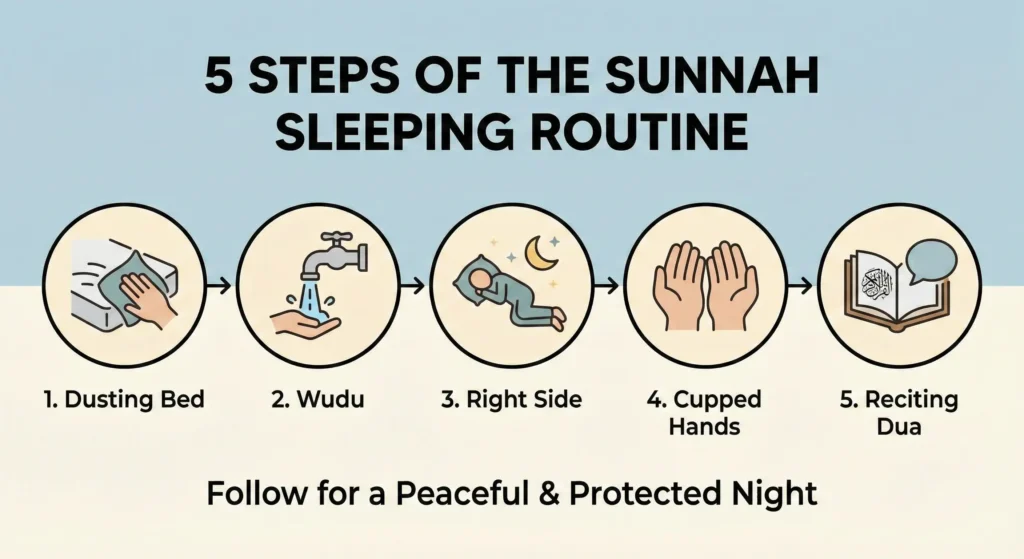
The complete Sunnah sleep routine involves five key steps: performing Wudu (ablution) to sleep in purity, dusting the bed three times, sleeping on the right side to aid heart health and digestion, cupping hands to recite the 3 Quls, and finally reciting the specific sleeping dua. This routine combines physical hygiene with spiritual protection.
To truly fix your sleep hygiene, don’t just say the words—adopt the lifestyle.
1. The Physical Cleanse (Wudu)
The Prophet (ﷺ) said, “Whenever you go to bed, perform ablution like that for the prayer” (Bukhari & Muslim). Sleeping with Wudu keeps you in a state of purity, protecting you from nightmares and whispers of Shaitan.
2. The Bed Prep (Dusting)
Before lying down, dust the bed sheet three times.
- Why? Physically, it removes dust or insects. Spiritually, it signifies clearing your space for a new beginning.
3. The Posture (Right Side)
Lie on your right side and place your right hand under your right cheek.
- Modern Science Connection: Sleeping on the right side is proven to be lighter on the heart (which is located on the left) and aids in stomach emptying, preventing acid reflux.
4. The Shield (3 Quls & Ayatul Kursi)
Cup your hands, recite Surah Al-Ikhlas, Al-Falaq, and An-Nas, blow into your hands, and wipe them over your body (starting from the head). Do this three times. Also, recite Ayatul Kursi to appoint a guardian angel for the night.
Common Questions:
Yes, you can recite the sleeping dua without Wudu. While sleeping with Wudu is a highly recommended Sunnah (Mustahabb) and brings extra blessings, it is not obligatory (Fard). You can still remember Allah and recite the dua in any state.
If you forget to say the dua and wake up briefly or in the morning, do not worry; there is no sin upon you. Islam is built on intention (Niyyah). You can simply say it when you remember or focus on the morning dua upon waking up.
Yes. If you wake up startled, the Sunnah is to say: “A’udhu bikalimatillahi at-tammati min ghadabihi wa ‘iqabihi” (I seek refuge in the perfect words of Allah from His anger and punishment). This helps calm the heart immediately.
Deep Dive: The Tasbih of Fatimah (RA)
There is a hidden gem in the nightly routine often called the “remedy for fatigue.”
When the Prophet’s daughter, Fatimah (RA), complained of blistered hands from grinding corn and asked for a servant, the Prophet (ﷺ) gave her something better than a servant. He taught her to recite before sleep:
- 33 times SubhanAllah (Glory be to Allah)
- 33 times Alhamdulillah (Praise be to Allah)
- 34 times Allahu Akbar (God is the Greatest)
The Takeaway: If you feel physically drained or mentally exhausted from the 9-to-5 grind, add this Tasbih to your night routine. It provides spiritual energy that physical rest alone cannot give.
A Final Thought: The Morning Connection
The beauty of the sleeping dua is that it has a partner—the waking dua.
- Night: “I die” (Amutu)
- Morning: “He gave us life” (Ahyana)
By reciting “Allahumma bismika amutu wa ahya” tonight, you aren’t just sleeping; you are practicing for the day you meet your Lord, ensuring that your last conscious thought is His name.
