Why do Kings Fall and Outsiders Rise?
Have you ever wondered why some people reach the pinnacle of success only to vanish in an instant, while others rise from total obscurity to change the world? We often credit “luck” or “strategy,” but the Quran reveals a deeper, invisible law of physics governing our social status. This is the reality of Izzah (honor) and Dhullah (humiliation)—a cycle controlled by a single, Sovereign Hand.
What is the meaning of Watu Izzu Mantasha?
Watu Izzu Mantasha is an Arabic phrase meaning “You honor whom You will.” It is part of verse 3:26 in the Quran. It signifies that all dignity, respect, and high status are granted by God alone, regardless of a person’s wealth or social standing.
The Multilingual Quadrant: Proof of Sovereignty
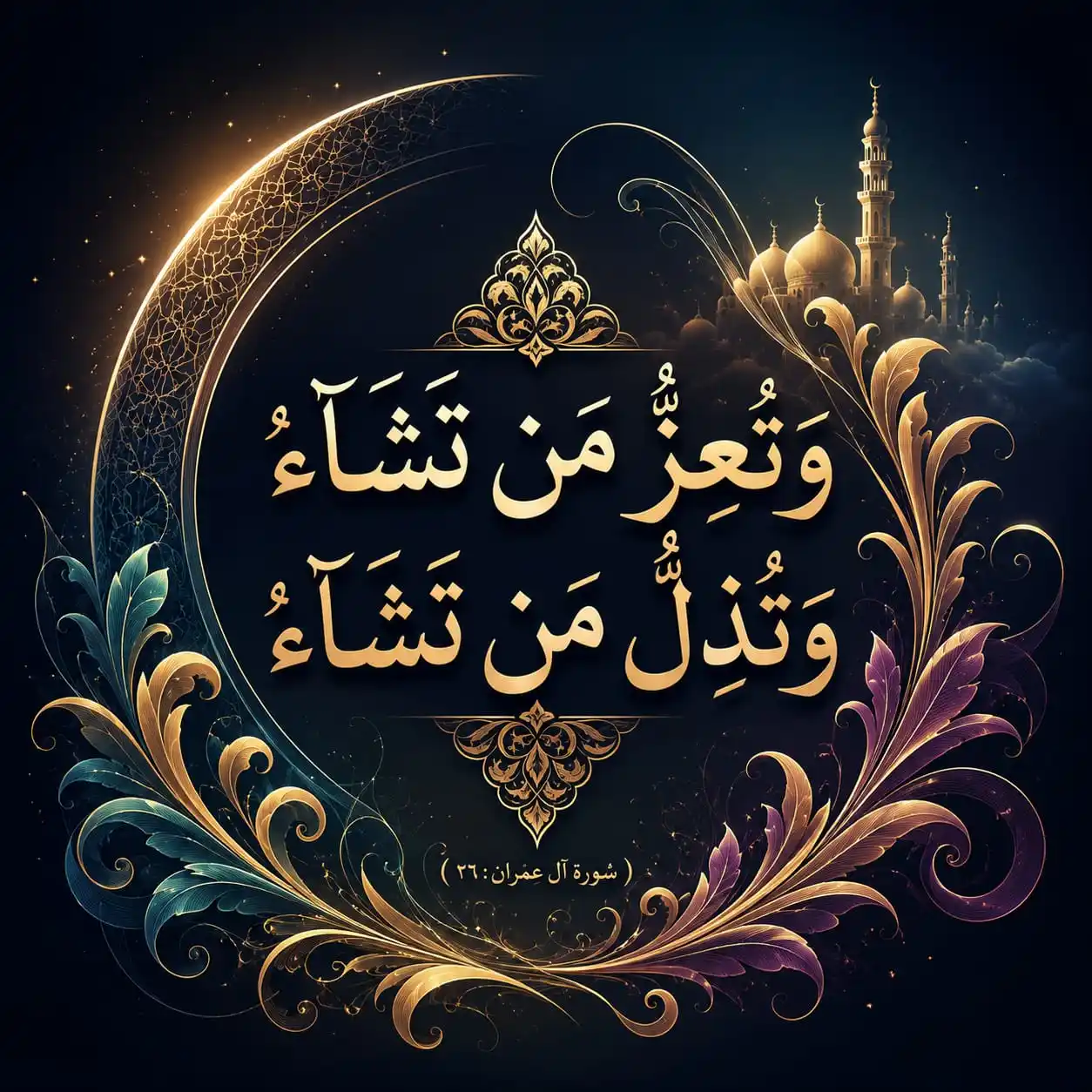
Arabic Text
وَتُعِزُّ مَنْ تَشَاءُ وَتُذِلُّ مَنْ تَشَاءُ
Transliteration
Wa tu’izzu man tashā’u wa tudhillu man tashā’u.
English Translation (Saheeh International)
“You honor whom You will, and You humble whom You will.”
Urdu Translation (Jalandhari)
“اور جس کو چاہے عزت دے اور جسے چاہے ذلت دے”
![A comprehensive educational infographic titled "UNDERSTANDING SURAH AL IMRAN, VERSE 26: DIVINE POWER & HONOR." The top half features ornate Islamic digital art with a glowing golden crescent moon, arabesque filigree, and a majestic mosque against a starry night sky, framing the central Arabic calligraphy: "وَتُعِزُّ مَنْ تَشَاءُ وَتُذِلُّ مَنْ تَشَاءُ" (You exalt whom You will, and You abase whom You will). Below this, a section titled "THE COMPLETE VERSE" displays the full Arabic text of 3:26 alongside its English translation: "Say: O Allah! Lord of all sovereignty! You bestow sovereignty on whom You will, and You withdraw sovereignty from whom You will. You exalt whom You will, and You abase whom You will. In Your hand is all good. Truly, You have power over all things." The bottom half breaks the verse down into four key analytical points, each accompanied by a visual icon: 1. DIVINE SOVEREIGNTY (AL-MULK) [Crown icon] explaining worldly power is a temporary trust from Allah. 2. CONFIRMING HONOR ('IZZ) [Standing figure icon] stating true honor comes from faith, not worldly position. 3. ALL GOOD IN HIS HAND [Cupped hands icon with Arabic text Al-Khayr] explaining every divine decree is part of a greater good. 4. ABLE TO DO ALL THINGS [Abstract power icon] affirming Allah's absolute power and limitless wisdom. The design uses a premium color palette of deep navy blue, purple, and metallic gold. Keywords: Quranic Tafsir, Islamic education, Surah Al-Imran 3:26 meaning, divine decree, Al-Mulk, Izz, visual theology breakdown.](https://currentislam.com/wp-content/uploads/2026/02/understanding-surah-al-imran-verse-26-infographic-811x1024.webp)
| Arabic Word | Transliteration | English Meaning |
|---|---|---|
| وَتُعِزُّ | Wa Tu’izzu | And You give honor / might |
| مَنْ | Man | Whom |
| تَشَاءُ | Tashā’u | You will |
| وَتُذِلُّ | Wa Tudhillu | And You humble / abase |
| مَنْ | Man | Whom |
| تَشَاءُ | Tashā’u | You will |
Deep Scholarship: Tafsir and Historical Context
Classical scholars like Ibn Kathir explain that this verse was revealed when the Prophet Muhammad (ﷺ) was promised the empires of Persia and Rome. It reassured believers that God can shift world power from mighty empires to a small, oppressed group in the desert.
The Scholarship Depth:
- Classical View (Ibn Kathir): He notes that “In Your hand is [all] good” implies that even when God humbles someone, there is a hidden wisdom or a “good” purpose behind it—perhaps to trigger repentance or growth.
- Modern 2026 Context: In an era of Cancel Culture, we see people “de-platformed” (humbled) or “made viral” (honored) overnight. This verse teaches us that while the “Digital Crowd” may be the tool, the ultimate decree is Divine.
The Prophetic Connection: Hadith on Honor and Humility
Authentic Hadiths reinforce that honor is not found in wealth, but in character. The Prophet Muhammad (ﷺ) taught that when a person humbles themselves for the sake of God, it triggers the “Watu Izzu” promise—God elevates their status in the hearts of people.
The Multilingual Hadith Proof (Sahih Muslim):
Arabic Text
مَا نَقَصَتْ صَدَقَةٌ مِنْ مَالٍ، وَمَا زَادَ اللَّهُ عَبْدًا بِعَفْوٍ إِلَّا عِزًّا، وَمَا تَوَاضَعَ أَحَدٌ لِلَّهِ إِلَّا رَفَعَهُ اللَّهُ
Transliteration
Ma naqasat sadaqatun min mal, wa ma zadallahu ‘abdan bi ‘afwin illa ‘izza, wa ma tawada’a ahadun lillahi illa rafa’ahullah.
English Translation
“…and no one humbles himself for the sake of Allah except that Allah elevates him in status.”
Urdu Translation (اردو ترجمہ)
“…اور جو شخص اللہ کے لیے عاجزی اختیار کرتا ہے، اللہ اسے بلندی عطا فرماتا ہے۔”
Contextual Deep-Dive: The Prophet (ﷺ) explicitly linked Izzah (honor) to forgiveness and humility. In the modern “Digital Sunnah” framework, this means that “winning” an argument or “canceling” an opponent might feel like power, but true elevation comes from the restraint that God rewards with lasting respect.
7 Spiritual and Psychological Benefits
Reciting and reflecting on “Watu Izzu Mantasha” provides immediate mental relief and spiritual clarity. The primary benefits include the removal of social anxiety, protection against arrogance, and the development of “Tawakkul”—a deep, unshakable trust in God’s plan for your career and reputation.
Here’s why this matters for your daily life:
- Cures Imposter Syndrome: You realize your success isn’t just your “hustle”; it’s a Divine gift. This removes the crushing pressure to be perfect.
- Neutralizes “Cancel Culture” Anxiety: When you understand that honor is granted by the Creator, the fear of losing social status among people loses its power over your mental health.
- Dignity in Poverty: It reminds those struggling financially that their bank balance does not define their Izzah. A person can be poor yet carry the dignity of a king.
- Arrogance Insurance: For those at the top, this verse is a “pattern interrupt.” It warns that the power you hold is a loan, keeping your ego in check.
- Resilience in Crisis: During a “Zillu” (humbling) phase—like losing a job—it provides hope. The same Power that brought you low has the exclusive authority to raise you back up.
- Focus on Intent, Not Outcome: You stop obsessing over “going viral” and start focusing on being “accepted” by the Divine, which is the only status that lasts.
- Answered Supplication: Scholars often recommend this verse (3:26-27) as a powerful Wazifa for those seeking a breakthrough in their career or a restoration of their reputation.
Allah Grants Honor and Humility- Surah Ali ‘Imran (3:26) (PDF)
Scholarship Depth: The “Great Exchange”
Imam Al-Ghazali in his works on the Alchemy of Happiness notes that true Izzah is found in being independent of everyone except God. If you need people to praise you, you are “humbled” by your need for them. If you only need God, you are “honored” by your independence from them.
The Spiritual Habit Loop
Here’s why this matters for you in your daily life. We often get trapped in a “Validation Loop”—we seek honor from likes, titles, and salaries.
The Digital Sunnah Framework:
- The Cue: You feel a loss of status or “imposter syndrome.”
- The Routine: Instead of scrolling for validation, you recite 3:26 to recalibrate your heart.
- The Reward: You achieve Spiritual Sovereignty—a state where your confidence isn’t shaken by people’s opinions, because you know your Izzah comes from the Creator, not the creation.
People Also Ask:
True honor (Izzah) is found in obedience. As Umar ibn al-Khattab (RA) famously said, “We were the most humiliated people, but Allah honored us with Islam. If we seek honor elsewhere, Allah will humiliate us again.
Reciting this verse builds psychological resilience. It helps you stay humble during success (knowing it can be taken away) and stay hopeful during failure (knowing it can be restored).
No. Scholars explain that while the granting of honor is God’s power, He grants it based on a person’s efforts, intentions, and character. You provide the “seed” of action; He provides the “rain” of success.
