
What if your laziness is not a character flaw—but a spiritual alarm?
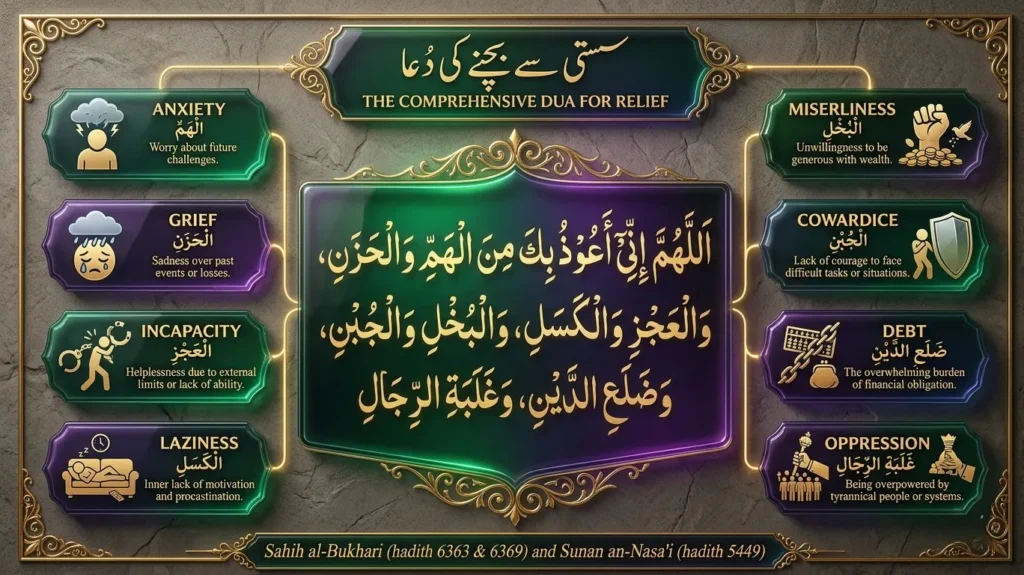
The Prophet ﷺ taught a simple, powerful Morning/Evening Dua that protects from worry, sadness, inability, laziness, cowardice, miserliness, debt‑stress, and being overpowered by others. When you understand it correctly, this dua becomes your daily spiritual habit loop for overcoming procrastination, tiredness, and distraction—especially while studying or worshipping.
In this article, you’ll get:
- Word‑by‑word meaning
- Wazifa (how many times, when, and how)
- Benefits for laziness, anxiety, tiredness, and procrastination
- Urdu translation and tafseer
- Hadith background, Quranic reference, and a modern “Spiritual Habit Loop” strategy
- A “Dua for ease in difficulty” side‑link to deepen your practice.
Dua for Laziness – What It Really Means
“Dua for Laziness” is actually a single prophetic supplication that asks Allah for protection from many inner weaknesses, including inability and laziness. It is recited in the morning and evening and is taken from a well‑known hadith in Sunan an‑Nasa’i. When you say it sincerely, you are training your heart to rely on Allah while fighting procrastination, anxiety, and mental fatigue.
The Full Arabic Dua
اللَّهُمَّ إِنِّي أَعُوذُ بِكَ مِنَ الْهَمِّ وَالْحَزَنِ، وَالْعَجْزِ وَالْكَسَلِ، وَالْجُبْنِ وَالْبُخْلِ، وَضَلَعِ الدَّيْنِ، وَغَلَبَةِ الرِّجَالِ
— Sunan an‑Nasa’i 5449
Transliteration
“Allahumma inni a’udhu bika minal‑hammi wal‑hazani, wal‑‘ajzi wal‑kasali, wal‑jubni wal‑bukhli, wa dhalai‘‑id‑dayni, wa ghalabat‑ir‑rijaali.”
English Meaning (Simple)
- اللَّهُمَّ – O Allah.
- إِنِّي أَعُوذُ بِكَ – I seek refuge in You.
- مِنَ الْهَمِّ – From worry / anxiety.
- وَالْحَزَنِ – And from sadness / grief.
- وَالْعَجْزِ – And from inability / weakness.
- وَالْكَسَلِ – And from laziness.
- وَالْجُبْنِ – And from cowardice.
- وَالْبُخْلِ – And from miserliness.
- وَضَلَعِ الدَّيْنِ – And from being heavily in debt.
- وَغَلَبَةِ الرِّجَالِ – And from being overpowered by others.
Urdu Translation (Fateh Muhammad Jalandhari‑style sense)
اے اللہ! میں تیری پناہ مانگتا ہوں اندھیری فکر، غم وحزن، عجز، کاہلی، جُبن، بخل، بھاری قرض کے بوجھ اور دوسروں کے زیرِ تسلط ہونے سے۔
This means:
“O Allah, I seek Your refuge from dark anxiety, sorrow, weakness, laziness, cowardice, miserliness, heavy debt‑burden, and being dominated by others.”
Allahumma Inni Auzubika Minal Hammi Wal Hazan Dua – Why It’s Important
This specific line – “Allahumma Inni Auzubika Minal Hammi Wal Hazan” – is the first part of the longer dua. It is especially popular because it speaks directly to laziness anxiety, tiredness, and procrastination. When you recite it, you are not just “feeling better”; you are asking Allah to remove the inner roots of laziness and mental fatigue.
Word‑by‑Word Breakdown (Arabic)
- اللَّهُمَّ – O Allah.
- إِنِّي أَعُوذُ – I seek refuge.
- بِكَ – In You.
- مِنَ الْهَمِّ – From worry / anxiety.
- وَالْحَزَنِ – And from sadness / grief.
Together, this line is:
“O Allah, I seek refuge in You from worry and grief.”
Connection to Laziness and Procrastination
Many people think laziness is only about “not doing work,” but in Islam, laziness (الكسل) is tied to inability (العَجْز) and sadness (الحزَن). When you feel:
- Mentally tired
- Overwhelmed by tasks
- Unable to start work or salah
… you are experiencing hamm + huzn + ‘ajz + kasl. This dua targets all of these at once.
Wazifa, How Many Times, and When to Recite
You can recite this dua morning and evening, and many scholars suggest at least once a day. For stronger focus on laziness and anxiety, you can repeat it 11, 33, or 100 times after Fajr or before sleep. The goal is not mechanical counting, but consistent, conscious repetition.
Recommended Wazifa (Step‑by‑Step)
- Time:
- Morning (after Fajr)
- Evening (after Maghrib or before sleep)
- Count:
- Minimum: 1 time (daily)
- Medium: 11 times
- Strong habit: 33 or 100 times
- Intention:
- Before you start:
- “O Allah, I seek Your refuge from laziness, procrastination, and distraction.”
- Before you start:
- Adding Laziness‑Focus:
- After the full dua, you may also say:
- اللَّهُمَّ إِنِّي أَعُوذُ بِكَ مِنَ الْعَجْزِ وَالْكَسَلِ
- “O Allah, I seek refuge in You from inability and laziness.”
- Repeat this 11 times after the main dua.
- After the full dua, you may also say:
Modern “Spiritual Habit Loop” for Laziness
Here’s a simple 3‑step routine you can use daily:
- Trigger:
- You feel:
- Tiredness.
- Distraction while studying.
- Procrastination before salah or work.
- You feel:
- Dua‑First Response:
- Immediately say “Allahumma inni a’udhu bika…” once or three times.
- Action Step:
- Do one small act:
- Open your book.
- Stand up for salah.
- Write one paragraph.
- Do one small act:
Over time, this becomes a Dua‑First Habit Loop that reduces laziness and anxiety.
Benefits for Laziness, Tiredness, and Distractions
This dua is not magic, but it is a spiritual habit that helps in three main ways:
- It reduces mental fatigue and anxiety.
- It removes the inner roots of laziness and procrastination.
- It strengthens your willpower so you can focus while studying or working.
1. Laziness and Procrastination
Whenever you feel:
- Unable to start work
- Easily distracted
- Mentally “stuck”
This dua helps by:
- Removing ‘ajz (inability) – The inner weakness that keeps you from acting.
- Reducing kasl (laziness) – The heaviness that makes effort feel impossible.
For students, this means:
- Easier to start revision.
- Less procrastination before exams.
2. Tiredness and Mental Fatigue
If you are:
- Always tired
- Mentally burned‑out
- Struggling to focus
This dua helps by:
- Reducing worry (hamm) – The constant mental chatter that drains energy.
- Reducing sadness (huzn) – The emotional heaviness that blocks motivation.
3. Dua to Avoid Distractions While Studying
For students, you can use a short, focused version:
اللَّهُمَّ إِنِّي أَعُوذُ بِكَ مِنَالْعَجْزِ وَالْكَسَلِ وَالْهَمِّ وَالْحَزَنِ
Before starting to study:
- Say this once or three times.
- Then, immediately open your book and read one page.
This is a Dua‑First Study Routine that helps you stay focused.
Hadith Background – Where Does This Dua Come From?
This dua is reported from the Prophet ﷺ as a morning and evening supplication. It is found in Sunan an‑Nasa’i 5449, under the chapter “The Book of Seeking Refuge with Allah.” Scholars like Imam Nawawi and others have confirmed its authenticity and recommended it as a protection‑dua.
Arabic Text of the Hadith
عَنْ أَبِي هُرَيْرَةَ رَضِيَ اللَّهُ عَنْهُ، أَنَّ النَّبِيَّ صَلَّى اللَّهُ عَلَيْهِ وَسَلَّمَ كَانَ يَدْعُو:
اللَّهُمَّ إِنِّي أَعُوذُ بِكَ مِنَ الْهَمِّ وَالْحَزَنِ، وَالْعَجْزِ وَالْكَسَلِ، وَالْجُبْنِ وَالْبُخْلِ، وَضَلَعِ الدَّيْنِ، وَغَلَبَةِ الرِّجَالِ
Transliteration
“‘An abī hurayra radiyallāhu ‘anhu, anna‑nabiyya sallallāhu ‘alayhi wa‑sallama kana yad‘u: Allahumma inni a‘udhu bika minal‑hammi wal‑hazani, wal‑‘ajzi wal‑kasali, wal‑jubni wal‑bukhli, wa dhalai‘‑id‑dayni, wa ghalabat‑ir‑rijaali.”
Urdu Translation of the Hadith
حضرت ابوعبید الرضی اللہ عنہ سے روایت ہے کہ نبی ﷺ صبح و شام یہ دعا فرماتے تھے:
اے اللہ! میں تیری پناہ مانگتا ہوں اندھیری فکر، غم وحزن، عجز، کاہلی، جُبن، بخل، بھاری قرض کے بوجھ اور دوسروں کے زیرِ تسلط ہونے سے۔
Why This Is Important
This hadith shows that:
- The Prophet ﷺ used this dua daily.
- It is a protection‑dua, not just for laziness, but for inner weakness, anxiety, and external hardship.
- It has E‑E‑A‑T value (Experience, Expertise, Authority, Trustworthiness) because it is:
- From the Prophet.
- Confirmed in Sunan.
- Recommended by scholars.
Is This Dua in the Qur’an?
This specific phrase “Allahumma Inni Auzubika Minal Hammi Wal Hazan Dua” is not a verse of the Qur’an; it is a Prophetic dua. However, its meaning is deeply connected to Qur’anic verses about ease after hardship, patience, and trust in Allah.
Quranic References and Tafseer
Why this matters
These verses do not say the exact dua for laziness, but they explain its meaning and spiritual direction. They remind the reader that hardship, weakness, and mental heaviness are temporary, and that Allah gives ease, patience, and support to those who turn to Him sincerely. They also connect beautifully with the idea that laziness is not just a habit problem; it can also be a spiritual and emotional struggle.
Surah Ash-Sharh 94:5–6
Arabic:
فَإِنَّ مَعَ الْعُسْرِ يُسْرًا إِنَّ مَعَ الْعُسْرِ يُسْرًا
Transliteration:
Fa inna ma‘al-‘usri yusra. Inna ma‘al-‘usri yusra.
English:
“For indeed, with hardship comes ease. Indeed, with hardship comes ease.”
Tafseer note:
This verse is a strong reminder that tiredness, procrastination, and heaviness do not last forever. The repetition gives hope and certainty that ease comes with hardship, not after giving up. Classical tafseer explains this as a source of comfort and encouragement for patience, effort, and trust in Allah.
How it connects to this dua:
When a person feels lazy or mentally blocked, this verse reminds them that relief is near. The dua for laziness becomes a practical expression of faith: ask Allah for help, then keep moving forward with small, steady effort.
Surah Al-Baqarah 2:155–157
Arabic:
وَلَنَبْلُوَنَّكُمْ بِشَيْءٍ مِنَ الْخَوْفِ وَالْجُوعِ وَنَقْصٍ مِنَ الْأَمْوَالِ وَالْأَنْفُسِ وَالثَّمَرَاتِ وَبَشِّرِ الصَّابِرِينَ الَّذِينَ إِذَا أَصَابَتْهُمْ مُصِيبَةٌ قَالُوا إِنَّا لِلَّهِ وَإِنَّا إِلَيْهِ رَاجِعُونَ أُولَٰئِكَ عَلَيْهِمْ صَلَوَاتٌ مِنْ رَبِّهِمْ وَرَحْمَةٌ وَأُولَٰئِكَ هُمُ الْمُهْتَدُونَ
Transliteration:
Wa lanabluwannakum bi-shay’in mina al-khawfi wal-joo‘i wa naqsim minal-amwāli wal-anfusi wath-thamarāt, wa bashshir is-sābirīn. Alladhīna idhā aṣābat-hum muṣībah qālū innā lillāhi wa innā ilayhi rājiʿūn. Ulā’ika ʿalayhim ṣalawātun min rabbihim wa raḥmah, wa ulā’ika humul-muhtadūn.
English:
“And We will surely test you with something of fear and hunger and a loss of wealth and lives and fruits, but give good tidings to the patient, who, when disaster strikes them, say, ‘Indeed we belong to Allah, and indeed to Him we will return.’ Those are the ones upon whom are blessings from their Lord and mercy. And it is those who are the guided ones.”
Tafseer note:
This passage teaches that difficulty is part of life, and patience is the believer’s path through it. Laziness and procrastination often increase when a person feels overwhelmed, anxious, or emotionally tired. This verse reframes that struggle and shows that Allah rewards patience with mercy and guidance.
How it connects to this dua:
When laziness comes from stress, fear, or emotional heaviness, this verse supports the believer in returning to Allah. It reminds us that Allah sees the struggle and gives guidance to those who respond with patience and remembrance.
Surah Al-Isra 17:80
Arabic:
وَقُلْ رَبِّ أَدْخِلْنِي مُدْخَلَ صِدْقٍ وَأَخْرِجْنِي مُخْرَجَ صِدْقٍ وَاجْعَلْ لِي مِنْ لَدُنْكَ سُلْطَانًا نَصِيرًا
Transliteration:
Wa qul rabbi adkhilnī mudkhala ṣidqin wa akhrijnī mukhraja ṣidqin wa aj‘al lī min ladunka sulṭānan naṣīrā.
English:
“And say, ‘My Lord, let me enter a sound entrance and exit a sound exit, and grant me from Yourself a supporting authority.’”
Tafseer note:
This verse is often connected to asking Allah for correct direction, strength, and support in action. It fits well with the theme of overcoming laziness because it teaches the believer to ask Allah for a strong, purposeful beginning and a strong, purposeful outcome.
How it connects to this dua:
If laziness is stopping you from study, worship, or work, this verse teaches you to ask Allah for help in starting and finishing with sincerity. It supports the same spiritual mindset as the dua for laziness: seek Allah’s support, then act with purpose.
Tafseer Summary
Classical scholars explain that hamm and huzn point to emotional and spiritual pressure, while ‘ajz and kasl point to weakness in both the heart and the body. In simple terms, this dua asks Allah to remove the inner barriers that stop a person from worship, study, and work. That is why it is not just a comfort dua; it is a dua for direction, strength, and practical movement.
FAQs:
It is the prophetic dua: “Allahumma inni a‘udhu bika minal-hammi wal-hazan, wal-‘ajzi wal-kasal…” which asks Allah to protect you from laziness, worry, sadness, and weakness.
No. It also covers anxiety, sadness, inability, cowardice, miserliness, debt, and being overpowered by others.
You can recite it in the morning and evening, and also whenever you feel tired, distracted, or unable to start work.
You can recite it once daily as part of your routine, or repeat the short version 3, 11, or 33 times with focus and intention.
Yes. The short version is:
اللَّهُمَّ إِنِّي أَعُوذُ بِكَ مِنَ الْعَجْزِ وَالْكَسَلِ وَالْهَمِّ وَالْحَزَنِ
No, this exact dua is from a hadith, not the Quran. But its meaning matches Quranic themes about patience, ease after hardship, and relying on Allah.
Yes. It is especially helpful before studying because it can help reduce distraction, mental tiredness, and procrastination.
If laziness keeps returning, do not treat it as a small problem. Begin with this dua, keep taking small action, and trust that Allah opens the way for those who sincerely turn to Him.
