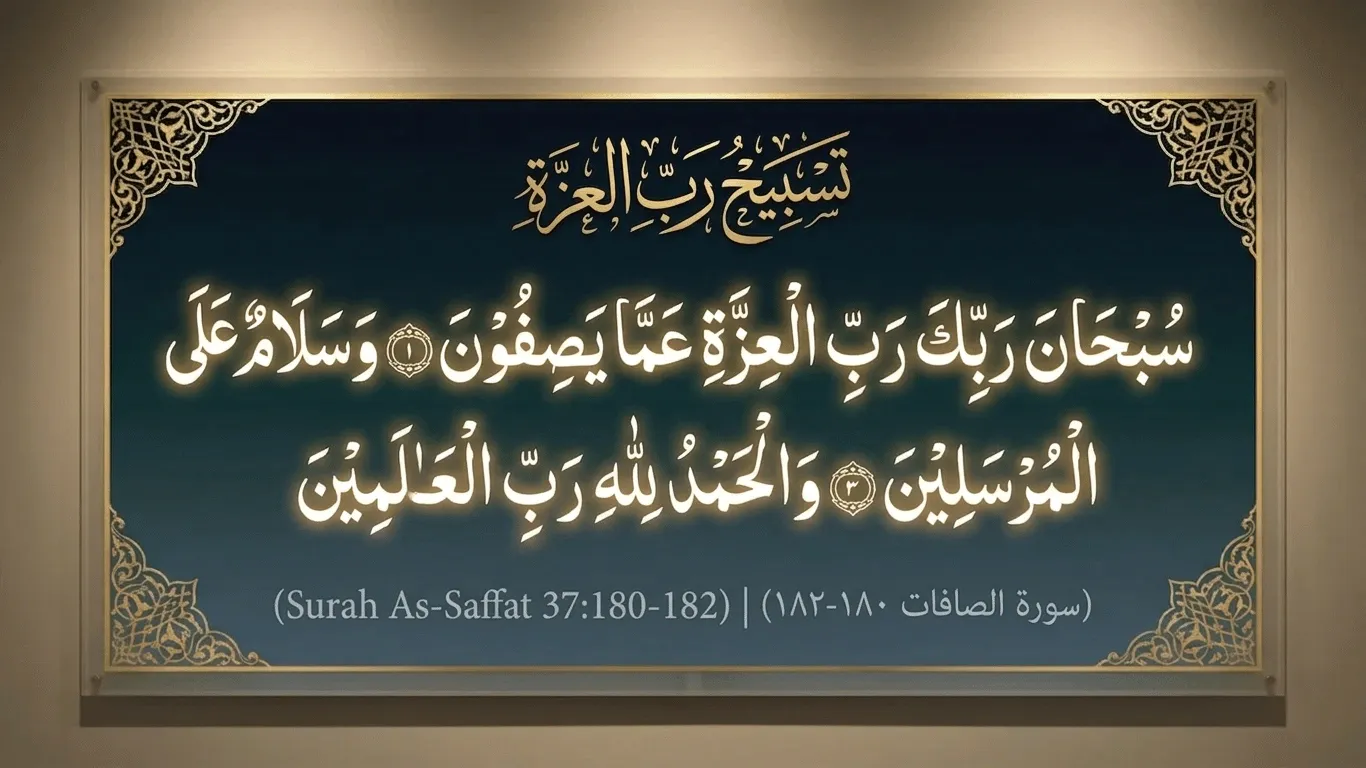
Ever felt that quiet unease in a chaotic world—scrolling endlessly, enemies lurking online or off, yet craving Allah’s shield like the Prophet sought in his final moments? These three verses from Surah As-Saffat hold the key.
What Are These Powerful Verses?
Subhana Rabbika Rabbil ‘Izzati ‘Amma Yasifun, Wa Salamun ‘Alal Mursalin, Wal Hamdulillahi Rabbil ‘Alamin—these are verses 180-182 of Surah As-Saffat (Chapter 37). They glorify Allah’s majesty, send peace on prophets, and praise Him as Lord of all worlds. Recite them to affirm divine protection in daily trials.
Multilingual Proof
🌙 النص العربي الأصلي | Original Arabic Text
سُبْحَانَ رَبِّكَ رَبِّ الْعِزَّةِ عَمَّا يَصِفُونَ
وَسَلَامٌ عَلَى الْمُرْسَلِينَ
وَالْحَمْدُ لِلَّهِ رَبِّ الْعَالَمِينَ🔤 Transliteration (Romanized)
Subḥāna rabbika rabbil 'izzati ʿammā yaṣifūna.
Wa salāmun ʿalal-mursalīn.
Wal-ḥamdulillāhi rabbil-ʿālamīn.
🇺🇸 English Translation (Sahih International)
Glory be to your Lord, the Lord of Honor and Majesty, above what they describe.
And peace be upon the messengers.
And all praise is for Allah, Lord of the worlds.
🇵🇰 اردو ترجمہ | Urdu Translation (Fateh Muhammad Jalandhry)
پاک ہے تیرا رب عزت والا جو کچھ وہ کہتے ہیں اس سے پاک۔
اور سلام ہو رسولوں پر۔
اور تمام تعریفیں اللہ کے لیے ہیں جو تمام جہانوں کا رب ہے۔
Word-by-Word Meaning
Break it down for clarity:
Subhana” (glorified/pure), “Rabbika” (your Lord), “Rabbil ‘Izzati” (Lord of Honor/Might), “‘Amma Yasifun” (above what they ascribe/describe falsely), “Wa Salamun” (and peace/salutations), “‘Alal Mursalin” (upon the messengers/prophets), “Wal Hamdulillahi” (and praise/thanks to Allah), “Rabbil ‘Alamin” (Lord of the worlds/universe). Each word refutes shirk and elevates tawhid.
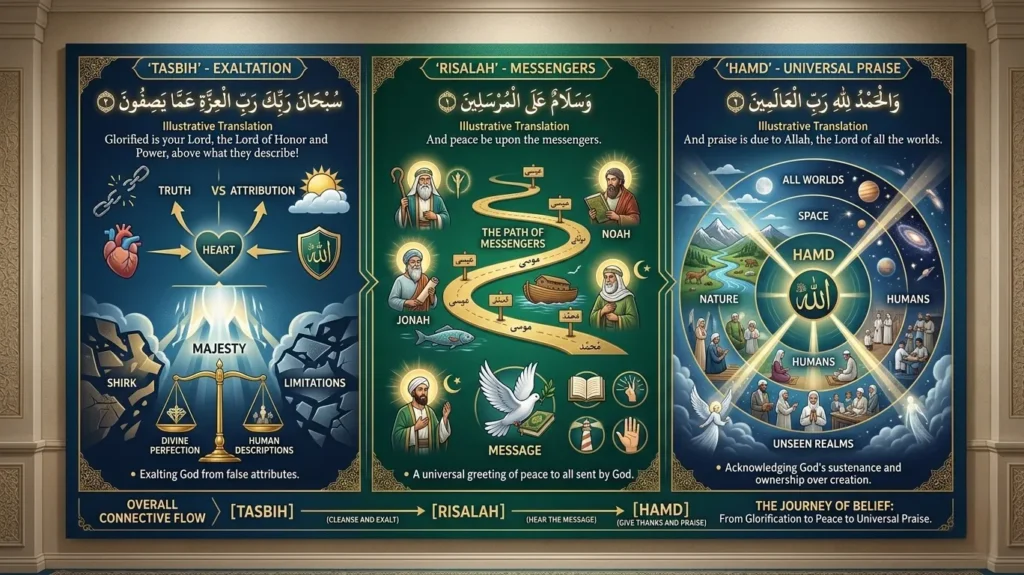
These words sanctify Allah from disbelievers’ lies, honor prophets, and end with universal praise—perfect for protection against fitnah.
From Where Do These Verses Come?
They close Surah As-Saffat, a Makki surah revealed to affirm resurrection, prophethood, and Allah’s power amid Meccan persecution. Ibn Kathir links them to refuting idolaters’ claims about Allah needing partners, tying back to stories of Noah and Abraham in the surah. Quranic reference: 37:180-182.
Why Are These Verses Important?
In a 2026 world of digital noise and hidden harms, they remind us Allah transcends all—your ultimate protector. Classical mufassir like Maududi call them a “recapitulation of tawhid,” while modern contexts see them shielding against misinformation or envy, much like the Prophet’s end-of-gathering recitals.
Direct Answer: Vital for spiritual armor; they elevate Allah above falsehoods, blessing messengers and praising creation’s Lord for holistic peace.
Full Tafseer Insights
Ibn Kathir explains verse 180 as Allah’s sanctity from pagans’ anthropomorphic tales, verse 181 salutes all prophets as truth-bearers, and 182 crowns with hamd like Fatiha’s opener. Maarif ul-Quran adds they summarize the surah: truth triumphs over kufr. Recite for barakah in trials.
Multilingual Proof (Key excerpt from Ibn Kathir, verse 180):
- Arabic: مَا لَهُمْ بِهِ مِنْ عِلْمٍ
- Transliteration: Mā lahum bihi min ‘ilmin.
- English: They have no knowledge of it.
- Urdu: ان کے پاس اس کا کوئی علم نہیں۔
Hadiths on These Verses
A hadith via Al-Sha’bi (from Abu Sa’id al-Khudri): “Recite the last three verses of Saffat at gathering’s end for full reward on Qiyamah.” Another: Prophet recited post-salah. Chains in Tabarani (some weak, but acted upon). No direct Sahih Bukhari, but virtuous for closure.
Prophetic advice: End talks with them for Judgment Day rewards; boosts like digital detox dhikr.
Wazifa, Times, and Benefits
Wazifa: Recite 3x after Fajr/Isha, or end gatherings. For protection: 7x daily with “Allahumma inni a’udhu bika…” Benefits: Shields from sharr (enemies, whispers), brings peace, elevates deeds per hadith. Modern: Pair with app reminders for “Digital Sunnah.”
| Benefit | Source | Repetitions |
|---|---|---|
| Judgment Day reward | Hadith (Tabarani) | 1x at end of talks |
| Protection from fitnah | Tafsir inference | 7x daily |
| Barakah in gatherings | Prophetic practice | 3x post-salah |
The Digital Sunnah Framework
Here’s why this matters for you: Turn these into a habit loop—cue (phone notification), routine (recite 3x), reward (inner peace). Like Prophet’s moderation, limit screens post-Isha, recite for detox. Links to powerful protection dua against enemies
OR
Fi Amanillah meaning for safe farewells. Gen Z thrives sharing via apps, per 2026 trends.
Daily recitation builds resilience: glorify Allah (cue), peace on prophets (routine), praise for worlds (reward)—your 2026 spiritual firewall.
People Also Ask:
Surah As-Saffat (37:180).
Benefits of reciting Surah Saffat last verses?
Protection, rewards, gathering barakah.
7x with protection dua.
See above quadrant.
Yes, these specifically.
