How many times have you treated the space between your two prostrations like a race? You go down into Sajdah, pop up for a split second, and dive right back down. Most of us do it automatically, driven by the rush of daily life. But what if rushing through the Jalsah means you are skipping the most powerful, life-altering 5-second spiritual reset of your entire day?
Let’s look at the heart of the issue. That brief moment of stillness was designed for a specific, comprehensive plea that covers every conceivable need you have in this world and the next.
What is the Dua Between the Two Prostrations?
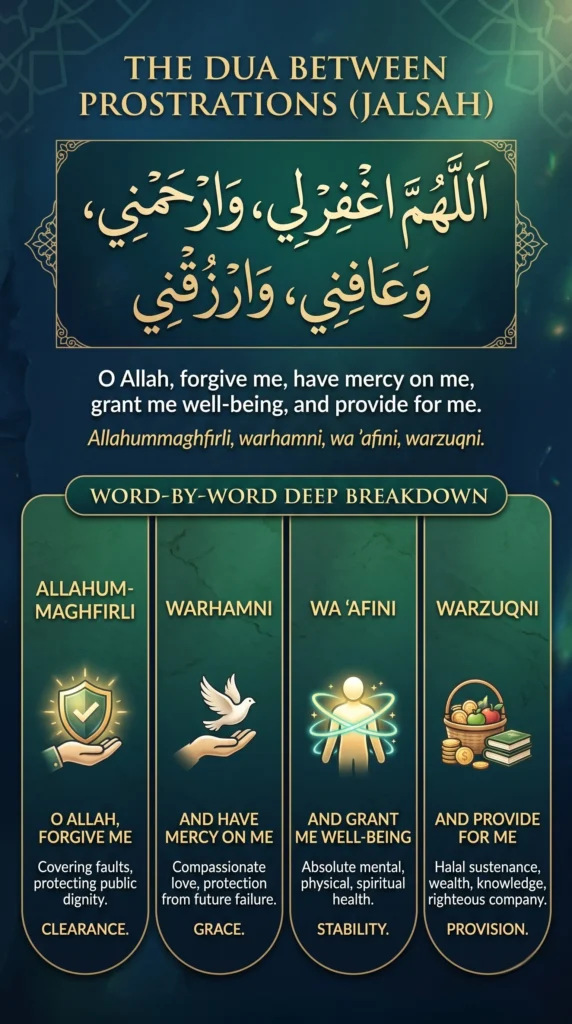
The dua “Allahummaghfirli warhamni wa afini warzuqni” is an authentic prophetic supplication recited during the Jalsah (the mandatory sitting between two prostrations in prayer). It translates to: “O Allah, forgive me, have mercy on me, grant me well-being, and provide for me.”
The Multilingual & Pronunciation Quadrant
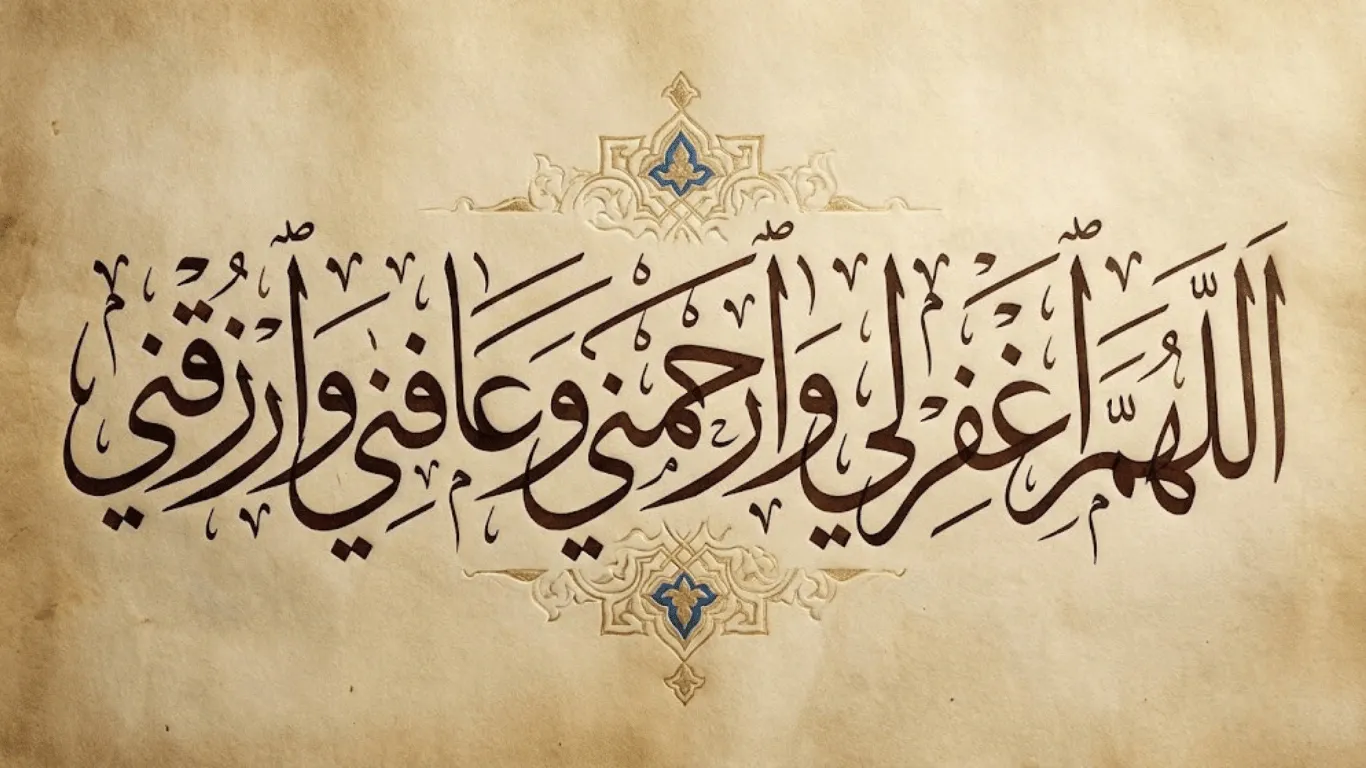
- Arabic (Original Script): اللَّهُمَّ اغْفِرْ لِي، وَارْحَمْنِي، وَعَافِنِي، وَارْزُقْنِي
- Transliteration: Allahummaghfirli, warhamni, wa ‘afini, warzuqni.
- Pronunciation Tip: Ensure you pronounce the ‘gh’ in Ighfirli from the back of the throat (like a gargling sound), and the ‘ayn’ (ع) in Afini deeply from the middle of the throat. This ensures the meaning remains intact.
- English (Saheeh International): “O Allah, forgive me, have mercy upon me, grant me well-being, and provide for me.”
- Urdu (Fateh Muhammad Jalandhari): اے اللہ! مجھے بخش دے، مجھ پر رحم فرما، مجھے عافیت دے، اور مجھے رزق عطا فرما۔
Word-by-Word Meaning and Deep Tafseer
Breaking down this supplication reveals a perfect hierarchy of human needs. It is not just a random list of requests; it is a strategic sequence that moves from clearing spiritual debt to securing physical health and worldly provisions.
- Allahummaghfirli (اللَّهُمَّ اغْفِرْ لِي – O Allah, forgive me): You cannot fill a vessel that is full of impurities. This first step asks Allah for Maghfirah—not just to pardon the sin, but to actively cover your faults so they do not ruin your spiritual state or public dignity.
- Warhamni (وَارْحَمْنِي – and have mercy on me): Once cleansed, the soul needs grace. Mercy (Rahmah) is the encompassing love of the Creator that protects you from future failures and grants you blessings you have not explicitly earned.
- Wa afini (وَعَافِنِي – and grant me well-being): Aafiyah is the ultimate form of protection. It translates to absolute well-being—a state completely free from physical illness, mental anxiety, and spiritual trials. It is the peace of mind required to function in a chaotic world.
- Warzuqni (وَارْزُقْنِي – and provide for me): Rizq is far more than just financial wealth. It encompasses everything that brings you benefit: halal income, a stable job, righteous company, emotional intelligence, and the time required to accomplish your goals.
Are These Verses in the Quran? (Primary Sources)
These specific words are not found in the Quran as a single verse. Rather, they form an authentic Prophetic Sunnah. The Prophet Muhammad (ﷺ) consistently recited this exact phrasing to establish tranquility during his daily prayers.
The primary proof for this supplication is recorded in major Hadith collections. It is narrated by Ibn Abbas (may Allah be pleased with him) that the Prophet (ﷺ) used to say between the two prostrations:
“O Allah, forgive me, have mercy on me, guide me, heal me, and provide for me.” > (Sunan Abi Dawud 850, Jami’ at-Tirmidhi 284 — Graded Hasan/Sahih)
Note: Some authentic narrations include slight variations, such as Wahdini (guide me) or Wajburni (console me), but the core four pillars of forgiveness, mercy, health, and provision remain constant.
Classical Scholarship
To understand the weight of this pause, we look to the classical Mufassirun and Jurists. Imam an-Nawawi explicitly highlights in Al-Majmu’ Sharh al-Muhaddhab that taking this distinct pause is a heavily emphasized Sunnah. It ensures the worshipper achieves Tum’aninah (tranquility and physical stillness)—without which the physical prayer is considered incomplete.
Furthermore, Ibn Kathir, in his extensive commentaries regarding human reliance on the Creator, frequently points to the daily pleas for Aafiyah and Rizq found in these exact prayer habits as absolute proof of our total dependence on Divine intervention.
The 5-Second Spiritual Reset (A Strategy for 2026)
Modern behavioral psychology relies on the “Habit Loop”—a system consisting of a cue, a routine, and a reward. We can apply this exact framework to the Sunnah of prayer. By using the physical movement of sitting up from prostration as your cue, reciting this dua becomes a deliberate routine that instantly rewards you with profound mindfulness.
We are constantly overwhelmed by digital notifications, economic anxiety, and endless deadlines. Integrating this supplication turns the Jalsah into a 5-Second Spiritual Reset. You are systematically hitting the pause button on worldly stress, acknowledging your vulnerabilities, and directly asking for health and provision from the Ultimate Source. It transforms a rushed, mindless physical transition into a deliberate anchor of peace.
The Chronology of Prayer
Achieving true Khushu (focus) requires understanding the exact sequence and escalating timeline of your Salah. Your prayer is not a set of isolated movements; it is an uninterrupted, flowing conversation.
The spiritual preparation begins before you even raise your hands, starting from the moment you hear the call establishing the prayer with Qad qamatis salah. As you progress through the physical postures, your connection deepens. After bowing humbly in Ruku, you transition to a standing posture of immense gratitude, declaring Rabbana lakal hamd after rising.
It is only after this standing praise that you descend into the ultimate physical submission of the first Sajdah. When you lift your head from the ground into the sitting position (Jalsah), you are in the most spiritually receptive posture possible. That exact moment is when you deploy Allahummaghfirli warhamni wa afini warzuqni—bridging your previous acts of praise with a direct request for your personal worldly and spiritual survival.
Elevate Your Daily Practice
You now know the immense weight and structural brilliance of the words Allahummaghfirli warhamni wa afini warzuqni. The next time you sit between your prostrations, do not rush. Correct your pronunciation, let the words settle in your heart, and claim your 5-second reset.
Want to memorize this beautifully? Drop your email below to subscribe to our weekly advanced Islamic strategies newsletter. We will instantly send you a stunning, 4K resolution digital infographic of this dua, designed in premium Thuluth calligraphy. It is visually optimized for your mobile lock screen to help you memorize the exact Arabic phrasing and perfect your daily Salah.
[Download the 4K Thuluth Infographic Now]
“Allahummaghfirli, warhamni, wa ‘afini, warzuqni”
A dua that asks for:
✔ Forgiveness
✔ Mercy
✔ Well-being
✔ Provision
Don’t rush this moment in Salah — it’s a فرصة (opportunity) to ask for everything that truly matters.
Save this & reflect next time you pray.
Complete Guide to the Jalsah Dua: Download the Scholarly PDF
People Also Ask:
The most authentic dua to read between the two prostrations (Sujood) in prayer is “Allahummaghfirli warhamni wa afini warzuqni.” This comprehensive prayer asks Allah for forgiveness, mercy, total well-being, and provision.
There is no separate numerical wazifa required for this specific dua outside of Salah. The most highly recommended and authentic practice is simply to recite it with focus during every single Jalsah (sitting pause) in both your obligatory and voluntary daily prayers.
This dua is incredibly special because it summarizes the entirety of a believer’s needs in under five seconds. It bridges the gap between spiritual purification (asking for forgiveness and mercy) and practical worldly survival (asking for physical health and daily sustenance).
Yes, it is a highly emphasized Sunnah to recite this supplication every time you sit up between the two prostrations. You should recite it during every single Rakah of your obligatory, Sunnah, and Nafl prayers to achieve complete tranquility.
