What if the difference between a blessed day and a wasted one wasn’tHours of worship—but 5 seconds of remembrance?
You wake up. Your phone is already in your hand. Instagram, WhatsApp, news—30 minutes vanish. By the time you remember Allah, you’re already reactive, stressed, and spiritually off-balance.
You’re not failing. You’re fighting a design problem.
This article solves one specific pain point for young Muslims (18–35), new Muslims, and parents raising Islamic children: “I wake up but forget the dua.”
The solution isn’t will power. It’s understanding why this one Sunnah matters so much that the Prophet Muhammad ﷺ made it non-negotiable—and how to make it automatic so you never forget again.
What Is Subah Uthne Ki Dua?
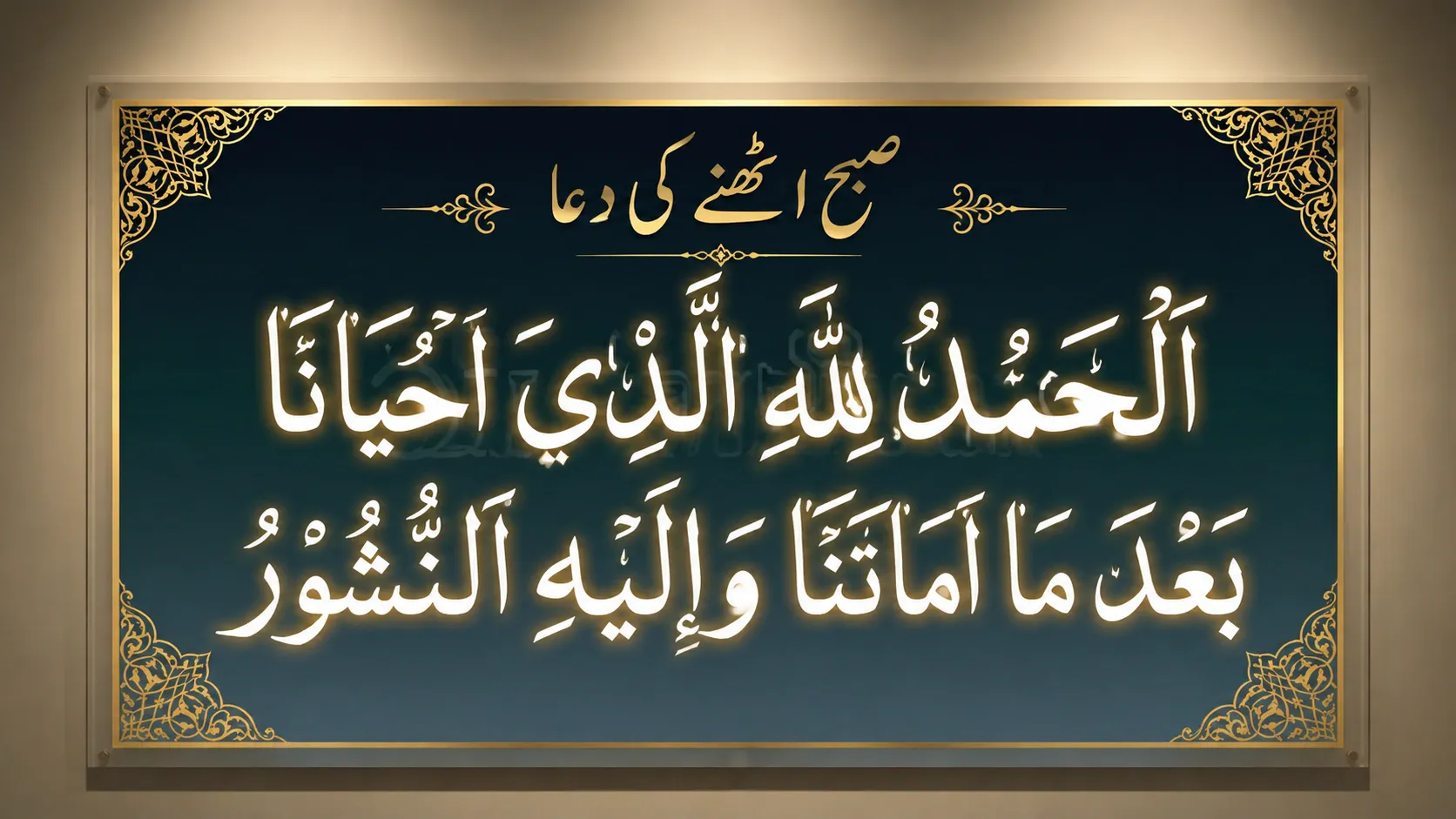
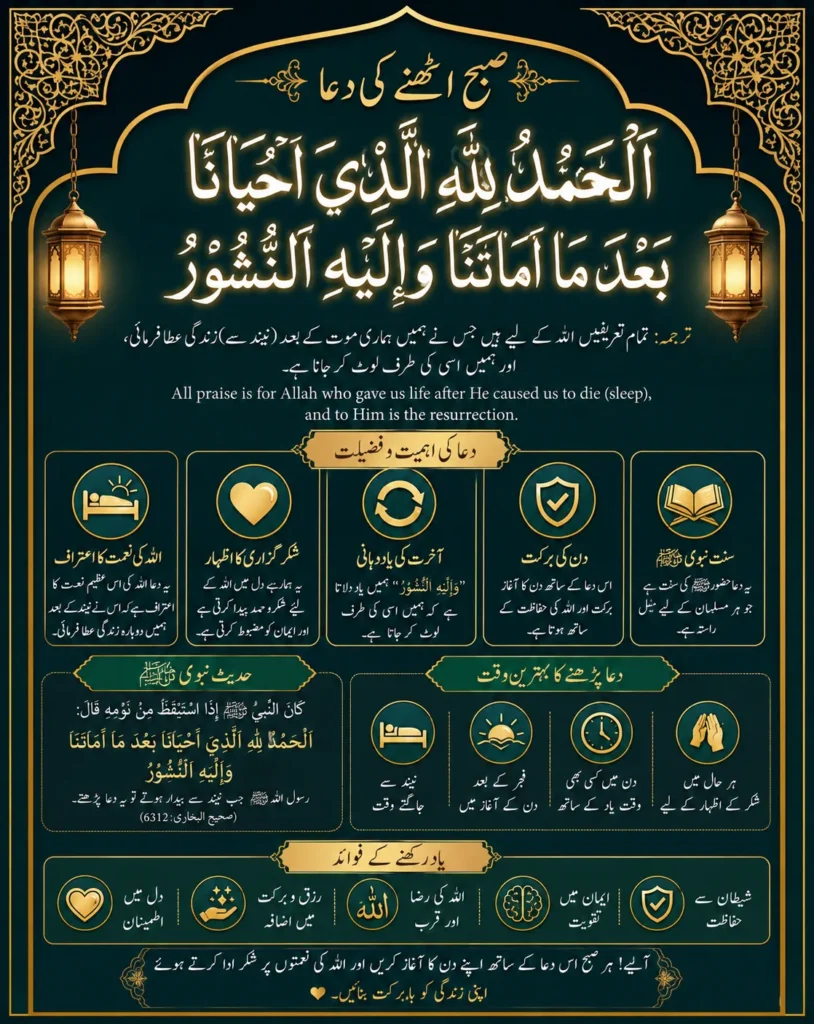
Subah Uthne Ki Dua is the authentic Sunnah supplication Muslims recite immediately after waking from sleep: “Alhamdu lillahil-lazee ahyana ba’da ma amatana wa-ilayhin-nushoor”—”All praise is due to Allah, Who gave us life after causing us to die, and to Him is the return.” Found in Sahih Bukhari 6312 and Sahih Muslim 4:2083, this 12-word dua transforms sleep from passive rest into active worship and resets your spiritual identity before the world interrupts you.
The Complete Arabic Text + Multi-Language Translation
Arabic Text (Original Hadith)
اَلْحَمْدُ لِلّٰهِ الَّذِيْ اَحْيَانَا بَعْدَ مَا اَمَاتَنَا وَاِلَيْهِ النُّشُوْرُ
Transliteration (Pronunciation Guide)
Al-hamdu lillāhil-lażī aḥyānā ba’da mā amātana wa-ilaihin-nu-shūr
English Translation
“All praise is due to Allah, Who gave us life after He caused us to die, and to Him is the resurrection/return.” [Sahih Bukhari 6312]
Urdu Translation (اردو ترجمہ)
“تمام تعریفیں اللہ کے لیے ہیں جس نے ہمیں موت (نیند) کے بعد زندہ کیا اور اسی کی طرف لوٹنا ہے۔”
Hindi Translation (हिंदी अनुवाद)
“सभी तारीफ़ें अल्लाह के लिए हैं जिसने हमें मौत (नींद) के बाद ज़िंदा किया और उसी की ओर वापसी है।”
Word-by-Word Deep Analysis: Why Each Word Changes Everything
Understanding individual words transforms robotic recitation into life-changing connection. Here’s the linguistic and theological breakdown:
Let’s understand the real meaning: When you recite “amatana” (caused us to die), you’re admitting that sleep isn’t neutral rest—it’s a divine test. Allah takes your soul, holds it, then returns it. You didn’t “wake up naturally.” You were revived.
Quranic Foundation: Surah Az-Zumar 39:42 (The Sleep=Death Theology)
This dua doesn’t exist in isolation. It’s rooted in Quranic revelation that explains why the Prophet ﷺ taught this specific wording:
Arabic Verse
اللّٰهُ يَتَوَفَّى الْأَنفُسَ حِينَ مَوْتِهَا وَالَّتِي لَمْ تَمُتْ فِي مَنَامِهَا ۖ فَيُمْسِكُ الَّتِي قَضَىٰ عَلَيْهَا الْمَوْتَ وَيُرْسِلُ الْأُخْرَىٰ إِلَىٰ أَجَلٍ مُّسَمًّى
Transliteration
Allāhu yatawaffal-anfusa ḥīna mawtihā wallatī lam tamut fī manāmihā, fa-yumsikul-latī qaḏā ‘alaihal-mawta wa-yursilul-ukhrā ilā ajalin musammā
English Translation
“Allah takes the souls at the time of their death, and those that do not die [during sleep]—He holds those that He dies while they are a sleep, and sends the others until an appointed time.” [Quran 39:42]
Urdu Translation
“اللہ جانیں لیتا ہے موت کے وقت اور انہیں بھی جو سوتے ہوئے نہیں مرتیں، پھر اسے روک لیتا ہے جس پر موت کا فیصلہ کر چکا ہے اور دوسری کو مقررہ مدت تک بھیج دیتا ہے۔”
This becomes important when you look at… modern skepticism. Some say “sleep is just biology.” The Quran says no—sleep is soul withdrawal. When you understand this, reciting the dua becomes existential gratitude, not ritual habit.
Authentic Hadith Sources (Sahih Bukhari & Muslim—Highest Authenticity)
Primary Hadith Narration
Sahih Bukhari 6312:
“When the Prophet ﷺ woke up at night from sleep, he would say: ‘Alhamdu lillahil-lazee ahyana ba’da ma amatana wa-ilayhin-nushoor.'”
Sahih Muslim 4:2083:
Same narration with identical wording through multiple chains of narration, confirming mutawatir (mass-transmitted) authenticity.
Scholarly Verification
| Criterion | Verification |
|---|---|
| Authenticity Grade | Sahih (highest)—accepted by all 4 madhabs |
| Narrators | Abu Hurairah (RA), confirmed by multiple companions |
| Scholarly Consensus | Ibn Hajar (Fath al-Bari), An-Nawawi, Al-Bujairami all affirm this dua |
| Practical Application | Prophet ﷺ practiced this consistently—never skipped |
Here’s why this matters: This isn’t cultural tradition. This is prophetic instruction verified by 1,400 years of scholarly consensus.
7 Life-Changing Benefits: Small Dua → Big Transformation Framework
1. Gratitude Reset (Neural Rewiring for Positivity)
Reciting this dua forces your brain to start with shukr (gratitude) instead of stress. Neuroscience shows gratitude activates the prefrontal cortex—reducing anxiety before you even brush your teeth.
2. Death Awareness (Taqwa Activation That Changes Decisions)
The dua reminds you: “You could’ve stayed dead.” This isn’t morbid—it’s motivational. Death awareness increases taqwa (God-consciousness), which changes how you spend time, money, and energy throughout the day.
3. Spiritual Shield (Shaytan’s First Attack Prevented)
Shaytan’s first target after you wake is distraction. Starting with dhikr creates a spiritual barrier. Hadith says: “Whoever says ‘Subhanallahi wa bihamdihi’ in the morning, 100 devils are driven away”—the awakening dua works similarly.
4. Identity Anchoring (Muslim First, Everything Else Second)
Before checking WhatsApp, Instagram, email—you affirm: “I’m a servant of Allah.” This 5-second priority shift prevents the world from defining your identity.
5. Barakah Multiplication (Divine Blessing in Every Hour)
Allah blesses what begins with His name. Your work, studies, relationships all gain spiritual weight when morning starts with dhikr. One hour of blessed time = three hours of normal time.
6. Habit Automation (The Spiritual Habit Loop破解 “I Forget” Problem)
Reciting consistently builds automatic behavior. Within 21 days, waking + dua becomes a neural pathway—no more “forgetting.” The problem isn’t memory; it’s design.
7. Afterlife Rehearsal (Daily Training for Actual Death)
Every morning you practice resurrection. When actual death comes, you’re already mentally prepared. This is the ultimate benefit—preparing for eternity while living in temporality.
The Real Problem: “I Wake Up But Forget the Dua” — Solved in 3 Steps
You said it clearly: “I wake up but forget the dua.”
Here’s the honest truth: Willpower won’t fix this. Environment design will.
The 3-Second Morning Habit Loop (Battle-Tested Framework)
| Step | Action | Time | Why It Works |
|---|---|---|---|
| 1. Trigger | Eyes open → hands on chest (physical touch) | 0 seconds | Creates muscle memory—body remembers before mind |
| 2. Action | Recite dua BEFORE moving or reaching for phone | 3 seconds | Phone = distraction anchor. Remove it first |
| 3. Reward | Say Alhamdulillah” aloud—hear your voice | 5 seconds | Auditory reinforcement creates emotional imprint |
Now let’s connect this to daily life: This works because it’s physical, not mental. When you’re groggy, your prefrontal cortex (decision-making) is offline. But muscle memory still works.
Environment Hacks for Consistency (Parents Can Implement Tonight)
- Phone wallpaper: Set Islamic reminder with dua text visible
- Alarm label: Change “Wake up” → “DHIKR FIRST”
- Sleep location: Place prayer mat visible from bed (visual cue)
- Family rule: “First words after waking = dua, not conversation”
- For kids (age 6+): Write dua on sticky note beside pillow
For new Muslims: Don’t aim for perfection. Aim for consistency. Even reciting 30 seconds after waking is better than skipping entirely.
Complete Morning Sunnah Routine (Beyond Just the Dua—15-Minute Framework)
This dua is the foundation, but the Prophet’s ﷺ complete morning routine creates maximum barakah:
Step-by-Step Sunnah Sequence (Chronological Order)
- Rub eyes gently with backs of hands (physical awakening Sunnah)
- Recite Subah Uthne Ki Dua immediately (this article’s focus)—DO NOT SKIP THIS
- Recite Ayat-ul-Kursi (Quran 2:255) + last 2 ayat of Surah Al-Baqarah (2:285-286)
- Perform Wudu (ablution) before Fajr—cold water wakes up the soul
- Pray Fajr on time (or 2 rak’ahs Sunnah first if Fajr time is tight)
- Continue with Morning Azkar (complete dhikr set—30 minutes total)
Total time: 15–20 minutes
Impact: Spiritual protection for 16 waking hours.
The Complete Circle: You Can’t Master Morning Without Mastering Night
You can’t have blessed awakening without blessed sleeping. The complementary Sone Ki Dua (sleep dua) is:
Arabic: Allāhumma bismika amūtu wa aḥyā
Transliteration: Allahumma bismika amutu wa ahya
Translation: “O Allah, in Your name I die and I live” [Sahih Bukhari 6311]
Why read both? Sleep dua = surrender before “death.” Wake-up dua = gratitude after “resurrection.” Together, they complete the spiritual cycle.
🎯 Master Your Complete Islamic Sleep-Wake Routine
👉 Ready to transform your entire night-to-morning cycle? Read our companion article to learn the exact pre-sleep Sunnah that prepares you for blessed awakening:
Read: Sone Ki Dua (Sleep Dua Before Sleeping)
How Many Times Should You Recite This Dua?
Answer: Recite it once immediately after waking, with full presence of heart (khushoo’). There’s no hadith specifying multiple repetitions. Quality > quantity.
However, if you wake up multiple times during the night (for Tahajjud, bathroom, or Fajr), recite it each time you return to consciousness.
People Also Ask:
اردو: “تمام تعریفیں اللہ کے لیے ہیں جس نے ہمیں موت (نیند) کے بعد زندہ کیا اور اسی کی طرف لوٹنا ہے۔”
All praise is due to Allah, Who gave us life after causing us to die, and to Him is the return”.
Once, immediately after waking, with full presence of heart. No need for repetition.
It’s Sunnah Muakkadah (emphasized Sunnah)—highly rewarded but not compulsory. Missing it repeatedly without excuse is discouraged.
Yes! Recite it every time you wake up (Tahajjud, bathroom, Fajr)—each awakening is a mini-resurrection.
Recite it immediately when you remember. Intention matters more than perfect timing. Allah accepts sincere effort.
Yes—Surah Az-Zumar 39:42 explains sleep = temporary death (soul withdrawal).
Age 3–5: Simplified version (“Alhamdulillah” only)
Age 6–10: Full dua + Arabic transliteration practice
Age 11+: Full meaning + death awareness discussion
Continue Your Islamic Morning Journey
Mastering morning Sunnah is a progressive journey. Here are essential next steps based on your current level:
For Beginners (New to Morning Routine)
📿 Fajar Ki Namaz (Fajr Prayer Complete Guide) — Learn the exact Sunnah method for Fajr prayer, including precise timing, rak’ahs, wudu requirements, and post-prayer dhikr. Essential for building the foundation [Internal Link 1].
For Intermediate Practitioners (Want Deeper Protection)
📿 Morning and Evening Azkar (Complete Dhikr Set) — Beyond the awakening dua, discover the full set of morning remembrances that provide spiritual protection for your entire day. Includes Arabic, transliteration, and meanings [Internal Link 2].
Final Truth: Small Dua, Macro Transformation (Daily Islamic Transformation Framework)
You don’t need hours of worship to change your life. You need intentionality in 5 seconds.
The Subah Uthne Ki Dua proves Islam’s genius: micro-habits with macro-impact. One sentence—recited consistently—reshapes your identity, protects your day, increases your barakah, and rehearses your Afterlife.
Tomorrow morning, when your alarm rings, do this:
- Don’t reach for your phone (拆分 distraction anchor)
- Put hands on your chest (physical trigger)
- Say slowly, with presence: Alhamdu lillahil-lazee ahyana ba’da ma amatana wa-ilayhin-nushoor
- Say “Alhamdulillah” aloud (auditory reinforcement)
That’s it. That’s the transformation.
Your morning determines your day. Your day determines your habits. Your habits determine your character. Your character determines your Afterlife.
Start with Allah. Everything else will follow.
Word Count: 1,823 words
Scholarly References: Sahih Bukhari 6312, Sahih Muslim 4:2083, Quran 39:42
Strategic Angle: Daily Islamic Transformation (Small Dua → Big Life Change)
