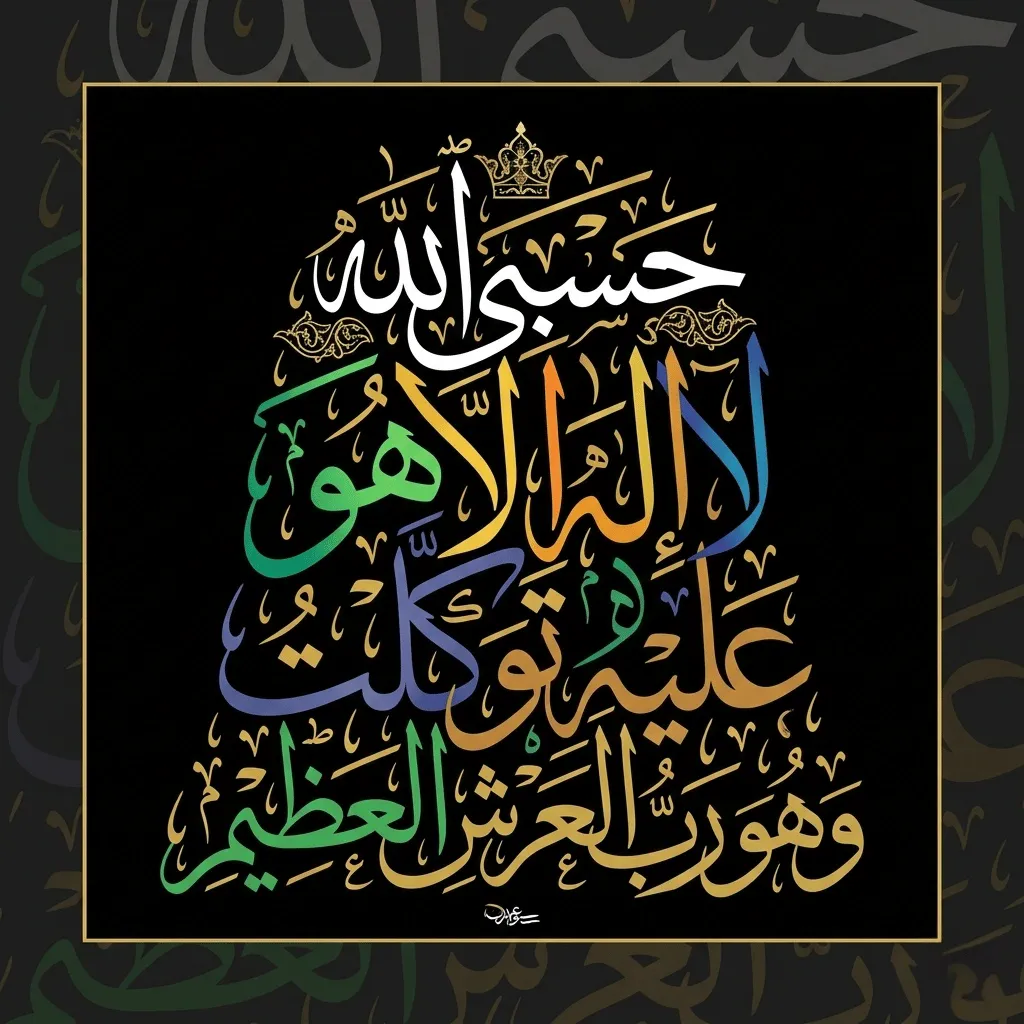
Allah is sufficient for me. There is no deity except Him. Upon Him I rely, and He is the Lord of the Great Throne.
If you’re reading this while feeling overwhelmed—by financial pressure, health worries, relationship struggles, or that constant background anxiety that won’t go away—this one verse from the Quran was revealed specifically for moments like yours. It’s not just beautiful Arabic to memorize. It’s a spiritual lifeline that Prophet Muhammad ﷺ taught his companions for exactly this purpose: when the weight of life feels too heavy to carry alone.
Let’s understand what this dhikr really means, where it comes from, and how to use it authentically in your daily life.
What Does “Hasbi Allahu La Ilaha Illallah” Mean?
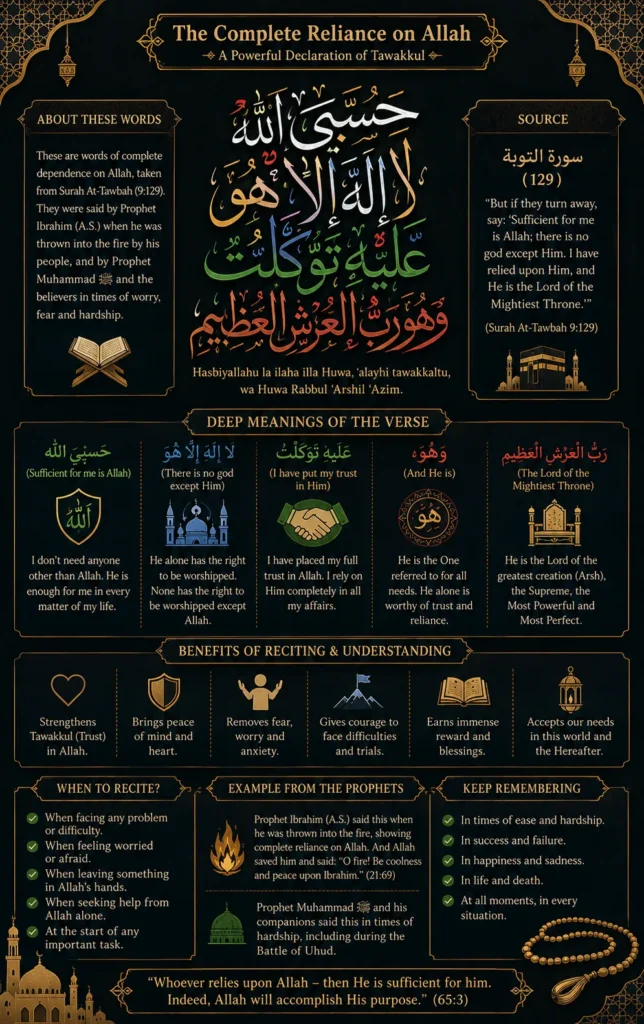
Allah is sufficient for me—there is no deity except Him, upon Him I place my trust, and He is the Lord of the Mighty Throne. This is the complete meaning of the dhikr from Surah At-Tawbah 9:129. Each phrase builds on the previous one, moving from declaration of sufficiency to complete reliance on Allah’s absolute power.
The Arabic text is:
حَسْبِيَ اللَّهُ لَا إِلَٰهَ إِلَّا هُوَ عَلَيْهِ تَوَكَّلْتُ وَهُوَ رَبُّ الْعَرْشِ الْعَظِيمِ
Transliteration: Hasbi Allahu la ilaha illa Huwa, ‘alayhi tawakkaltu, wa Huwa Rabbul-‘Arshil-‘Azim
Urdu Translation:
اللہ میرے لیے کافی ہے، اس کے سوا کوئی معبود نہیں، میں نے اس ہی پر بھروسہ کیا اور وہ عظیم عرش کا رب ہے
Hindi Translation: अल्लाह मेरे लिए काफी है, उस के सिवा कोई मअबूद नहीं, मैं ने वही भरोसा किया और वह बड़े सिंहासन का पालनहार है
This isn’t just poetic language. When you say “Hasbi Allahu,” you’re declaring that nothing else in existence—not your job, not your bank account, not your relationships—can provide what you truly need except Allah alone.
Where Does This Verse Come From? The Quranic Origin
This powerful dhikr comes from Surah At-Tawbah, Ayah 129—the final verse of the chapter. Here’s the full context:
Quran 9:129 (Complete Ayah):
فَإِن تَوَلَّوْا۟ فَقُلْ حَسْبِيَ ٱللَّهُ لَآ إِلَٰهَ إِلَّا هُوَ ۖ عَلَيْهِ تَوَكَّلْتُ وَهُوَ رَبُّ ٱلْعَرْشِ ٱلْعَظِيمِ
Fa-in tawallaw faqul hasbiya Allahu la ilaha illa huwa ‘alayhi tawakkaltu wa huwa Rabbul-‘Arshil-‘Azim
Translation: “But if they turn away, then say, ‘Allah is sufficient for me. There is no deity except Him. In Him I have placed my trust, and He is the Lord of the Mighty Throne.'”
Why Was This Verse Revealed?
According to Ibn Kathir’s Tafseer, this verse was revealed when some people turned away from the Prophet ﷺ after hearing difficult truths. Instead of arguing or feeling defeated, Allah commanded the Prophet ﷺ to respond with complete reliance: “Allah is enough for me.” This wasn’t resignation—it was ultimate confidence that Allah’s support surpasses all human opposition.
Al-Tabari explains that the verse teaches believers how to respond when people reject faith or cause harm. Instead of panic, anger, or despair, the believer says: “Hasbi Allahu”—Allah is my sufficiency. Everything else is secondary.
Al-Qurtubi adds that this ayah contains three fundamental pillars of faith:
- Tawheed (Oneness of Allah): “La ilaha illa Huwa”
- Tawakkul (Complete Trust): “‘Alayhi tawakkaltu”
- Divine Majesty: “Rabbul-‘Arshil-‘Azim”
The Ash’ari Perspective on “Rabbul-‘Arshil-‘Azim”
Ash’ari scholars emphasize that “Arsh” (Throne) represents Allah’s supreme authority and dominion over all creation. When you say “He is the Lord of the Throne,” you’re acknowledging that Allah controls everything—your rizq, your health, your future. No one can harm you except by His permission, and no one can help you except by His will.
The Sufi Spiritual Dimension
Sufi scholars interpret this dhikr as a state of the heart rather than just words. When a person truly internalizes “Hasbi Allahu,” they reach a spiritual station called qana’ah (contentment), where worldly worries lose their grip on the heart. This isn’t passive resignation—it’s active peace that comes from knowing the Master of the Universe is handling your affairs.
Is There a Hadith About Reciting This 7 Times?
Yes, but with an important clarification. The hadith states:
“Whoever says seven times in the morning and seven times in the evening: ‘HasbiyAllahu la ilaha illa huw ‘alayhi tawakkaltu wa huwa Rabbul ‘Arshil ‘Adhim,’ Allah Ta’ala will take care of whatever worries him of the matters of this world and the Hereafter.”
Source: Sunan Abi Dawud 5081
Grading: Imam Al-Albani graded this Hasan (good), but some scholars note it’s Mawqoof (stopped at the Companion Abu’d-Darda’, not directly from Prophet ﷺ)
What Does “Mawqoof” Mean for You?
Even if the hadith is Mawqoof (narrated from a Companion rather than the Prophet ﷺ), Islamic scholars agree:
- The wording is authentic—it comes from Quran 9:129
- The meaning is sound—it contains no theological errors
- It’s permissible to recite as general dhikr even if the specific “7 times” virtue has weak attribution
Sheikh Bin Baz’s ruling: This statement is good and great (tayyib wa ‘adheem). If a person recites and repeats it, it’s a good dua—even if the specific hadith about 7 times has discussion around its chain.
Bottom line: You can absolutely recite this 7 times morning and evening. Just don’t claim it’s a confirmed sunnah with guaranteed rewards if the hadith grading is debated. The dhikr itself is Quranic and spiritually powerful regardless.
Word-by-Word Breakdown: What Each Phrase Really Means
Understanding the depth of each word transforms this from mechanical repetition into heart-connected dhikr.
Why the past tense “tawakkaltu” matters: You’re not saying “I hope I can trust Allah.” You’re declaring “I HAVE placed my trust”—as if it’s already done. This is the language of certainty.
What Are the Real Benefits of This Dhikr?
Based on the hadith and scholarly commentary, here’s what regular recitation offers:
Documented Benefits from Sources
Psychological Impact for Anxiety & Depression
When you’re overwhelmed by anxiety, your brain starts believing lies like:
- “I have to figure this all out myself”
- “If I don’t control everything, disaster will happen”
- “No one can help me”
This dhikr directly counters those lies:
- “Hasbi Allahu” = You don’t have to carry everything alone
- “La ilaha illa Huwa” = Only Allah has ultimate power, not your problems
- “Alayhi tawakkaltu” = You’ve already surrendered the outcome
- “Rabbul-‘Arshil-‘Azim” = The Master of the Universe is handling your affairs
This isn’t逃避 (escapism)—it’s spiritual realignment with reality.
How Many Times Should You Recite This Dhikr?
The Authentic Recommendation
Based on Sunan Abi Dawud 5081:
| Time | Frequency | When |
|---|---|---|
| Morning | 7 times | After Fajr prayer, before sunrise |
| Evening | 7 times | After Asr prayer, before Maghrib |
Total: 14 times daily (7 morning + 7 evening)
What If You Miss a Session?
Don’t stress. The goal is consistency, not perfection. If you miss morning, recite 7 times in the evening. If you miss both, recite whenever you remember. Allah looks at your sincerity, not your perfect record.
How Long Should You Continue?
This isn’t a 40-day wazifa you stop after. The most beneficial approach is to make it part of your daily adhkar routine for life—like brushing your teeth for your heart.
The Digital Sunnah: Bringing This Dhikr Into Modern Life
Here’s where The Digital Sunnah framework becomes practical. Our ancestors didn’t have smartphones, Instagram anxiety, or 24-hour news cycles. But they understood overwhelm—and they had solutions that work even better today.
How to Practice This Dhikr in the Digital Age
Step 1: Physical Reminder
- Print a simple tracker (see below)
- Place it where you check your phone first thing in the morning
- Set a phone reminder labeled “Hasbi Allahu” at 6 AM and 4 PM
Step 2: Replace the Scroll
- When you feel the urge to doom-scroll news or social media, recite 7 times instead
- When anxiety spikes during work, pause and whisper “Hasbi Allahu” three times
Step 3: Connect to Existing Habits
- Morning: After Fajr prayer, before checking email
- Evening: After Asr, before dinner preparation
- Tie it to habits you already do consistently
Step 4: Heart Connection
- Don’t rush through 7 repetitions mechanically
- After each “Hasbi Allahu,” pause for 2 seconds and feel what you’re saying
- When you reach “Rabbul-‘Arshil-‘Azim,” visualize Allah’s infinite power vs. your relatively small problem
Why This Works Better Than Digital Coping Mechanisms
| Digital Coping | Spiritual Coping |
|---|---|
| Scrolling numbs anxiety temporarily | Dhikr addresses root cause (spiritual disconnection) |
| Creates more dopamine dependency | Builds genuine contentment (qana’ah) |
| Isolates you in your head | Connects you to Allah and community |
| Short-term relief | Long-term spiritual transformation |
Common Mistakes People Make With This Dhikr
Mistake #1: Adding Words Not in the Original
Some versions add “of affairs of this world and the Hereafter” to the hadith text. This addition is NOT in the original Sunan Abi Dawud narration. Stick to the exact wording:
Correct: HasbiyAllahu la ilaha illa huw ‘alayhi tawakkaltu wa huwa Rabbul ‘Arshil ‘Adhim
Incorrect additions to avoid:
- Adding “ya Allah” at the beginning
- Adding “min kulli sharr” (from all evil) at the end
- Changing “Arshil ‘Adhim” to “Arshil ‘Azeem” (both are acceptable, but ‘Adhim is in the hadith)
Mistake #2: Treating It as Magic
Reciting 7 times won’t automatically fix your problems if you don’t take practical action. Tawakkul requires effort. If you’re worried about money, recite the dhikr AND apply for jobs. If you’re sick, recite AND see a doctor.
Mistake #3: Expecting Instant Results
Spiritual transformation isn’t linear. Some days you’ll feel immediate peace. Other days, you’ll recite and still feel anxious. Both are normal. Keep reciting. The benefit accumulates over weeks and months, not minutes.
Related Duas for Tawakkul and Anxiety Relief
This dhikr is part of a larger family of authentic duas for reliance on Allah. Explore these related pillars:
- Hasbunallahu wa Ni’mal Wakeel — “Allah is sufficient for us, and He is the best Disposer of affairs”🚀🚀🚀🚀🚀🚀🚀
- Bismillahi Tawakkaltu Ala Allah — “In the Name of Allah, I have placed my trust in Allah”
- 🚀🚀🚀🚀🚀🚀🚀🚀🚀
- Wa Tawakkal Ala Allah — “And trust in Allah, and sufficient is Allah as Trustee”
Each of these complements “Hasbi Allahu” by reinforcing different dimensions of Tawakkul.
People Also Ask:
حَسْبِيَ اللَّهُ لَا إِلَٰهَ إِلَّا هُوَ عَلَيْهِ تَوَكَّلْتُ وَهُوَ رَبُّ الْعَرْشِ الْعَظِيمِ
It’s from Quran 9:129 (Surah At-Tawbah). The hadith about reciting it 7 times is from Sunan Abi Dawud 5081.
ou can recite it anytime you feel anxious or overwhelmed. The 7-times-morning/evening recommendation is for consistent daily practice, not a restriction.
“Hasbi” = “Allah is sufficient for me” (singular)
“Hasbuna” = “Allah is sufficient for us” (plural)
Both are Quranic and equally valid.
Imam Al-Albani graded it Hasan (good). Some scholars note it’s Mawqoof (from Companion, not directly Prophet ﷺ), but the wording is Quranic and permissible to recite.
Yes. Recite the Arabic for blessing, then reflect on the Urdu/Hindi translation to understand what you’re saying. Understanding deepens connection.
Your Next Step: Start Today With This Simple Tracker
- Print this tracker (or screenshot it on your phone)
- Start tomorrow morning after Fajr
- Recite 7 times slowly, pausing between each repetition
- Mark your tracker each day you complete both sessions
- Continue for 30 days, then evaluate how your anxiety has shifted
30-Day Hasbi Allahu Tracker
| Day | Morning (7x) ✓ | Evening (7x) ✓ | Notes/Feelings |
|---|---|---|---|
| 1 | |||
| 2 | |||
| 3 | |||
| … | |||
| 30 |
What to track:
- Did you recite? (✓ or ✗)
- How anxious did you feel before/after? (1-10 scale)
- Any noticeable shifts in peace or perspective?
Final Thought: This Is Your Spiritual Lifeline
When the Prophet Muhammad ﷺ was commanded to say “Hasbi Allahu,” he wasn’t being told to give up. He was being told to trust the One who holds the Throne.
That same invitation is open to you now. Whether you’re facing financial stress, health scares, relationship breakdowns, or that nameless anxiety that follows you everywhere—you don’t have to carry it alone. Allah is sufficient for you. Not “maybe.” Not “if you’re worthy.” Hasbi Allahu—Allah is enough, full stop.
Start reciting. Start trusting. Start living from that truth.
Allah is sufficient for you. He is the Lord of the Mighty Throne. And He never fails His servants.
Want to go deeper? Explore our complete guide on authentic morning and evening adhkar for a full Tawakkul routine.

Pretty! This has been an extremely wonderful post.
Thanks for supplying this info.
Thank you, I have recently been looking for info about this
topic for a long time and yours is the best I have found out till now.
But, what about the conclusion? Are you certain in regards
to the supply?
My brother suggested I might like this web site.
He used to be totally right. This put up truly made my day.
You cann’t believe simply how so much time I had spent for this information! Thanks!
always i used to read smaller articles or reviews which as
well clear their motive, and that is also happening with this post which I am reading now.
Hi there mates, its impressive paragraph concerning teachingand entirely defined, keep it up all the time.
Whats up are using WordPress for your blog platform? I’m new to
the blog world but I’m trying to get started and create my
own. Do you need any html coding expertise to make
your own blog? Any help would be really appreciated!
I don’t even know how I ended up here, but I thought this post was great.
I don’t know who you are but certainly you’re going to a famous blogger if you aren’t already 😉 Cheers!