When you wake up in New York at 6 AM on a Monday and feel overwhelmed before your day even starts—scrolling through emails, checking notifications, worrying about your commute on the subway—this ancient dua from Prophet Muhammad (PBUH) becomes your first weapon against anxiety. It takes just 90 seconds. And in our digital age of constant distractions, Surah An-Nas (the 114th and final chapter of the Quran) is your spiritual firewall against the invisible whispers that drain your focus before breakfast.
What Is Surah An-Nas and Why Does It Matter for Western Muslims in 2026?
Surah An-Nas is the 114th chapter of the Quran with 6 verses, also known as “Mankind.” It’s part of the Mu’awwidhatayn (the two protecting Surahs) along with Surah Al-Falaq. For Muslims living in secular Western societies like the US, UK, Canada, and Australia, this Surah provides a quick, powerful protection practice that works whether you’re at your office in Manhattan, waiting for the Tube in London, or studying in a Toronto classroom.
Correct Arabic with proper tashdid:
قُلْ أَعُوذُ بِرَبِّ ٱلنَّاسِ
مَلِكِ ٱلنَّاسِ
إِلَٰهِ ٱلنَّاسِ
مِن شَرِّ ٱلْوَسْوَاسِ ٱلْخَنَّاسِ
ٱلَّذِى يُوَسْوِسُ فِى صُدُورِ ٱلنَّاسِ
مِنَ ٱلْجِنَّةِ وَٱلنَّاسِ
Transliteration:
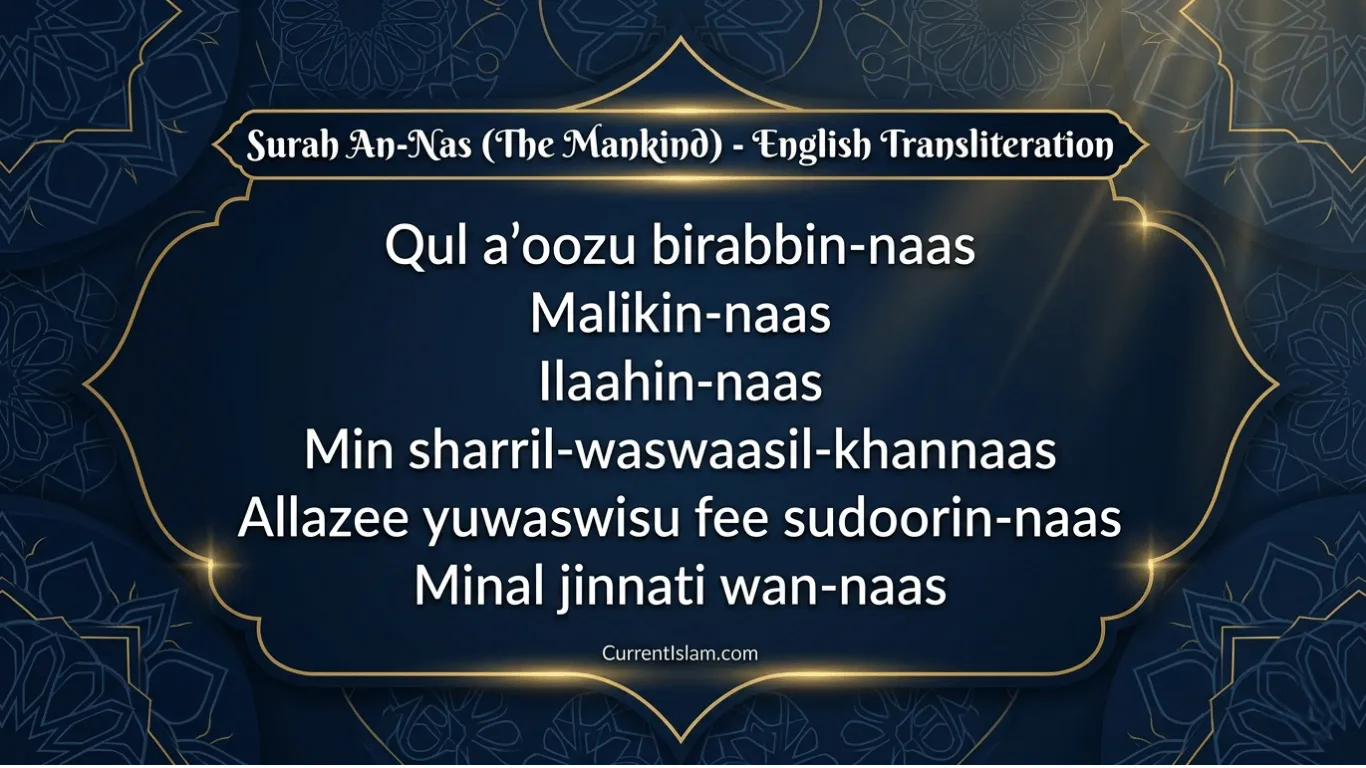
- Qul a’oozu birabbin-naas
- Malikin-naas
- Ilaahin-naas
- Min sharril-waswaasil-khannaas
- Allazee yuwaswisu fee sudoorin-naas
- Minal jinnati wan-naas
English Translation (US spelling):
- Say, “I seek refuge in the Lord of mankind,”
- The King of mankind,
- The God of mankind,
- From the evil of the whispering deceiver who withdraws,
- Who whispers in the hearts of mankind,
- From among jinn and humans.
Urdu Translation:
- کہو، میں پناہ مانگتا ہوں لوگوں کے رب کی۔
- جو تمام لوگوں کا بادشاہ ہے۔
- جو تمام لوگوں کا معبود ہے۔
- وسوسہ ڈالنے والے شیطان کے شر سے جو پیچھے ہٹ جاتا ہے۔
- جو لوگوں کے دلوں میں وسوسہ ڈالتا ہے۔
- چاہے وہ جنات میں سے ہو یا انسان میں سے۔
The Word-by-Word Meaning: Understanding the Arabic Terms
Each Arabic word in Surah An-Nas carries deep theological weight that becomes clear when you understand the root meanings. Here’s why this matters for your morning routine in NYC or London.
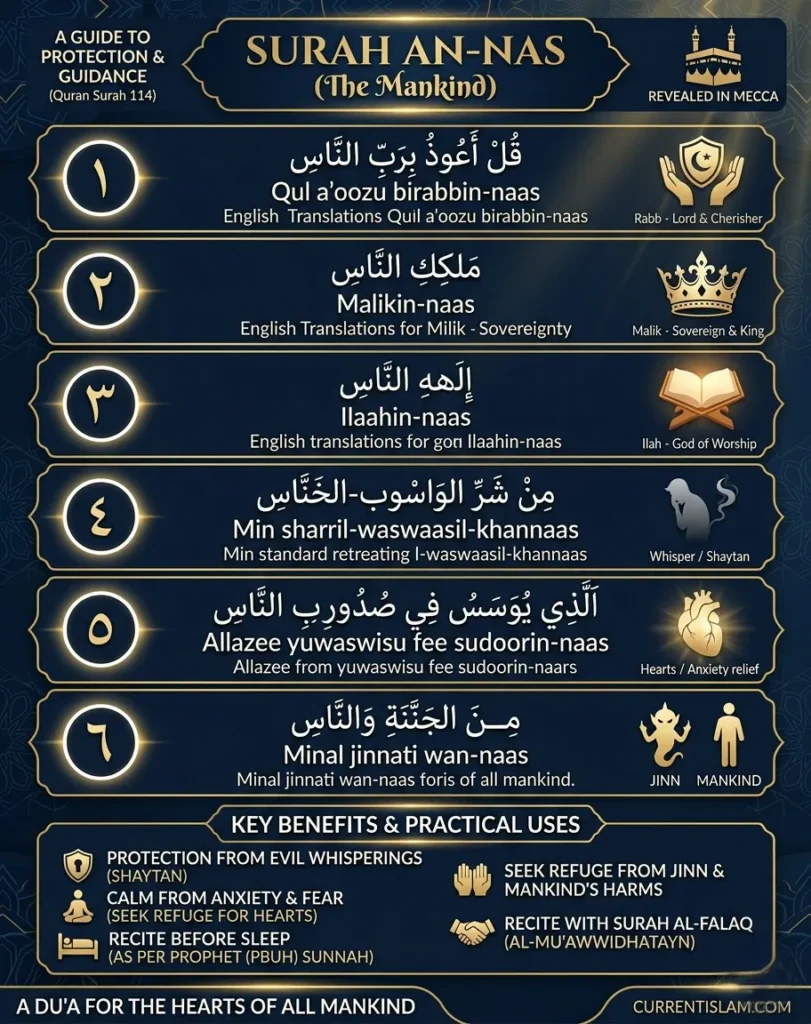
rabbin-naas (Lord of mankind): This means Allah is the Creator, Cherisher, and Sustainer of all people. For a Muslim working in Silicon Valley or on Fleet Street, this reminds you that your employer, your boss, and your colleagues are all under Allah’s ultimate authority.
malikin-naas (King of mankind): Allah has absolute sovereignty and ownership. When you feel stressed about a presentation at your firm in Canary Wharf or a meeting in downtown Toronto, remember that true power belongs only to Allah.
ilaahin-naas (God of mankind): Allah is the only true deity worthy of worship. In secular Western societies where materialism dominates, this verse anchors your faith daily.
waswaasil-khannaas (the whispering deceiver who withdraws): This describes Shaytan who plants negative thoughts but retreats when you remember Allah. Ever felt sudden anxiety before a Zoom call? That’s the waswas.
How Many Times Should You Recite Surah An-Nas? The Sunnah Count
The Prophet Muhammad (PBUH) recited Surah An-Nas and Surah Al-Falaq every night before sleeping. According to Sahih Bukhari, Aisha (RA) reported: “When the Prophet (PBUH) became ill, he recited the Mu’awwidhat (Surah Al-Falaq and Surah An-Nas) and blew over himself with water” (Sahih Bukhari 5:59:458).
Recommended practice for Western Muslims:
- Recite 3 times before waking up (7 AM EST in NYC, 9 AM GMT in London)
- Recite 3 times before starting work or school
- Recite 3 times before sleeping (10 PM PST in Los Angeles)
This 90-second practice (3 recitations × 30 seconds each) fits perfectly into your morning routine without disrupting your schedule.
The Spiritual Benefits: Why Surah An-Nas Works for Anxiety and Stress
Classical tafseer scholars explain the profound spiritual mechanics of this Surah. Ibn Kathir writes that Allah commands us to seek refuge with the one who has three attributes: lordship, sovereignty, and divinity. These three attributes mean Allah creates everything, owns everything, and everyone is subservient to Him. Therefore, when seeking protection, seek refuge with the One who has complete power over the whisperer.
Al-Jalalayn states that the “whisperer who withdraws” is the devil perched upon the heart of humanity. When a person becomes heedless, the devil whispers. When they remember Allah, the devil withdraws.
Modern scientific-spiritual connection: Studies show that brief mindfulness practices reduce cortisol levels. Reciting Surah An-Nas for 90 seconds creates a spiritual mindfulness pause that interrupts the anxiety loop before your brain floods with stress hormones.
Using Surah An-Nas in American and British Daily Life
Here’s how to make this Sunnah work for your 2026 digital life:
Before Your Morning Commute (7:30 AM EST, NYC):
Stand on the subway platform. Recite 3 times. Feel the anxiety about your meeting dissolve before you even board.
Before Your First Zoom Call (9:00 AM GMT, London):
Open your laptop. Close your eyes. Recite 3 times. The whispering thoughts about “what if I fail” withdraw immediately.
Before School Exams (10:00 AM in Toronto):
Sit at your desk. Recite 3 times. The negative thoughts about “I’m not smart enough” disappear.
The Digital Sunnah Hack: Set a phone reminder at 6:30 AM daily labeled “Surah An-Nas Protection.” When it alerts, close all apps, close your eyes, and recite. This creates a faith-based habit loop that competes with your default behavior of scrolling Instagram.
What Did Prophet Muhammad (PBUH) Say About Protection From Whispers?
The Prophet (PBUH) explained that Shaytan runs through the son of Adam like blood runs through veins. He confirmed: “There is not a single one of you except that his companion (a devil) has been assigned to him.” The Companions asked, “What about you, O Messenger of Allah?” He replied, “Yes, however, Allah has helped me against him and he has accepted Islam” (Sahih Muslim 2813).
This means every Muslim has a assigned whisperer. But Surah An-Nas is your spiritual shield.
Why This Matters for You in 2026
In a world where your phone alerts constant and your inbox never empties, the whispering deceiver has new weapons: comparison on social media, burnout from overwork, and spiritual disconnect from secular environments. Surah An-Nas remains your 90-second antidote.
Whether you’re a convert in Manchester, a diaspora parent in Vancouver, or a student in Sydney, this ancient protection practice works. The digital age hasn’t changed the whisperer’s tactics—it just given him more channels. But Allah’s protection hasn’t changed either.
Ready to build your complete morning dua routine?
Read our full guide on Surah Ikhlas with English Transliteration: Qul Huwallahu Ahad to pair An-Nas with the Surah of Allah’s uniqueness.
🚀🚀🚀
Then learn Surah Fatiha Transliteration: Alhamdulillahi Rabbil Alamin for your complete pre-work spiritual setup.
Your 90-second digital firewall starts now. Close this article. Close your eyes. Recite.
