Have you ever listened to a piece of poetry that instantly stills the noise in your mind? For centuries, Muslims have turned to the recitation of poetic verses not just as an art form, but as a profound spiritual anchor. The search for the lyrics to this timeless Naat is often a search for that exact tranquility. It is a deep desire to connect with the Prophet Muhammad ﷺ through words that capture his unmatched beauty, character, and rank.
What Does “Ya Muhammad Noor E Mujassam” Mean?
The phrase “Ya Muhammad Noor E Mujassam” translates directly to “O Muhammad, Light Incarnate.” It is a revered piece of Islamic poetry that praises the Prophet Muhammad ﷺ as a physical manifestation of divine light, highlighting his perfect character, immense beauty, and status as a merciful guide for humanity.
Here’s why this matters. When we refer to the Prophet as “Noor-e-Mujassam,” we are acknowledging that his existence brought spiritual illumination to a world in darkness. This is not merely metaphoric; it speaks to the clarity of his message and the warmth of his presence. Islamic scholars have long discussed the concept of the Prophet’s light (Noor), which signifies guidance, purity, and the absolute truth of revelation.
Understanding the full context of this Naat elevates the experience of reciting it. It transforms a simple reading into an act of deep reverence. The words serve as a reminder of the Prophet’s dual nature: he is the ultimate servant of Allah, yet he holds an unparalleled, majestic rank among all of creation.
Complete Ya Muhammad Noor E Mujassam Lyrics in Urdu and English
Below is the complete, authentic text of the Ya Muhammad Noor E Mujassam lyrics. We have provided the original Urdu script alongside a clear Roman transliteration and an accurate English translation to help you understand the profound meanings behind each verse of this beautiful Naat.
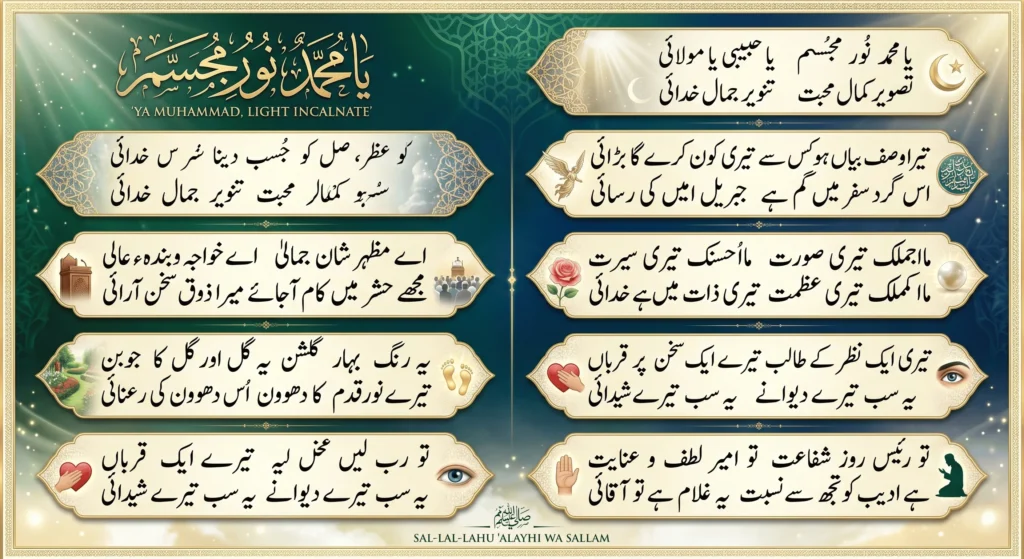
- Verse 1
- Urdu: یا محمد نور مجسم یا حبیبی یا مولائی
- Roman: Ya Muhammad noor-e-mujassam, Ya Habibi Ya Maulai
- English: O Muhammad, Light Incarnate, O my Beloved, O my Master.
- Verse 2
- Urdu: تصویر کمال محبت تنویر جمال خدائی
- Roman: Tasveer-e-kamal-e-mohabbat, Tanveer-e-jamal-e-Khudaayi
- English: The image of perfect love, the illumination of Divine beauty.
- Verse 3
- Urdu: تیرا وصف بیاں ہو کس سے تیری کون کرے گا بڑائی
- Roman: Tera wasf bayaan ho kis se, Teri kaun karega barhai
- English: Who can adequately describe Your virtues? Who can truly extol Your greatness?
- Verse 4
- Urdu: اس گرد سفر میں گم ہے جبریل امیں کی رسائی
- Roman: Is gard-e-safar mein gum hai Jibreel-e-Amin ki rasai
- English: Even Jibreel (Gabriel), the trustworthy, is lost in the dust of this journey to comprehend You.
- Verse 5
- Urdu: اے مظہر شان جمالی اے خواجہ وبندہ ء عالی
- Roman: Aye mazhar-e-shaan-e-jamali, Aye Khwaja-o-Banda-e-Aali
- English: O Manifestation of Divine Majesty, O Master and Noble Servant.
- Verse 6
- Urdu: مجھے حشر میں کام آجائے میرا ذوق سخن آرائی
- Roman: Mujhe hashr mein kaam aajaye mera shauq-e-sukhan aarayee
- English: May my passion for poetic praise be of benefit to me on the Day of Resurrection.
- Verse 7
- Urdu: مااجملک تیری صورت مااحسنک تیری سیرت
- Roman: Ma Ajmalaka teri soorat, Ma Ahsanaka teri seerat
- English: How beautiful is Your appearance, how excellent is Your character.
- Verse 8
- Urdu: مااکملک تیری عظمت تیری ذات میں گم ہے خدائی
- Roman: Ma Akmalaka teri azmat, Teri zaat mein gum hai khudayi
- English: How perfect is Your greatness, the creation is lost in contemplating Your essence.
- Verse 9
- Urdu: یہ رنگ بہار گلشن یہ گل اور گل کا جوبن
- Roman: Yeh rang-e-bahar-e-gulshan, Yeh gul aur gul ka joban
- English: This color of the garden’s spring, this flower and the flower’s youthful bloom.
- Verse 10
- Urdu: تیرے نورقدم کا دھوون اس دھوون کی رعنائی
- Roman: Tere noor qadam ka dhowan, Us dhowan ki ranayi
- English: Are but the wash of Your luminous feet, the elegance of that washing.
- Verse 11
- Urdu: تیری ایک نظر کے طالب تیرے ایک سخن پر قرباں
- Roman: Teri ek nazar ke talib, Tere ek sukhan par qurban
- English: They seek just one glance from You; they are ready to sacrifice for one word from You.
- Verse 12
- Urdu: یہ سب تیرے دیوانے یہ سب تیرے شیدائی
- Roman: Yeh sab tere deewane, Yeh sab tere shedayee
- English: All of these are Your devoted lovers, all of these are passionately devoted to You.
- Verse 13
- Urdu: تو رئیس روز شفاعت تو امیر لطف و عنایت
- Roman: Tu Raees-e-roz-e-shafa’at, Tu Ameer-e-lutf-o-inayat
- English: You are the Chief of the Day of Intercession, the Leader of Grace and Mercy.
- Verse 14
- Urdu: ہے ادیب کو تجھ سے نسبت یہ غلام ہے تو آقائی
- Roman: Hai Adeeb ko tujh se nisbat, Yeh ghulam hai tu Aqaayi
- English: Adeeb (the poet) has a connection with You; he is the slave, and You are the Master.
ya muhammad noor e mujassam lyrics pdf
Finding Peace Through Recitation
Reciting Naats creates a powerful spiritual habit loop that actively rewires the brain for peace. By repeatedly engaging with rhythmic, positive affirmations praising the Prophet ﷺ, believers trigger a psychological response of comfort, reducing anxiety and establishing a consistent routine of mindfulness and divine remembrance.
Let’s understand the real meaning behind this practice. When looking closely at behavioral psychology, we see that habits are successfully formed through a continuous loop: a cue, a routine, and a reward. In the context of spiritual practice, feeling overwhelmed or disconnected acts as the cue. The routine becomes the intentional recitation of islamic poetry praising prophet muhammad. The reward is the profound, immediate sense of emotional release and the spiritual reassurance of receiving divine blessings in return.
This is not merely a cultural tradition; it is a structured, behavioral pathway to mental tranquility. When you engage with these verses, the auditory repetition and structured cadence help anchor the mind. It shifts focus away from worldly anxieties and redirects it toward the perfect character (Seerat) of the Prophet ﷺ. This daily Islamic transformation grounds the believer, creating a reliable, calming sanctuary of thought.
Scriptural Foundation for Praising the Prophet
The foundation for sending blessings upon the Prophet ﷺ is directly mandated by Allah in the Quran and reinforced by authentic Hadith. These scriptural proofs elevate the recitation of Naats from simple cultural poetry to a highly rewarded act of spiritual worship and divine obedience.
The Quranic Mandate
- Transliteration: Inna Allaha wa malaikatahu yusalloona ‘ala an-Nabi; ya ayyuha allatheena amanoo salloo ‘alayhi wasallimoo tasleema.
- English Translation: “Indeed, Allah confers blessing upon the Prophet, and His angels [ask Him to do so]. O you who have believed, ask [Allah to confer] blessing upon him and ask [Allah to grant him] peace.” (Surah Al-Ahzab, 33:56)
- Urdu Translation: بیشک اللہ اور اس کے فرشتے نبی پر درود بھیجتے ہیں، اے ایمان والو! تم بھی ان پر درود اور خوب سلام بھیجا کرو۔
- Modern Relevance: This verse is a timeless call to action. It shows that sending peace and blessings is an action shared by Allah and the angels, making it a universal, spiritually unifying act that believers can participate in daily to seamlessly align themselves with divine will.
The Prophetic Tradition (Hadith)
- Transliteration: Man salla ‘alayya wahidatan salla Allahu ‘alayhi ashran.
- English Translation: “Whoever sends blessings upon me once, Allah will send blessings upon him ten times.” (Sahih Muslim)
- Urdu Translation: جس نے مجھ پر ایک مرتبہ درود بھیجا، اللہ اس پر دس رحمتیں نازل فرماتا ہے۔
- Modern Relevance: This beautifully highlights the return on spiritual investment. In moments of difficulty, adopting the routine of sending salutations brings exponential divine mercy, serving as a powerful, comforting remedy for the believer’s heart and mind.
Deep Analysis of the Core Verses
The verses of this Naat masterfully blend high poetic art with deep theological truths. By analyzing the mentions of the Archangel Jibreel, the Day of Judgment, and the Prophet’s physical and moral beauty, we uncover a rich layer of scholarly Islamic reverence within the poetry.
This becomes important when you look at the specific imagery the poet uses to construct a mental picture of the Prophet’s exalted status.
The Station of Jibreel (Gabriel) Is gard-e-safar mein gum hai Jibreel-e-Amin ki rasai. The poet gracefully notes that even Jibreel, the highest of angels who brought the revelation, reaches his limit when trying to comprehend the full majestic reality of the Prophet ﷺ. This refers specifically to the miraculous event of Al-Isra wal-Mi’raj (The Night Journey), where Jibreel had to stop at Sidrat al-Muntaha, allowing the Prophet to proceed alone into the divine presence. It firmly establishes the Prophet’s status as utterly unparalleled in all of creation.
The Perfect Character and Form Ma Ajmalaka teri soorat, Ma Ahsanaka teri seerat. Here, the poet utilizes classical Arabic phrasing within the standard Urdu structure. It beautifully references the dual perfection of the Prophet. “Soorat” refers to his physical, outward beauty, which companions repeatedly described as shining brighter than the full moon. “Seerat” refers to his internal character, which Aisha (RA) famously described as “a walking Quran.”
The Hope of Intercession Tu Raees-e-roz-e-shafa’at. The ultimate hope of every devout believer is safely navigating the trials of the Day of Judgment. By calling him the “Chief of the Day of Intercession,” the poet acknowledges the authentic, foundational Islamic belief in Shafa’at al-Kubra, the Great Intercession, where the Prophet ﷺ will uniquely intercede on behalf of humanity.
How to Apply This Islamic Poetry in Daily Life
Integrating this Naat into your daily life involves mindful listening, intentional recitation, and studying its true meanings. By making it a regular part of your spiritual routine, you create moments of dedicated reflection that reinforce your emotional connection to the Prophet ﷺ and Islamic teachings.
We can easily weave the wisdom of these lyrics into our daily schedules to foster a more grounded mindset. Instead of passively listening as background noise, take time to read the urdu naat sharif lyrics written text with complete focus. Allow the beautifully structured words to dictate a moment of genuine pause.
You might choose to recite these verses softly during your morning commute, or listen to high-quality audio renditions while focusing on your breathing. This practical application ensures that the legacy of the Prophet ﷺ is not just historical text, but a living, breathing part of your current reality. It transforms empty time into moments of immense spiritual productivity.
People Also Ask
The phrase “Noor-e-Mujassam” translates strictly to “Light Incarnate” or “Embodied Light.” In Islamic tradition, it is heavily used as a title of immense respect and love for the Prophet Muhammad ﷺ, symbolizing that his life, perfect character, and message were a guiding light for humanity, bringing people safely out of the darkness of ignorance.
The Naat was masterfully penned by a devoted Islamic poet, often identified by the poetic pen name (Takhallus) “Adeeb,” which is explicitly mentioned in the final verse: “Hai Adeeb ko tujh se nisbat.” It has been recited by many prominent Naat Khawans globally, making it a beloved, foundational staple in gatherings of praise.
Yes, absolutely. Listening to or reciting this Naat daily is highly encouraged as a means of sending Durood and Salaam (peace and blessings) upon the Prophet ﷺ. As established by Prophetic tradition, frequent recitation actively brings peace to the heart and invites exponential blessings from Allah.
Elevate Your Spiritual Journey Today
Having a reliable, beautifully formatted copy of these lyrics allows you to read and reflect without digital distractions. Click below to download the complete text and translation directly to your device for daily recitation.
Now that you have explored the deep meanings and the spiritual habit loop behind this beautiful Naat, it is time to bring it into your daily practice. Having a physical or dedicated digital copy ensures you can engage with the words meaningfully anytime, anywhere.
Download the beautifully formatted ya muhammad noor e mujassam pdf right here to keep the original Urdu text, transliteration, and English translation safely with you wherever you go.
