You shut down your laptop, but your brain refuses to turn off. A new notification chimes, your chest tightens, and a familiar wave of dread washes over you. Modern culture tells us that chronic burnout, hyper-fixation on digital status, and constant performance anxiety are simply the costs of survival. It is easy to internalize this pressure and assume your internal chaos stems from a spiritual deficit.
Here is why this matters: feeling overwhelmed is not a sign of weak faith. It is a sign of being human. Islamic psychology does not shame the anxious mind; instead, it provides a structured, neurological, and spiritual blueprint to reclaim your peace.
How to Overcome Anxiety in Islam: A Modern Perspective
Overcoming anxiety in Islam requires balancing spiritual surrender (Tawakkul) with proactive physical means, including therapy and medical treatment. The Islamic perspective views emotional distress as a natural human trial rather than a failure of faith, offering specific remedies like the remembrance of Allah to reset the nervous system.
For the high-functioning professional facing clinical burnout or the young person drowning in digital comparison, anxiety usually manifests as a desperate attempt to control things outside your reach. In classical Islamic texts, scholars distinguished between two types of mental distress: Al-Hamm (anxiety regarding the unwritten future) and Al-Hazan (depression regarding the unalterable past).
Let’s understand the real meaning behind these terms. When you suffer from anxiety, your mind is racing forward into worst-case scenarios. When you suffer from depression, your heart is anchored backward in regret. Both states are thieves of the present moment.
In the 9th century, the pioneering Islamic scholar Abu Zayd al-Balkhi wrote Sustenance of the Soul, the world’s first major treatise on psychosomatic medicine. Al-Balkhi argued that mental ailments require structural interventions just as physical illnesses do. He emphasized that the mind and body are fundamentally intertwined; when the mind spirals, the nervous system follows. To halt this spiral, Islam introduces an immediate cognitive disruption framework.
Dua for Anxiety and Depression: The Power of La Hawla
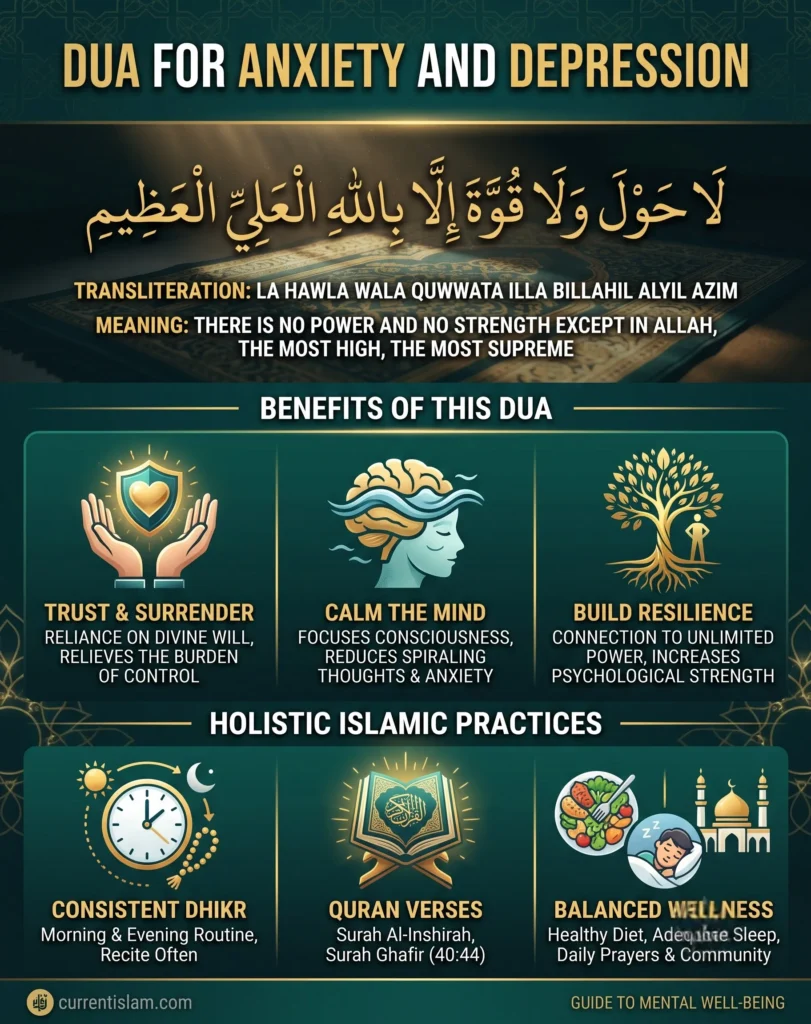
The most powerful dua for anxiety and depression is La hawla wala quwwata illa billahil aliyyil azim. This prophetic statement acts as a direct psychological release mechanism, allowing a person to shift the crushing weight of control from their own fragile shoulders back to the Creator.
When the mind experiences severe distress, it requires a phrase that cuts through cognitive loops. This specific formula provides a complete paradigm shift for an anxious mind.
The Core Prophetic Remedy
Arabic Text:
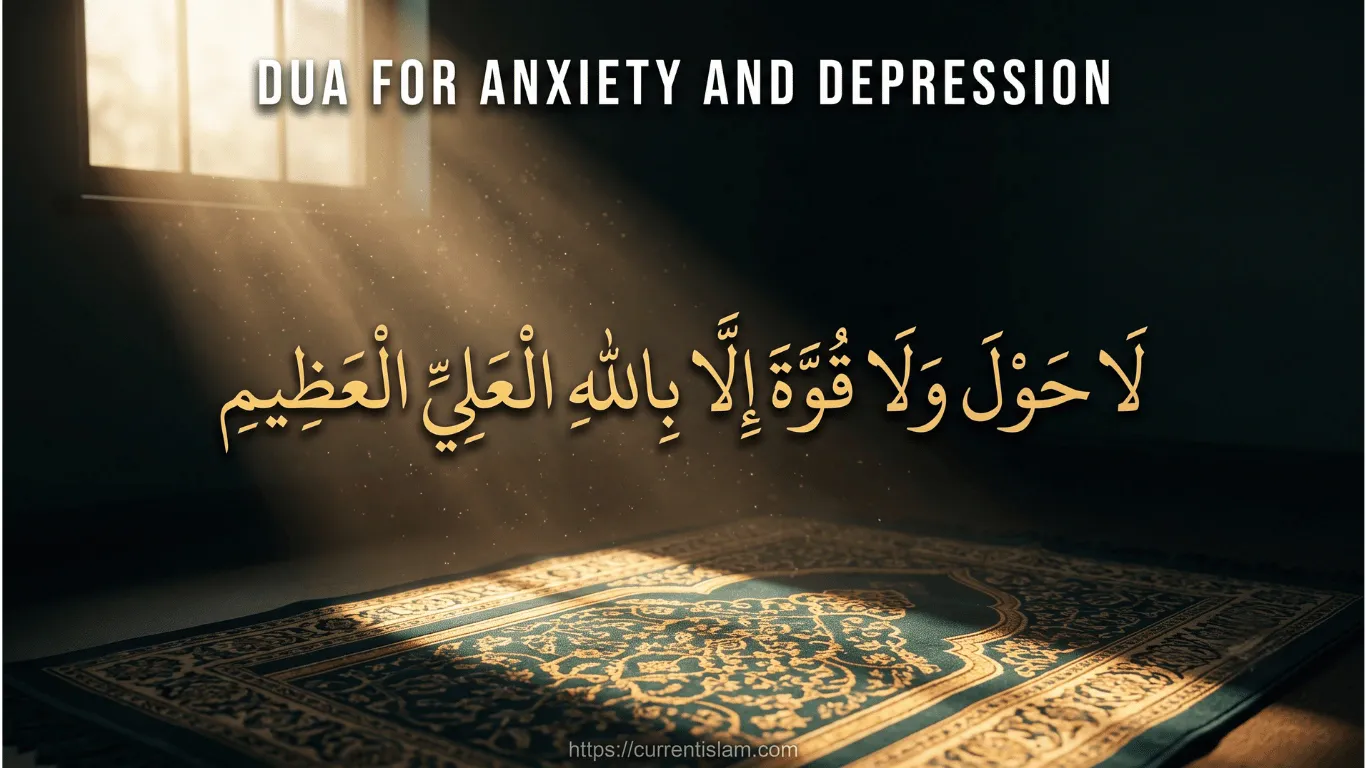
لَا حَوْلَ وَلَا قُوَّةَ إِلَّا بِاللهِ الْعَلِيِّ الْعَظِيمِ
Transliteration: La hawla wala quwwata illa billahil ‘aliyyil ‘azim
English Translation: “There is no change, nor power except through Allah, the Most High, the Supreme.”
Urdu Translation:
اللہ کے سوا نہ کوئی تبدیلی لانے کی طاقت ہے اور نہ کوئی قوت، جو بہت بلند اور بڑی عظمت والا ہے۔
Hindi Translation:
अल्लाह के अलावा न कोई बदलाव लाने की ताक़त है और न कोई क़ुव्वत, जो बहुत बुलंद और बड़ी अज़मत वाला है।
This becomes important when you look at how the Prophet Muhammad (ﷺ) described these words. In a narration found in Sahih al-Bukhari, he stated that this phrase is “a treasure from the treasures of Paradise.” Classical scholars like Ibn al-Qayyim explained that La Hawla has an extraordinary effect on helping individuals endure difficult hardships, bear heavy intellectual burdens, and enter into terrifying spaces with complete calm.
When you recite this anxiety ki dua, you are performing a radical act of psychological surrender. You are admitting that you do not possess the power to alter the future on your own strength, effectively silencing the hyper-vigilance that triggers chronic stress response cycles.
Stop the Overthinking: An Islamic Guide to Reclaiming Your Peace
1. The Anchor of Inner Peace
Context: This is the primary Quranic proof that spiritual remembrance (Dhikr) functions as an emotional stabilizer.
- Arabic Text:الَّذِينَ آمَنُوا وَتَطْمَئِنُّ قُلُوبُهُم بِذِكْرِ اللَّهِ ۗ أَلَا بِذِكْرِ اللَّهِ تَطْمَئِنُّ الْقُلُوبُ
- Transliteration:Alladhina amanu wa tatma’innu qulubuhum bidhikrillahi, ala bidhikrillahi tatma’innul-qulub.
- English Translation:“Those who have believed and whose hearts are assured by the remembrance of Allah. Unquestionably, by the remembrance of Allah hearts are assured.” (Surah Ar-Ra’d, 13:28)
- Urdu Translation:جو لوگ ایمان لائے اور جن کے دل اللہ کے ذکر سے اطمینان پاتے ہیں۔ خبردار! اللہ ہی کے ذکر سے دلوں کو اطمینان نصیب ہوتا ہے۔
2. The Dua of Prophet Yunus (AS) for Deep Distress
Context: When feeling trapped, isolated, or overwhelmed by past regrets (depression), this is the specific formula used by a Prophet in the darkest of circumstances.
- Arabic Text:لَّا إِلَٰهَ إِلَّا أَنتَ سُبْحَانَكَ إِنِّي كُنتُ مِنَ الظَّالِمِينَ
- Transliteration:La ilaha illa anta subhanaka inni kuntu minaz-zalimin.
- English Translation:“There is no deity except You; exalted are You. Indeed, I have been of the wrongdoers.” (Surah Al-Anbiya, 21:87)
- Urdu Translation:آپ کے سوا کوئی معبود نہیں، آپ پاک ہیں، بے شک میں ہی قصوروار ہوں۔
3. The Formula for Anxiety and Fear
Context: Used when facing daunting future uncertainties or external threats, this verse shifts the burden of defense to Allah.
- Arabic Text:حَسْبُنَا اللَّهُ وَنِعْمَ الْوَكِيلُ
- Transliteration:Hasbunallahu wa ni’mal wakeel.
- English Translation:“Sufficient for us is Allah, and [He is] the best Disposer of affairs.” (Surah Al-Imran, 3:173)
- Urdu Translation:ہمیں اللہ کافی ہے اور وہ بہترین کارساز ہے۔
Setting Up a Daily Wazifa for Overthinking
Implementing the spiritual habit loop involves replacing the cue of an anxious thought with the routine of reciting La hawla wala quwwata illa billah. Practicing this wazifa consistently—such as 100 times daily—reprograms the subconscious mind to release panic and accept divine decree.
Modern habit psychology tells us that behavior change relies on a three-step process: a cue, a routine, and a reward. You can use this exact mechanism to create a spiritual habit loop that counteracts chronic anxiety.
- The Cue: A physical symptom of burnout (e.g., a racing pulse, a stressful email, or an intrusive thought).
- The Routine: Instantly interrupting that thought pattern by mindfully breathing and reciting La hawla wala quwwata illa billahil aliyyil azim.
- The Reward: Achieving Sakeenah (divine tranquility)—a measurable drop in your heart rate and cortisol levels as you yield control to God.
If you are looking for a specific wazifa for daily management, scholars suggest establishing a consistent morning and evening routine. Reciting this phrase 100 times after Fajr or Asr serves as an intentional cognitive reset button before your day begins or as it winds down. To build a comprehensive spiritual fortress against persistent distress, many also incorporate structured prayers like darood-muqadas to invite divine blessings into their daily routine.
Depression and Anxiety Treatment in Islam: Merging Faith with Therapy
Islamic psychology integrates spiritual remedies with physical medicine, stating that seeking professional clinical therapy is a fulfillment of the Sunnah. True Tawakkul requires a person to utilize every available earthly tool—including psychiatric care—while placing their ultimate trust in the Healer.
Now let’s connect this to daily life. A major barrier to healing within modern communities is the toxic narrative that needing professional help reflects a lack of spirituality. This idea contradicts established prophetic teachings. The Prophet Muhammad (ﷺ) clearly declared: “Take medicine, for Allah has not created a disease without creating a cure for it.”
If your brain chemistry is altered due to prolonged trauma or clinical depression, demanding that you “just pray more” is equivalent to telling someone with a compound bone fracture to simply walk it off. Spiritual tools like a depression ki dua work alongside clinical modalities.
True healing happens when you utilize therapy, cognitive behavioral tools, or prescribed medical treatments while simultaneously grounding your soul in remembrance. To complement your clinical healing journey, incorporating highly revered supplications like darood-e-lakhi can help soothe an aching heart and re-establish a sense of spiritual safety.
Questions:
For sudden, acute panic or overwhelming distress, the swiftest remedy is to recite La hawla wala quwwata illa billah or Hasbunallahu wa ni’mal wakeel (Allah is sufficient for us, and He is the best disposer of affairs). Focus entirely on the meaning: you are transferring your helplessness into the hands of Ultimate Power.
The most renowned prayer for lifting deep sorrow and isolation is the supplication of Prophet Yunus found in Surah Al-Anbiya (21:87): La ilaha illa anta subhanaka inni kuntu minaz-zalimin. The Quran explicitly notes that this phrasing saved him from extreme distress, serving as a permanent promise for all future believers.
No, depression is a complex human trial, never a definitive sign of divine anger. The Quran explicitly documents the profound grief experienced by noble prophets, including Prophet Yaqub, who wept until his eyesight faded. Allah treats a broken heart with infinite mercy, using trials to cleanse your soul and elevate your rank.

12 thoughts on “Dua for anxiety and depression – La hawla wala quwwata illa billahil”