
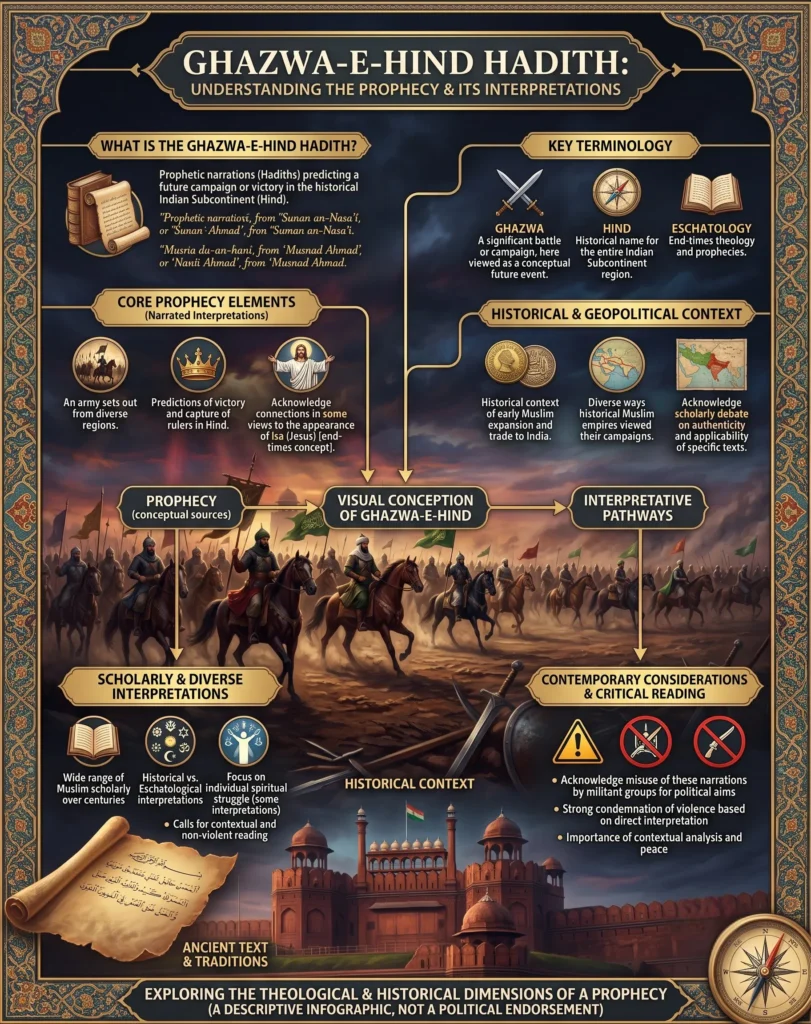
When you search for the term “Ghazwa-e-Hind,” the results are often a chaotic mix of geopolitical anxiety, extremist propaganda, and historical confusion. The term, which translates to “Expedition to India,” stems from ancient Islamic prophecies regarding the Indian subcontinent.
For centuries, these narrations were a minor, esoteric subject within Islamic eschatology (the theology of the end of times). Today, however, they are frequently weaponized in political discourse. This article strips away the modern political spin to examine the actual Arabic texts, their scholarly authenticity, and their historical context.
Textual Origins: Where is the Ghazwa-e-Hind Mentioned?
To understand the theology behind the term, we must first look at where the text is—and isn’t—recorded.
Why it is Missing from Sahih al-Bukhari and Sahih Muslim
In Sunni Islam, the two most universally trusted and authoritative collections of the Prophet Muhammad’s sayings are Sahih al-Bukhari and Sahih Muslim. It is a crucial fact that neither of these collections contains any mention of the Ghazwa-e-Hind.
The Core Narrations in Sunan an-Nasa’i and Musnad Ahmad
The prophecies are primarily found in two other major, yet slightly less universally strict, collections: Sunan an-Nasa’i and Musnad Ahmad ibn Hanbal. They trace back to two companions of the Prophet:
- The Thawban Narration: Thawban, a freed slave of the Prophet, reported: “There are two groups of my Ummah whom Allah will free from the Fire: The group that invades India, and the group that will be with Isa bin Maryam [Jesus], peace be upon him.”
- The Abu Hurairah Narration: Abu Hurairah reported a promise that Muslims would mount an expedition to India. He states that if he lives to see it and is martyred, it is well, and if he survives, he will be “Abu Hurairah the freed (from the Fire).”
The Rejected Narrations in Kitab al-Fitan
You may also encounter highly violent versions of this prophecy that describe dragging Indian kings in chains before returning to Syria to find Jesus. These details come from Nu’aym ibn Hammad’s Kitab al-Fitan. Strict Islamic scholars widely criticize this specific book for containing fabricated and weak apocalyptic reports, and these specific embellishments are overwhelmingly rejected by mainstream theology.
The Science of Hadith: Are These Prophecies Authentic?
In the Islamic science of Hadith, a text’s validity depends on an unbroken chain of reliable transmitters (isnad).
Understanding Hadith Grading
Scholars grade narrations into three main categories:
- Sahih: Authentic and highly reliable.
- Hasan: Good or acceptable, though slightly less rigorous than Sahih.
- Da’if: Weak, usually due to a broken chain or an unreliable narrator.
The Consensus of Classical Scholars
The Ghazwa-e-Hind narrations have received mixed gradings.
- The Thawban Narration is generally considered the strongest, with modern scholars like Muhammad Nasiruddin al-Albani grading it as Sahih or Hasan.
- The Abu Hurairah Narrations, however, have highly disputed chains. Several research institutes and scholars grade specific versions of his account as Da’if (weak).
A core principle of Islamic jurisprudence (Fiqh) is that a Da’if hadith cannot be used to establish core laws or justify warfare.
The Theological Definition of “Ghazwa” vs. “Sariyah”
A major point of contention lies in the literal Arabic linguistics of the term itself.
Historically, a Ghazwa refers strictly to a military expedition physically led by the Prophet Muhammad himself. In contrast, a Sariyah was an expedition led by his companions in his absence. Because the Prophet passed away in 632 CE, many classical scholars argue that a literal “Ghazwa” occurring centuries later is a theological impossibility, suggesting the term is being misapplied or used metaphorically.
Historical Fulfillment vs. End-of-Times Prophecy
Did this expedition already happen, or is it a future apocalyptic event? Classical scholars are divided into two main camps:
The Umayyad Campaigns (Sindh)
712 CE
Many scholars argue the prophecy was fulfilled during the early Muslim expansions led by Muhammad bin Qasim into the Sindh region.
The Ghaznavid Expansions
11th Century CE
Other historians point to the later campaigns by Mahmud of Ghazni as the fulfillment of the text, viewing the event as part of history rather than an outstanding religious obligation.
Conversely, the Eschatological View focuses on the Thawban narration, which explicitly links the expedition to India with the descent of Jesus (Isa). Because the return of Jesus is a major sign of the Islamic Apocalypse, some scholars argue this is a divine, end-of-times event. However, classical theology insists that eschatological events will unfold according to God’s will—they are not instructions for humans to initiate unprovoked wars today.
The Difference Between Historical “Al-Hind” and Modern Borders
A major source of modern confusion is geography.

When 7th-century Arabs spoke of “Al-Hind,” they were not referring to the modern Republic of India. “Al-Hind” was a massive geographic expanse that encompassed modern-day India, Pakistan, Bangladesh, Sri Lanka, and parts of Afghanistan. Applying an ancient, broad geographical term specifically to the post-1947 borders of India and Pakistan is historically anachronistic.
The Modern Politicization of Ghazwa-e-Hind
For fourteen centuries, this concept was a quiet, academic footnote. It was only revived in the late 20th century.
Weaponization by Extremist Groups (1990s–Present)
During the Afghan-Soviet War and the subsequent rise of militancy in Kashmir, extremist organizations heavily weaponized the term. Groups stripped the Hadith of its historical and theological context, using it to recruit fighters, justify cross-border terrorism, and frame modern geopolitical conflicts over land as a holy mandate.
The Rejection by Mainstream Islamic Institutions
Mainstream Islamic scholars have severely criticized this modern interpretation. Prominent institutions—spanning Deobandi, Barelvi, and Ahl-e-Hadith traditions—have publicly rejected the militant application of Ghazwa-e-Hind. Mainstream jurisprudence dictates that ambiguous prophecies about the future never override the concrete, established laws of Islam regarding the sanctity of life, the honoring of modern treaties, and the strict prohibition of terrorism.
Conclusion
The Ghazwa-e-Hind is a highly nuanced, debated eschatological concept that has been distorted into a modern political instrument. By understanding the varying strengths of the source texts, the historical definitions of the region, and the strict rules of Islamic jurisprudence, it becomes clear that ancient prophecies cannot be ethically or theologically used to justify modern geopolitical violence.
