You carry a heavy load. Between managing your career, protecting your family, processing global events, and planning your future, the pressure is constant. Modern culture tells you that you must be entirely self-reliant. It demands that you manifest your own success and hold everything together.
The result? Spiritual exhaustion and overwhelming anxiety. When you believe your survival depends entirely on your own intellect and effort, one small failure feels like the end of the world.
The Prophet Muhammad ﷺ understood this human fragility. He offered a profound remedy—a precise dua for distress and hardship that immediately lifts the crushing weight of hyper-independence off your shoulders.
Quick Answer: How to Relieve Distress Immediately
- The Dua: Allahumma rahmataka arju, fala takilni ila nafsi tarfata ‘aynin…
- The Meaning: “O Allah, it is Your mercy that I hope for, so do not leave me to myself even for the blink of an eye…”
- The Benefit: It shifts the burden of managing your life from your limited capacity to Allah’s infinite power.
The Complete Dua for Distress (Arabic, Transliteration, and Translation)
This supplication is authentically reported from the Prophet ﷺ, explicitly prescribed for the distressed person (al-makrub).
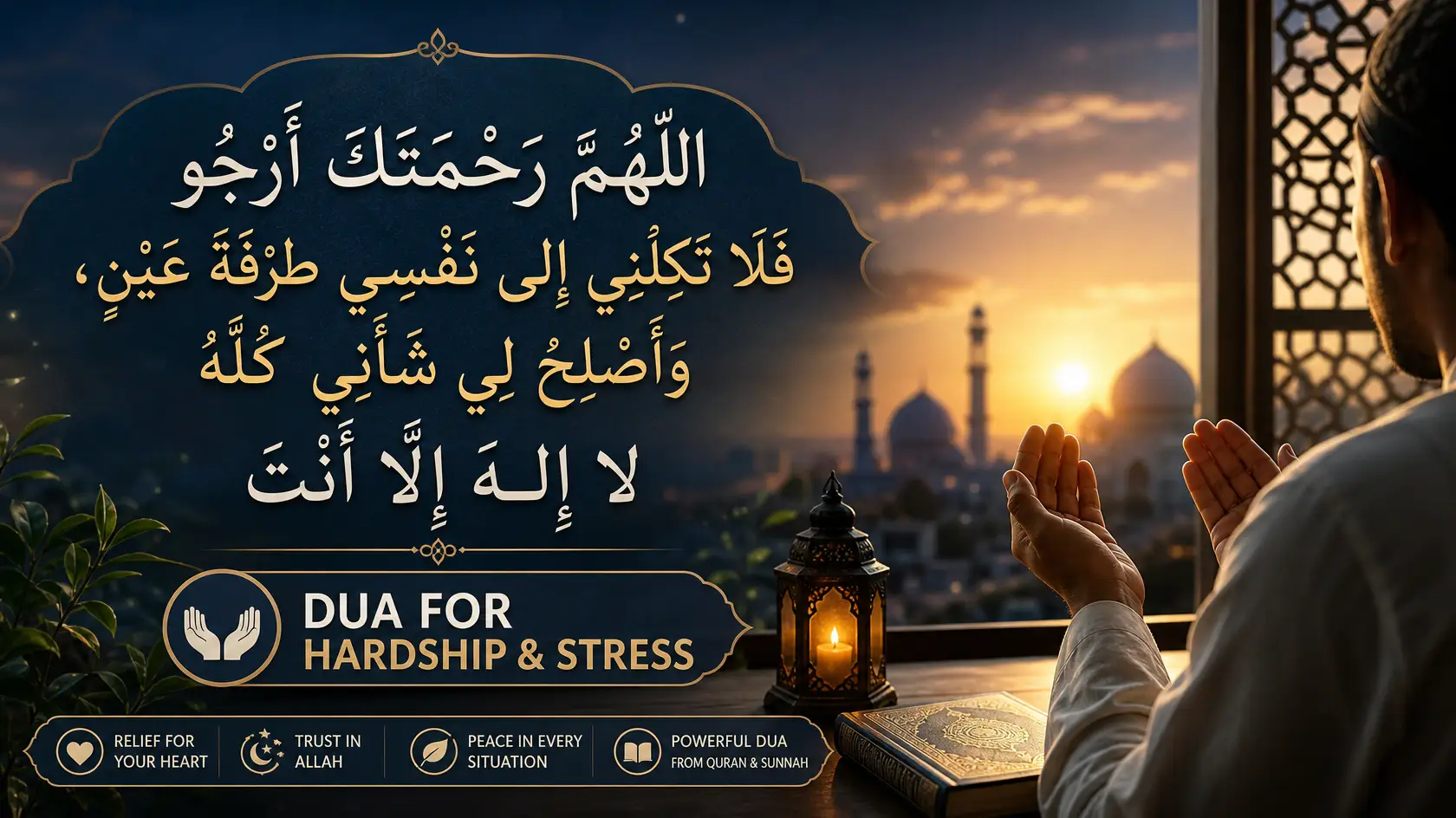
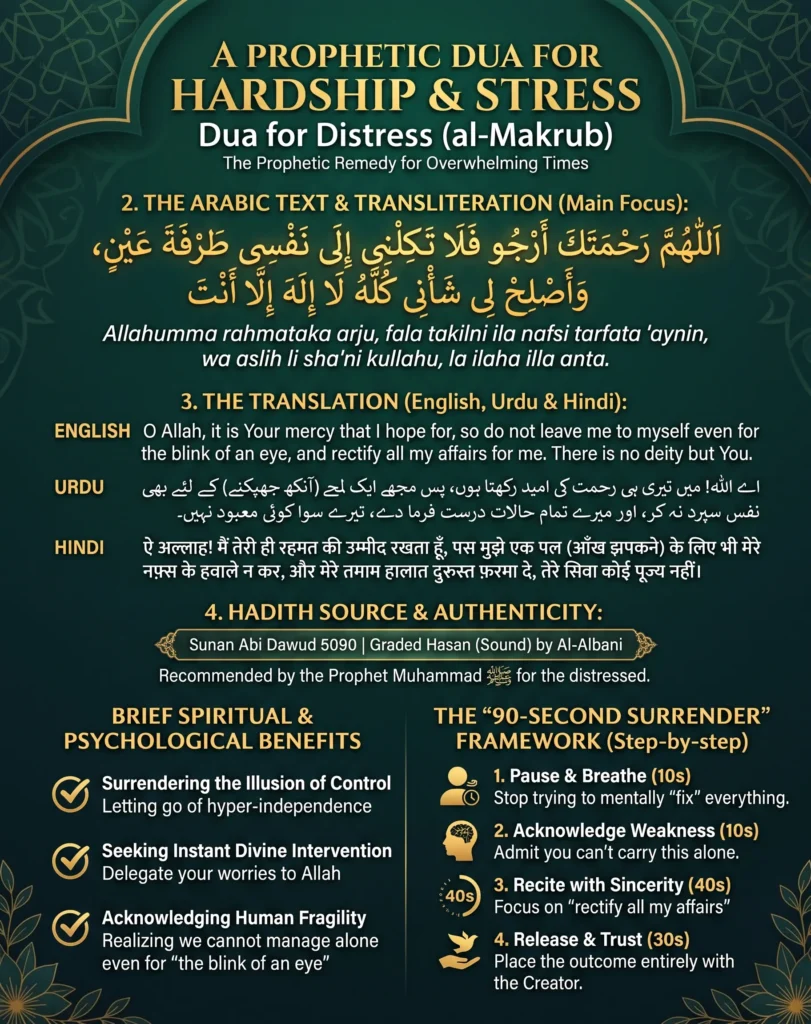
اللَّهُمَّ رَحْمَتَكَ أَرْجُو فَلَا تَكِلْنِي إِلَى نَفْسِي طَرْفَةَ عَيْنٍ، وَأَصْلِحْ لِي شَأْنِي كُلَّهُ لَا إِلَهَ إِلَّا أَنْتَ
Transliteration:
Allahumma rahmataka arju, fala takilni ila nafsi tarfata ‘aynin, wa aslih li sha’ni kullahu, la ilaha illa anta.
English Translation:
“O Allah, it is Your mercy that I hope for, so do not leave me to myself even for the blink of an eye, and rectify all my affairs for me. There is no deity but You.”
Urdu Translation:
اے اللہ! میں تیری ہی رحمت کی امید رکھتا ہوں، پس مجھے ایک لمحے (آنکھ جھپکنے) کے لئے بھی میرے نفس کے سپرد نہ کر، اور میرے تمام حالات درست فرما دے، تیرے سوا کوئی معبود نہیں۔
Hindi Translation:
ऐ अल्लाह! मैं तेरी ही रहमत की उम्मीद रखता हूँ, पस मुझे एक पल (आँख झपकने) के लिए भी मेरे नफ़्स के हवाले न कर, और मेरे तमाम हालात दुरुस्त फ़रमा दे, तेरे सिवा कोई पूज्य नहीं।
(Source: Sunan Abi Dawud 5090. Graded Hasan by Al-Albani)
Word-by-Word Arabic Breakdown
Understanding the exact phrasing deepens the spiritual impact of this dua.
| Arabic Word | Transliteration | Meaning |
| اللَّهُمَّ | Allahumma | O Allah (an intimate, emphatic call) |
| رَحْمَتَكَ | Rahmataka | Your mercy (placed first for exclusivity) |
| أَرْجُو | Arju | I hope for / I expect |
| فَلَا تَكِلْنِي | Fala takilni | So do not entrust me / leave me |
| إِلَى نَفْسِي | Ila nafsi | To myself / my own ego |
| طَرْفَةَ عَيْنٍ | Tarfata ‘aynin | For the blink of an eye |
| وَأَصْلِحْ لِي | Wa aslih li | And rectify / fix for me |
| شَأْنِي كُلَّهُ | Sha’ni kullahu | All of my affairs |
[SCHOLAR ANECDOTE: Not long ago, a final-year university student sat in my office, completely paralyzed by career anxiety. They were losing sleep over the current job market, frantically trying to micro-manage a future they simply couldn’t control. Their hyper-independence had pushed them to the brink of burnout.
I gave them one simple assignment: write Allahumma rahmataka arju, fala takilni ila nafsi tarfata ‘aynin on a sticky note and place it directly on their bathroom mirror.
Within a week, it completely rewired their morning routine. Instead of waking up, grabbing their phone, and instantly panicking over LinkedIn or unanswered applications, their day started with a physical exhale. By looking at that sticky note first thing every morning, they actively handed the management of their life over to Allah before the world could rush in. It didn’t magically give them a job on day one, but it gave them the mental clarity and spiritual relief needed to actually do the work.]
The Psychology of “Do Not Leave Me to Myself”
The most powerful phrase in this supplication is fala takilni ila nafsi tarfata ‘aynin (do not leave me to myself for the blink of an eye).
When anxiety strikes, your brain attempts to control uncontrollable variables. You stay awake plotting how to fix your finances, relationships, and health. This dua acts as a psychological circuit breaker. By admitting that you cannot manage your own soul for even a fraction of a second, you surrender the illusion of control.
This is not passive defeat; it is active trust (Tawakkul). It acknowledges that human vision is limited. You require the profound healing described in Surah Yunus ayat 57 to cure the distress in your chest. When you ask Allah to rectify all your affairs, you delegate your worries to the Only One capable of managing them perfectly.
(Note: Islamic supplication complements professional mental health care. If you experience chronic clinical anxiety, seek support from a licensed therapist alongside your spiritual practice.)
Hyper-Independence vs. Prophetic Reliance
Modern society pushes you toward isolation, while the Sunnah pulls you toward divine support.
| Trait | Hyper-Independence (Modern Anxiety) | Prophetic Reliance (Tawakkul) |
| Mindset | “If I don’t fix this, everything collapses.” | “I will tie my camel, but Allah controls the outcome.” |
| Reaction to Hardship | Panic, isolation, and burnout. | Making dua, seeking counsel, and remaining patient. |
| Self-View | I must be strong and perfect at all times. | I am weak, but my Lord is infinitely strong. |
| Time Focus | Obsessing over the distant, unknown future. | Seeking Allah’s help for the exact current moment. |
Real-Life Application for Western Muslims
How do you apply allahumma rahmataka arju when living a busy life in the US or UK?
At Work or University:
When an unexpected deadline drops, or you face a confrontational meeting, your heart rate spikes. Before opening your email or speaking, silently recite this dua. It takes five seconds but entirely shifts your mental state from panic to reliance. If you are dealing with a specifically difficult manager or colleague, you might also recite Allahumma layyin qalbi fulan to soften their heart toward you.
During Late-Night Overthinking:
Night time often amplifies hardship. When the house is quiet, your worries get louder. Reciting the revelation, such as Inna anzalna fi lailatul qadr, brings immense tranquility. Say this dua of distress as you lie in bed to formally hand your burdens over to Allah before sleeping.
During Specific Hardships:
Distress comes in specific forms. It might be intense medical anxiety, where a Dua for pregnancy and safe delivery is needed for your family. Or it might be the heavy grief of witnessing global suffering, reminding believers of historical trials like Allahumma Lan Qatalatal Hussain. In all cases, Allahumma rahmataka arju forms the foundation of your reliance.
Frequently Asked Questions
When is the best time to say this dua?
You can say it at any time. However, reciting it during moments of sudden panic, between the Adhan and Iqamah, or in Sujood (prostration) maximizes its spiritual impact, as these are accepted times for supplication.
Can I recite this in English?
Yes. While the Arabic carries the precise prophetic words and specific blessings, Allah hears and understands all languages. If you struggle with Arabic, say the English translation with absolute sincerity.
What does ‘tarfata aynin’ mean?
It translates to “the blink of an eye.” It is a profound metaphor indicating the smallest conceivable measurement of time, emphasizing that we cannot survive without Allah’s mercy for even a microsecond.
Is this dua authentic?
Yes. It is recorded in Sunan Abi Dawud (Hadith 5090) and graded as Hasan (sound and reliable) by classical and contemporary hadith scholars, including Al-Albani.
Next step:
Read another post to strengthen your daily routine: Inna laka fin nahari sabhan taweelah
