
Quick Answer
- Poet: Munawwar Badayuni (منور بدایونی), according to established Urdu literary sources.
- Theme: Devotional love, humility, hope, and reverence for the Prophet Muhammad ﷺ.
- Reliable text: Consult Rekhta and Naat Kainaat for attribution and textual comparison. Verify copyright permission before publishing the complete lyrics.
What Is “Na Kahin Se Door Hain Manzilein”?
“Na Kahin Se Door Hain Manzilein” is a well-known Urdu naat associated with the poet Munawwar Badayuni. A naat is devotional poetry written in praise of the Prophet Muhammad ﷺ. The poem expresses reverence, spiritual hope, humility, and a believer’s longing for mercy.
Readers often search for this naat using its opening line, the phrase “Ye Dar-e-Habib Ki Baat Hai,” or the Arabic words “Balaghal Ula Bi Kamalihi.” These phrases may appear together in devotional performances, but they should not automatically be treated as one continuous poem. The Arabic couplet and the Urdu naat should be identified separately, with their sources checked.
This guide explores the poet, the meaning of the poem, common wording differences, difficult expressions, and ways to find a reliable text or recitation.
Who Wrote “Na Kahin Se Door Hain Manzilein”?
The Urdu naat is attributed to Munawwar Badayuni (منور بدایونی) by Rekhta and Naat Kainaat. Literary biographies record his birth in Badayun in 1908 and his death in Karachi in 1984.
Munawwar Badayuni is remembered for his Urdu poetry, including devotional poetry. His pen name appears in the closing line of this naat, providing an additional literary clue to its attribution.
The poet and the reciter are not the same person. Munawwar Badayuni wrote the poem, while a naat khwan is someone who performs it. Different reciters may use different melodies, pacing, and textual variants. Always check the recording’s official description before crediting a particular performer.
What Is the Opening Line in Urdu?
The principal opening line is:
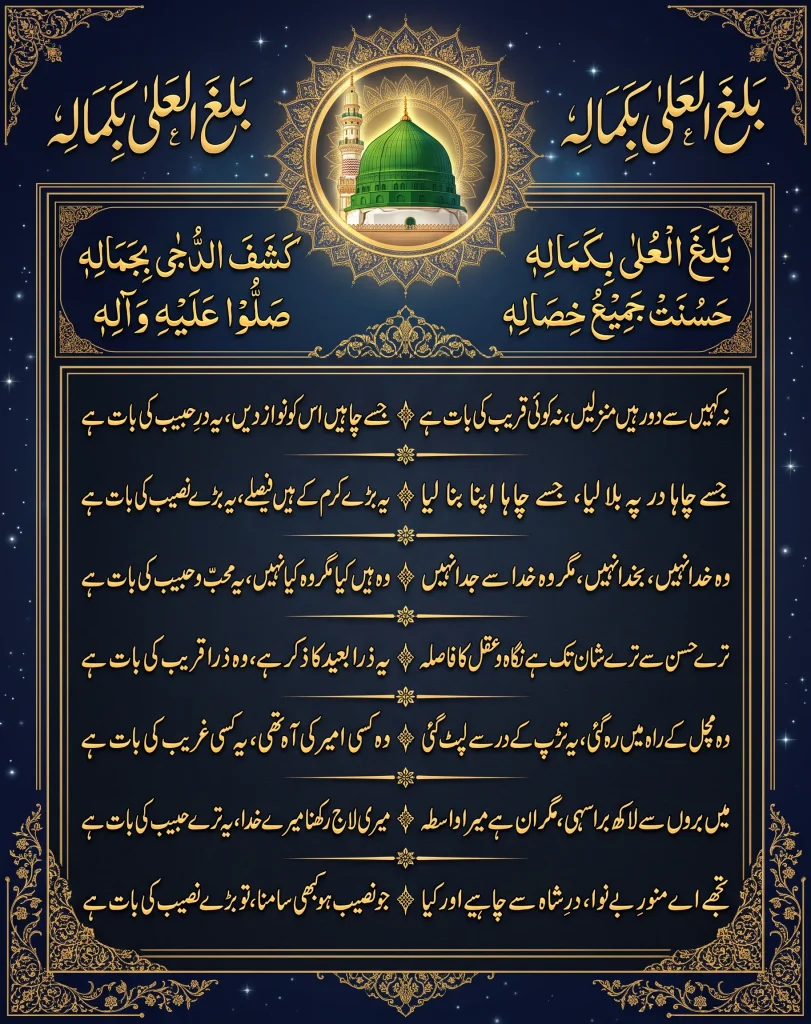
نہ کہیں سے دور ہیں منزلیں، نہ کوئی قریب کی بات ہے
Roman Urdu: Na kahin se door hain manzilein, na koi qareeb ki baat hai.
Hindi: न कहीं से दूर हैं मंज़िलें, न कोई क़रीब की बात है।
English sense: The destination is not simply a matter of distance or nearness.
This is a poetic expression rather than a literal statement about physical travel. Its interpretation should be considered within the complete couplet and the poem’s devotional context.
Editorial note: Verify the precise wording against the selected authoritative edition before publication.
Balaghal ula be kamalehi lyrics Infographic
What Is the Meaning of This Naat?
The naat uses the language of closeness, invitation, generosity, longing, and humility to express devotional feeling. Its speaker reflects on the honour associated with the Prophet Muhammad ﷺ and expresses hope despite personal shortcomings.
The poem’s emotional power comes from contrasts: distance and nearness, wealth and poverty, being welcomed and remaining outside, and human weakness alongside hope.
A responsible explanation should distinguish poetic expression from a formal statement of Islamic creed. Some lines use intense devotional language and should be reviewed by a qualified scholar before being interpreted as theological propositions.
1. The Language of Distance and Nearness
The opening couplet uses distance as a poetic metaphor. The speaker suggests that spiritual attainment cannot be understood only through ordinary measures of proximity. The following line directs attention toward the generosity associated with the beloved’s door.
This interpretation should not be extended into claims about unseen matters or religious doctrine without reliable scholarly support.
2. Being Called and Being Welcomed
The next couplet contrasts being invited to a door with being accepted as one’s own. Its emotional emphasis is on welcome, honour, and grace rather than personal achievement.
The language of generosity gives the poem its hopeful character. The speaker presents acceptance as a blessing rather than something that can be demanded as an entitlement.
3. Humility and Devotional Expression
The speaker does not portray himself as perfect. Instead, he acknowledges his shortcomings and expresses hope through his devotional connection.
This is one reason the naat may resonate with listeners who approach devotional poetry as an expression of love, longing, and humility. The explanation should remain faithful to the text rather than inventing a personal story about the poet.
4. The Contrast Between Wealth and Poverty
The poem contrasts an affluent person with a poor person to emphasize the emotional force of longing. In this poetic setting, status alone does not determine the intensity of a person’s appeal.
Readers should not assume that the comparison describes a documented historical event. Unless a reliable source identifies a particular incident, it is best understood as poetic imagery.
5. The Final Expression of Hope
The closing lines address Munawwar by his pen name and express the hope of receiving an honourable encounter. The ending gives the poem a personal quality: the poet moves from broader devotional reflection to an individual expression of longing.
This personal ending also helps explain why attribution matters. A version that omits the poet’s name or changes the final line may lose part of the poem’s literary context.
What Does “Balaghal Ula Bi Kamalihi” Mean?
The Arabic devotional verse is commonly written as follows:
بلغ العلیٰ بکمالہ
کشف الدجی بجمالہ
حسنت جمیع خصالہ
صلوا علیہ وآلہ
The verse celebrates excellence, beauty, and noble qualities, and concludes by calling for blessings upon the Prophet Muhammad ﷺ and his family.
Important distinction: This Arabic verse is a separate, well-known devotional text. It may be paired with the Urdu naat during performances or in online lyric collections, but the texts should be identified separately unless an authoritative source establishes a particular combined version.
If you publish both texts, create separate headings and identify the source and copyright status of each.
Why Do Online Versions Contain Different Words?
Naat lyrics circulate through printed collections, recordings, oral recitation, social media, and copied lyric pages. A performer may omit a couplet, repeat a line, or follow a variant version.
Online versions of this naat can differ in spelling, punctuation, and wording. A reliable editorial process should follow these steps:
- Select an authoritative printed edition or a rights-holder-approved text.
- Compare the chosen version with established literary sources.
- Record meaningful variants rather than silently merging them.
- Check Urdu spelling and pronunciation with a competent Urdu editor.
- Confirm the rights to reproduce the selected text.
A search result or popular recording is useful evidence, but it does not automatically establish the definitive wording or grant permission to republish the lyrics.
Who Was Munawwar Badayuni?
Munawwar Badayuni was an Urdu poet whose devotional writing remains part of the South Asian naat tradition. Rekhta records his dates as 1908–1984 and lists Munawwar Naatein among his works.
His pen name, Munawwar, appears in the closing line of this naat. This literary signature helps connect the poem to its author.
For a detailed biography, consult established literary references and verify dates and publication details before including them in a scholarly profile. Do not attribute a particular recitation, tune, or recording to the poet unless reliable evidence supports that claim.
How Should This Naat Be Read or Recited?
Begin with a reliable text and read each couplet slowly. Urdu readers should pay attention to similar-sounding words, while Roman Urdu readers should follow one consistent transliteration style.
A useful practice is to read the Urdu couplet first, review its plain-language meaning, and then listen to an authorized recitation. This helps readers understand the words rather than merely imitate the melody.
When sharing the naat at a gathering, credit the poet and reciter separately. If you distribute a recording, image, or printable lyrics card, confirm the applicable rights and permission requirements first.
Frequently Asked Questions
Who Is the Poet of “Na Kahin Se Door Hain Manzilein”?
The poem is attributed to Munawwar Badayuni by Rekhta and Naat Kainaat. He was an Urdu poet whose dates are recorded as 1908–1984. Before publishing a definitive text, compare the wording against a reliable literary edition and distinguish the poet from the performer.
What Is the First Line in Urdu?
The opening line is “نہ کہیں سے دور ہیں منزلیں، نہ کوئی قریب کی بات ہے”. Roman Urdu readers commonly search for it as “Na kahin se door hain manzilein, na koi qareeb ki baat hai.” Spelling and transliteration may vary between websites.
What Does “Ye Dar-e-Habib Ki Baat Hai” Mean?
The phrase refers to the special generosity and honour associated with the beloved’s door within the poem’s devotional context. A fuller interpretation depends on the complete couplet and should not be separated from its literary and religious setting.
Is “Balaghal Ula Bi Kamalihi” Part of the Same Naat?
It is a separate, well-known Arabic devotional verse. It may be paired with the Urdu naat in a performance or online compilation, but the texts should be identified separately unless an authoritative source establishes a particular combined version.
Who Recites This Naat?
Different naat khwans may perform the poem. The correct reciter depends on the specific recording. Check the official audio or video description before publishing an artist’s name, label, recording date, or production credit.
Is There a Hindi Version?
Hindi-script versions circulate online. When publishing one, use a consistent Devanagari transliteration and check that each line corresponds to the selected Urdu text. Do not present a Hindi paraphrase as a verbatim translation of the lyrics.
Can I Copy the Complete Lyrics onto My Website?
First verify the copyright status in the relevant jurisdictions or obtain permission from the rights-holder. Online availability does not itself grant republication rights. Until the rights are confirmed, provide a short identifying excerpt, explain the poem, and link to an established source.
Where Can I Find a Reliable Text?
Rekhta provides a page identifying the poem with Munawwar Badayuni, and Naat Kainaat also lists the poem under his name. Compare the wording and consult an authoritative edition before presenting any version as definitive.
A Simple Way to Read, Understand, and Share
Use this three-step approach:
- Read: Start with the Urdu text and identify the poet.
- Understand: Review the meaning of each couplet and any difficult words.
- Share: Link to an established source, credit the poet and reciter correctly, and check rights before distributing complete lyrics.
The lasting value of devotional poetry lies not only in remembering its words, but also in understanding the humility, reverence, and longing those words express.
Related Devotional Poetry & Kalam
- Deepen your spiritual connection and discover the meaning behind the famous Dare Nabi Par Lyrics.
- Read the complete Tera Naam Khwaja Moinuddin Lyrics to experience classical Sufi manqabat and tribute.
- Explore the historical and joyous celebrations of the Ahl al-Bayt with the Ali Ke Sath Hai Zehra Ki Shadi Lyrics.
