Have you ever held a slice of watermelon or a fresh date and truly thought about the journey it took to reach your hand? In our fast-paced world, we often consume without connection. But in Islam, eating a simple piece of fruit is not just nutrition—it is a moment of worship. It is a direct transaction of gratitude between you and your Creator.
This guide clarifies the authentic Phal Khane Ki Dua, the specific prayer for seeing new seasonal fruit, and the forgotten spiritual habits of the Prophet (ﷺ) that turn a snack into a rewardable deed.
Dua for Seeing New Seasonal Fruit (Naya Phal Dekhne Ki Dua)
What is the specific Dua for seeing new fruit in Islam? When seeing a new seasonal fruit for the first time, the Prophet (ﷺ) would recite a specific dua asking for Barakah (blessing) in the fruit, the city, and the measurements of trade. This specific prayer acknowledges that the arrival of fruit is a sign of Allah’s mercy and provision for the community.
The Authentic Narration (Tirmidhi & Muslim)
According to authentic Hadith, when the Prophet Muhammad (ﷺ) saw new fruit, he would place it on his eyes and lips (as a sign of respect/love for the blessing) and recite:
Arabic Text:
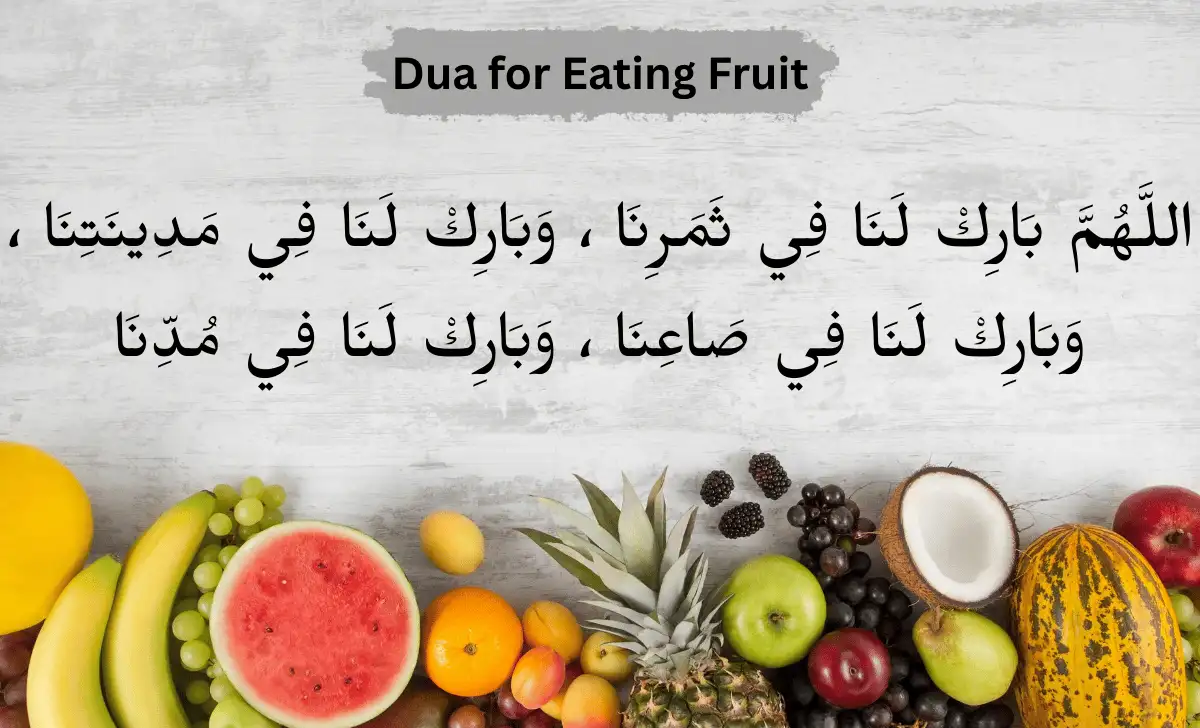
اللَّهُمَّ بَارِكْ لَنَا فِي ثَمَرِنَا ، وَبَارِكْ لَنَا فِي مَدِينَتِنَا ، وَبَارِكْ لَنَا فِي صَاعِنَا ، وَبَارِكْ لَنَا فِي مُدِّنَا
Transliteration: Allahumma barik lana fi thamarina, wa barik lana fi madinatina, wa barik lana fi sa’ina, wa barik lana fi muddina.
English Translation (Saheeh Meaning): “O Allah! Bless us in our fruits, bless us in our city, bless us in our Sa’ (measurement), and bless us in our Mudd (measurement).” (Reference: Sahih Muslim 1373; Jami` at-Tirmidhi 3455)
Urdu Translation (Fateh Muhammad Jalandhari Style): “Aye Allah! Hamare liye hamare phaloon mein barkat de, aur hamare liye hamare shehar (Madina) mein barkat de, aur hamare liye hamare Sa’ (naap) aur Mudd mein barkat ata farma.”
Masnoon Dua for Eating Fruit and Sunnah Method (PDF)
General Dua Before Eating Fruit (Phal Khane Ki Dua)
What do you say before eating fruit if it is not new? For general fruit consumption, the ruling is the same as eating any food in Islam. You must recite “Bismillah” (In the name of Allah) with your right hand. If you forget to say it at the start, you should recite “Bismillahi awwalahu wa akhirahu” when you remember.
The Foundation of Barakah
The Prophet (ﷺ) said: “When one of you eats, he should mention Allah’s name; if he forgets to mention Allah’s name at the beginning, he should say: ‘In the name of Allah at the beginning and at the end of it.'”
Arabic: بِسْمِ اللَّهِ (Bismillah)
Urdu: “Allah ke naam se shuru karta hoon.”
The “Modern Sahaba” master plan The Fruit of Gratitude
Think of eating fruit as a “Spiritual Anchor.” In 2026, we are often eating while scrolling on our phones, disconnected from the act.
The Prophet (ﷺ) did not just eat; he honored the sustenance.
- Visual Gratitude: When you see the fruit, pause for 3 seconds. Acknowledge its color and design.
- The “Barakah” Audit: As you recite the dua “…Barik lana fi thamarina” (Bless us in our fruits), intend for this energy to give you strength for your next prayer or work task. This turns the sugar in the fruit into spiritual fuel.
- Community First: It is Sunnah that if you are in a gathering, offer the fruit to the youngest child present first (after the Dua), as they are the joy of the community (Sahih Muslim).
Etiquette (Adab) of Eating Fruit in Islam
What is the Sunnah method of eating fruit? To eat fruit according to Sunnah, sit down and do not eat while standing or walking. Use your right hand strictly, as the left hand is reserved for cleaning impurities. If the fruit has seeds (like dates), do not mix the pits with the fresh dates on the same tray.
- Right Hand Rule: “Shaitan eats with his left hand, so eat with your right.” (Sahih Muslim)
- Combining Fruits: It is proven in Bukhari that the Prophet (ﷺ) used to eat cucumber with fresh dates or watermelon with fresh dates to balance the heat of one with the coolness of the other. This is an ancient “Bio-hack” for digestion.
- The Melon Dua: While not a fixed “dua,” when eating melon, the Prophet (ﷺ) would say: “The heat of this (date) neutralizes the cold of that (melon), and the cold of this neutralizes the heat of that.” (Abu Dawud).
People Also Ask:
No, there is no specific Dua mentioned in the Hadith for individual fruits like apples or bananas. You should recite the general Dua for new seasonal fruit when eating them for the first time in the season, or simply “Bismillah” for daily eating.
Yes, it is perfectly permissible to eat fruit without Wudu. While being in a state of Wudu is praiseworthy for a believer at all times, it is not a requirement for eating or drinking.
The Quran mentions fruits (Thumarat) frequently as a sign of Paradise (Jannah). Fruits mentioned specifically include dates (Nakhl), pomegranates (Rumman), grapes (Inab), olives (Zaytoon), and figs (Tin). They are described as easy to reach and abundant for the believers.
In Arabic, the prayer for fruit is called “Du’a Akl al-Thamar” (دعاء أكل الثمر) or “Du’a Ru’yat al-Bakura” (Prayer for seeing the first fruit).
