Quick Answer
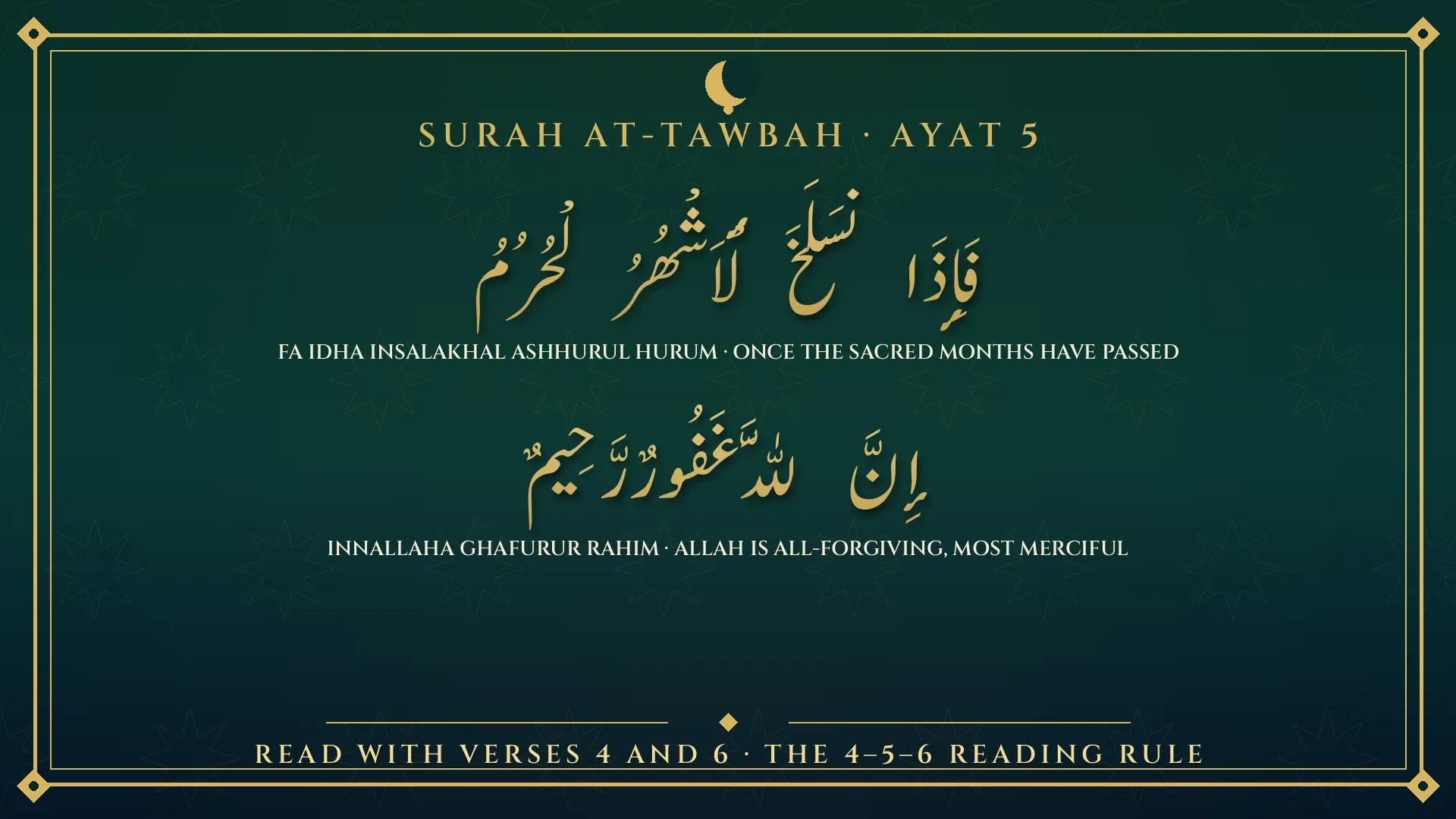
- Surah Tawbah ayat 5 is a command revealed about specific Arab tribes that had broken their peace treaties with the Prophet ﷺ. Its opening words, Fa idha insalakhal ashhurul hurum, mean “once the sacred months have passed” (Quran 9:5, Khattab).
- Read it with its neighbors: verse 4 protects treaty-keepers to the last day of their term, and verse 6 orders protection and safe escort for any polytheist who asks to hear the Quran.
- There is no verified wazifa, fixed count, or promised protection formula attached to reciting this verse. It is a passage to understand, not a charm to repeat.
Table of Contents
- What Is Surah Tawbah Ayat 5?
- Surah Tawbah Ayat 5 in Arabic, Transliteration, English, Urdu and Hindi
- Word-by-Word Meaning of Fa Idha Insalakhal Ashhurul Hurum
- Why Is 9:5 Called the Verse of the Sword?
- What Happened Before This Verse? The Treaty Story
- What Are the Sacred Months in This Verse?
- Does Surah Tawbah 9:5 Apply to Every Non-Muslim?
- Three Groups in Three Verses: The Context Table
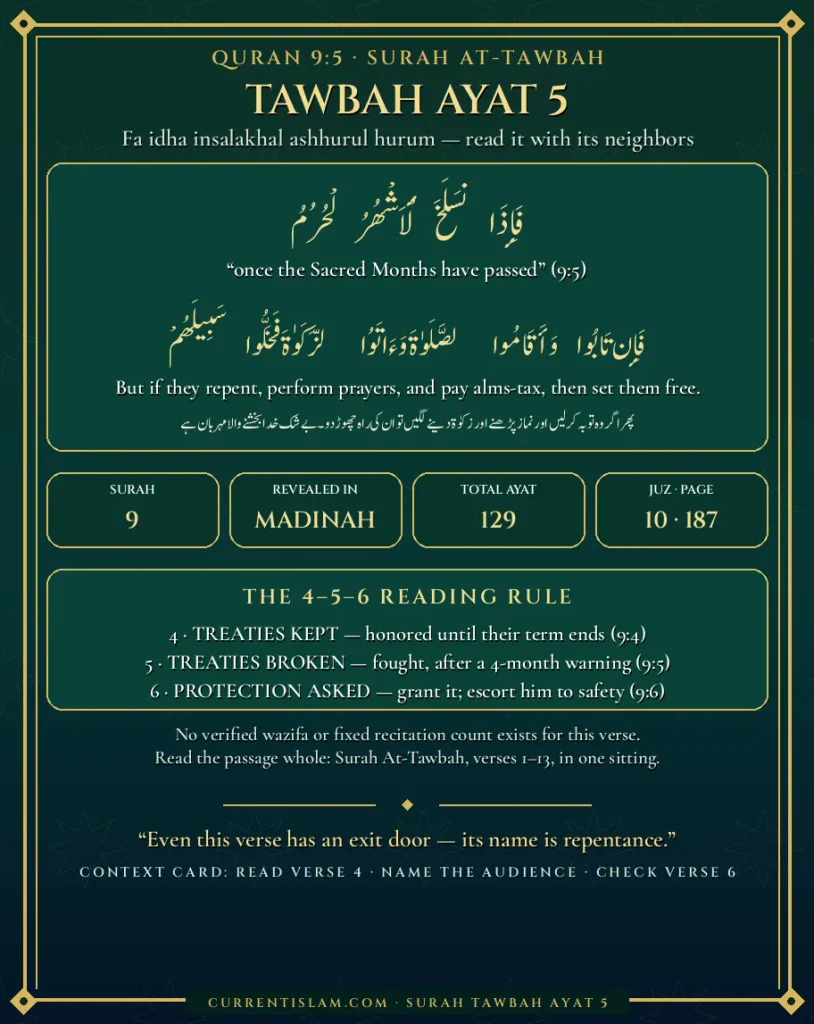
- The 4–5–6 Reading Rule: What This Verse Teaches Today
- Is There a Wazifa or Fixed Benefit for Reciting 9:5?
- How Can You Explain 9:5 at Work, at School, or at Home?
- Common Mistakes and Misconceptions
- Save This: The Context Card
- FAQ
- Next Step
What Is Surah Tawbah Ayat 5?
Maybe a coworker sent it to you with no explanation. Maybe you met it alone, late at night, and your heart sank. Surah Tawbah ayat 5 is the fifth verse of Surah At-Tawbah, the ninth chapter of the Quran, and it is a command about war against treaty-breaking tribes in Arabia, revealed in Madinah near the end of the Prophet’s ﷺ life. It is the surah’s most quoted verse, usually out of context, because one line travels well and its limits, printed in the verses around it, do not. This article puts the limits back.
Surah Tawbah Ayat 5 in Arabic, Transliteration, English, Urdu and Hindi
فَإِذَا ٱنسَلَخَ ٱلْأَشْهُرُ ٱلْحُرُمُ فَٱقْتُلُوا۟ ٱلْمُشْرِكِينَ حَيْثُ وَجَدتُّمُوهُمْ وَخُذُوهُمْ وَٱحْصُرُوهُمْ وَٱقْعُدُوا۟ لَهُمْ كُلَّ مَرْصَدٍ ۚ فَإِن تَابُوا۟ وَأَقَامُوا۟ ٱلصَّلَوٰةَ وَءَاتَوُا۟ ٱلزَّكَوٰةَ فَخَلُّوا۟ سَبِيلَهُمْ ۚ إِنَّ ٱللَّهَ غَفُورٌ رَّحِيمٌ
Fa-idha insalakha al-ashhurul-hurumu faqtulul-mushrikina haythu wajadtumuhum, wa khuzuhum wahsuruhum waq’udu lahum kulla marsad. Fa-in tabu wa aqamus-salata wa atawuz-zakata fa-khallu sabilahum. Innallaha Ghafurur-Rahim.
“But once the Sacred Months have passed, kill the polytheists ˹who violated their treaties˺ wherever you find them, capture them, besiege them, and lie in wait for them on every way. But if they repent, perform prayers, and pay alms-tax, then set them free. Indeed, Allah is All-Forgiving, Most Merciful.” (Surah At-Tawbah 9:5, Dr. Mustafa Khattab, The Clear Quran, checked on Quran.com)
Urdu (Fateh Muhammad Jalandhari, checked via the Quran.com API):
“جب عزت کے مہینے گزر جائیں تو مشرکوں کو جہاں پاؤ قتل کر دو اور پکڑلو اور گھیرلو اور ہر گھات کی جگہ ان کی تاک میں بیٹھے رہو۔ پھر اگر وہ توبہ کرلیں اور نماز پڑھنے اور زکوٰة دینے لگیں تو ان کی راہ چھوڑ دو۔ بےشک خدا بخشنے والا مہربان ہے”
Hindi (Maulana Azizul Haque al-Umari, checked via the Quran.com API): “अतः जब सम्मानित महीने बीत जाएँ, तो बहुदेववादियों (मुश्रिकों) को जहाँ पाओ, क़त्ल करो और उन्हें पकड़ो और उन्हें घेरो और उनके लिए हर घात की जगह बैठो। फिर यदि वे तौबा कर लें और नमाज़ क़ायम करें तथा ज़कात दें, तो उनका रास्ता छोड़ दो। निःसंदेह अल्लाह अति क्षमाशील, अत्यंत दयावान् है।”
Notice two things. Khattab prints a bracketed phrase, “who violated their treaties,” because that is who the passage is about. And the verse ends with an open door, not a threat: repent, pray, give, and you are set free.
Word-by-Word Meaning of Fa Idha Insalakhal Ashhurul Hurum
| Arabic | Transliteration | Meaning |
| فَإِذَا | Fa-idha | Then, when |
| ٱنسَلَخَ | Insalakha | Have passed, slipped away, ended |
| ٱلْأَشْهُرُ | Al-ashhuru | The months |
| ٱلْحُرُمُ | Al-hurumu | The sacred, the inviolable |
| فَٱقْتُلُوا۟ | Faqtulu | Then kill (a battlefield command to the believers of that time) |
| ٱلْمُشْرِكِينَ | Al-mushrikin | The polytheists (here, the treaty-breakers addressed) |
| حَيْثُ وَجَدتُّمُوهُمْ | Haythu wajadtumuhum | Wherever you find them |
| وَخُذُوهُمْ | Wa khuzuhum | And capture them |
| وَٱحْصُرُوهُمْ | Wahsuruhum | And besiege them |
| وَٱقْعُدُوا۟ لَهُمْ كُلَّ مَرْصَدٍ | Waq’udu lahum kulla marsad | And lie in wait for them at every place of ambush |
| فَإِن تَابُوا۟ | Fa-in tabu | But if they repent |
| وَأَقَامُوا۟ ٱلصَّلَوٰةَ | Wa aqamus-salah | And establish the prayer |
| وَءَاتَوُا۟ ٱلزَّكَوٰةَ | Wa atawuz-zakah | And give the zakah |
| فَخَلُّوا۟ سَبِيلَهُمْ | Fa-khallu sabilahum | Then set them free, let them go their way |
| إِنَّ ٱللَّهَ غَفُورٌ رَّحِيمٌ | Innallaha Ghafurur-Rahim | Indeed, Allah is All-Forgiving, Most Merciful |
One word carries the opening: insalakha means something slipping away, the way a month slides out of the year. The command is tied to a calendar date, the end of a stated waiting period, not written as a standing order for all places and times.
Surah At-Tawbah Ayat 5: Context, Translations, and the 4-5-6 Reading Rule
Why Is 9:5 Called the Verse of the Sword?
Commentators call it Ayat al-Sayf, the Verse of the Sword, because its command to fight sits at the center of Surah Tawbah’s treaty passage. Ibn Kathir uses that exact heading on Quran.com. The name describes its battlefield setting; it was never the verse’s own title in the Quran.
The name is half of the misunderstanding. “The sword verse” sounds like a summary of a whole religion; it is only a commentator’s heading in a passage that is, from verse 1 to verse 13, a legal announcement about treaties: which still stand, which were broken, how much warning the breakers get, and how seekers are treated. Headings do not cancel verses.
What Happened Before This Verse? The Treaty Story
Surah At-Tawbah opens with an announcement, not a battle cry. Verse 1 declares the end of treaty obligations toward tribes that had broken theirs. Verse 2 gives those tribes four months to travel the land in safety. Verse 4 then draws the line: tribes that kept every term and never helped an enemy against the Muslims keep their treaty in full, to its very end, “Surely Allah loves those who are mindful of Him” (9:4, Khattab).
Only after that exemption and that warning period comes verse 5. The order is the lesson: announcement, safe months, protection for every honored covenant, then the command against those who took the other path. Verse 13 describes that group plainly: people who “have broken their oaths, conspired to expel the Messenger, and attacked you first” (9:13, Khattab). A reader who starts at verse 1 meets a target already named, twice, before the command appears.
What Are the Sacred Months in This Verse?
Ibn Kathir records that Mujahid, Qatadah, Muhammad ibn Ishaq, As-Suddi and others understood these as the four months announced in verse 2 of this surah: a grace period in which the treaty-breaking tribes could move freely before the command of verse 5 took effect.
So the word “months” can mislead a quick reader. In the reading Ibn Kathir reports, they are not simply the calendar’s holy months; they are a deadline set inside this passage: four months of safety in which the other side could keep the peace, leave, or prepare. A deadline announced in advance is a warning with a date on it, not a surprise attack.
Does Surah Tawbah 9:5 Apply to Every Non-Muslim?
No. The passage names its own audience. Verse 4 protects polytheists who kept their treaties. Verse 13 describes the addressed group as oath-breakers who attacked first. Verse 6 protects any polytheist who asks for safety. Belief alone is not the target; treaty-breaking aggression is.
Verse 6 deserves a slow reading; quote-posts leave it out. “And if anyone from the polytheists asks for your protection, grant it to them so they may hear the Word of Allah, then escort them to a place of safety, for they are a people who have no knowledge” (9:6, Khattab). The same surah commands a Muslim to walk an unarmed seeker, from the very group at war with them, to safety after he hears the Quran, even if he does not accept it. It is the next verse, and any reading of 9:5 that cannot survive 9:6 was never the passage’s reading.
Three Groups in Three Verses: The Context Table
| Group in the passage | What the Quran says | Source |
| Polytheists who kept their treaty | Honor the treaty with them until the end of its term | Quran 9:4 |
| Polytheists who broke their treaty | After the announced months end, fight them; if they repent, pray and give zakah, set them free | Quran 9:5 |
| A polytheist who asks for protection | Grant it, let him hear the Word of Allah, and escort him to a place of safety | Quran 9:6 |
The passage sorts people by conduct: those who kept their word, those who broke it and attacked, and those who came asking to listen. Three groups, three rulings, one passage.
The 4–5–6 Reading Rule: What This Verse Teaches Today
Here is the framework to keep: the 4–5–6 Reading Rule. Never read verse 5 standing alone. Read verse 4 before it and verse 6 after it, every time. Verse 4 teaches that a kept promise is sacred. Verse 5 teaches that broken agreements carry consequences. Verse 6 teaches that curiosity is protected: a person who comes only to hear is escorted to safety, not harmed.
Three habits grow out of that rule. Keep your own covenants the way verse 4 describes, because Allah names treaty-keepers as people He loves. Take your own repentance through the door verse 5 leaves open: tawbah (repentance), salah (prayer) and zakah (charity) are the verse’s exit ramp, offered even to former enemies; start with the most powerful duas for forgiveness, led by Sayyidul Istighfar. When the Quran asks the heedless reader, Ya ayyuhal insanu ma gharraka, what has deluded him about his Generous Lord, this surah’s answer is: come back before the months run out. For those who return, Surah Yunus ayat 9 promises guidance itself: those who believe and do righteous deeds are guided by their Lord because of their faith.
Is There a Wazifa or Fixed Benefit for Reciting 9:5?
No authentic source we can verify gives a fixed count, a set time, or a promised worldly benefit for reciting this verse as a wazifa. It is a command inside a treaty passage, not a dua. Recite it for study and understanding; do not attach promises Allah never made.
This needs saying plainly, because the searches are full of counts: recite it so many times for protection or victory. A wazifa (a set daily recitation practice) needs a basis, and for this verse none of the classical sources used here, including Ibn Kathir on the verse itself, prescribes one. What the verse promises is written inside it, and it is better: a door back. For taught words of protection, start with the morning and evening remembrances. The dua after salah is the prayer habit its exit ramp points to; its other half, zakah, is taught as worship in the hadith on zakat.
How Can You Explain 9:5 at Work, at School, or at Home?
We rarely meet this verse in a debate hall; we meet it in a break room, a classroom, or a family chat. Keep the 4–5–6 Reading Rule in your pocket. A thirty-second version sounds like this: “That verse is about tribes that had peace treaties with the Prophet ﷺ and broke them and attacked. The verse right before it says treaties with tribes that kept their word stay fully in force. The verse right after it says if one of them asks for protection just to hear the Quran, escort him to safety. It is a passage about treaties, not about neighbors.”
At work, that answer respects a real concern without conceding a false one. At school, it gives classmates three verse numbers they can check themselves. At home, it teaches your children a skill bigger than this verse: reading a passage whole. The same surah holds La Tahzan, Innallaha Ma’ana for hard days, and closes with the Prophet’s ﷺ tenderness in the Surah Taubah last 2 ayat. One surah, read whole, answers one verse read alone.
Common Mistakes and Misconceptions
Quoting verse 5 without verses 4 and 6. Most other mistakes grow from this one. The passage was revealed as one announcement; cutting it is a choice.
Treating “the polytheists” as every non-Muslim in every age. The word is defined by conduct: treaty kept, treaty broken, or protection requested. Two of the three groups are protected by the same text.
Building a wazifa on the verse. No verified source sets a count or a benefit for repeating 9:5. Attaching one turns a legal passage into a lucky charm.
Reading the verse as a command for individuals today. The command sits inside a state announcement about named treaty parties, with a public deadline and named exemptions, not in a personal instruction to a lone reader.
Assuming context is a modern excuse. Verses 4 and 6 are Quran, revealed with verse 5, and the treaty reading is the classical commentary tradition, not a recent apology.
Save This: The Context Card
Print this card or save it to your phone. Run it before you quote, share or judge this verse.
- ☐ I read verse 4 first: treaty-keepers are protected to the end of their term.
- ☐ I read verse 6 after it: a seeker of protection is escorted to safety.
- ☐ I can name the audience: tribes that broke their treaties and attacked first (9:13).
- ☐ I remember the deadline: four months of safe travel were announced first (9:2).
- ☐ I can say the exit ramp by heart: repent, establish prayer, give zakah, and they are set free (9:5).
- ☐ I will not attach a wazifa count or a benefit that no source gives.
Start tonight: open Surah At-Tawbah and read verses 1 to 13 in one sitting, slowly, in translation. It takes about five minutes. That single sitting teaches more about this verse than a hundred quote-posts.
surah taubah ayat 5 pdf urdu translation
FAQ
What is Surah Tawbah ayat 5 in English?
In Khattab’s translation: “But once the Sacred Months have passed, kill the polytheists who violated their treaties wherever you find them, capture them, besiege them, and lie in wait for them on every way. But if they repent, perform prayers, and pay alms-tax, then set them free.”
Why is Surah Tawbah ayat 5 called the verse of the sword?
Commentators named it Ayat al-Sayf, the Verse of the Sword, and Ibn Kathir uses that heading for his commentary, because the verse carries the passage’s command to fight treaty-breaking tribes after their warning period ended. The name is a commentator’s label, not a title inside the Quran.
Does 9:5 command Muslims to kill all non-Muslims?
No. Verse 4 orders treaties with polytheists who kept their terms to be honored until they end. Verse 6 orders protection and a safe escort for any polytheist who asks to hear the Quran. Verse 13 limits the fighting to oath-breakers who attacked first.
What are the sacred months in Surah Tawbah ayat 5?
Ibn Kathir reports that Mujahid, Qatadah, Muhammad ibn Ishaq, As-Suddi and Abdur-Rahman ibn Zayd ibn Aslam took them as the four months of safe travel announced in verse 2 of this surah: a public grace period given to the treaty-breaking tribes before the command of verse 5 took effect.
Who were the polytheists in Surah Tawbah ayat 5?
They were tribes of Arabia in treaties with the Prophet ﷺ and the Muslims of Madinah. Verse 13 describes the group the command addresses: people who broke their oaths, conspired to expel the Messenger from Makkah, and attacked first. Tribes that kept their treaties are excepted by verse 4.
What are the benefits of reciting Surah Tawbah ayat 5?
The honest benefit is understanding, not a promised outcome. No verified source gives this verse a fixed recitation count or a benefit formula. Its built-in blessings are the lessons it teaches: covenants are sacred, aggression has limits, and repentance opens a door. Recite it to study it.
Is there a wazifa of Surah Tawbah ayat 5 for protection from enemies?
No wazifa of this verse exists in the sources checked, including Ibn Kathir’s commentary. It is a command inside a treaty passage, not a supplication. Websites that present it as a counted protection formula give no chain and no source, so this article does not repeat their claims.
How should a Muslim explain 9:5 to a non-Muslim friend?
Use the 4–5–6 Reading Rule and keep it under a minute: the verse concerns tribes that broke treaties and attacked; verse 4 protects every tribe that kept its treaty; verse 6 commands escorting a listener to safety. Offer the verse numbers so your friend can check it.
Next Step
- Read the passage whole this week: Surah At-Tawbah, verses 1–13, in translation.
- Stay inside this surah a little longer with Surah Taubah last 2 ayat.
- When your own heart needs the door this verse leaves open, begin with the duas for forgiveness.
Last reviewed: 2 November 2026 · Author: [SHAHAB KHAN] · Reviewed by: [ATIF KHAN]
