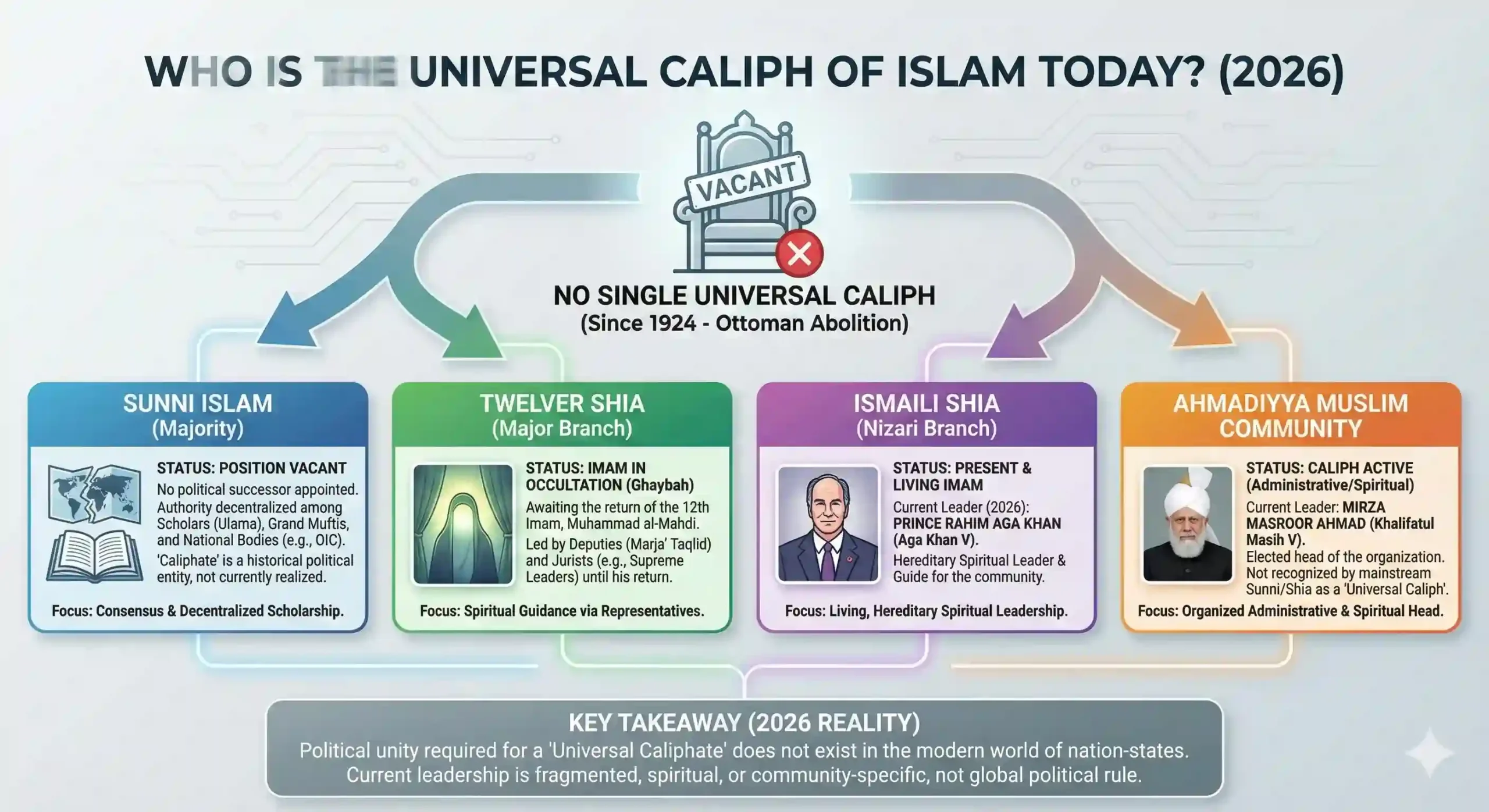
If you walked into a mosque in Cairo, Istanbul, or Jakarta today and asked, “Who is the Caliph?”, you wouldn’t get a name. You would get silence, or perhaps a history lesson.
For the first time in over 1,300 years of Islamic history, the global Muslim community (Ummah) has lived for a century without a single, universally recognized political leader. There is no man on earth today who commands the allegiance of all 1.9 billion Muslims.
But if there is no Caliph, who is in charge? And what about the leaders who claim the title?
Is There a Caliph Right Now?
There is no current Caliph in Islam.
For the vast majority of the world’s 1.9 billion Muslims, the position of Caliph (the universal political and spiritual head of the Ummah) remains vacant. It has not been officially filled since the abolition of the Ottoman Caliphate in 1924. While specific communities (like the Ahmadiyya) or political groups may claim the title, they lack the universal consensus (Ijma) required by Islamic Law.
1. Why the Seat is “Vacant” (The Sunni Perspective)
In mainstream Sunni Islam, the Caliphate is currently “dormant.” Since the Ottoman Empire ended in 1924, no individual has been able to unite the Muslim lands under a single government, which is a requirement for a valid Caliphate.
The confusion often stems from a misunderstanding of what a “Caliph” actually is. In classical Islamic theology (Fiqh), a Caliph isn’t just a pope-like spiritual figure; he is a Head of State. He must govern territory, protect borders, and uphold the law.
Because the Muslim world is now divided into over 50 distinct nation-states (like Pakistan, Saudi Arabia, and Malaysia), the political unity required for a Caliphate does not exist.
The “Knots” of Islam
The Prophet Muhammad (ﷺ) actually predicted this era of political vacuum. In a famous Hadith, he described the dismantling of Islamic governance structure.
The Prophecy of the Untying Knots:
| Language | Text |
| Arabic | لَيُنْقَضَنَّ عُرَى الْإِسْلَامِ عُرْوَةً عُرْوَةً … فَأَوَّلُهُنَّ نَقْضًا الْحُكْمُ وَآخِرُهُنَّ الصَّلَاةُ |
| Transliteration | La-yunqadanna ‘ura al-islami ‘urwatan ‘urwah… fa-awwaluhunna naqdan al-hukmu wa-akhiruhunna as-salah. |
| English | “The knots of Islam will be undone one by one… The first to be undone will be Governance (Rule) and the last will be the Prayer.” (Musnad Ahmad) |
| Urdu | اسلام کی گرہیں ایک ایک کر کے ٹوٹ جائیں گی… سب سے پہلے حکم (حکومت) ٹوٹے گا اور سب سے آخر میں نماز۔ |
Scholars like Sheikh Yusuf al-Qaradawi and Mufti Taqi Usmani have long argued that this “undoing of governance” refers to the fall of the Caliphate.
2. The Exception: The Ahmadiyya Caliphate
The Ahmadiyya Muslim Community is the only global group with an active, functioning Caliphate. However, because mainstream Muslims differ with them on key theological issues, this Caliph is not recognized by the wider Islamic world.
While the Sunni world operates without a central leader, the Ahmadiyya Muslim Community has maintained an unbroken line of succession since 1908.
- Current Caliph: Mirza Masroor Ahmad (Khalifatul Masih V).
- Headquarters: Tilford, United Kingdom.
- Role: He is an administrative and spiritual leader, elected for life. He does not claim political territory but leads a global organization of millions.
Note: This is a point of major theological contention. Mainstream Sunni and Shia scholars generally consider the Ahmadiyya beliefs regarding Prophethood to be outside the fold of Islam, which is why Mirza Masroor Ahmad is not viewed as the “Caliph of Islam” by the general public.
3. The Shia Leadership (Imamate vs. Caliphate)
Shia Muslims do not rely on a “Caliph” elected by the people. They follow the “Imam” chosen by God. For Twelver Shias, this leader is currently in hiding. For Ismaili Shias, he is present and known.
The Shia view of leadership is hereditary and spiritual, centered on the Ahl al-Bayt (Family of the Prophet).
- Twelver Shia (The Majority): They believe the 12th Imam, Muhammad al-Mahdi, is currently in Ghaybah (Occultation). He is the rightful leader, but in his physical absence, the community is guided by high-ranking jurists (Marja’) like Ayatollah Sistani or the Supreme Leader of Iran.
- Ismaili Shia (The Nizaris): They follow a living, hereditary Imam.
- Current Imam (2026): Prince Rahim Aga Khan (Aga Khan V).
- Succession: He succeeded his father, Aga Khan IV, in February 2025. He serves as the spiritual guide and manages the massive Aga Khan Development Network.
4. The “Spiritual Caliphate” of the Self
Since there is no political Caliph to solve our problems, the responsibility shifts to the individual. In the Quran, every human being is called a “Khalifa” (Successor/Steward) of the Earth.
This is where the concept touches your daily life. We often wait for a “Salahuddin” or a “Caliph” to fix the state of the world. But Allah (SWT) placed the title of Khalifa on you before He even created the political systems.
The Primordial Title:
| Language | Text |
| Arabic | إِنِّي جَاعِلٌ فِي الْأَرْضِ خَلِيفَةً |
| Transliteration | Innee ja’ilun fi al-ardi khalifah. |
| English | “Indeed, I will make upon the earth a successive authority (Vicegerent/Caliph).” (Quran 2:30) |
| Urdu | میں زمین میں اپنا نائب (خلیفہ) بنانے والا ہوں۔ |
What this means for you in 2026:
The “Digital Ummah” is the new frontier. You are a Caliph of your own conduct, your keyboard, and your home. When the political structure falls, the moral structure must be upheld by the individual. You don’t need a Caliph to feed the poor, speak the truth, or refine your character.
People Also Ask:
No. Major global Islamic bodies (like Al-Azhar and the OIC) have universally rejected their claims. In Islamic Law, a Caliph cannot seize power through terrorism or slaughter; they must be appointed by the consensus and security of the people.
Many prophecies in Sunni Hadith literature speak of a return to “Caliphate on the path of Prophethood” before the end of times. However, most scholars agree this is a future event tied to the coming of the Mahdi, not a political campaign we can vote for today.
There is no single leader. Muslims are citizens of their respective countries. For religious rulings, they follow local Muftis or international scholarly councils, but these bodies do not have political authority over them.
