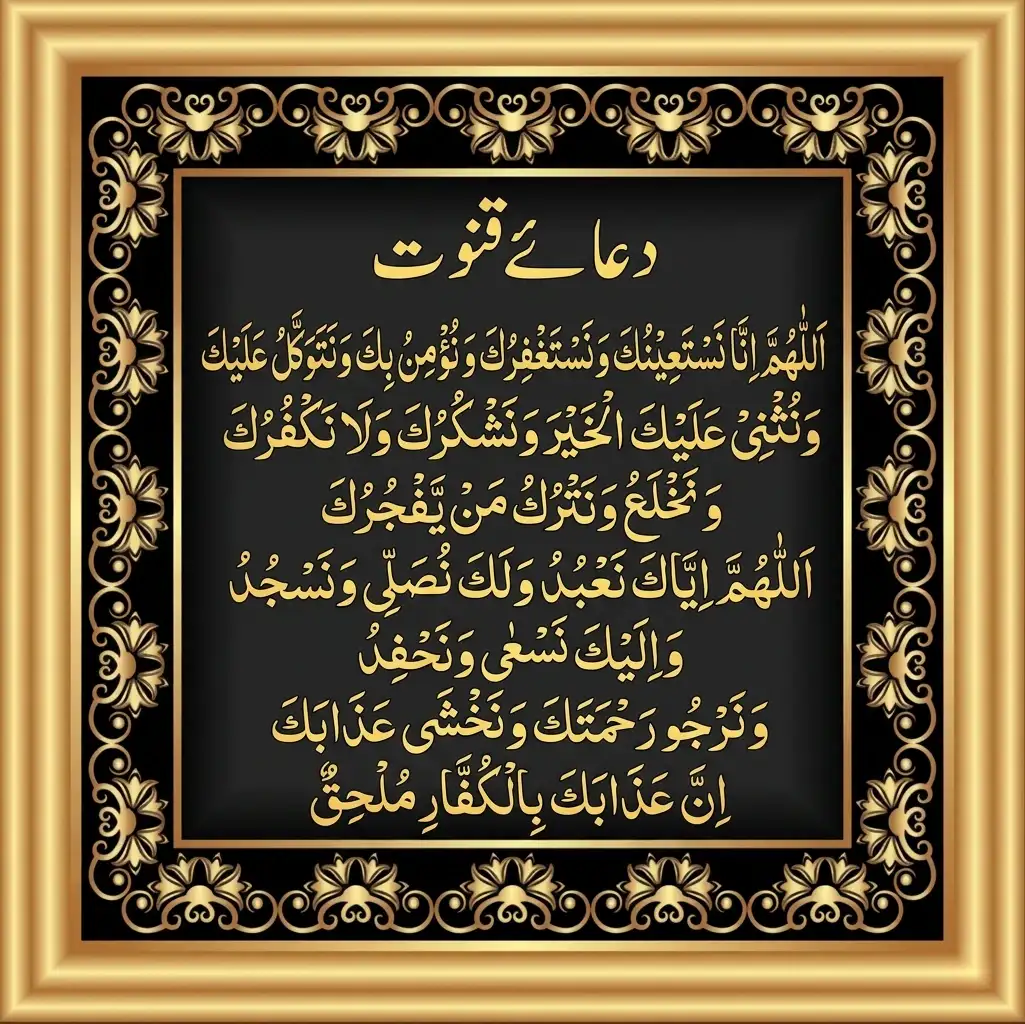
Dua e Qunoot is a beautiful and powerful supplication recited in Witr prayer, asking Allah for guidance, protection, mercy, and steadfastness. This updated guide gives you the Arabic text, word-by-word meaning, Urdu translation, hadith references, and a simple explanation of why this dua matters in daily worship.
What is Dua e Qunoot?
Dua e Qunoot is a special supplication recited in the Witr prayer, usually in the last rak’ah. It is a moment of humility in which the worshipper asks Allah for help, forgiveness, guidance, and safety from evil.
Different schools of thought may recite slightly different versions, but the meaning stays centered on complete dependence on Allah.
Arabic Text
Hanafi version
اللَّهُمَّ إِنَّا نَسْتَعِينُكَ وَنَسْتَغْفِرُكَ وَنُؤْمِنُ بِكَ وَنَتَوَكَّلُ عَلَيْكَ
وَنُثْنِي عَلَيْكَ الْخَيْرَ وَنَشْكُرُكَ وَلَا نَكْفُرُكَ
وَنَخْلَعُ وَنَتْرُكُ مَنْ يَفْجُرُكَ
اللَّهُمَّ إِيَّاكَ نَعْبُدُ وَلَكَ نُصَلِّي وَنَسْجُدُ
وَإِلَيْكَ نَسْعَى وَنَحْفِدُ
وَنَرْجُو رَحْمَتَكَ وَنَخْشَى عَذَابَكَ
إِنَّ عَذَابَكَ بِالْكُفَّارِ مُلْحِقٌ
Shafi’i version
اللَّهُمَّ اهْدِنِي فِيمَنْ هَدَيْتَ، وَعَافِنِي فِيمَنْ عَافَيْتَ، وَتَوَلَّنِي فِيمَنْ تَوَلَّيْتَ، وَبَارِكْ لِي فِيمَا أَعْطَيْتَ، وَقِنِي شَرَّ مَا قَضَيْتَ، إِنَّكَ تَقْضِي وَلَا يُقْضَى عَلَيْكَ، وَإِنَّهُ لَا يَذِلُّ مَنْ وَالَيْتَ، وَلَا يَعِزُّ مَنْ عَادَيْتَ، تَبَارَكْتَ رَبَّنَا وَتَعَالَيْتَ
Word-by-word meaning
Hanafi version
- Allahumma = O Allah.
- Inna nastaeenuka = We seek Your help.
- Wa nastaghfiruka = And we ask Your forgiveness.
- Wa nu’minu bika = And we believe in You.
- Wa natavakkalu ‘alayk = And we rely upon You.
- Wa nuthni ‘alaykal khayr = And we praise You for all good.
- Wa nashkuruka = And we thank You.
- Wa la nakfuruk = And we are not ungrateful to You.
- Wa nakhla’u wa natruku man yafjuruk = And we leave and reject those who disobey You.
- Iyyaka na’budu = You alone we worship.
- Wa laka nusalli wa nasjud = And for You we pray and prostrate.
- Wa ilayka nas’a wa nahfid = And to You we strive and hurry.
- Wanrju rahmatak = And we hope for Your mercy.
- Wa nakhsha ‘adhabak = And we fear Your punishment.
- Inna ‘adhabaka bil-kuffari mulhiq = Surely Your punishment overtakes the disbelievers.
Shafi’i version
- Ihdini = Guide me.
- Fiman hadayta = Among those You have guided.
- Wa ‘afini = Grant me well-being.
- Fiman ‘afayta = Among those You have granted well-being.
- Wa tawallani = Take care of me / be my protector.
- Fiman tawallayta = Among those You have taken as Your allies.
- Wa barik li = And bless me.
- Fima a’tayta = In what You have given.
- Wa qini sharra ma qadayta = And protect me from the evil of what You have decreed.
- Innaktaqdi wa la yuqda ‘alayk = You decree and none can decree against You.
- La yadhillu man walayta = Not humiliated is the one You protect.
- La ya’izzu man ‘adayta = Not honored is the one who opposes You.
- Tabarakta rabbana wa ta‘alayta = Blessed and exalted are You, our Lord.
Urdu Translation
Hanafi version
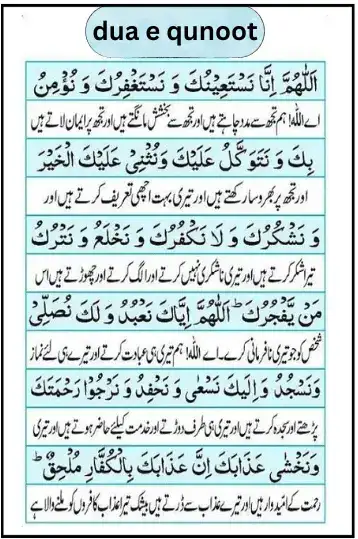
اے اللہ! ہم تجھ ہی سے مدد چاہتے ہیں، تجھ سے بخشش مانگتے ہیں، تجھ پر ایمان رکھتے ہیں اور تجھی پر بھروسہ کرتے ہیں۔
ہم تیری ہی تعریف کرتے ہیں، تیرا شکر ادا کرتے ہیں اور تیری ناشکری نہیں کرتے۔
اور ہم اس شخص سے الگ ہوتے ہیں اور اسے چھوڑ دیتے ہیں جو تیری نافرمانی کرے۔
اے اللہ! ہم تیری ہی عبادت کرتے ہیں، تیرے ہی لیے نماز پڑھتے ہیں اور سجدہ کرتے ہیں۔
ہم تیری ہی طرف دوڑتے ہیں اور خدمت کے لیے حاضر ہوتے ہیں۔
ہم تیری رحمت کی امید رکھتے ہیں اور تیرے عذاب سے ڈرتے ہیں۔
بے شک تیرا عذاب کافروں کو پہنچنے والا ہے.
Shafi’i version
اے اللہ! ہمیں ہدایت دے ان لوگوں میں جنہیں تو نے ہدایت دی، اور ہمیں عافیت دے ان لوگوں میں جنہیں تو نے عافیت دی۔
اور ہمیں اپنے خاص بندوں میں شامل فرما، اور جو کچھ تو نے عطا کیا ہے اس میں برکت دے۔
اور ہمیں اس برائی سے بچا جو تو نے مقدر کی۔
بے شک تو فیصلہ کرتا ہے اور تیرے خلاف کوئی فیصلہ نہیں کیا جا سکتا۔
جسے تو دوست رکھے وہ ذلیل نہیں ہوتا، اور جس سے تو دشمنی رکھے وہ عزت نہیں پاتا۔
اے ہمارے رب! تو بابرکت اور بلند ہے.
Meaning and Tafseer of Dua e Qunoot
- Explain not just the literal translation but also the spiritual attitude (humility, reliance, gratitude, fear of punishment).
- Link it to the idea of Qunoot = humility and obedience in salah.
Benefits of Dua e Qunoot
Dua e Qunoot teaches complete reliance on Allah. It reminds the believer that guidance, protection, and mercy come from Him alone.
It also strengthens concentration in Salah, because the worshipper is not just reciting words but asking Allah directly for help in every area of life.
Another benefit is spiritual humility: the dua places the servant in a state of need, gratitude, and hope at the same time.
For many Muslims, it is also a daily reminder that Witr is not only about finishing prayer, but about ending the night with trust in Allah.
- Increases humility and hope in Allah.
- Deepens connection with Witr prayer.
- Teaches gratitude and fear of Allah.
Hadith About Dua e Qunoot
A well-known hadith reports that the Prophet ﷺ taught Hasan ibn Ali رضي الله عنه words to say in Witr. The dua begins: “O Allah, guide me among those You have guided…” and continues with the well-known Shafi’i wording.
Another important point is that scholars mention Qunoot in Witr is a Sunnah and not something that must be recited in only one rigid way.
Some jurists also note that it is better not to treat Qunoot as a mechanical routine every single time, but to recite it with awareness and devotion.
Quranic Context
Dua e Qunoot is not quoted as a direct verse from the Quran, so it should not be presented as a Quranic ayah. However, its meaning strongly matches Quranic themes of guidance, mercy, worship, and reliance on Allah.
The idea of asking Allah for guidance is deeply rooted in the Quran, and the dua reflects that same spiritual direction.
So the correct way to present this section is: not a Quran verse, but a supplication fully aligned with Quranic teaching.
Tafseer and Importance
The deeper meaning of Dua e Qunoot is that a believer stands before Allah with honesty. The dua moves from asking for help to asking for forgiveness, then to worship, then to hope and fear.
That sequence matters because it shows the complete inner state of a Muslim: dependence, gratitude, obedience, and reverence.
In tafseer-like reflection, the dua teaches that Allah is not only the giver of blessings, but also the One who guides the heart and protects the servant from harm.
This is why the dua is important in Witr: it turns a short prayer into a moment of spiritual renewal.
When to Recite It
Dua e Qunoot is commonly recited in the last rak’ah of Witr prayer. Some scholars mention it after ruku’, while others allow before ruku’ depending on madhhab practice.
In Hanafi practice, the well-known version is the one beginning with “Allahumma inna nastaeenuka…,” while the Shafi’i tradition often uses “Allahumma ihdini fiman hadayta…”.
If a person does not know the full dua yet, scholars mention that they may recite short phrases like “Allahummaghfirli” until they memorize it.
Why this dua is important
- Why Dua e Qunoot matters in Witr.
- How it strengthens salah.
- How parents can teach it to children using Arabic + Urdu + meaning.
- This matches what other sites include under “significance” or “importance”.
Practical Recitation Tips
- Read one line at a time.
- Memorize the meaning before memorizing the full Arabic.
- Repeat the dua after every Witr until it becomes natural.
- Use transliteration if Arabic reading is difficult.
- Teach it to children slowly, with Arabic, Urdu, and meaning together.
Peoples also ask:
Dua e Qunoot is a supplication recited in Witr prayer, asking Allah for guidance, mercy, and protection.
Not as a direct verse, but its meaning aligns with Quranic themes of reliance, worship, and guidance.
Yes, the Prophet ﷺ taught a well-known version to Hasan ibn Ali رضي الله عنه.
You may follow the version commonly used in your school of thought, either Hanafi or Shafi’i.
Yes, scholars mention that reciting from a paper until you memorize it is allowed.
It connects Salah with humility, gratitude, trust, and hope in Allah’s mercy.
Related Masnoon Duas
- Dua for healing.
- Surah Ikhlas translation in Urdu.
- Rabbish Rahli Sadri wa Yassirli Amri.
- Dua after eating food.
- Dua before sleeping.
Last Updated
Last updated: May 24, 2026
Your Next Step
Don’t let another night pass where you carry the burden of the world to bed with you.
[Download the Pocket Qunoot PDF] – Save it to your phone, listen to the correct pronunciation, and make this “Nightly Audit” a permanent part of your life.
