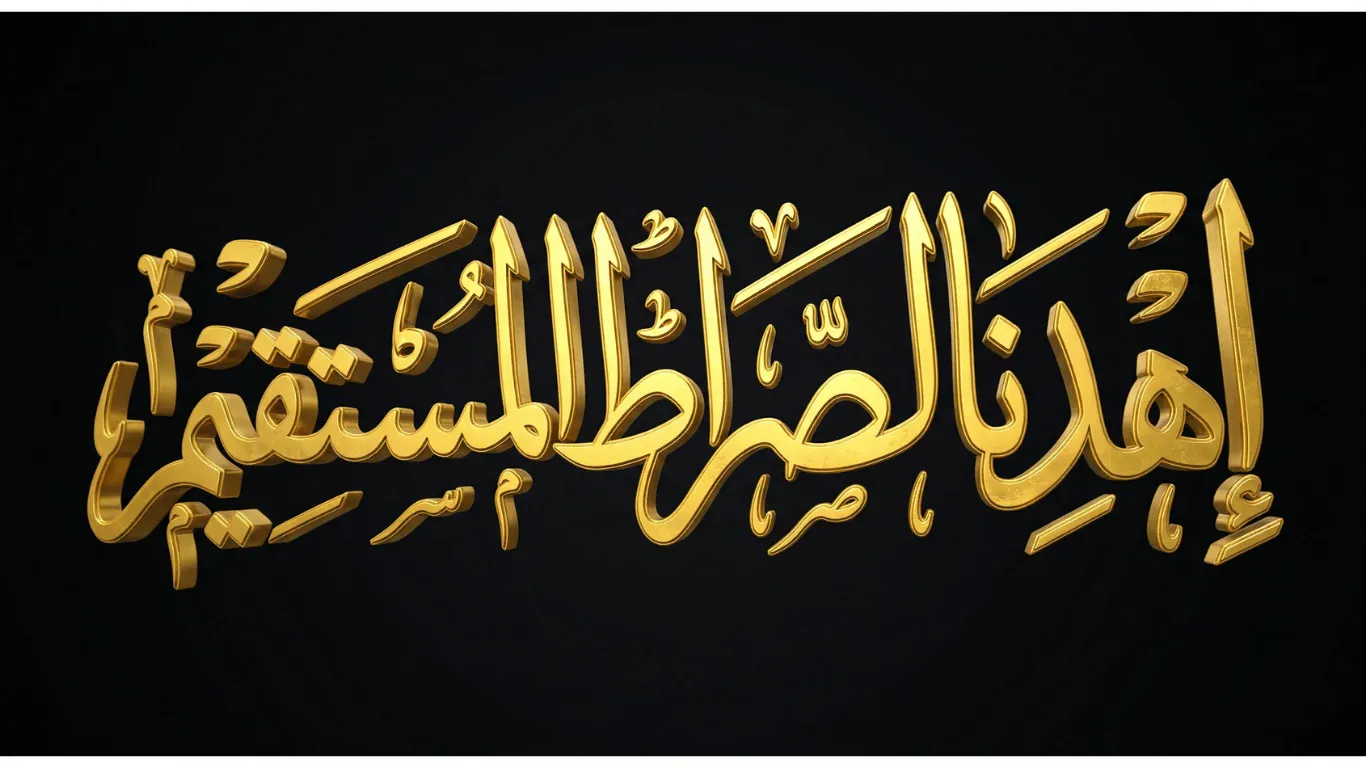
Have you ever wondered why Allah asks us to beg for guidance at least 17 times a day, even if we are already standing on the prayer mat? It is not because we are hopelessly lost. It is a profound pattern-interrupt. The world is constantly trying to pull us off balance with noise, stress, and endless distractions. This single, powerful phrase is our divine anchor.
Here’s why this matters for you today, and how this ancient verse holds the ultimate blueprint for modern clarity.
The Meaning and Word-by-Word Breakdown
Ihdinas sirat al mustaqeem is the sixth verse of Surah Al-Fatiha. It translates to “Guide us to the straight path.” Muslims recite this powerful dua daily to seek Allah’s continuous guidance, spiritual protection, and clarity amidst life’s daily challenges and modern distractions.
To grasp the true weight of Surah Al-Fatiha (1:6), we have to look at the linguistic precision of the Arabic language. Every word carries a universe of meaning.
- Ihdina (إِهْدِنَا): This does not just mean “point the way.” It comes from Hidayah, which means to gently, lovingly take someone by the hand and lead them safely to their destination. Notice it says “us,” not “me.” We are asking for the collective success of our families and communities.
- As-Sirat (الصِّرَاطَ): The Quran uses several words for a road, like Tariq. But Sirat is a massive, well-lit, established highway. It is wide enough for everyone, but there is only one.
- Al-Mustaqeem (الْمُسْتَقِيمَ): This means upright and ascending. The path does not just go forward; it elevates you.
Before we can ask for guidance, we must first establish our absolute reliance on Allah, acknowledging that You alone we worship and You alone we ask for help, which perfectly sets up the plea for the straight path.
Tafseer and Scholarship Depth in the Quran
Classical scholars like Ibn Kathir explain that the straight path represents Islam itself, the Quran, and the Prophet’s Sunnah. It is a clear, unbending route. We ask for this guidance repeatedly because human hearts change, requiring constant spiritual realignment to stay upright.
Let’s look at the heart of the issue through the lens of classical scholarship. Imam Nawawi and Ibn Kathir both emphasize that guidance is not a one-time achievement; it is a continuous spectrum. You can be on the path, but you still need light to see the next step.
The Primary Proof: Surah Al-Fatiha (1:6)
Arabic:
إِهْدِنَا الصِّرَاطَ الْمُسْتَقِيمَ
Transliteration: > Ihdinas sirat al mustaqeem.
English Translation (Saheeh International): > Guide us to the straight path.
Urdu Translation (Fateh Muhammad Jalandhari):
ہمیں سیدھا راستہ دکھا
The Prophetic Blueprint for Steadfastness
To remain on this path, the Prophet Muhammad (ﷺ) gave a very simple, yet profound instruction regarding our daily posture in life.
Arabic:
قُلْ: آمَنْتُ بِاللَّهِ ثُمَّ اسْتَقِمْ
Transliteration: > Qul amantu billahi thummastaqim.
English Hadith (Saheeh Muslim): > Say, ‘I believe in Allah,’ and then remain steadfast.
Urdu Translation (Contextual):
کہہ دو، ‘میں اللہ پر ایمان لایا’، اور پھر ثابت قدم رہو۔
The Digital Sunnah: Your Spiritual Habit Loop
In our hyper-connected 2026 world, our attention is constantly hijacked. Reciting this verse acts as a spiritual habit loop. It provides an immediate mental reset, filtering out digital noise and realigning your focus toward eternal, meaningful goals every few hours.
Think about the structure of your day. Whether you are praying the 2 rakats of Fajr or the 10 rakats of Zuhr, you are forced to disconnect from your screens, stand upright, and ask for direction.
This is the ultimate “Digital Sunnah.” In an era where algorithms dictate what we see, what we buy, and how we feel, Ihdinas sirat al mustaqeem is a daily dopamine detox. It breaks the cycle of anxiety and reminds you that your ultimate destination is not found on a timeline, but on the path laid out by the Creator.
Benefits and Wazifa of Ihdinas Sirat Al Mustaqeem
The primary benefit of reciting this dua is profound peace of mind and protection from misguidance. As a daily wazifa, repeating it with deep focus strengthens your intuition, helps you make better life decisions, and cures spiritual anxiety and doubt.
If you are looking for a practical application (wazifa) for this verse in your daily life, the most authentic method is simply perfecting your focus (Khushu) during your obligatory prayers.
However, many scholars recommend reflecting on this specific ayah when faced with difficult life choices. If you are at a crossroads in your career, relationships, or personal growth, pausing to recite this verse slowly brings immediate clarity. It shifts the burden of figuring everything out entirely on your own, placing your trust back in Allah’s flawless design.
Remaining steadfast on this path is not just a daily goal, but an eternal necessity, especially when we remember the definitive reality that every soul will taste death. This realization transforms our plea for guidance from a casual routine into an urgent, heartfelt prayer.
People Also Ask:
We say it daily because the human heart is fragile and easily distracted. Praying for the straight path ensures Allah continuously protects us from going astray, keeping our faith strong through life’s changing circumstances.
In Islam, sirat al mustaqeem means the straight, wide, and upright path of truth. It refers to the religion of Islam, the teachings of the Quran, and the way of life demonstrated by Prophet Muhammad.
A practicing Muslim recites this verse a minimum of 17 times a day during the obligatory prayers. It is repeated in every single unit, or rakat, of the daily Salah.
Call to Action: If this breakdown helped you find clarity today, we invite you to share this article with someone who might need a spiritual reset. Let us know in the comments: What is your biggest challenge in staying on the straight path today?

1 thought on “Surah Al-Fatiha (1:6) Ihdinas Sirat Al Mustaqeem”