
Have you ever felt completely overwhelmed by the chaos of your daily life, wishing for a single phrase that could instantly reset your mind and connect you to something greater? Most of us rush through our daily prayers, muttering words we barely feel while our minds scroll through a never-ending to-do list. But what if the very first sentence of the Quran was purposefully designed to be the ultimate cure for modern anxiety?
Let’s look at the heart of the issue.
What is the Meaning of Alhamdulillahi Rabbil Alamin?
Alhamdulillahi Rabbil Alamin means “All praise and thanks belong to Allah, the Lord of the worlds.” It is the opening verse of Surah Fatiha. Muslims recite this daily to express absolute gratitude and acknowledge Allah’s ultimate control over the entire universe.
To grasp the true weight of this phrase, we have to look at the words individually. The word Al-Hamd goes far beyond a simple “thank you.” It is an all-encompassing expression of absolute praise, love, and veneration. When you add Li-llah (to Allah), you are declaring that every single good thing you experience originates from one source.
And then comes Rabbil Alamin. He isn’t just a distant creator; He is the Rabb—the Sustainer, the Nurturer, and the Master of every single universe, from the galaxies above us to the microscopic cells within us.
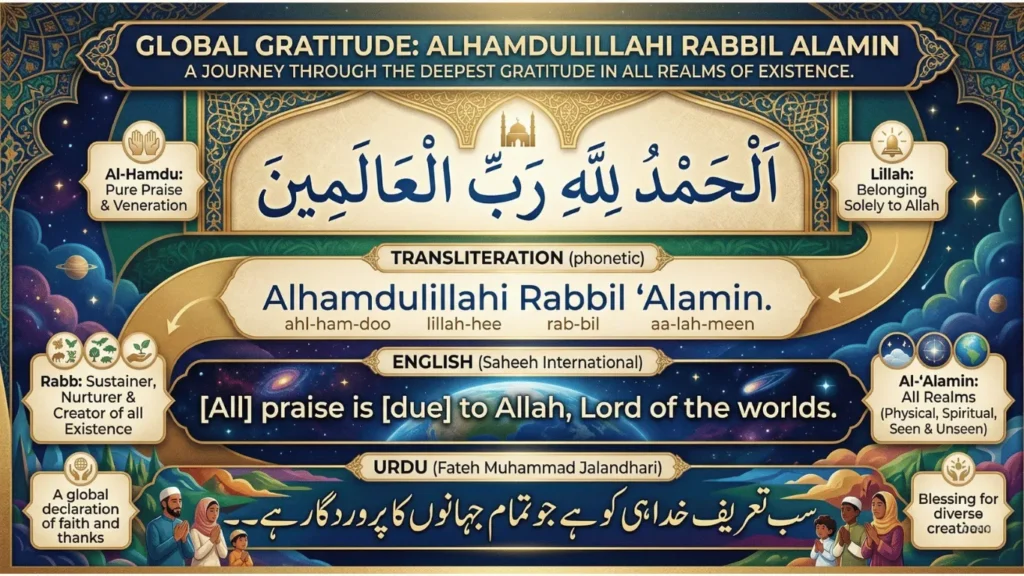
The Multilingual Quadrant: A Closer Look at the Primary Source
Whenever we look at the foundation of our faith, returning to the original text is essential.
Arabic:
الْحَمْدُ لِلَّهِ رَبِّ الْعَالَمِينَ
Transliteration: Alhamdulillahi Rabbil ‘Alamin.
English (Saheeh International): [All] praise is [due] to Allah, Lord of the worlds.
Urdu (Fateh Muhammad Jalandhari):
سب تعریف خدا ہی کو ہے جو تمام جہانوں کا پروردگار ہے۔
Tafseer and Scholarship: What the Classics Say
Classical scholars like Ibn Kathir explain that Alhamdulillahi Rabbil Alamin is a comprehensive statement of praise. It signifies that Allah alone deserves gratitude for His countless blessings, both seen and unseen, and affirms His role as the absolute Sustainer of all creations.
Imam Qurtubi and Ibn Kathir both highlight that starting the Book of Allah with gratitude sets the standard for a believer’s entire life. It is the baseline of existence. When we fully internalize that He is the Lord of all systems and situations, it naturally shifts our perspective. We stop relying on our own fragile plans and start trusting His perfect wisdom.
This realization seamlessly prepares the heart for the next crucial steps in our dialogue with Him. Acknowledging His absolute power is exactly what allows us to confidently declare that You alone we worship and You alone we ask for help.
The Spiritual Habit Loop: Rewiring Your Brain
The Spiritual Habit Loop uses the phrase Alhamdulillahi Rabbil Alamin as a trigger to replace modern anxiety with divine gratitude. By consistently praising Allah during moments of stress, you train your brain to recognize His blessings instead of focusing on worldly problems.
We live in an era of constant digital distraction, where algorithms are built to keep us in a state of outrage or comparison. Implementing this verse as a mindful habit disrupts that cycle. It is a grounding technique that was taught over 1400 years ago.
Consider the profound Hadith Qudsi where Allah directly responds to us during prayer:
Arabic:
قَالَ اللَّهُ تَعَالَى: قَسَمْتُ الصَّلَاةَ بَيْنِي وَبَيْنَ عَبْدِي نِصْفَيْنِ… فَإِذَا قَالَ الْعَبْدُ: الْحَمْدُ لِلَّهِ رَبِّ الْعَالَمِينَ، قَالَ اللَّهُ تَعَالَى: حَمِدَنِي عَبْدِي
Transliteration:
Qalallahu ta’ala: Qasamtu as-salata bayni wa bayna ‘abdi nisfayn… Fa idha qala al-‘abdu: Alhamdulillahi Rabbil ‘Alamin, qala Allahu ta’ala: Hamidani ‘abdi.
English Translation (Saheeh International):
Allah the Exalted said: ‘I have divided prayer between Myself and My servant into two halves… When the servant says: “All praise is due to Allah, the Lord of the worlds,” Allah the Exalted says: “My servant has praised Me.”‘
Urdu Translation:
اللہ تعالیٰ فرماتا ہے: میں نے نماز کو اپنے اور اپنے بندے کے درمیان دو حصوں میں بانٹ دیا ہے… پھر جب بندہ کہتا ہے: سب تعریف خدا ہی کو ہے جو تمام جہانوں کا پروردگار ہے، تو اللہ تعالیٰ فرماتا ہے: میرے بندے نے میری تعریف کی ہے۔
Wazifa and Benefits: The Power of Daily Recitation
Reciting Alhamdulillahi Rabbil Alamin daily brings immense benefits, including spiritual peace, physical healing, and protection. It acts as a powerful wazifa to increase provisions and strengthen your relationship with Allah, reminding you that He sustains all of your worldly and spiritual affairs.
When things are going well, reciting it protects you from arrogance. When things are difficult, it protects you from despair. Many scholars recommend keeping your tongue moist with this praise as a daily practice to invite Barakah (blessing) into your wealth, health, and family life.
Here’s why this matters for you: Gratitude is the very first step of the journey, but it isn’t the final destination. Once we acknowledge who is in control, our immediate next requirement is to ask Him to guide us to the straight path so that we can navigate the complexities of this world safely.
People Also Ask:
“Al-Hamd” means the ultimate praise and gratitude. “Li-llah” means exclusively for Allah. “Rabb” means the Lord, Nurturer, and Sustainer. “Al-Alamin” means the worlds or universes.
According to a famous Hadith Qudsi, when a worshipper says this phrase during Salah, Allah responds directly by saying, “My servant has praised Me.”
Reciting it frequently acts as a powerful spiritual practice (wazifa) that increases your provision, invites peace into your heart, and solidifies your trust in Allah’s perfect plan.
Because His authority, mercy, and sustenance are not limited to humans or a specific place. He sustains the world of angels, jinn, nature, the cosmos, and realms we cannot even perceive.
