What happens when a mother quietly dedicates her unborn child to Allah? Surah Al Imran Ayat 35 gives a deeply moving answer: sincere intention, private du’a, and trust in Allah can shape a life before it even begins.
Introduction
Surah Al Imran Ayat 35 is one of the most emotionally powerful verses in the Qur’an because it speaks about a mother’s vow, a child’s destiny, and Allah’s perfect knowledge. The verse describes the wife of Imran dedicating what is in her womb to Allah’s service, hoping that her child will be accepted for sacred devotion. This moment becomes the opening scene for the birth story of Maryam, and it offers a timeless lesson for every believer who cares about sincerity, parenting, and trust in Allah.
This verse matters because it shows that spiritual influence begins long before public action. A mother’s du’a, a father’s intention, and a family’s dedication to Allah can all become part of a child’s path. When read together with Surah Al Imran 3:36 and 3:37, the verse becomes even richer, because Allah responds to the vow in a way greater than the mother expected.
Arabic Verse and Translation
Arabic:
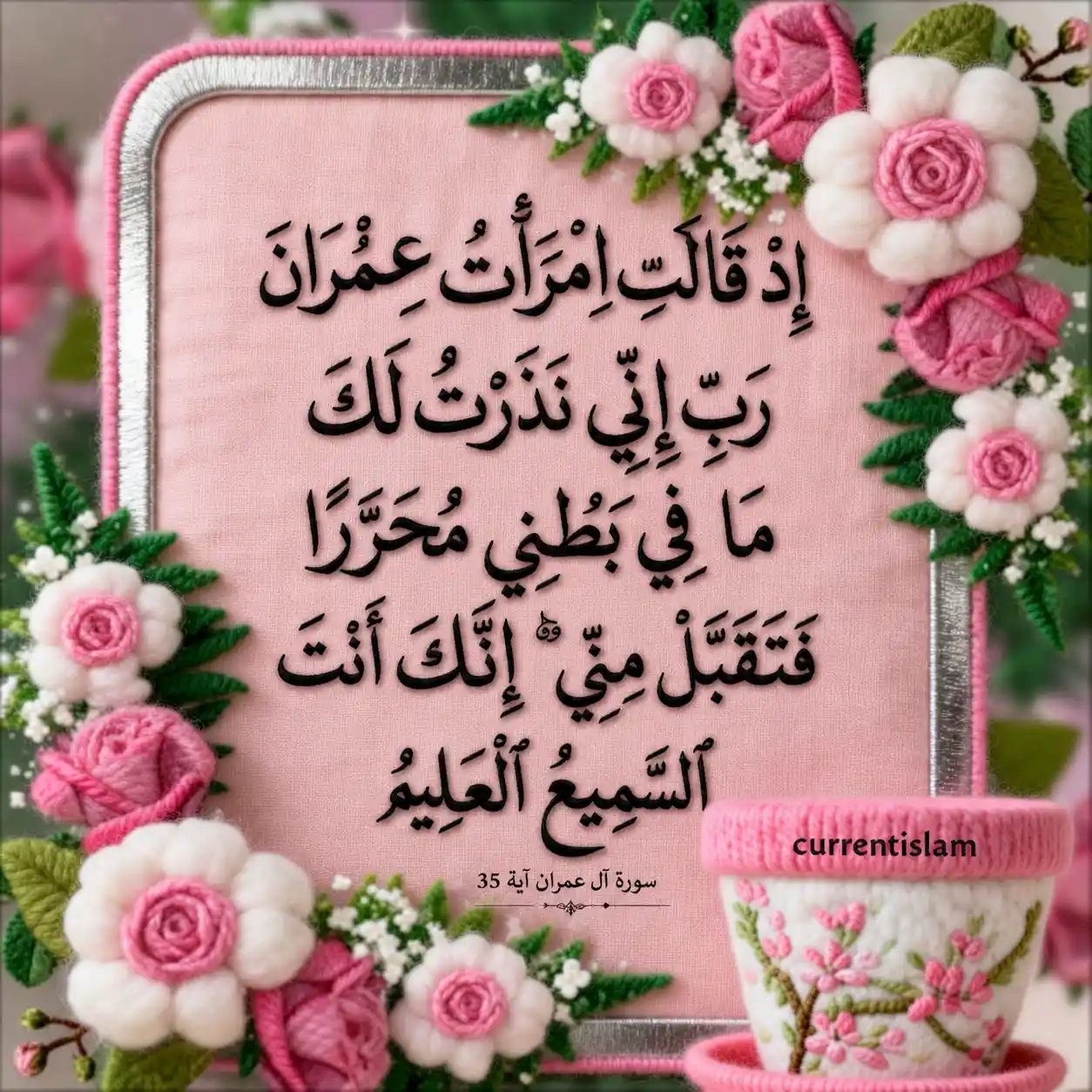
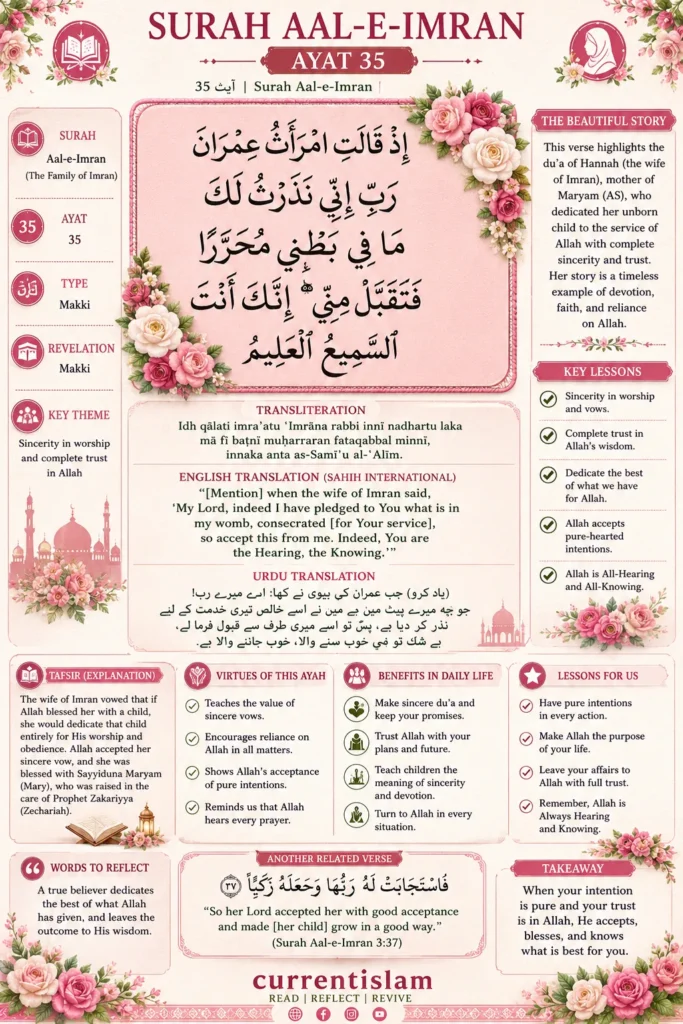
إِذْ قَالَتِ امْرَأَتُ عِمْرَانَ رَبِّ إِنِّي نَذَرْتُ لَكَ مَا فِي بَطْنِي مُحَرَّرًا فَتَقَبَّلْ مِنِّي ۖ إِنَّكَ أَنْتَ السَّمِيعُ الْعَلِيمُ
Transliteration:
Idh qālat imra’atu ʿImrāna rabbi innī nadhartu laka mā fī baṭnī muḥarraran fataqabbal minnī innaka anta as-samīʿu al-ʿalīm.
English meaning:
“[Remember] when the wife of Imran said, ‘My Lord, I have dedicated what is in my womb entirely to Your service, so accept it from me. Indeed, You are the All-Hearing, All-Knowing.’”
Urdu translation:
“جب عمران کی بیوی نے کہا: اے میرے رب! میں نے جو کچھ میرے پیٹ میں ہے اسے تیرے لیے خاص خدمت کے لیے وقف کر دیا ہے، تو اسے مجھ سے قبول فرما۔ بے شک تو خوب سننے والا، سب کچھ جاننے والا ہے۔”
हिंदी अनुवाद:
“जब इमरान की पत्नी ने कहा: ‘ऐ मेरे रब! मैंने अपने पेट में जो कुछ है, उसे तेरी सेवा के लिए समर्पित कर दिया है, इसलिए तू इसे मुझसे स्वीकार कर ले। निश्चय ही तू सब कुछ सुनने वाला, सब कुछ जानने वाला है।’”
This verse is short, but every phrase carries meaning. The wording is not casual; it is the language of vow, surrender, and hope.
Word-by-Word Meaning
This verse becomes clearer when its key words are broken down.
- Imra’at ʿImrān: the wife of Imran, identified in tafsir as Maryam’s mother.
- Nadhartu: I have vowed or dedicated.
- Laka: to You, meaning for Allah alone.
- Mā fī baṭnī: what is in my womb.
- Muḥarraran: set free, devoted, or dedicated for sacred service.
- Fataqabbal minnī: so accept it from me.
- As-Samīʿ: the All-Hearing.
- Al-ʿAlīm: the All-Knowing.
The heart of the verse is the phrase muḥarraran, which shows that the mother did not want this child for ordinary worldly purposes. She wanted the child to be free for Allah’s path. That is why this verse is often discussed in connection with sincerity, sacred purpose, and the spiritual training of a child before birth.
Tafsir Ibn Kathir
Tafsir Ibn Kathir explains that this verse begins the story of Maryam’s birth and shows the sincere vow made by her mother. The woman of Imran is understood to be the mother of Maryam, who hoped to dedicate the unborn child to worship and service in the sanctuary. In the narrative, the mother expected a particular outcome, but Allah had a greater plan.
This is one of the most important lessons in the passage. Human beings often imagine one future, but Allah chooses the better one. The mother wanted a child dedicated to worship, and Allah accepted the vow, but the child turned out to be Maryam, who became one of the chosen women in Islamic history. Her life was not just private family joy; it became a sign for the world.
Tafsir scholars also emphasize that 3:35 cannot be fully understood without 3:36 and 3:37. In the next verses, the mother gives birth and discovers that she has delivered a female child, then Allah accepts Maryam with grace and causes her to grow up under special care. That sequence shows that divine acceptance may not look exactly like human expectation, but it always carries wisdom.
Hadith on Intention
A key supporting teaching for this verse is the famous hadith about intentions. The Prophet Muhammad ﷺ said:
Arabic:
إِنَّمَا الأَعْمَالُ بِالنِّيَّاتِ
Transliteration:
Innamā al-aʿmālu bin-niyyāt.
English meaning:
“Actions are judged by intentions.”
Urdu meaning:
“اعمال کا دارومدار نیتوں پر ہے۔”
This hadith fits Surah Al Imran Ayat 35 beautifully because the verse is all about intention before action. The mother’s vow is not just a statement; it is an act of the heart directed toward Allah. The Qur’an and Sunnah together show that sincerity comes first, and outward results follow by Allah’s will.
This also matters for parenting. A child’s future is not only shaped by education, money, or status. It is also shaped by the prayers, intentions, and spiritual atmosphere created by parents. That is why this verse has such deep emotional and practical value for Muslim families.
Spiritual Lessons
Surah Al Imran Ayat 35 gives several powerful lessons for the believer.
First, it teaches that private du’a matters. The mother speaks to Allah in a moment known only to Him, and the Qur’an preserves that moment forever. This reminds us that hidden prayers may carry greater weight than public words.
Second, it teaches that sincere dedication is valuable before Allah. She does not ask for fame, comfort, or worldly reward. She asks for acceptance. That is a major spiritual lesson: true success is not only having goals, but having goals that are accepted by Allah.
Third, it teaches that Allah hears and knows completely. The verse ends with As-Samīʿu al-ʿAlīm, which means Allah hears every whispered prayer and knows every hidden intention. This gives comfort to anyone making du’a for a child, a family, or a future they cannot control.
Fourth, it teaches that a mother’s prayer can shape a mission. Maryam’s life was not accidental. Her upbringing was linked to a vow, and that vow became part of a larger divine story.
Modern Relevance
This verse feels especially relevant today because many parents are searching for a better model of raising children. People want academic success, emotional stability, and good manners, but the Qur’an adds something deeper: spiritual purpose. Surah Al Imran Ayat 35 shows that parenting begins with intention before it begins with planning.
In modern life, parents often think first about schools, careers, and social development. Those things are important, but the Qur’an asks a deeper question: what is the child being dedicated to? If the heart of the family is connected to Allah, then the child grows up within a spiritual framework rather than a purely material one.
The verse also speaks to people who are waiting for Allah’s help in difficult times. Sometimes a person makes du’a for a child, a marriage, healing, or change, and the response comes differently than expected. This verse teaches calm trust. Allah may answer in a way that exceeds human planning.
Practical Application
The most useful way to read this verse is to turn it into action.
- Make du’a for righteous children, whether you already have children or hope for them in the future.
- Renew your own intention before Allah in matters of worship, family, and work.
- Read Surah Al Imran 3:35–37 together instead of stopping at one verse.
- Reflect on what you are “dedicating” your life to.
- Teach children that their identity is not only social or academic, but spiritual.
You can also use this verse in family discussions, Islamic study circles, and parenting reminders. It is especially meaningful for mothers, fathers, and young couples who want to begin family life with sincere faith rather than only worldly ambition.
Related Verses
Surah Al Imran Ayat 35 becomes fuller when read with the next two verses.
Surah Al Imran 3:36
The mother gives birth and says she has delivered a female child, while Allah knows best what she delivered. This shows that human expectations can be limited, but Allah’s wisdom is greater.
Surah Al Imran 3:37
Allah accepts Maryam graciously and causes her to grow up in a beautiful way under the care of Zakariyya عليه السلام. This verse shows divine favor, nurture, and special preparation.
Together, these verses show a complete spiritual story: a vow, a birth, an acceptance, and a divine mission.
People Also Ask:
It describes the wife of Imran dedicating her unborn child to Allah’s service and asking Allah to accept that vow.
Classical tafsir identifies her as the mother of Maryam, peace be upon her.
It means devoted, freed, or dedicated to Allah’s service.
Its main benefit is spiritual reflection: it teaches sincerity, du’a, and trust in Allah’s plan. It also inspires parents to make du’a for righteous children.
Yes, as a reflection and inspiration for sincere prayer, especially when asking Allah for righteous offspring and accepted deeds.
- Surah Al Imran Ayat 154 explanation for your page on thumma anzala alaykum min ba‘di.
- intention in Islam for a supporting article on sincerity.
- Bismillahi Tawakkaltu Ala Allah meaning for your page on reliance and trust in Allah.
- du’a for righteous children for a parenting-focused resource.
- Maryam in the Quran for a biography and thematic study.
- vows in Islam for a fiqh or spirituality article.
Conclusion
Surah Al Imran Ayat 35 is a verse about a mother’s vow, but its meaning reaches much further than that. It teaches that sincere intention, private du’a, and trust in Allah can shape a child’s story before birth. It also reminds us that Allah hears every prayer and knows every hidden hope.
For parents, students, and general readers, this verse offers a powerful model: dedicate your intentions to Allah, ask Him to accept your efforts, and trust His wisdom even when outcomes look different from what you expected. Save this explanation for study and reflection, and return to it whenever you want to renew your heart before Allah.
References
- The Noble Qur’an, Surah Al Imran 3:35–37.
- Ibn Kathir, Tafsir al-Qur’an al-‘Azim, commentary on Surah Al Imran 3:35–37.
- Al-Bukhari and Muslim, hadith on intentions: “Actions are judged by intentions.”
