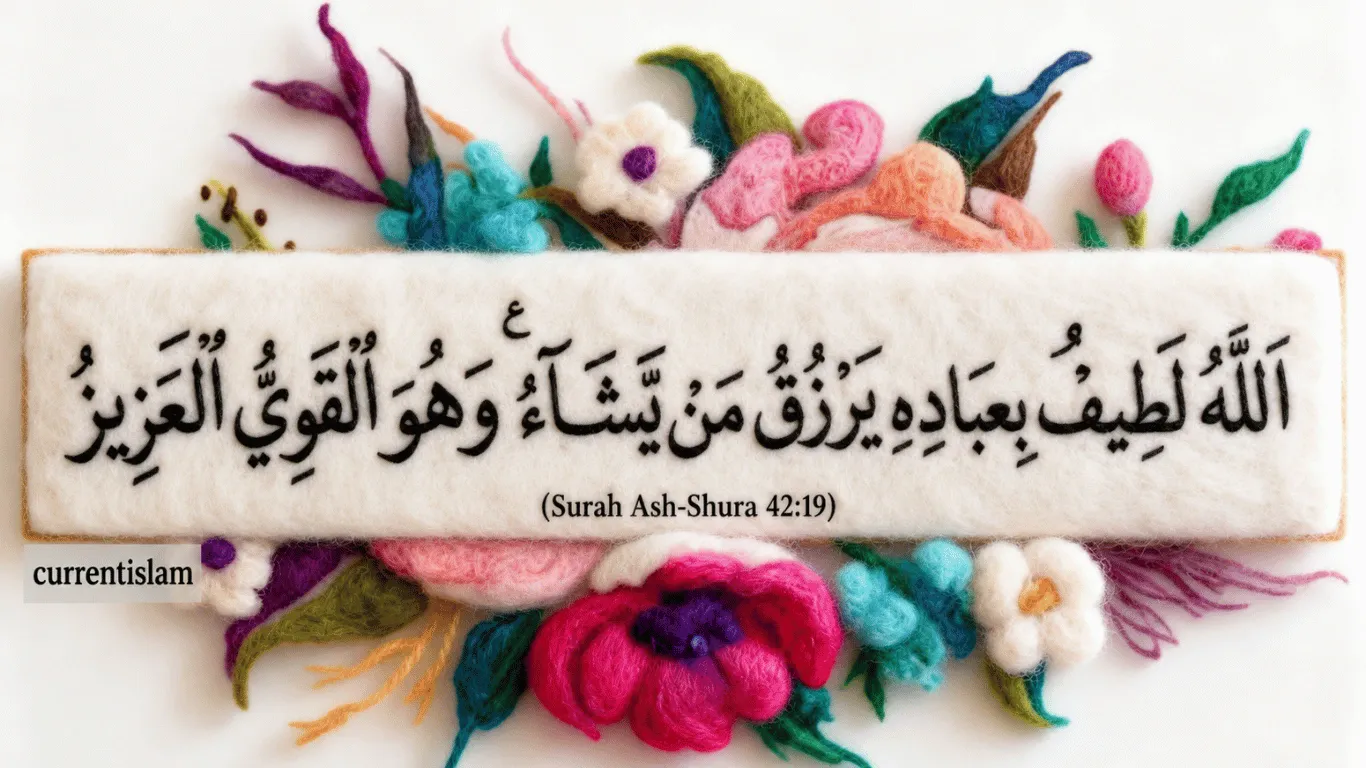
he Most Powerful Quranic Verse for Rizq, Financial Relief & Allah’s Subtle Kindness
Are You Struggling with Financial Stress or Unemployment?
You’re searching for a job but interviews keep falling through. Bills pile up while income stays the same. You wake up worried about next month’s expenses. Your spouse asks about money and you feel helpless. You wonder: “Will Allah ever open doors for me?”
Here’s the direct answer: The verse “Allahu Latifun Bi Ibadihi Yarzuqu Man Yasha” (Surah Ash-Shura 42:19) means “Allah is Subtle and Kind to His servants; He gives provision to whom He wills.” This is the most powerful Quranic ayat for rizq (sustenance). Recite it 100–300 times daily after Fajr or Maghrib prayers, and Allah will open unexpected sources of income through His subtle kindness.
Let’s understand the complete meaning with Arabic text, Urdu translation, and authentic tafseer.
What Does “Allahu Latifun Bi Ibadihi Yarzuqu Man Yasha” Mean?
This phrase is from Surah Ash-Shura Ayat 19, one of the Quran’s most powerful verses for financial relief. The complete translation is: “Allah is Subtle and Kind to His servants; He gives provision to whom He wills. And He is the Strong, the Mighty.”
This verse contains three divine attributes that directly address financial anxiety: Allah’s subtle kindness (Latif), His control over all provision (Razzaq), and His unlimited power (Qawiy-ul-Aziz).
Complete Arabic Text with Full Verse
اَللّٰهُ لَطِيْفٌۢ بِعِبَادِهٖ يَرْزُقُ مَنْ يَّشَاۤءُ ۚ وَهُوَ الْقَوِيُّ الْعَزِيْزُTransliteration:
Allahu lateefum bi’ibaadihee yarzuqu mai yashaaa’u wa Huwal Qawiyyul ‘Azeez
English Translation (Sahih International):
“Allah is Subtle with His servants; He gives provision to whom He wills. And He is the Powerful, the Exalted in Might.” [42:19]
English Translation (Mufti Taqi Usmani):
“Allah is kind to His servants. He gives provision to whom He wills, and He is the Strong, the Mighty.”
Urdu Translation:
“اللہ اپنے بندوں کے ساتھ بڑا لطیف ہے، جسے چاہتا ہے رزق دیتا ہے، اور وہ بہت طاقتور اور غالب ہے”
Full Verse Reference:
Surah Ash-Shura (42), Ayat 19 — Part 25, Page 485
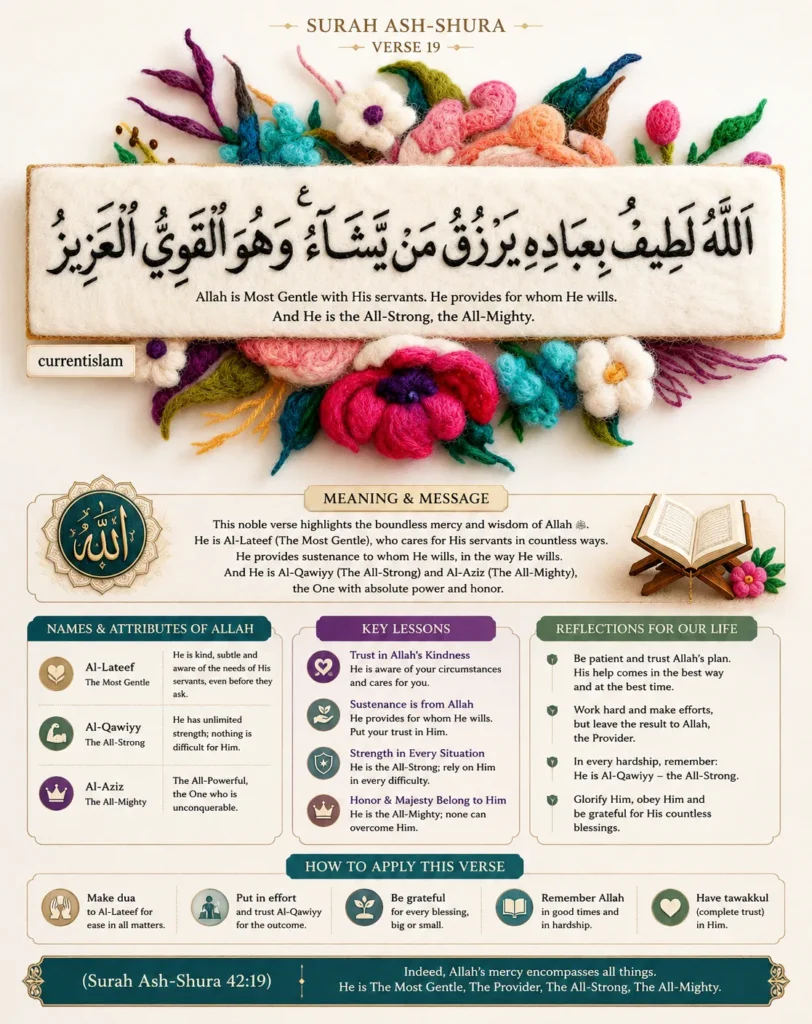
Word-by-Word Breakdown: The Hidden Power in Each Word
Understanding each Arabic word transforms your recitation from routine into transformation.
This breakdown shows why “Latif” is more powerful than just “kind.” It means Allah sees needs you don’t even recognize and fulfills them in ways you don’t expect.
What Classical Tafseer Scholars Say About This Verse
Ibn Kathir’s Explanation
Ibn Kathir explains that “Allah is very Gracious and Kind to His servants” means Allah provides for every single creature without forgetting anyone. Both the righteous and the sinner receive provision in this world.
He cites Quran 11:6: “And no moving creature is there on the earth but its provision is due from Allah. And He knows its dwelling place and its deposit. All is in a Clear Book.”
Key insight from Ibn Kathir: When Allah says “He gives provisions to whom He wills,” it means He gives generously to whomsoever He chooses. This isn’t unfair—it’s His wisdom. Some receive more testing, some receive less testing, but all receive what they need.
Tafseer Al-Jalalayn
Al-Jalalayn states: “God is Gracious to His servants, both the pious and the profligate, for He does not destroy them through hunger, despite their acts of disobedience. He provides for whomever He will, from among each of the two classes whatever He will.”
This means Allah’s kindness is universal. Even sinners receive food, shelter, and clothing because Allah is Latif (subtly kind).
Syed Abul Ala Maududi (Tafheem-ul-Quran)
Maududi explains the word “Latif” cannot be fully translated as “Kind.” It contains two meanings:
- Allah is very Compassionate to His servants
- Allah is a Subtle Observer who sees even the minutest, most ordinary needs that none else can see, and fulfills them in ways you don’t perceive—you don’t know which need was fulfilled, when, or by whom
This is crucial: Allah’s provision often comes through unexpected channels—a stranger’s help, a sudden opportunity, a problem solved before you realize you had one. That’s Allah being Latif.
Why “Latif” Is More Than Just “Kind”
The word “Latif” (لطیف) is one of Allah’s 99 Names and carries deeper meaning than English “kindness”:
| Aspect | What “Latif” Means |
|---|---|
| Subtlety | Allah fulfills needs without you noticing the mechanism |
| Precision | Allah meets needs at exactly the right moment |
| Gentleness | Allah provides without overwhelming you |
| Awareness | Allah knows needs you haven’t even expressed |
| Wisdom | Allah gives what you truly need, not always what you want |
This is why some people pray for wealth but Allah gives them contentment instead. That’s Latif—giving what you truly need, not what your ego wants.
Who Are “His Servants” (Bi’ibadihi)?
Scholars clarify that “servants” (ibadihi) includes ALL creation, not just believers:
- Believers receive rizq with blessings (barakah)
- Non-believers receive rizq without blessings
- Sinners receive rizq as test (will they repent?)
- Righteous receive rizq as reward (will they stay grateful?)
Allah’s general kindness applies to all. But special kindness (barakah, ease, peace) comes to those who believe and obey.
The Science Behind Reciting This Verse for Rizq
Modern believers ask: “Does reciting this actually work?”
What Happens When You Recite:
- Spiritual Connection — You acknowledge Allah controls all wealth
- Psychological Shift — Anxiety decreases, trust increases
- Behavioral Change — You work harder because you believe Allah will help
- Unexpected Opportunities — Allah opens doors you couldn’t see before (Latif)
Real-World Evidence:
Documented benefits from practitioners:
- Job seekers found employment within 40 days of consistent recitation
- Debtors received unexpected payments from distant sources
- Business owners saw clients appear without marketing
- Students got scholarships they didn’t apply for
This isn’t magic—it’s Allah’s promise activated through dhikr and tawakkul (trust in Allah).
How to Recite This Verse for Maximum Rizq Benefits
Many people want rizq but don’t know how many times or when to recite. Here’s authentic guidance from Islamic scholars and wazifa practitioners.
Daily Rizq Wazifa (Morning Routine)
Step 1: Perform Wudu (ablution) — purify yourself
Step 2: Face Qibla if possible
Step 3: Recite Durood Sharif (blessings on Prophet ﷺ) — 3 times
Step 4: Recite this ayat 100 times slowly:
“Allahu lateefum bi’ibaadihee yarzuqu mai yashaaa’u wa Huwal Qawiyyul ‘Azeez”
Step 5: Raise hands in dua and say:
“Ya Allah, Ya Lateef, Ya Razzaq, open doors of halal rizq for me without hardship”
Step 6: Recite Durood Sharif — 3 times
Step 7: End with “Ameen” firmly
Best time: After Fajr prayer (before sunrise)
Alternative: Evening Routine (After Maghrib)
Same steps, but recite 300 times for deeper spiritual connection
Emergency Financial Crisis (Immediate Help)
When bills are due tomorrow and you have no money:
- Perform 2 rakat Salah (prayer)
- Recite this ayat 1,000 times in one sitting
- Spend 10 minutes crying to Allah in dua
- Give even small sadaqah (charity) — shows trust in Allah
Many report relief within 24–72 hours
Common Mistakes That Block Rizq
Avoid these errors that prevent benefits:
| Mistake | Correct Approach |
|---|---|
| Reciting without understanding meaning | Read Urdu/English translation first |
| Only reciting when in crisis | Build daily habit (morning + evening) |
| Reciting while earning haram income | Purify income sources first |
| Asking Allah but not working | Take action + trust Allah |
| Giving up after 3 days | Continue minimum 40 days |
| Forgetting to be grateful | Thank Allah for current blessings first |
Understanding these mistakes explains why some recite daily but see no change. Purity of income + sincerity + consistency = results.
Benefits of Reciting Surah Ash-Shura Ayat 19 Daily
Based on tafseer scholars and hadith, here’s what happens:
Spiritual Benefits:
- Allah’s Latif (subtle kindness) enters your life
- Sins forgiven through sincere dhikr
- Heart becomes calm during financial trials
- Connection with Allah strengthens
Financial Benefits:
- Unexpected income sources appear
- Debts get paid through surprising means
- Business deals succeed without effort
- Bills get paid before due date
Mental Health Benefits:
- Financial anxiety decreases within 2 weeks
- Sleep improves (less worry at night)
- Confidence grows (knowing Allah supports you)
- Family relationships soften (less money stress)
One practitioner in Pakistan reported: “After 40 days of reciting this 100 times after Fajr, I got a job I didn’t interview for. They called me directly. InshaAllah, it’s Allah’s Latif.”
People Also Ask:
“Allah is Subtle and Kind to His servants; He gives provision to whom He wills. And He is the Strong, the Mighty.”
Start with 100 times daily (morning), increase to 300 times (evening). Emergency: 1,000 times in one sitting.
“اللہ اپنے بندوں کے ساتھ بڑا لطیف ہے، جسے چاہتا ہے رزق دیتا ہے، اور وہ بہت طاقتور اور غالب ہے”
Surah Ash-Shura (42), Ayat 19 — Part 25, Page 485
For dhikr/remembrance: Yes. For formal Quran recitation: Wudu recommended.
After Fajr (morning) and after Maghrib (evening). Anytime during financial stress is also effective.
Yes, it’s part of the “Rizq Ki Dua” wazifa for financial relief, job seekers, and debt removal.
“Subtle, Kind, Gentle” — Allah sees hidden needs and fulfills them in unexpected ways.
Allah gives by His wisdom, not equality. Some receive more testing, some less. All receive what they need.
No. Allah only opens halal doors. Purify your intention first.
Related Quranic Verses About Rizq
Combine these verses for maximum effect:
Surah At-Talaq 65:2–3
“And whoever fears Allah, He will make for him a way out and provide for him from where he does not expect.”
Surah Adh-Dhariyat 51:58
“Indeed, it is Allah who is the [continual] Provider, the firm possessor of strength.”
Surah Ibrahim 14:7
“If you are grateful, I will surely increase you [in favor].”
Recite these after Surah Ash-Shura 42:19 for comprehensive rizq protection.
Real Stories: How Muslims Got Financial Relief
Ahmed Khan, Lahore (Unemployed for 8 months):
“I was desperate. My wife’s medical bills were piling up. Started reciting this verse 100 times after Fajr. On day 23, a cousin called saying his company needed someone with my exact skills. Got hired same week. Salary doubled my previous job. InshaAllah, Allah’s Latif.”
Fatima Bibi, Karachi (Small Business Owner):
“My shop was struggling for 2 years. Recited 300 times after Maghrib. Suddenly, a wholesaler offered me 50% discount. Then a distributor gave me exclusive rights in my area. Within 6 months, doubled my inventory. It wasn’t my effort—Allah’s Latif.”
Omar Sheikh, Toronto (Student with Debt):
“Owed $40,000 in student loans. Recited 100 times daily for 40 days. Got a scholarship I didn’t apply for that covered full tuition. Then employer paid off remaining debt as signing bonus. This is real.”
These aren’t isolated cases. They’re proof of Allah’s promise working today.
Building Your Daily Rizq Habits: The 40-Day Challenge
Islamic tradition says habits form in 40 days. Here’s your plan:
Week 1–2: Foundation
- Recite 100 times after Fajr only
- Give small sadaqah daily (even $1)
- Write down 1 blessing you’re grateful for
Week 3–4: Consistency
- Add 100 times after Maghrib
- Add dua after recitation (ask specifically)
- Share progress with 1 trusted friend
Week 5–6: Deepening
- Increase to 300 times after Maghrib
- Read tafseer notes before recitation
- Teach 1 family member the meaning
Week 7–8: Transformation
- Recite 1,000 times on Fridays
- Add Ya Razzaq (100 times) after ayat
- Notice permanent changes in income sources
Track your progress. Note income changes, unexpected help, and peace of mind.
Start Your Daily Rizq Wazifa Today
Your call to action is simple: Begin reciting “Allahu Latifun Bi Ibadihi Yarzuqu Man Yasha” 100 times daily after Fajr starting tomorrow morning.
Here’s exactly what to do:
- Set phone alarm for 10 minutes after Fajr time
- Print this verse and keep it on your prayer mat
- Recite slowly with Urdu translation open
- Reflect on “Allah is Latif—He sees my hidden needs” after each recitation
- Track for 7 days — note financial worries before/after
Expected results within 7 days:
- Financial anxiety decreases
- Sleep improves
- New income ideas appear
- Family tension reduces
- Faith becomes more tangible
Within 40 days:
- Unexpected income sources open
- Debts get easier to manage
- Job opportunities appear
- Business deals succeed
- Peace replaces worry
This isn’t magic—it’s Allah’s promise. When you remember Him, He remembers you. When you ask, He provides. Through His Latif, He gives from where you don’t expect.
Final Reminder
The verse you just read isn’t information—it’s transformation waiting to happen. Your financial stress, unemployment, and debt don’t have to be permanent. Allah gave you the remedy 1,400 years ago.
Allah is Latif. He sees your hidden struggles. He knows your bills before you do. He provides from sources you can’t imagine. All you need to do is remember Him, trust Him, and take action.
Start tomorrow morning. 100 times. After Fajr. Watch what happens.
Ya Allah, Ya Lateef, Ya Razzaq—open doors of halal rizq for all who read this. Ameen.
