
Have you ever found yourself completely stuck in a situation where every single door seems permanently locked? You have tried every strategy, exhausted every favor, and pleaded your case, but the outcome remains unchanged. When human effort reaches its absolute limit and worldly hope evaporates, what happens to the human heart?
This is the exact psychological and spiritual state captured in Surah Yusuf, Ayat 80. It is a moment of profound desperation, deep guilt, and ultimate surrender. When the brothers of Prophet Yusuf (A.S.) realize they cannot save their youngest brother Benjamin from being detained in Egypt, their carefully constructed plans collapse.
In this pillar article, we will examine the meaning of this powerful verse, extract the psychology of guilt and repentance from the Quran, and provide a practical Surah Yusuf Ayat 80 wazifa for those facing impossible dead ends in their own lives.
Quran 12:80 Context and Explanation
Surah Yusuf verse 80 marks the exact turning point where the brothers of Yusuf lose all control over their narrative. After failing to convince the Egyptian Vizier (who is secretly Yusuf himself) to release Benjamin, they retreat to face the crushing reality of their failure.
Here is the complete textual reference for this verse:
Arabic Text:
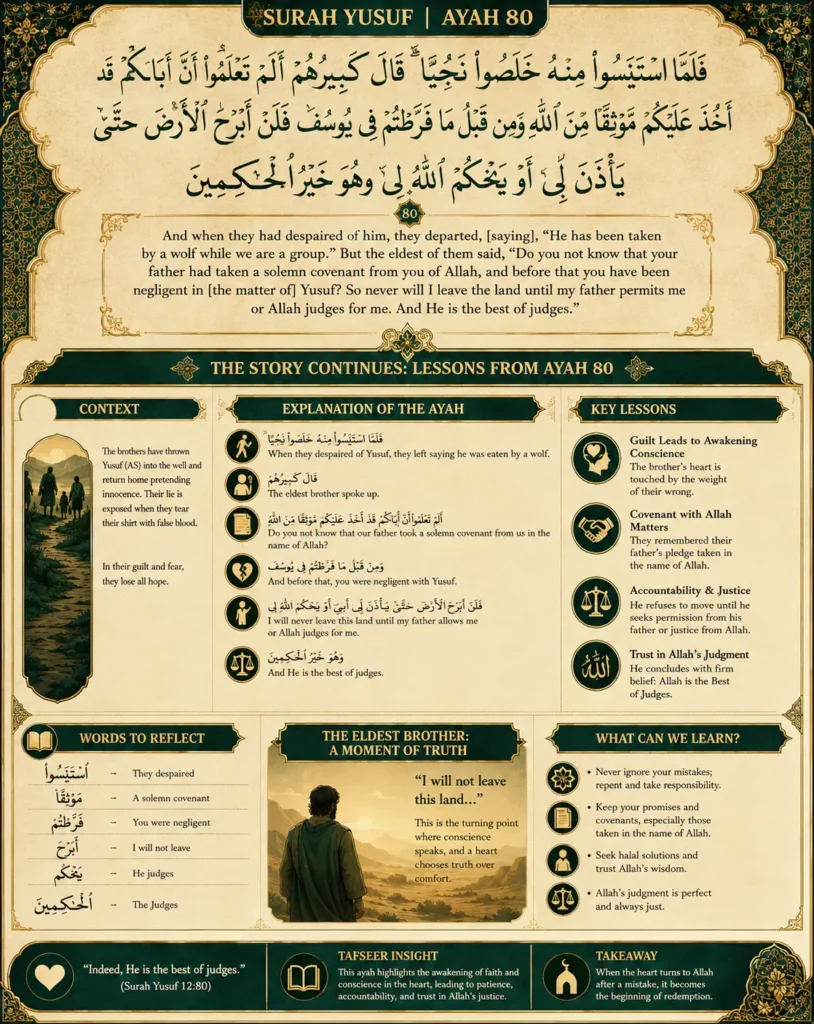
فَلَمَّا ٱسْتَيْـَٔسُوا۟ مِنْهُ خَلَصُوا۟ نَجِيًّا ۖ قَالَ كَبِيرُهُمْ أَلَمْ تَعْلَمُوٓا۟ أَنَّ أَبَاكُمْ قَدْ أَخَذَ عَلَيْكُم مَّوْثِقًا مِّنَ ٱللَّهِ وَمِن قَبْلُ مَا فَرَّطتُمْ فِى يُوسُفَ ۖ فَلَنْ أَبْرَحَ ٱلْأَرْضَ حَتَّىٰ يَأْذَنَ لِىٓ أَبِىٓ أَوْ يَحْكُمَ ٱللَّهُ لِى ۖ وَهُوَ خَيْرُ ٱلْحَٰكِمِينَ
Transliteration: Falamma istayasoo minhu khalasoo najiyyan. Qaala kabeeruhum alam ta’lamoo anna abaakum qad akhadha ‘alaykum mawthiqan mina Allahi wa min qablu maa farrattum fee Yoosufa. Falan abraha al-arda hattaa ya’dhana lee abee aw yahkuma Allahu lee, wahuwa khayru al-haakimeen.
English Translation: “So when they had despaired of him, they secluded themselves in private consultation. The eldest of them said, ‘Do you not know that your father has taken a solemn promise from you in the name of Allah, and how, before this, you failed in your duty regarding Yusuf? So I will never leave this land until my father permits me, or Allah decides for me, and He is the best of judges.'”
Urdu Translation:
“پھر جب وہ اس سے مایوس ہو گئے تو اکیلے میں جا کر مشورہ کرنے لگے۔ ان میں جو سب سے بڑا تھا اس نے کہا: کیا تم نہیں جانتے کہ تمہارے والد نے تم سے اللہ کے نام پر پختہ عہد لیا تھا، اور اس سے پہلے تم یوسف کے معاملے میں بھی زیادتی کر چکے ہو؟ پس میں تو اس سرزمین سے ہرگز نہیں ٹلوں گا جب تک کہ میرے والد مجھے اجازت نہ دیں یا اللہ میرے حق میں کوئی فیصلہ فرما دے، اور وہی سب سے بہتر فیصلہ کرنے والا ہے۔”
The Meaning of Istay’asū in the Quran
The Arabic word istay’asū goes far beyond normal sadness. It represents absolute, crushing despair after every single worldly effort has been completely exhausted. It is the moment you realize that your own power is entirely useless.
Let’s understand the real meaning of this precise vocabulary. The root word for despair is ya’s. However, Allah uses the intensified form istay’asū. This linguistic structure implies a grueling process. The brothers did not give up immediately; they argued, negotiated, and offered themselves as substitutes. Only when every single logical avenue was shut did they experience istay’asū.
This becomes important when you look at how humans process failure. We often rely entirely on our intellect and connections. When those fail, we crash. But from an Islamic perspective, this breaking point is exactly where true spiritual reliance (Tawakkul) begins. When you run out of human options, you are forced to wait for the decree of Khayrul Haakimeen (The Best of Judges).
Tafsir Surah Yusuf Verse 80 English (Ibn Kathir)
Tafsir Ibn Kathir explains that Surah Yusuf Ayat 80 highlights the intense private consultation of the brothers. The eldest brother, recognizing the immense weight of their broken oath to Allah, refuses to return home, choosing self-exile until Allah passes a judgment.
According to the classical exegesis of Imam Ibn Kathir, the phrase khalasoo najiyyan means they separated themselves from the people of Egypt to whisper among themselves in absolute secrecy and panic. They were dealing with a catastrophic failure.
The eldest brother (often identified as Judah or Ruba’bil) steps up. He reminds them of two glaring realities:
- The Broken Covenant: Their father, Yaqub (A.S.), had made them swear by Allah to bring Benjamin back safely.
- The Past Sin: He points out their historical trauma—“and how, before this, you failed in your duty regarding Yusuf.”
Ibn Kathir notes that the eldest brother could not bear the shame of facing his father’s grief again. His statement, “until Allah decides for me,” shows a profound shift. He is no longer plotting; he is surrendering. He recognizes that human scheming has failed, and only the divine decree matters now.
Lessons from the Brothers of Prophet Yusuf
The story of the brothers provides a profound psychological framework regarding repentance and patience. It teaches us that buried guilt will eventually surface during a crisis, and true repentance requires facing our past actions without making any more excuses.
Here’s why this matters. The brothers of Yusuf carried a dark secret for decades. They thought they had moved on from throwing their brother into the well. But guilt is a heavy psychological burden. The moment they lost Benjamin, the psychological dam broke. The eldest brother immediately connected their current disaster in Egypt to their past sin in Canaan.
From a psychological perspective, this is the first real step of Tawbah (repentance). As long as a person makes excuses for their past cruelty, they cannot heal. The eldest brother verbalized their shared sin: “You failed in your duty regarding Yusuf.” He shattered their collective delusion.
To overcome severe guilt, one must undergo this painful confrontation with the truth. Repentance is not just feeling bad; it is the active restructuring of your internal morality. They finally realized that trying to outsmart destiny only leads to humiliation. This spiritual realization mirrors the truth that Allah is absolutely predominant over His affairs, even when humans plot otherwise.
The Patience of Yaqub (A.S) and Prophetic Hadith
While the brothers panicked in Egypt, Prophet Yaqub (A.S.) demonstrated “Sabrun Jameel” (beautiful patience) back home. Beautiful patience is defined as enduring severe emotional pain without complaining to the creation, directing all grief solely to the Creator.
Now let’s connect this to daily life. When calamity strikes, our first instinct is often to panic, complain to friends, or express anger. Prophet Yaqub (A.S.) lost his beloved sons, his eyesight to grief, and his comfort, yet his response was anchored in complete trust in Allah.
The Prophet Muhammad (ﷺ) emphasized the timing of patience in a famous Hadith. Anas bin Malik reported that the Messenger of Allah (ﷺ) passed by a woman who was weeping over a grave and told her to fear Allah and be patient. When she later realized who he was and apologized, he (ﷺ) stated: “Verily, the patience is at the first stroke of a calamity.” (Sahih al-Bukhari).
Yaqub’s (A.S.) patience was not a passive, weak submission. It was an active, powerful psychological resilience. He knew his sons were lying decades ago, and he knew Allah would eventually reunite him with Yusuf. He maintained a healthy spiritual psychology by detaching his hope from the creation and attaching it purely to the Creator.
Surah Yusuf Ayat 80 Wazifa: Spiritual Solution for Dead Ends
The wazifa for Surah Yusuf Ayat 80 is a powerful spiritual remedy for those facing closed doors, false accusations, or impossible situations. By reciting this verse, a believer internalizes absolute surrender to Allah, calling upon “The Best of Judges” to resolve their crisis.
When you are facing a situation where you are legally, financially, or emotionally trapped, human words fail. This verse becomes a spiritual shield. It was spoken at the moment of ultimate dead-ends.
How to Perform the Wazifa: If you are dealing with an unjust situation, a halted court case, or an unbearable family crisis, establish this spiritual practice:
- Preparation: Perform fresh Wudu in a quiet space after Isha prayers.
- Durood: Recite Durood Shareef (Salawat) 11 times.
- The Recitation: Recite Surah Yusuf Ayat 80 exactly 41 times. Focus specifically on the ending words: wa huwa khayru al-haakimeen (and He is the best of judges).
- Closing: Recite Durood Shareef 11 times again.
- The Dua: Raise your hands and present your absolute helplessness to Allah. Do not give Allah a specific blueprint of how to save you. Simply ask Him to judge your matter with His infinite wisdom.
This practice aligns your heart with divine timing. If your hardship is caused by the ill intentions or spiritual harm of others, combining this practice with prayers that break blockages, such as the recitations found in Surah Yunus Ayat 81, can help clear unseen spiritual interference.
Reframing Guilt into Growth
A modern psychological framework regarding repentance requires us to reframe guilt. Destructive guilt paralyzes you, making you feel unworthy of Allah’s mercy. Constructive guilt—the kind experienced by the eldest brother—forces you to stop running, face your mistakes, and leave the outcome to God.
Here’s why this matters for you right now. You might be carrying the weight of past sins, fractured family ties, or severe personal failures. You might feel like the brothers: cornered, ashamed, and out of options. The solution is not to double down on deception or fall into absolute despair. The solution is absolute surrender.
Acknowledge your mistakes honestly. Fulfill your broken promises. And when you cannot fix a situation with your own two hands, step back and say what the eldest brother said: Allah will decide for me, and He is the best of judges.
Surah Yusuf Ayat 80 pdf
People Also Ask:
The main theme is absolute despair in human efforts, the confrontation of past guilt, and the ultimate surrender to Allah’s decree as the finest and most just Judge.
It is an acknowledgment that human plans are flawed and often unjust. Leaving a matter to “The Best of Judges” means trusting that Allah will resolve the crisis with perfect fairness, exact timing, and infinite wisdom.
Yes. Surah Yusuf was revealed to Prophet Muhammad (ﷺ) during the “Year of Sorrow” to comfort him. Reading it, understanding its psychological framework, and reciting its powerful verses acts as a profound healing for depression, grief, and anxiety.
For severe hardships and blocked paths, it is traditionally recommended to recite the verse 41 times after Isha prayer, focusing deeply on the meaning of surrendering your affairs entirely to Allah.
Your Daily Spiritual Action Plan
Do not let guilt or dead ends paralyze your spiritual growth. The psychology of repentance demands action. Starting tonight, commit to a daily spiritual practice.
When you finish your Isha prayers, take five quiet minutes. Recite this verse, focus on the words khayru al-haakimeen, and consciously hand over your deepest anxieties, court cases, or family disputes to Allah. Stop trying to control the uncontrollable. Build this wazifa into your nightly routine, and watch how the Best of Judges opens doors you thought were locked forever.
