
We live in an era where our minds are constantly racing. Anxiety, emotional exhaustion, and spiritual burnout are the silent epidemics of our time. We seek therapy, download meditation apps, and try countless remedies, yet our hearts often remain restless and fatigued. But what if the ultimate psychological reset—a guaranteed cure for a heavy heart and an anxious mind—has been available to us for over 1,400 years?
What is the Meaning of Wa Nunazzilu Minal Quran?
“Wa nunazzilu minal quran” is a profound declaration from Surah Al-Isra (Quran 17:82). It establishes that the Quran is revealed as an absolute healing (Shifa) and mercy for believers. It serves as a comprehensive spiritual, emotional, and physical cure, offering immediate tranquility to restless minds and weary hearts.
To truly grasp the magnitude of this verse, we must look at the exact words chosen by Allah, along with their precise translations across multiple languages.
Arabic Text:
وَنُنَزِّلُ مِنَ الْقُرْآنِ مَا هُوَ شِفَاءٌ وَرَحْمَةٌ لِّلْمُؤْمِنِينَ ۙ وَلَا يَزِيدُ الظَّالِمِينَ إِلَّا خَسَارًا
Transliteration: Wa nunazzilu minal-qur’ani ma huwa shifa’un wa rahmatul-lil-mu’mineena wa la yazeeduz-zalimeena illa khasara.
English Translation: And We send down of the Qur’an that which is healing and mercy for the believers, but it does not increase the wrongdoers except in loss.
Urdu Translation:
اور ہم قرآن میں وہ چیز نازل کرتے ہیں جو مومنوں کے لیے شفا اور رحمت ہے، اور ظالموں کے لیے تو یہ صرف نقصان ہی میں اضافہ کرتا ہے۔
Hindi Translation:
और हम क़ुरआन में वह उतारते हैं जो ईमान वालों के लिए शिफ़ा (आरोग्य) और दया है, और अत्याचारियों के लिए तो यह केवल घाटे को ही बढ़ाता है।
The Quranic ‘Shifa’ as a Psychological and Emotional Reset
The Quranic concept of “Shifa” goes far beyond basic medicine; it guarantees an absolute cure. Reciting this verse acts as a profound cognitive reset, breaking the destructive loops of overthinking, panic, and anxiety by instantly reconnecting the human mind to the ultimate source of peace.
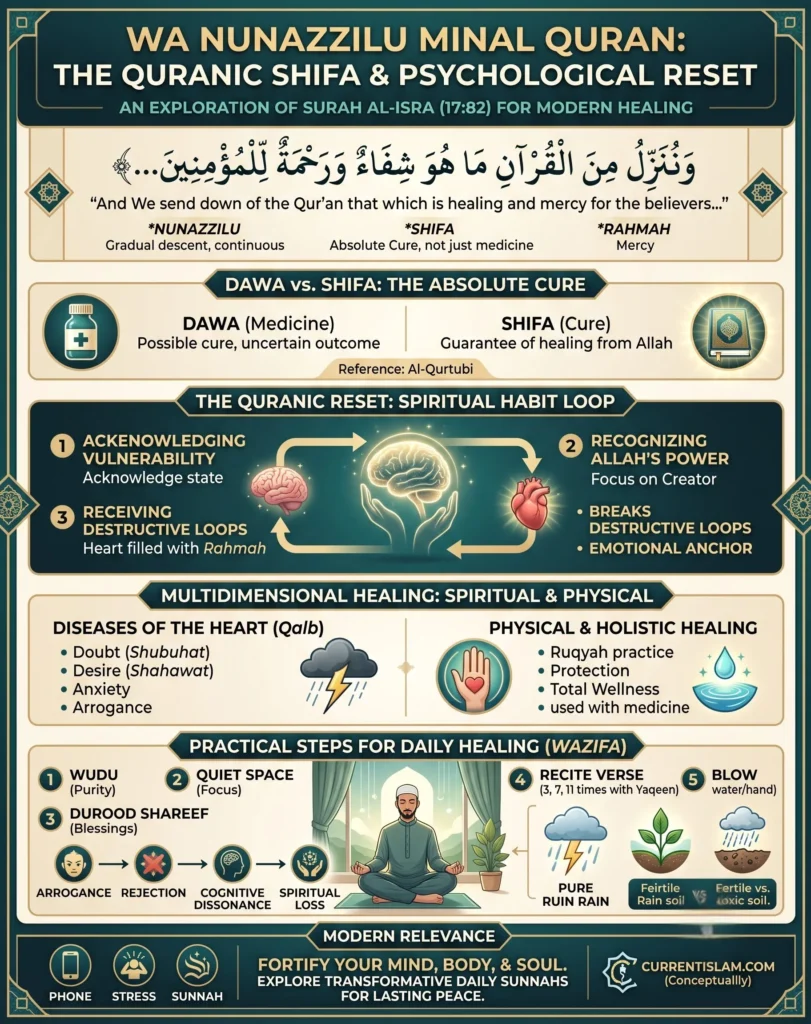
Let’s understand the real meaning behind the vocabulary of this verse. In classical Arabic literature, there is a distinct difference between Dawa (medicine) and Shifa (cure). As Imam Al-Qurtubi outlines in his renowned Tafseer, a doctor prescribes Dawa. You take it hoping it works, but the outcome is uncertain. Allah, however, did not call the Quran Dawa; He called it Shifa. The Quran is the cure itself.
This becomes important when you look at modern anxiety. Anxiety often stems from a feeling of losing control over the future or dwelling on the past. The Quran acts as an emotional anchor. When a believer recites this verse, they are undergoing a spiritual habit loop: acknowledging their own vulnerability, recognizing Allah’s absolute power, and receiving divine mercy (Rahmah). The healing removes the pain and chaos from the mind, while the mercy fills that newly emptied space with deep cognitive resilience, clarity, and inner peace.
Spiritual Healing vs. Physical Ruqyah
Islamic scholars confirm the Quran heals both the unseen diseases of the heart, like doubt and arrogance, as well as physical illnesses. Prophet Muhammad (peace be upon him) frequently utilized specific verses as Ruqyah to seek physical relief and spiritual protection from bodily harm.
According to the Tafseer of Ibn Kathir, the Quran cures the heart from the diseases of misguidance, hypocrisy, and impurity. Yet, its power is not limited to the metaphysical. The practice of Ruqyah—reciting verses of the Quran over oneself or the sick—is a well-documented Sunnah for physical ailments.
Here’s why this matters: Islam does not ask you to reject modern medicine. Instead, it asks you to elevate your healing process. You seek medical treatment for the body, but you apply the Quran for the soul and the underlying life force. For those currently facing severe bodily ailments or persistent sickness, pairing the recitation of this verse with a powerful dua for health provides a comprehensive, holistic approach to complete wellness.
How to Use Surah Al-Isra Ayat 82 as a Wazifa for Healing
To use this verse as a wazifa, recite it with deep conviction 3, 7, or 11 times. Blow gently over a glass of water and drink it, or place your right hand firmly on the area of physical or emotional pain while reciting it with focus.
For traditional audiences seeking specific rulings on how to apply this in daily life, the method is straightforward but relies heavily on your internal state (Yaqeen).
- Perform Wudu (ablution) to ensure physical and spiritual purity.
- Sit in a quiet place, ideally facing the Qiblah.
- Recite Durood Shareef (sending blessings upon the Prophet) 3 times.
- Recite Wa nunazzilu minal-qur’ani ma huwa shifa’un wa rahmatul-lil-mu’mineena 7 times, focusing entirely on the pain you want removed—whether it is a migraine, a heavy chest from anxiety, or a chronic illness.
- End with Durood Shareef 3 times.
Now let’s connect this to daily life. Whether you are battling an unexpected health diagnosis or seeking relief from an overwhelming financial or family crisis, turning to Allah is the primary step. If you are making this wazifa for a very specific, urgent need that is causing you distress, it is highly recommended to combine this practice with the dua e hajat to ensure your supplication is spiritually fortified and your immediate needs are brought before the Creator.
Why Does the Quran Cause “Loss” to the Wrongdoers?
The Quran acts like pure, life-giving rain; its ultimate effect depends entirely on the soil it lands on. While it brings life to a believer’s humble heart, it only increases the arrogance and stubbornness of an oppressor, deepening their spiritual loss.
This is the meaning behind the phrase Wala yazidu zalimina illa khasara (but it does not increase the wrongdoers except in loss). It seems like a paradox—how can a book of absolute healing cause damage?
Classical scholars explain that a heart darkened by oppression, ego, and the refusal to submit to truth experiences severe cognitive dissonance when exposed to the Quran. The purity of the revelation irritates their arrogance. Instead of humbling them, the verses trigger their defensiveness. Just as a rich, heavy meal will only sicken a stomach that is already severely diseased, the profound truths of the Quran will only push an arrogant heart further into rebellion. Therefore, their rejection of the cure becomes the very thing that seals their ultimate loss.
People Also Ask:
The primary benefits include immediate relief from psychological distress, spiritual protection against negative unseen forces, the cleansing of the heart from hypocrisy, and physical healing when used as Ruqyah over water or directly on the body.
While there is no strict limit, traditional Islamic scholars often recommend reciting it 3, 7, or 11 times as an odd number is beloved to Allah. The most important factor is reciting it with absolute certainty (Yaqeen) that Allah is the ultimate healer.
Yes, it acts as a powerful cognitive and emotional reset. While seeking professional psychological help is encouraged in Islam, reciting this verse removes the spiritual weight of anxiety, clears the mind of intrusive thoughts, and replaces despair with divine mercy.
Place your right hand over the part of your body that is in pain, or over your chest if you are feeling emotional distress. Recite the verse 7 times with focused intention, and gently blow over yourself. Alternatively, recite it over a glass of pure water and drink it.
Build Your Cognitive and Spiritual Resilience
True healing is not a one-time event; it is a lifestyle. The verse Wa nunazzilu minal quran reminds us that the medicine for our modern exhaustion is already on our bookshelves and in our hearts, waiting to be activated. By integrating the recitation of this verse into your daily routine, you shift your mindset from reacting to life’s anxieties to proactively shielding your heart with divine revelation.
If you are ready to fortify your mind, body, and soul against the daily stresses of the modern world, the secret lies in building consistent, faith-based habits. Take the next step in your spiritual journey and read our complete pillar page on Daily Sunnahs to discover the small, transformative routines that will bring lasting peace and productivity to your life.
