You sit down with your phone or Mus’haf after a long day of back-to-back classes, endless Zoom meetings, and non-stop notifications. You want to connect with Allah. You want to recite the Quran. But instead of feeling spiritual relief, your chest tightens. You stumble over the Arabic letters. You worry your pronunciation is completely wrong, or you rush through a page just to hit a daily quota, feeling absolutely nothing.
The weight of modern burnout has turned what should be a conversation with your Creator into a mechanical chore.
But Allah knew the heaviness of the world would drain you. Long before the era of digital overload, the Prophet Muhammad (PBUH) was given a heavy task. He needed strength, focus, and a way to anchor his heart. The divine remedy was not a complex ritual. It was a command to change his pace. The solution is found in the profound strategy of Tarteel (measured recitation).
Here is exactly how integrating this single mindset shift into your daily routine will transform your relationship with the Quran, cure your recitation anxiety, and bring immediate mental stillness.
What Does Aw Zid Alaihi Warattilil Quran Tarteela Mean?
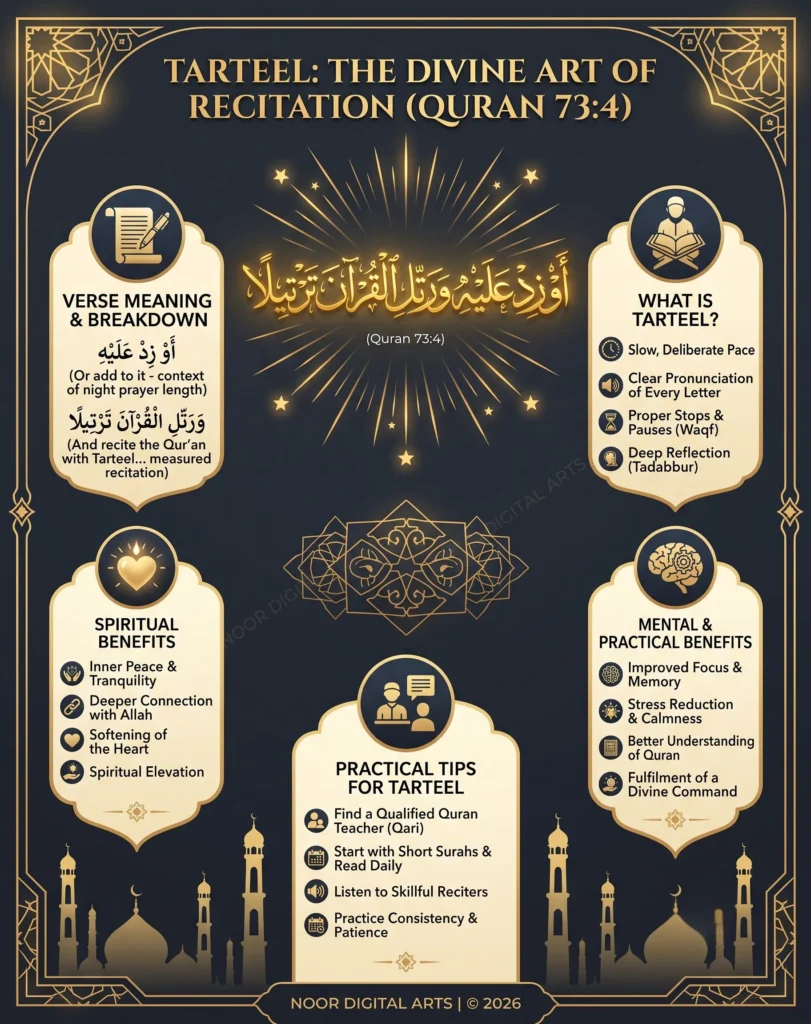
“Aw zid alaihi warattilil quran tarteela” means “Or add to it, and recite the Quran with measured, slow, and distinct recitation.” It is a direct command from Surah Al-Muzzammil, instructing believers to read the Quran carefully, giving each letter its right, rather than rushing through the words.
The Divine Command (Surah Al-Muzzammil 73:4)
Arabic Text:
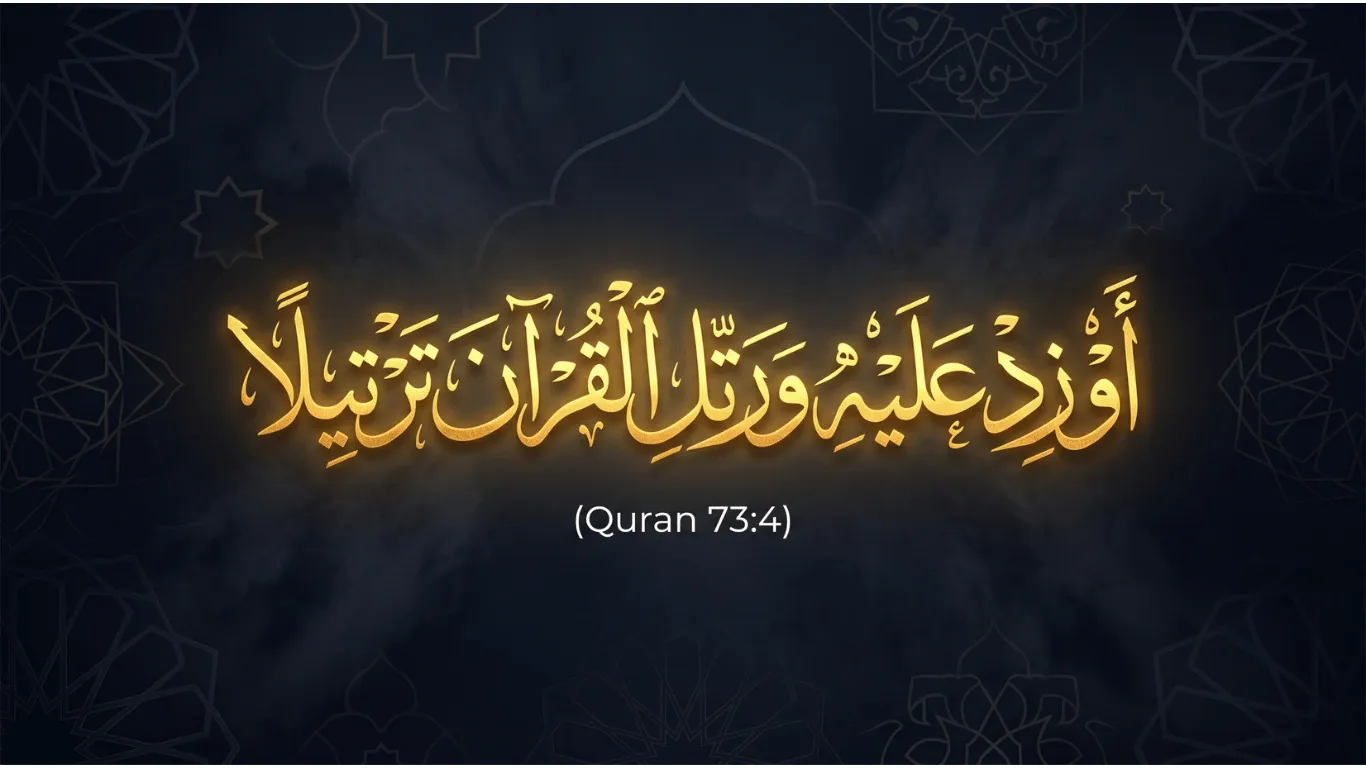
أَوْ زِدْ عَلَيْهِ وَرَتِّلِ الْقُرْآنَ تَرْتِيلًا
(Quran 73:4)
Transliteration:
Aw zid ‘alayhi warattilil qur’ana tarteela
English Translation:
Or add to it, and recite the Qur’an with measured recitation.
Urdu Translation:
یا اس پر بڑھا دیں اور قرآن کو خوب ٹھہر ٹھہر کر پڑھیں۔
Hindi Translation:
या उस पर थोड़ा बढ़ा दें और क़ुरआन को ठहर-ठहर कर पढ़ें।
The Linguistic Breakdown of Tarteel
The word Tarteel comes from an Arabic root meaning “to put things in a neat, orderly arrangement.” Classical scholars like Ibn Kathir explain that reading with Tarteel means articulating every letter clearly, stopping at the designated pauses, and letting the meaning of the words settle in the heart.
When you recite fast, your brain stays in a state of high-beta wave activity—the exact same stress state caused by scrolling through social media. When you deliberately slow down your tongue to practice Tarteel, you force your nervous system to down-regulate. You are physically signaling to your body that it is safe to pause.
Read our complete guide to finding spiritual stillness in the modern world to see how classical Quranic concepts directly combat modern anxiety.
Overcoming the Tajweed Struggle: Why Perfection is Not the First Step
Struggling with Tajweed does not invalidate your recitation. In fact, Islam rewards the struggle. The Prophet (PBUH) explicitly stated that a person who stammers, stumbles, and finds reciting Arabic difficult receives a double reward for their sustained effort and patience.
You might feel a mental block because Arabic is not your native language. Diaspora parents, students, and converts often abandon reciting altogether out of fear of disrespecting the text through mispronunciation.
Let’s break down the exact meaning of this beautiful Hadith to silence that inner critic.
The Guarantee for the Struggling Reciter (Sahih Bukhari 4937)
Arabic Text:
وَالَّذِي يَقْرَأُ الْقُرْآنَ وَيَتَتَعْتَعُ فِيهِ وَهُوَ عَلَيْهِ شَاقٌّ لَهُ أَجْرَانِ
Transliteration:
Walladhi yaqra’ul-qur’ana wa yatata’ta’u fihi wa huwa ‘alayhi shaqqun lahu ajran.
English Translation:
“And he who recites the Qur’an and finds it difficult to recite, doing his best to recite it in the best way possible, will have two rewards.”
Urdu Translation:
اور جو شخص قرآن پڑھتا ہے اور اس میں اٹکتا ہے اور وہ اس پر شاق گزرتا ہے تو اس کے لیے دو اجر ہیں۔
Hindi Translation:
और जो व्यक्ति क़ुरआन पढ़ता है, उसमें अटकता है और उसे पढ़ने में कठिनाई महसूस करता है, उसके लिए दोहरा सवाब है।
The first reward is for the recitation itself. The second reward is strictly for the psychological friction you endure while trying. When you apply Aw zid alaihi warattilil quran tarteela, you remove the pressure of speed. You allow yourself to be a student.
If you are dealing with chronic stress regarding your spiritual habits, explore our targeted daily Masnoon Duas for anxiety and mental health.
The Quran as Active Healing: Moving Beyond the Tongue
Reciting with Tarteel transforms the Quran from a vocal exercise into a spiritual remedy. When you read slowly and deliberately, the verses actively work to cure emotional distress, cure anxiety, and soften hardened hearts, proving the Quran is a tangible psychological cure for the believer.
Once you remove the pressure of speed and perfection, you begin to experience the actual purpose of the text: Shifa (healing). The Quran is not meant to just sit on your tongue; it is designed to penetrate the chest. If you are rushing through the pages at top speed just to cross it off your daily to-do list, you completely bypass the profound healing mechanisms embedded in the words.
When you slow your pace to a deliberate Tarteel, you allow the verses to act as a spiritual medicine against modern burnout. If you are currently dealing with heavy emotional distress, reading slowly activates the curative properties of specific verses. For a step-by-step breakdown of how to apply this for personal distress, read our complete guide on using Surah Al-Isra Ayat 81-82 for healing.
Furthermore, the digital age often leaves us feeling isolated, emotionally hardened, and disconnected from our faith. Mechanical recitation does nothing to fix this emptiness. Deliberate, thoughtful reading softens the chest and removes that emotional friction. It physically alters your state of mind. To understand the profound impact divine revelation has on softening and uniting anxious, divided hearts, explore the powerful Tafseer of Surah Anfal Ayat 63.
By practicing Aw zid alaihi warattilil quran tarteela, you stop treating the Quran as a race and start treating it as your daily remedy.
Rebuilding Your Quranic Routine
To build a sustainable Quranic habit, replace the goal of “finishing pages” with the goal of “measured engagement.” By dedicating just 5 minutes to slow, deliberate recitation (Tarteel) daily, you create a high-retention spiritual loop that prioritizes emotional connection over volume.
We need to shift away from treating the Quran like a textbook we cram for an exam. Let’s look at the exact differences between speed-reading and practicing true Tarteel.
How to Implement This Today
- Reduce the Volume: If you usually read two pages quickly, read half a page slowly.
- Listen and Shadow: Play a recitation by a renowned Qari (like Mishary Rashid Alafasy or Mahmoud Khalil Al-Husary) and read along softly. Match their measured pace.
- Engage the Meaning: Keep a translation open. Read the Arabic slowly, then read the translation. This breaks the language barrier and bridges the gap between your tongue and your heart.
People Also Ask
Reciting the Quran with Tarteel ensures that the reader gives every letter its proper pronunciation and right (Tajweed). It allows the heart to reflect on the meanings of the verses, creating a deeper emotional and spiritual connection with Allah rather than just mechanically repeating words.
Yes. Reciting the Quran slowly with measured breaths activates the parasympathetic nervous system. This physical slowing of your breathing, combined with the spiritual weight of the words, lowers cortisol levels and drastically reduces feelings of modern anxiety and overwhelm.
Do not stop reading. The Sunnah teaches that anyone who struggles, stammers, or finds reciting the Quran difficult receives a double reward from Allah. Slow down your pace, practice Tarteel, and focus on gradual improvement rather than immediate perfection.
Take Action: Perfect Your Pace Today
You now understand the immense power behind Aw zid alaihi warattilil quran tarteela. The next step is not to feel guilty about your current level, but to take one practical step toward better, slower recitation.
You do not need to figure out the rules of pronunciation on your own.
Download our comprehensive, beginner-friendly Tajweed PDF guide right now. It breaks down the exact rules of Tarteel into bite-sized, visual lessons designed specifically for non-Arabic speakers. Start your journey toward confident, peaceful recitation today.

1 thought on “Aw zid alaihi warattilil quran tarteela — Surah al-muzzammil 73:4”