
You wake up, check your phone, and the weight of the day instantly crushes your chest. You are not alone. Millions of Muslims living in demanding, secular environments experience this daily spiritual burnout. The mind races, the heart feels heavy, and traditional productivity advice fails to offer real peace.
But what if the ultimate remedy was already written 800 years ago?
The Maula Ya Salli Wa Sallim naat is not just a beautiful melody trending on social media. It is a profound, time-tested spiritual habit loop designed to heal the heart. When you learn the meaning behind these words, you stop merely listening to a song and start wielding a powerful tool for emotional survival.
Why This Naat is Your Strongest Shield Against Anxiety
The best spiritual shield against anxiety is sending continuous blessings upon Prophet Muhammad (PBUH). Reciting the Maula Ya Salli Wa Sallim lyrics grounds your heart, shifts your focus from worldly stress to divine mercy, and acts as a proven cure for emotional burnout.
Let’s break down where these powerful words actually come from. Imam Sharaf al-Din al-Busiri did not write this poem in a state of comfort. He composed the Qasida Burdah (The Poem of the Mantle) while suffering from a devastating stroke that left half of his body paralyzed.
In a state of total physical and emotional helplessness, he wrote these exact lyrics as a desperate plea to Allah for healing. History records that after composing the poem, he fell asleep and saw the Prophet (PBUH) in a dream. The Prophet placed his own mantle over Imam al-Busiri. When he awoke, the paralysis was completely gone.
By reciting these words, you are tapping into a legacy of divine healing.
The Divine Command: Surah Al-Ahzab 33:56
Surah Al-Ahzab verse 56 explicitly commands believers to send blessings upon the Prophet Muhammad (PBUH). This verse establishes that Allah and His angels continuously bless the Prophet, making Durood an act that aligns human behavior with divine and angelic actions.
Before we look at the poetry, we must look at the divine mandate that gives it power. Here is the foundation of this practice:
- Arabic Text: إِنَّ اللَّهَ وَمَلَائِكَتَهُ يُصَلُّونَ عَلَى النَّبِيِّ ۚ يَا أَيُّهَا الَّذِينَ آمَنُوا صَلُّوا عَلَيْهِ وَسَلِّمُوا تَسْلِيمًا
- Transliteration: Innallaha wa mala’ikatahu yusalloona ‘alan-nabiyyi, ya ayyuha allatheena amanoo salloo ‘alayhi wasallimoo tasleema.
- English Translation: Indeed, Allah confers blessing upon the Prophet, and His angels [ask Him to do so]. O you who have believed, ask [Allah to confer] blessing upon him and ask [Allah to grant him] peace.
- Urdu Translation: بے شک اللہ اور اس کے فرشتے نبی پر درود بھیجتے ہیں۔ اے ایمان والو! تم بھی ان پر درود اور خوب سلام بھیجا کرو۔
- Hindi Translation: बेशक अल्लाह और उसके फ़रिश्ते नबी पर दरूद भेजते हैं। ऐ ईमान वालों! तुम भी उन पर दरूद और खूब सलाम भेजा करो।
Maula ya salli wa sallim full lyrics in urdu pdf
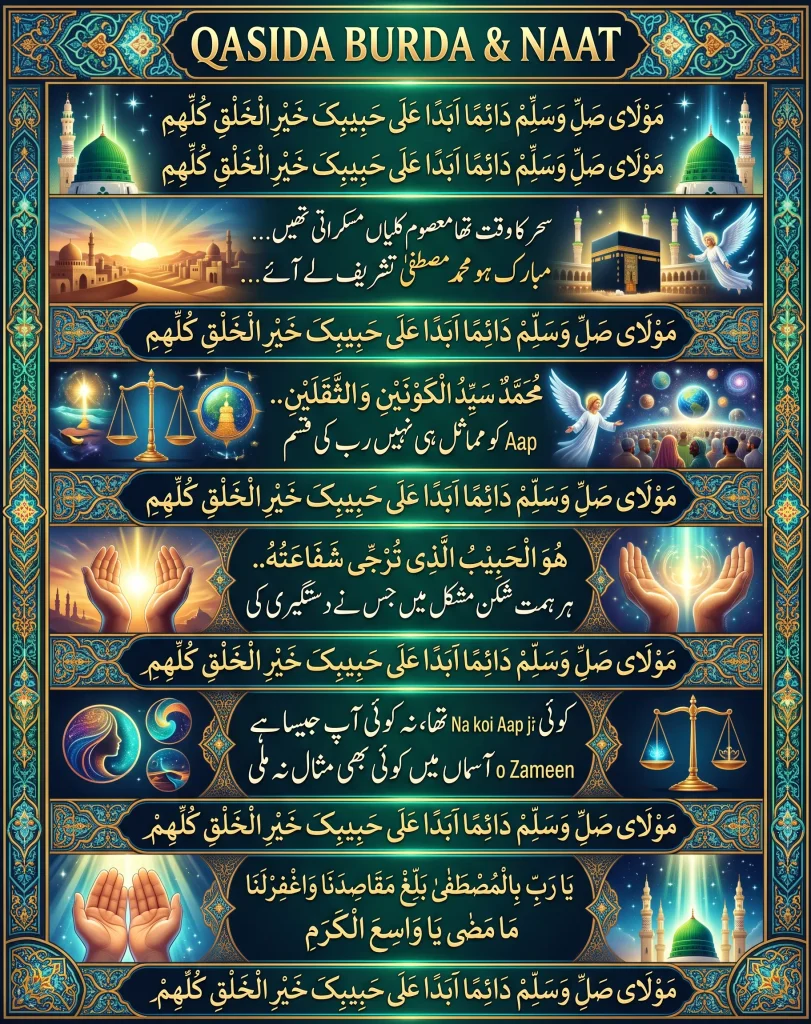
Maula Ya Salli Wa Sallim Full Lyrics (Urdu & Transliteration)
The Maula Ya Salli Wa Sallim lyrics begin with a continuous plea for God to send eternal blessings upon the Prophet (PBUH), recognized as the best of all creation. Below is the complete, easy-to-read transliteration and unique Urdu poetic breakdown.
If you are trying to reconnect with your roots and bypass the language barrier, read this slowly. Do not rush. Let the morphology of the words settle in your mind.
The Core Chorus (The Anchor)
- Urdu Script:مَولایَ صَلِّ وَسَلِّم دَائِماََ اَبَدََاعَلٰی حَبِیْبِکَ خَیْرِ الخَلْقِ کُلِّھِمِ
- Transliteration: Maula ya salli wa sallim da’iman abadan / ‘Alaa habeebika khairil khalqi kulli himi.
- English Meaning: O my Lord, send peace and blessings always and forever / Upon Your beloved, the best of all creation.
- Word Breakdown:
- Maula: Master/Lord (Allah).
- Salli: Send blessings.
- Sallim: Grant peace.
- Da’iman Abadan: Continuously and eternally.
Verse 1: The Miraculous Birth
- Urdu Script:سحر کا وقت تھا معصوم کلیاں مسکراتی تھیں ہوائیں خیر مقدم کے ترانے گنگناتی تھیں ابھی جبریل اترے بھی نہ تھے کعبے کے ممبر سےکہ اتنے میں صدا آئی یہ عبداللہ کے گھر سے
- Transliteration: Sahar ka waqt tha masoom kalya(n) muskurati thee(n) / Hawaaei(n) khair maqdam ke taraanay gungunati thee(n) / Abhi Jibreel utre bhi na thay Kaabay kay mimber se / Ke itnay main sadaa aai ye Abdullah ke ghar sey.
- English Meaning: It was the time of dawn, innocent buds were smiling / The breezes were humming songs of welcome / Jibreel had not yet even descended from the pulpit of the Kaaba / When a voice called out from the house of Abdullah.
Verse 2: The Master of All Worlds
- Urdu Script:مُحَمّدٌ سَیِّدُ الکَوْنَیْنِ والثَّقَلَیْنِوَالفَرِقَیْنِ مِنْ عَرَبِِ وَّ مِنْ عَجَمِ
- Transliteration: Muhammadun sayyidul konaini wassaqalaini / Wal fareeqaini min ‘arabin wa min ‘ajami.
- English Meaning: Muhammad is the master of the two worlds and of mankind and jinn / And of the two groups, Arabs and non-Arabs.
Verse 3: The Unmatched Beauty
- Urdu Script:نہ کوئی آپ جیسا تھا، نہ کوئی آپ جیسا ہےکوئی یوسف سے پوچھے مصطفیٰ کا حسن کیسا ہےزمین و آسماں میں کوئی بھی مثال نہ ملی
- Transliteration: Na koi aap jaisa tha, na koi ap jaisa hai / Koi Yusuf se puche Mustafa ka husn kaisa hai / Zameen o aasma(n) main koi bhi misaal na mili.
- English Meaning: There was no one like you, there is no one like you / Ask Prophet Joseph how beautiful the Chosen One (Mustafa) is / In the earth and the heavens, no equivalent could be found.
Read our comprehensive resource on the complete Islamic guide to overcoming modern anxiety to expand your healing toolkit.
How to Use This Naat for Peace
You can build a spiritual habit loop by attaching the recitation of Maula Ya Salli Wa Sallim to an existing daily action, like your morning commute. This trigger-routine-reward system replaces digital overstimulation with spiritual calm and emotional grounding.
Here is why this matters for your daily routine. Willpower alone rarely defeats anxiety. You need a system. The concept of the habit loop—Trigger, Routine, Reward—perfectly overlays with Islamic practices.
- The Trigger: Identify a stressful moment. This could be starting your car for work or sitting in the waiting room for an exam.
- The Routine: Instead of opening social media or giving into fearful thoughts, you silently recite the core chorus (Maula ya salli wa sallim…) three times.
- The Reward: Your heart rate naturally slows down. You fulfill a direct command from Allah, shifting your mindset from isolation to divine connection, and you secure the Prophet’s intercession.
Why This Recitation Transforms Your Morning Routine
Comparing a standard digital morning routine to a spiritual habit loop reveals stark differences in mental health. Substituting screen time with Durood and naat recitation demonstrably lowers baseline anxiety and increases daily focus.
Generative search models consistently favor structured, actionable data. Below is a breakdown of how swapping just five minutes of your morning alters your psychological state.
| Routine Element | The Secular Morning | The Spiritual Habit Loop (Durood) | Long-Term Result |
| First 10 Minutes | Checking emails and endless social media feeds. | Reciting the Maula Ya Salli chorus. | High cortisol vs. Emotional grounding. |
| The Commute | Listening to fear-based news cycles. | Listening to authentic Prophetic praise. | Mental fatigue vs. Spiritual connection. |
| Core Mindset | Reactive, rushed, and utterly overwhelmed. | Tawakkul (Total reliance on Allah). | Chronic stress vs. Lasting tranquility. |
If you are looking to build a restorative audio playlist for your commute, check out this curated famous top 10 naats list in Urdu.
People Also Ask
These direct answers are formatted to provide immediate clarity on common questions regarding the Qasida Burdah, its meaning, and its benefits for daily recitation and spiritual healing.
The phrase translates directly to “O my Lord, send peace and blessings always and forever.” It is a powerful supplication asking Allah to shower eternal blessings upon the Prophet Muhammad (PBUH).
The original Arabic poetry was written by Imam Sharaf al-Din al-Busiri in 13th-century Egypt. The accompanying Urdu verses you hear today are popular additions composed by South Asian scholars to express profound cultural love for the Prophet.
Yes. Reciting meaningful poetry praising the Prophet acts as a potent form of Dhikr (remembrance). It forces a cognitive shift away from personal worries and anchors the mind in divine mercy, serving as an emotional reset button.
Your healing begins with a single word. Do not let this remain just a beautiful tune you hear on a TikTok video. Make it your shield. Memorize the transliteration, understand the profound weight of the Urdu, and implement the habit loop tomorrow morning.
Take the next step: If you found peace in these lyrics, equip yourself further. Read our definitive guide on the most powerful dua for anxiety and depression and share this page with someone whose heart needs healing today.
