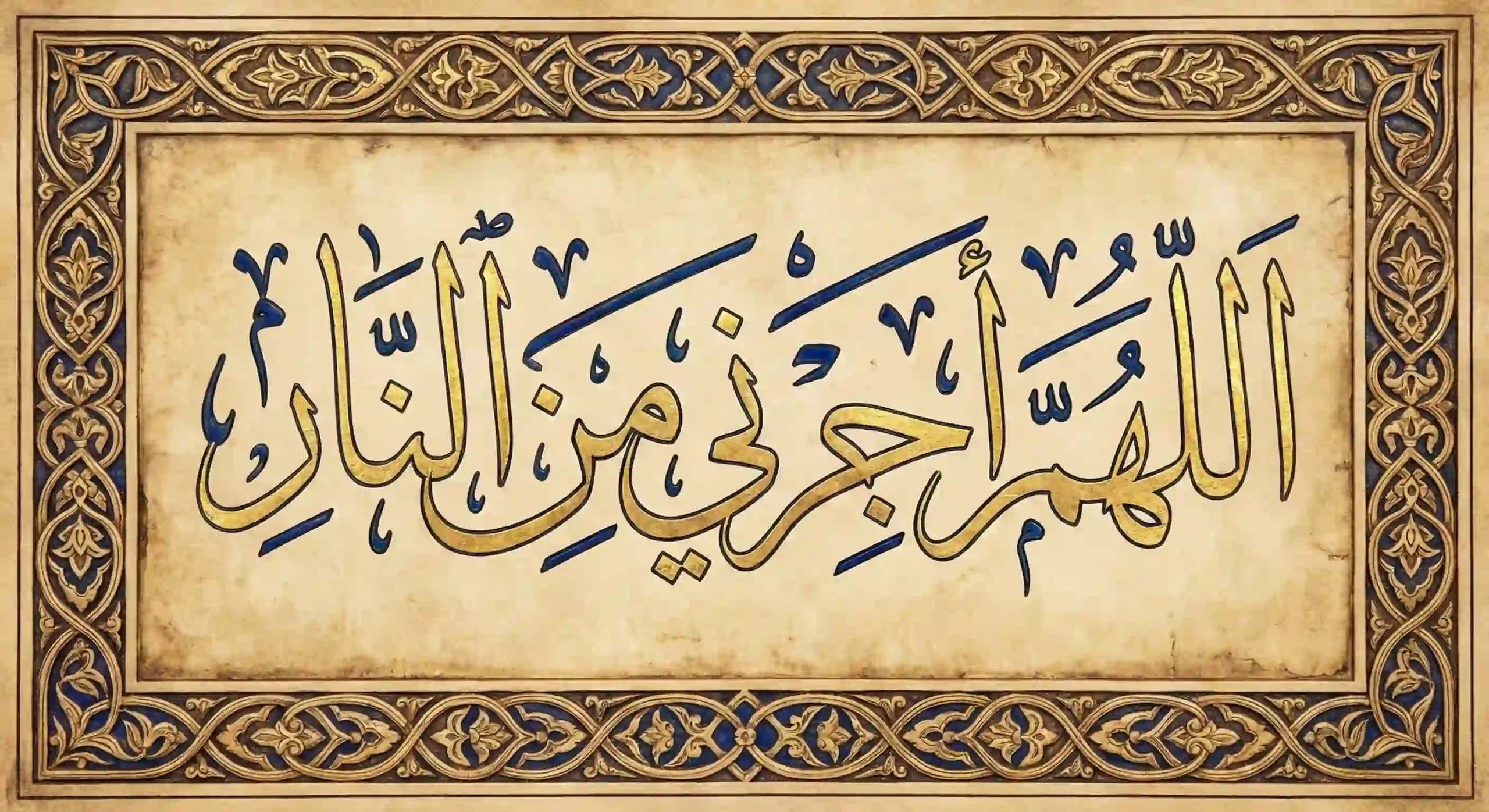
Imagine starting your day knowing you are walking under an invisible dome of protection.
We live in an era of high anxiety—financial uncertainty, health scares, and the spiritual weight of our mistakes. We often feel exposed. But what if there was a specific “spiritual password” given by the Prophet Muhammad (ﷺ) that guarantees your safety from the ultimate danger? This isn’t just a ritual; it is a divine contract of asylum known as the “Dawn & Dusk Shield.”
What is the Meaning of “Allahumma Ajirni Minan Naar”?
“Allahumma ajirni minan naar” is a concise Arabic supplication meaning “O Allah, protect me from the Fire.” It is a plea for Jiwar (asylum), asking God to grant you immediate safety from the punishments of Hellfire and the trials of the Hereafter.
To truly feel the power of this Dua, we must look beyond the surface translation. The magic lies in the Arabic morphology.
Word-by-Word Deep Dive
| Arabic Word | Transliteration | Meaning | Deep Linguistic Context |
| اللَّهُمَّ | Allahumma | O Allah | A cry that summons all of Allah’s attributes of power and mercy. |
| أَجِرْنِي | Ajirni | Protect/Save me | Comes from “Jiwar” (Neighbor/Asylum). You are asking Allah to take you in as a refugee under His personal protection. |
| مِنَ | Min | From | Preposition of separation. |
| النَّارِ | An-Naar | The Fire | Specifically Hellfire (Jahannam), representing the ultimate loss. |
The Multilingual Evidence
To ensure you are reciting this with the intention of the Ummah (global community), here is the text in its most authoritative forms:
- Arabic Text:اللَّهُمَّ أَجِرْنِي مِنَ النَّارِ
- Transliteration:Allahumma ajirni minan naar
- English (Saheeh International):“O Allah, protect me from the Fire.”
- Urdu (Fateh Muhammad Jalandhari Style):اے اللہ! مجھے آگ (جہنم) سے پناہ دے۔
The Origin Story: Where Does This Dua Come From?
The prayer “Allahumma ajirni minan naar” originates directly from the Prophet Muhammad (ﷺ). It was recorded by the great Hadith scholars Imam Abu Dawood and Imam Ahmad ibn Hanbal over 1,200 years ago, transmitted through the companion Muslim at-Tamimi.
To understand the weight of these words, we must look at the source. This isn’t a random invention; it is a spiritual prescription handed down through a chain of trust.
The Chain of Transmission (Sanad)
The narration travels through history as follows:
- The Prophet Muhammad (ﷺ) whispered this secret to…
- Al-Harith ibn Muslim at-Tamimi, who told his son…
- Muslim at-Tamimi, who passed it to the generations of scholars.
In Sunan Abi Dawud (Book of Adab, Hadith 5079), the Prophet (ﷺ) specifically instructed his companion:
“When you finish the Maghrib prayer, say ‘Allahumma ajirni minan naar’ seven times… If you die that night, protection from it will be recorded for you.”
The Dawn & Dusk Shield Protocol
Most people recite this robotically. To make this a life-changing habit, we need to apply the specific protocol taught in the traditions.
Think of the day as a battlefield.
- Fajr (The Dawn): You are entering the “battle” of the day—work stress, temptations, and heedlessness. Reciting this 7 times here locks your “spiritual armor” in place before you speak to a human being.
- Maghrib (The Dusk): The sun sets, and darkness begins. You are tired and vulnerable. Reciting this 7 times here turns on a security system for your soul before you sleep.
The “Legs Crossed” Technique
Scholars mention that for the maximum reward, one should say this while still sitting in the Tashahhud position (legs folded) immediately after the Salaam, before moving your feet or speaking to anyone. This discipline teaches focus—putting Allah before the world.
More Powerful Duas for Ultimate Protection
1. The Shield Against Sudden Harm
When to read: 3 times in the Morning & Evening. The Promise: Nothing in the heavens or earth can harm you.
- Arabic: بِسْمِ اللَّهِ الَّذِي لَا يَضُرُّ مَعَ اسْمِهِ شَيْءٌ فِي الْأَرْضِ وَلَا فِي السَّمَاءِ وَهُوَ السَّمِيعُ الْعَلِيمُ
- Transliteration: Bismillahil-ladhi la yadurru ma’as-mihi shai’un fil-ardi wa la fis-sama’i, wa Huwas-Sami’ul-‘Alim
- Meaning: “In the Name of Allah with Whose Name there is protection against every kind of harm in the earth or in the heaven, and He is the All-Hearing and All-Knowing.”
2. Protection From Evil & Harmful Creatures
When to read: 3 times in the Evening, or whenever entering a new place/building. The Promise: Protection from the evil of created things (including insect bites and hidden dangers).
- Arabic: أَعُوذُ بِكَلِمَاتِ اللهِ التَّامَّاتِ مِنْ شَرِّ مَا خَلَقَ
- Transliteration: A’udhu bikalimatillahi at-tammati min sharri ma khalaq
- Meaning: “I seek refuge in the Perfect Words of Allah from the evil of what He has created.”
3. Protection From Anxiety & Heavy Debt
When to read: When feeling overwhelmed, stressed, or financially burdened. The Promise: Removes worry and settles debts (as taught to Abu Umamah by the Prophet ﷺ).
- Arabic: اللَّهُمَّ إِنِّي أَعُوذُ بِكَ مِنَ الْهَمِّ وَالْحَزَنِ، وَالْعَجْزِ وَالْكَسَلِ، وَالْجُبْنِ وَالْبُخْلِ، وَغَلَبَةِ الدَّيْنِ وَقَهْرِ الرِّجَالِ
- Transliteration: Allahumma inni a’udhu bika minal-hammi wal-hazani, wal-‘ajzi wal-kasali, wal-jubni wal-bukhli, wa ghalabatid-dayni wa qahrir-rijal
- Meaning: “O Allah, I seek refuge in You from anxiety and sorrow, weakness and laziness, miserliness and cowardice, the burden of debts and being overpowered by men.”
4. The 360-Degree Security System
When to read: Once in the Morning & Evening. The Promise: Protection from all six directions: front, back, right, left, above, and below (earthquakes/swallowing).
- Arabic: اللَّهُمَّ احْفَظْنِي مِنْ بَيْنِ يَدَيَّ، وَمِنْ خَلْفِي، وَعَنْ يَمِينِي، وَعَنْ شِمَالِي، وَمِنْ فَوْقِي، وَأَعُوذُ بِعَظَمَتِكَ أَنْ أُغْتَالَ مِنْ تَحْتِي
- Transliteration: Allahummah-fazni min bayni yadayya, wa min khalfi, wa ‘an yamini, wa ‘an shimali, wa min fawqi, wa a’udhu bi-‘azamatika an ughtala min tahti
- Meaning: “O Allah, protect me from before me, and behind me, and from my right, and from my left, and from above me, and I seek refuge in Your Greatness from being attacked from underneath me.”
5. Protection From Severe Illness (Leprosy, Madness)
When to read: Any time as a general supplication. The Promise: Safety from physical deterioration and terrible diseases.
- Arabic: اللَّهُمَّ إِنِّي أَعُوذُ بِكَ مِنَ الْبَرَصِ وَالْجُنُونِ وَالْجُذَامِ وَمِنْ سَيِّئِ الأَسْقَامِ
- Transliteration: Allahumma inni a’udhu bika minal-barasi wal-jununi wal-judhami wa min sayyi’il-asqam
- Meaning: “O Allah, I seek refuge in You from leprosy, insanity, mutilation, and from all serious illnesses.”
6 Life-Changing Benefits of This Wazifa for Protection
The primary benefits of reciting “Allahumma ajirni minan naar” include guaranteed protection from Hellfire, the intercession of the Fire itself on your behalf, and starting your day and night with a spiritual shield against anxiety.
Why do millions of Muslims recite this every day? It is not just about fear; it is about immense gain.
1. The “Written” Guarantee of Safety
The Hadith states that if you die on the day or night you recited this, “protection from it will be recorded for you.” In a world of uncertainty, this is a divine insurance policy for your soul.
2. The Fire Becomes Your Lawyer (Intercession)
This is a profound concept. When you seek refuge from the Fire (especially 3 times or more), the Hellfire itself speaks to Allah.
- The Hadith: The Fire says, “O Allah, save him from me!”Imagine the very thing you fear asking God to protect you. This turns a threat into an advocate.
3. The “Jiwar” (Divine Asylum)
As analyzed earlier, the word Ajirni implies entering Allah’s neighborhood. You are no longer just a “servant”; you are a “protected guest” of the King. This status brings a psychological peace that no amount of money can buy.
4. A Shield Against Daily Sins
Scholars note that when a person sincerely asks for protection from the Fire at Fajr, they become more conscious of their actions during the day. It acts as a moral compass—you are less likely to lie or cheat because you just asked to be saved from the consequences of those sins.
5. Reviving a Forgotten Sunnah
In an age where we rush off our prayer mats to check our phones, sitting still to recite this 7 times revives a specific practice of the Prophet (ﷺ). You get the reward of following the Sunnah, which is the key to Allah’s love.
6. Calmness in the “Hinges” of the Day
Sunrise and Sunset are times of transition. Biologically, our bodies release different hormones; spiritually, the “guard” changes. Anchoring yourself with this Dua at these precise times reduces anxiety and grounds you.
3 Times vs. 7 Times vs. 100 Times: Which is Correct?
Reciting the Dua seven times is specific to Fajr and Maghrib prayers for the “Shield” reward. However, narrations also state that asking for protection three times causes the Fire to intercede for you. Reciting it 100 times is a general voluntary act of remembrance (Wazifa).
The Verdict:
- Best Practice: Stick to 7 times after Fajr and Maghrib to follow the specific Hadith of Al-Harith.
- Backup Plan: If you forget, ensure you say it at least 3 times to trigger the intercession of the Fire.
- Spiritual Boost: Recite it 100 times if you are feeling heavy-hearted and need to soften your heart with the remembrance of the Hereafter.
People Also Ask:
Yes. While the “gold standard” is to say it before moving or speaking, the mercy of Allah is vast. If you forgot, say it as soon as you remember. You will still get the reward of the Dua, even if you missed the specific “Sunnah perfection” of the moment.
The word An-Naar specifically means Hellfire. However, scholars note that whoever is saved from the ultimate calamity (Hell) is essentially saved from the smaller calamities of this world. It puts your worldly problems into perspective.
Absolutely. This is a Dua (supplication) and Dhikr (remembrance), not Salah (prayer). Women can and should recite this for protection during their menses without any restrictions.
It is pronounced as Ah-jir-nee. The ‘r’ is rolled slightly, and the ‘nee’ is stretched. It rhymes with “Hear me.”
Final Thought: Your Next Step
Don’t just read this and close the tab.
Tonight at Maghrib, try the Protocol. Sit still after your prayer. Do not check your phone. Do not adjust your legs. Say Allahumma ajirni minan naar seven times with full conviction. You are not just saying words; you are locking the door against the Fire.
