Medical Disclaimer: The content provided here is for spiritual healing and informational purposes only. It is not a substitute for professional medical advice, diagnosis, or treatment. Always seek the advice of your physician for severe or chronic pain.
Why Does My Head Feel Heavy? A Spiritual Perspective
Have you ever felt a throbbing pain in your head that no amount of water or rest seems to fix? In our fast-paced 2026 lives, we often treat a headache as just a physical annoyance. But what if that pressure is a signal? A signal to pause, disconnect from the noise, and reconnect with your Creator.
Pain, in the Islamic tradition, is often a “Purification Filter”—a means to wash away minor sins. As the Prophet Muhammad (ﷺ) said, even the prick of a thorn expiates sins. Imagine the weight lifting off your soul as you recite these words.
1. The Most Powerful Sir Dard Ki Dua (Quranic)
What is the best Dua for a headache?
The most effective Dua for a headache is Surah Al-Waqiah (verse 19) or simply placing your hand on the pain and reciting “Bismillah” 3 times, followed by the seeking of refuge in Allah’s power.
Option A: The Specific Verse
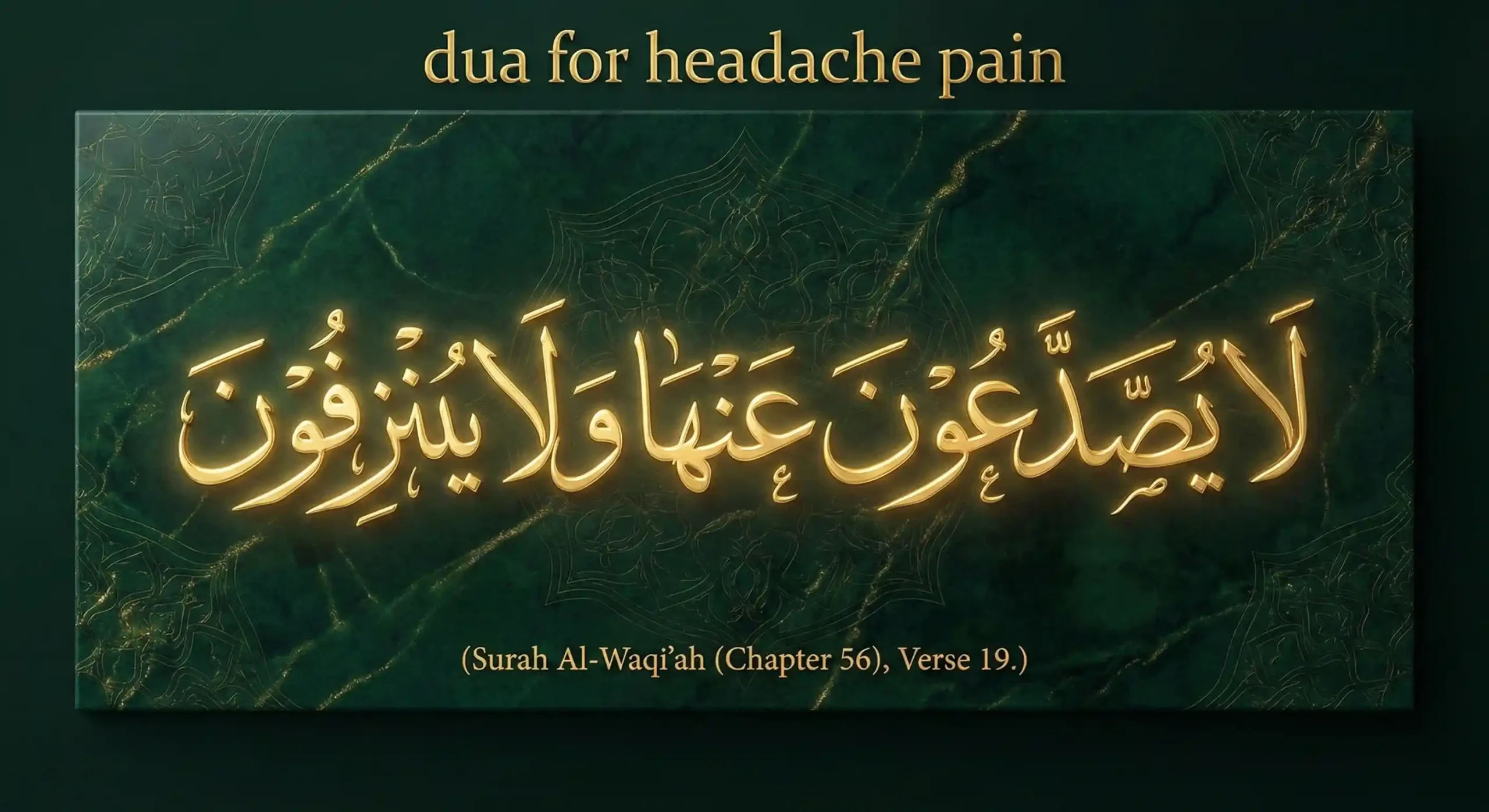
Scholars often recommend this verse from Surah Al-Waqiah, which describes the people of Jannah who feel no pain.
- Arabic: لَّا يُصَدَّعُونَ عَنْهَا وَلَا يُنزِفُونَ
- Transliteration: La yusadda’una ‘anha wa la yunzifun
- English (Sahih International): “No headache will they have therefrom, nor will they be intoxicated.”
- Urdu (Jalandhari): “Na us se sar dard ho ga aur na un ki aqal jati rahe gi.”
2. The Sunnah Method: Self-Ruqyah for Instant Relief
How do I perform Ruqyah on myself for pain?
Place your right hand on the area of pain. Say “Bismillah” (In the Name of Allah) 3 times. Then, recite the specific seeking of refuge Dua 7 times.
This method comes directly from Sahih Muslim, taught by the Prophet (ﷺ) to Uthman bin Abul-As (RA) when he complained of pain.
The Step-by-Step Method:
- Place your right hand directly on your forehead or the spot that hurts.
- Say: “Bismillah” (3 times).
- Recite this 7 times:
- Arabic: أَعُوذُ بِاللَّهِ وَقُدْرَتِهِ مِنْ شَرِّ مَا أَجِدُ وَأُحَاذِرُ
- Transliteration: A’udhu Billahi wa qudratihi min sharri ma ajidu wa uhadhiru.
- English: “I seek refuge in Allah and in His Power from the evil of what I find and of what I guard against.”
- Urdu: “Main Allah aur Us ki qudrat ki panah mangta hoon us shar se jo main mahsoos karta hoon aur jis se main darta hoon.”
3. Adhe Sar Ka Dard (Migraine) Ki Dua
Is there a Dua specifically for Migraines?
While the general Ruqyah applies to all pain, for severe migraines (Adhe Sar Ka Dard), reciting Surah Al-Fatiha 7 times with deep concentration is known as “The Cure” (Ash-Shifa).
The Spiritual Habit Loop: “The Fatiha Connection”
Don’t just read it; breathe it.
- Recite: Alhamdulillah rabbil alameen…
- Visualize: The healing light of the Quran entering your forehead and the dark tension leaving with your exhale.
- Repeat: 7 times. This number is specific and significant in the Sunnah.
4. Tibb an-Nabawi: Physical Remedies from the Sunnah
What did the Prophet (ﷺ) use for headaches?
The Prophet (ﷺ) used Hijama (Cupping) for migraine relief and occasionally applied Henna to the head. He also recommended Honey as a general cure for ailments.
- Hijama (Cupping): Narrated in Sahih Bukhari, the Prophet (ﷺ) was cupped on his head for a unilateral headache (migraine) while he was in Ihram.
- Hydration: Often, headaches are dehydration. The Sunnah is to drink water in 3 sips, sitting down. This simple act aligns your physical body with spiritual mindfulness.
Authentic Dua for Bad Eye (Nazar Protection)
Shield yourself and your family immediately. Read the complete Ruqyah guide and Prophet’s Sunnah method.
Subhanallahi Wa Bihamdihi: The Weight of Heavy Scales
Learn the Dhikr that is “light on the tongue but heavy on the scales” and erases sins like foam on the ocean.
5. Common Questions
Yes, you can recite Duas for pain relief without Wudu, as they are supplications (Dhikr), though being in Wudu is always better.
For the specific Ruqyah Dua, the Sunnah specifies reciting it 7 times. For other verses, you can recite them as many times as needed until you feel relief.
No, there is no restricted time. You should recite it the moment you feel pain. However, reciting after Fajar or Asr prayers is often considered a time of acceptance.
Final Thought: Pain as a Messenger
Next time a headache strikes, don’t just reach for the pill bottle immediately. Start with “Bismillah.” Use the pain as a trigger to speak to Allah. The pill heals the body, but the Dua heals the heart—and often, calming the heart is exactly what the head needs.