“Hum ko bulana ya Rasool Allah” ﷺ is an Urdu naat, a poem in praise of the Prophet ﷺ, built around the wish to be called to Madinah. This page pairs an illustrated infographic of the naat with a clear explanation of who wrote it, who recited it, what each of its six panels means and how to recite it with etiquette. An image cannot be searched, so every panel is explained in text below. For more poems of this kind, see our list of famous naats in Urdu.
Quick Answer
- Poet: Syed Riazuddin Soharwardy
- Form and theme: a naat about longing to visit Madinah. The best-known recitation is by the late Junaid Jamshed
- Full text: read it only from a licensed source. This page gives the first line, the meaning and a glossary.
This page quotes only the first line of the naat, ہم کو بلانا یا رسول اللہ (Hindi: हम को बुलाना या रसूल अल्लाह), and explains the meaning in words.
Contents
- Who wrote “Hum Ko Bulana Ya Rasool Allah”?
- Who recited it?
- What does each panel of the infographic mean?
- Hard words explained
- How to recite the naat
- When is the naat recited?
- Scholarly views on addressing “Ya Rasool Allah”
- Similar naats on this site
- Common mistakes
- A simple method: Verify, Understand, Recite
- Frequently asked questions
Who wrote “Hum Ko Bulana Ya Rasool Allah”?
This page credits the naat to Syed Riazuddin Soharwardy. This credit covers the verses only, not the recitation. Naat credits are often wrong online, so treat this name as provisional until a primary source confirms it, and take care when you copy it elsewhere.
A poet (shayar) writes the verses. A reciter (naat khwan) performs them. A famous voice often replaces the poet’s name in people’s memory, so we list the two separately.
Poets with similar names exist, so check the spelling against a reliable source. The poet’s birth, death, city and published collection stay blank until verified.
Who recited it?
The naat became widely known in the voice of the late Junaid Jamshed, a Pakistani naat khwan. He was the reciter, not the poet. Knowing the reciter does not tell you who wrote the verses. We will add a listening link once the recording is confirmed.
Junaid Jamshed began as a pop singer, left music in 2004 and turned to religious work. He died in a plane crash on 7 December 2016, according to ARY News.
We do not guess an album or a release year. Recording details will be added only with a reliable source.
What does each panel of the infographic mean?
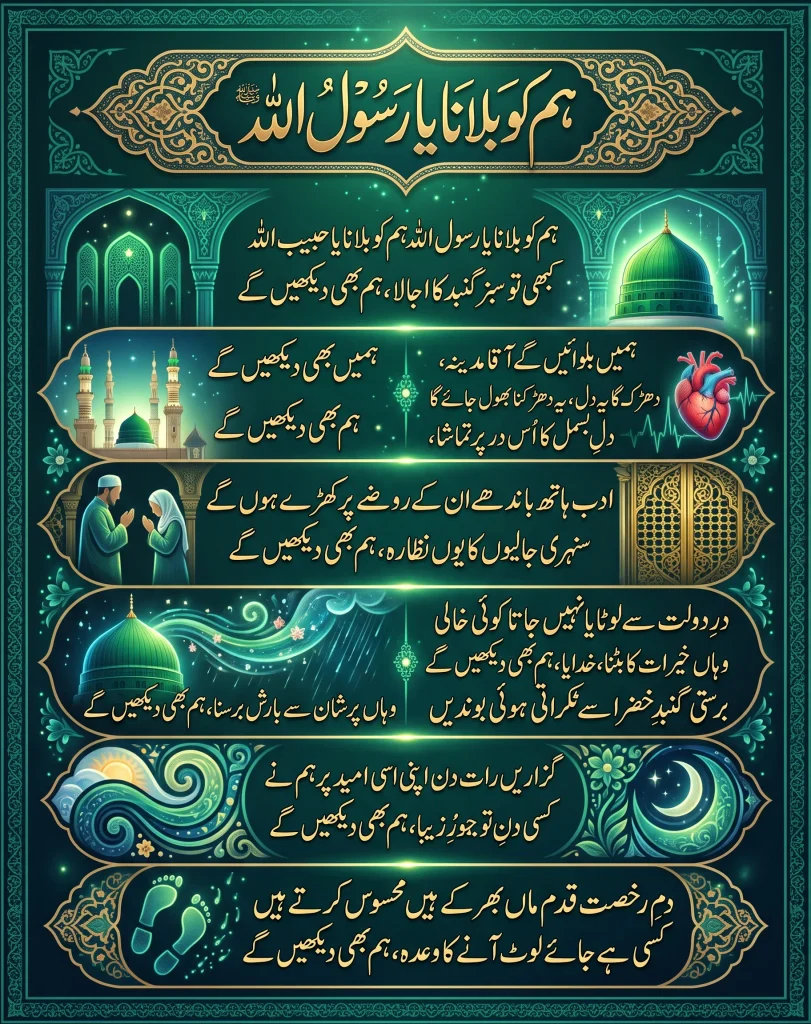
The infographic follows six moments in the naat: the call to Madinah, a racing heart, standing with respect at the Prophet’s ﷺ resting place, generosity and rain, nights of waiting, and the hope to return. Each ends on longing, not on a claim.
A sher is a couplet of two lines, and each line is a misra. The naat moves through six scenes, and each panel in the infographic shows one.
Panel 1: the call. A glowing Green Dome sits beside the opening lines. The poet asks to be summoned to Madinah. He treats it as a gift from the Prophet ﷺ, not a right. The Green Dome stands over the Prophet’s ﷺ resting place in the Prophet’s Mosque.
Panel 2: the racing heart. A heart with a pulse line fills this panel. The poet imagines his heart beating so hard at that door that it forgets its own rhythm.
Panel 3: etiquette. Two worshippers raise their hands next to golden lattice screens. The poet imagines standing with folded hands before the grilles around the Prophet’s ﷺ resting place. The voice drops and the heart beats fast. The reciter should keep the same mood.
Panel 4: generosity and rain. The poet says no one is turned away empty-handed from this door, and he wants to see charity given there. Read it as an expression of love and good faith. Drops striking the Green Dome stand for mercy in his imagination. This is poetic imagery, not an explanation of any verse or hadith.
Panel 5: waiting. A sun and a crescent moon mark the days and nights. The poet spends them on one hope, to see the beautiful face of the Prophet ﷺ.
Panel 6: parting and return. Footprints close the infographic. This verse seems to speak of leaving and a wish to return, but the wording in the version we received is doubtful.
Reciters usually begin and end a naat with durood. The Quran mentions Allah and His angels sending blessings on the Prophet ﷺ and tells believers to do the same, in Surah Al-Ahzab 33:56 (also on Quran.com) . Read the wording and virtues in our Durood Shareef guide.
If the naat stirs a wish to visit, our Umrah guide for first-time pilgrims gives a practical plan.
Hard words explained
Some words in the naat are unfamiliar to new readers. In plain terms:
| Word | Urdu | Hindi | Meaning | Origin |
|---|---|---|---|---|
| Rauza | روضہ | रौज़ा | The Prophet’s ﷺ blessed grave and its enclosure | Arabic |
| Gumbad-e-Khazra | گنبدِ خضرا | गुंबद-ए-ख़ज़्रा | The Green Dome; “khazra” means green | Persian + Arabic |
| Jaaliyan | جالیاں | जालियाँ | Carved lattice screens around the Rauza | Hindi/Urdu |
| Dil-e-bismil | دلِ بسمل | दिल-ए-बिस्मिल | A wounded, restless heart | Persian |
| Jamal | جمال | जमाल | Beauty | Arabic |
| Rooye zeba | روئے زیبا | रू-ए-ज़ेबा | A beautiful face | Persian |
| Khairat | خیرات | ख़ैरात | Charity given for Allah’s sake | Arabic |
| Habibullah | حبیب اللہ | हबीबुल्लाह | “Beloved of Allah”, a title of the Prophet ﷺ | Arabic |
How to recite the naat
A naat asks for the same respect as worship. Six steps help:
- Begin with durood.
- Read the text slowly first, then study the meaning.
- Pause after each verse so the meaning can settle.
- Keep the voice soft. This is a humble request, not a cry.
- You may learn the tune of a recording, but correct words come first.
- End with durood.
Watch your pronunciation. Say the kh and z in “Khazra” clearly.
When is the naat recited?
It is usually recited during Ramadan, on Fridays, in Rabi ul Awwal gatherings, at home and at school events. Because the theme is longing for Madinah, people also listen to it before Hajj or Umrah journeys and during travel preparations.
For Rabi ul Awwal dates, see Islamic months in Urdu. For Friday recitation, see which surah to recite on Friday.
Scholars differ on Mawlid and naat gatherings. Some see them as permissible and blessed. Others allow reciting a naat but are cautious about particular forms or arrangements of a gathering. Ask a trusted scholar you follow.
Scholarly views on addressing “Ya Rasool Allah”
The naat opens by addressing the Prophet ﷺ directly. Scholars hold different views on this.
One view says direct address is allowed in poetry as an expression of love, and points to “as-salamu alayka ayyuhan-nabi” in the prayer’s tashahhud. Another view says the address should not suggest that help is being asked from anyone other than Allah, and prefers that the wish be asked from Allah as a prayer.
We state both views with respect. The reader should decide with the guidance of their own scholar.
Similar naats on this site
If you like naats about longing for Madinah, these pages may help.
| Naat | Poet | Form | Theme | Link |
|---|---|---|---|---|
| Hum ko bulana ya Rasool Allah | Syed Riazuddin Soharwardy | Naat | Longing to visit Madinah | This page |
| Meetha Meetha Hai Mere Muhammad ﷺ Ka Naam | [VERIFY] | Naat | [VERIFY] | Meetha Meetha naat lyrics |
| Zahe Muqaddar | [VERIFY] | Naat | [VERIFY] | Zahe Muqaddar naat |
| Ho Karam Sarkar | [VERIFY] | Naat | [VERIFY] | Ho Karam Sarkar naat |
| Ya Nabi Salam Alaika | [VERIFY] | Salam | [VERIFY] | Ya Nabi Salam Alaika lyrics |
Common mistakes
- Crediting the reciter as the poet.
- Publishing text written from memory with no source.
- Mixing up different naats about longing for Madinah.
- Changing words in a line, especially in the last verse.
A simple method: Verify, Understand, Recite
We suggest one rule: verify, understand, recite. First verify the text and the poet from a reliable source. Then understand the meaning. Last, recite with etiquette and a soft voice.
Frequently asked questions
Does the infographic show the full naat?
The image carries the full text, so it can be published only with a confirmed licence or permission. Until then, this page uses a version with the first line only, plus the meaning of each panel in words. For the full text, use a licensed source.
What is the difference between naat and hamd?
Hamd is praise of Allah alone. A naat is written in praise of the Prophet ﷺ. A manqabat is composed in honour of the Companions or revered figures of the faith. Each has its own etiquette, so do not give one the place of another.
When was this naat first recited?
We found no reliable date for its first publication or first recording, so we do not state one. If you have a diwan or recording reference, send it to us and we will correct the page. We never guess a year.
Did Junaid Jamshed write this naat?
Our information says no. The poet is Syed Riazuddin Soharwardy and the late Junaid Jamshed recited it. Listing poet and reciter separately is correct, because a famous voice often takes the place of the poet’s name. Both points still need final confirmation.
What does the Green Dome mean?
The Green Dome stands over the Prophet’s ﷺ blessed resting place in the Prophet’s Mosque in Madinah. It is also called Gumbad-e-Khazra, and “khazra” means green in Arabic. For visitors it is the best-known sign of Madinah, and it is one of the naat’s main images.
Can I share or download the infographic?
Share the page link freely. Downloading or reposting the image depends on the licence, which is not yet confirmed. If sharing is allowed, the page will offer a download button and an embed code that credits this page. Please do not crop out the credit line.
Why do I find different texts of this naat?
Naats spread by word of mouth and audio. People write down what they hear, and words change along the way. That is why one naat has several texts. The correct text is the one that comes from the poet’s collection or a licensed publication.
Which durood should I recite before a naat?
Reciting durood before a naat is a mark of respect. You can begin with any established durood, such as Durood-e-Ibrahimi. We do not state any special condition without a reliable reference. Texts of different duroods are on our durood pages.
Next step: first read the Durood Shareef text and benefits. Then see our Umrah preparation guide. After that, explore more naats in Urdu.
Last reviewed: [4,October] 2026 | Scholar review: Shahab Khan | Language editor: [ATIF KHAN] | To report a correction or a rights concern, contact [ozafakhan316@gmail.com].
