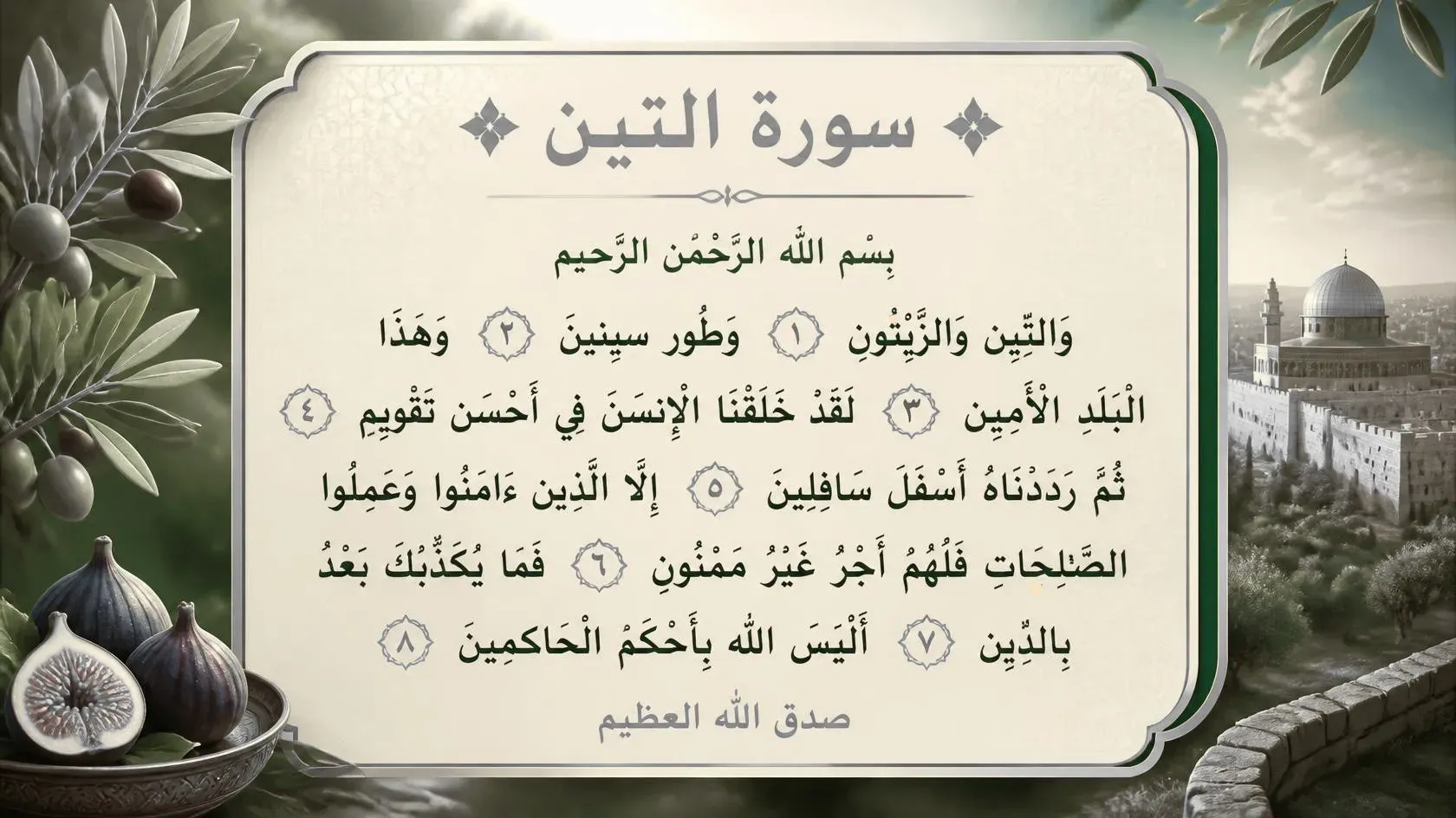
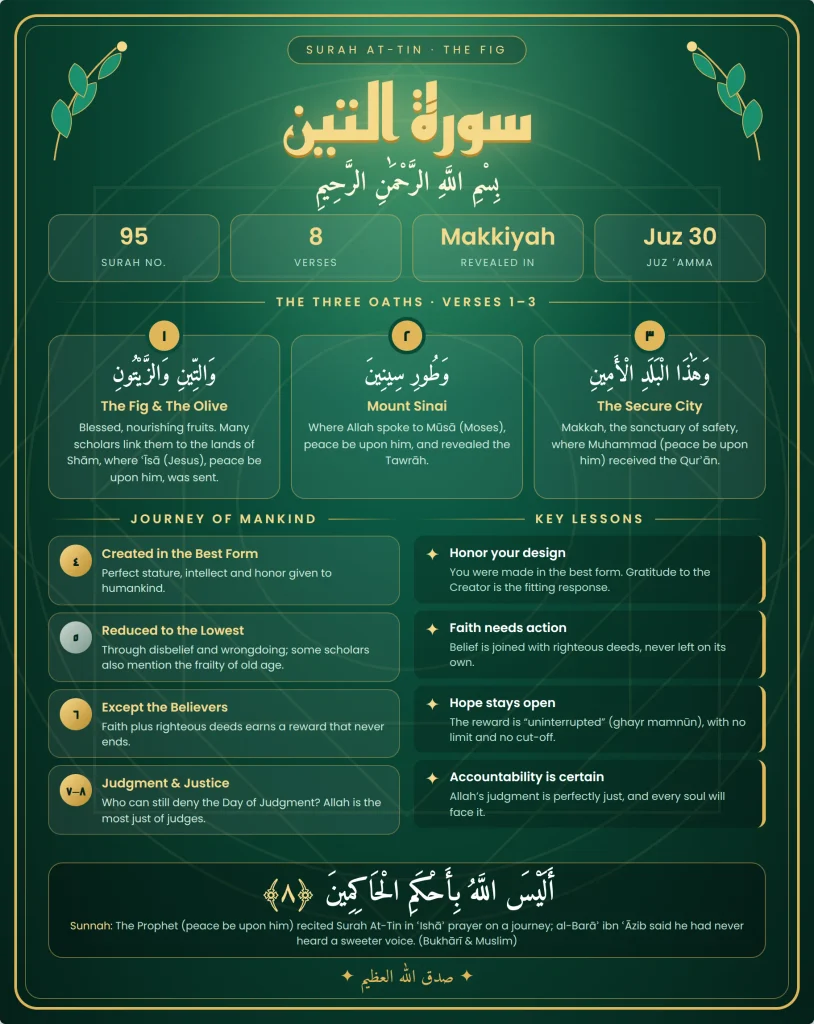
Surah Teen (formally transliterated as Surah At-Tin, meaning “The Fig”) is Chapter 95 of the Quran, located in the 30th Para (Juz Amma). Revealed as an early Meccan surah of 8 verses, it opens with four sacred oaths—the fig, the olive, Mount Sinai, and Mecca—to prove that Allah (God) created human beings in the finest physical and spiritual mold (Ahsani Taqwim), while showing how faith and good deeds protect us from spiritual decline.
Quick Answer: Surah Teen at a Glance
- Core Facts: Chapter 95 of the Quran | 30th Para (Juz Amma) | 8 Verses | 34 Arabic Words | Early Meccan Revelation.
- Core Message: You were designed by Allah at peak spiritual and intellectual potential (Ahsani Taqwim). Only conscious faith (Iman) and righteous action (Amal Salih) prevent burnout and moral decline (Asfala Safilin).
- Tonight’s Action: Recite Surah Teen in the first or second unit (rak’ah) of your Isha (night) prayer following the authentic Sunnah (prophetic tradition) in Sahih al-Bukhari 769, and pause for three seconds at Verse 4 to reset your focus.
Table of Contents
- Why Do We Recite Surah Teen on Autopilot?
- How Do You Read Surah Teen With Arabic, Transliteration, and English, Urdu, and Hindi Translations?
- What Does Each Word of Surah At-Tin Mean?
- Why Does Allah Swear by the Fig, Olive, Mount Sinai, and Mecca?
- How Does Surah Teen Explain Spiritual Burnout and Self-Worth?
- What Are the Authentic Benefits and Wazifa of Surah Tin?
- How Can You Practice the “4-Oath Ahsani Taqwim Anchor” Tonight?
- What Common Mistakes Should You Avoid When Reciting Chapter 95?
- Frequently Asked Questions About Surah Teen
You stand on your prayer mat after a ten-hour workday in London, Chicago, or Toronto. Your phone is buzzing on the desk. You begin Isha (the night prayer), and your tongue automatically reaches for one of the shortest chapters you memorized as a child: “Wat-teeni waz-zaytoon…” Thirty seconds later, you bow into Ruku (bowing posture), realizing you did not register a single word you just said.
That robotic feeling carries a heavy emotional weight. When you spend all day battling workplace pressure, endless screen scrolling, and the quiet exhaustion of being the only visibly practicing Muslim in your office or lecture hall, an empty prayer leaves you feeling even more disconnected. You know you have potential, yet you feel yourself slipping into mental fatigue and spiritual numbness.
The prophetic remedy is already sitting on your tongue. When the Prophet Muhammad ﷺ traveled or led the night prayer, he turned to Surah At-Tin not because it was quick, but because its eight verses rebuild human dignity from the ground up.
[SCHOLAR ANECDOTE: A young marketing professional in London once told me she felt like a corporate machine, completely drained by endless quarterly metrics and client demands. When we sat down to reflect on Surah At-Tin, she realized her autopilot recitation of Verse 4 (Ahsani Taqwim) was the exact mirror she needed: Allah designed her in the finest mold, not to measure her worth by spreadsheets, but to stand upright with divine dignity. That single realization transformed her Isha prayer from a chore into a daily sanctuary that restored her mental and spiritual balance.]
To read Surah Teen accurately, recite the 8 Arabic verses with proper vowel markings (tashkeel) while reflecting on the meaning. Below is the complete text of Chapter 95 with phonetic transliteration (watini wa zaitun wa toore seneen), alongside verified English, Urdu, and Hindi translations for deeper comprehension.
Translation Sources: English from The Clear Quran by Dr. Mustafa Khattab; Urdu from Fateh Muhammad Jalandhri; Hindi from Maulvi Muhammad Farooq Khan [VERIFY: Reviewer to confirm exact Hindi Devanagari typesetting against printed edition].
✦ سورة التين ✦
بِسْمِ اللَّهِ الرَّحْمَٰنِ الرَّحِيمِ
وَالتِّينِ وَالزَّيْتُونِ ﴿١﴾ وَطُورِ سِينِينَ ﴿٢﴾ وَهَٰذَا الْبَلَدِ الْأَمِينِ ﴿٣﴾ لَقَدْ خَلَقْنَا الْإِنسَانَ فِي أَحْسَنِ تَقْوِيمٍ ﴿٤﴾ ثُمَّ رَدَدْنَاهُ أَسْفَلَ سَافِلِينَ ﴿٥﴾ إِلَّا الَّذِينَ آمَنُوا وَعَمِلُوا الصَّالِحَاتِ فَلَهُمْ أَجْرٌ غَيْرُ مَمْنُونٍ ﴿٦﴾ فَمَا يُكَذِّبُكَ بَعْدُ بِالدِّينِ ﴿٧﴾ أَلَيْسَ اللَّهُ بِأَحْكَمِ الْحَاكِمِينَ ﴿٨﴾
صدق الله العظيم
Bismillah (Opening Invocation)
Bismillahir-Rahmanir-Raheem
- English: In the Name of Allah—the Most Compassionate, Most Merciful.
- Urdu: شروع اللہ کے نام سے جو بڑا مہربان نہایت رحم والا ہے۔
- Hindi: अल्लाह के नाम से जो बड़ा मेहरबान, निहायत रहम वाला है।
Verse 1
Surah teen Transliteration:
Wat-teeni waz-zaytoon
- English: By the fig and the olive, (Quran 95:1)
- Urdu: انجیر کی قسم اور زیتون کی،
- Hindi: अंजीर की क़सम और ज़ैतून की,
Verse 2
Transliteration:
Wa toori seeneen
- English: and Mount Sinai, (Quran 95:2)
- Urdu: اور طور سینین کی،
- Hindi: और तूर-ए-सीनीन (सीनाई पर्वत) की,
Verse 3
Tansliteration:
Wa haadhal-baladil-ameen
- English: and this secure city [of Mecca]! (Quran 95:3)
- Urdu: اور اس امن والے شہر (مکہ) کی،
- Hindi: और इस अमन वाले शहर (मक्का) की,
Verse 4
Transliteration:
Laqad khalaqnal-insaana fee ahsani taqweem
- English: Indeed, We created humans in the best form. (Quran 95:4)
- Urdu: بے شک ہم نے انسان کو بہترین صورت میں پیدا کیا،
- Hindi: बेशक हमने इंसान को बेहतरीन साँचे (सूरत) में पैदा किया,
Verse 5
Transliteration:
Thumma radadnaahu asfala saafileen
- English: But We reduce them to the lowest of the low, (Quran 95:5)
- Urdu: پھر ہم نے اسے سب سے نیچے پھیر دیا،
- Hindi: फिर हमने उसे सब से नीचे वालों में फेर दिया,
Verse 6
Transliteration:
Illal-ladheena aamanoo wa ‘amilus-saalihaati falahum ajrun ghayru mamnoon
- English: except those who believe and do good—they will have a never-ending reward. (Quran 95:6)
- Urdu: مگر جو لوگ ایمان لائے اور نیک عمل کیے تو ان کے لیے بے انتہا اجر ہے،
- Hindi: सिवाय उन लोगों के जो ईमान लाए और नेक अमल किए, तो उनके लिए कभी न ख़त्म होने वाला बदला है,
Verse 7
Transliteration:
Famaa yukadhdhibuka ba’du bid-deen
- English: Now, what makes you deny the [final] Judgment? (Quran 95:7)
- Urdu: تو اس کے بعد تمہیں روزِ جزا کے بارے میں کون سی چیز جھٹلاتی ہے؟
- Hindi: तो इसके बाद तुम्हें बदले के दिन (आख़िरत) के बारे में कौन-सी चीज़ झुठलाती है?
Verse 8
Transliteration:
Alaysal-laahu bi-ahkamil-haakimeen
- English: Is Allah not the most just of all judges? (Quran 95:8)
- Urdu: کیا اللہ سب حاکموں سے بڑا حاکم نہیں ہے؟
- Hindi: क्या अल्लाह सब हाकिमों से बड़ा हाकिम (इंसाफ़ करने वाला) नहीं है?
Understanding each Arabic word in Surah At-Tin transforms your prayer from mechanical repetition into an active conversation with Allah. This word-by-word breakdown covers the key vocabulary across all eight verses of Chapter 95 so you can recognize every phrase while standing in Salah.
For a broader overview of how short surahs connect across the Quran, explore our master guide on short surahs in the Quran.
In classical Tafsir (Quranic exegesis), Allah swears by the fig, the olive, Mount Sinai, and Mecca to connect physical blessings with sacred prophetic history. As Imam Ibn Kathir explains in Tafsir Ibn Kathir (Vol. 8, Surah At-Tin), these four oaths trace the geographical footsteps of revelation from Jerusalem and Sinai directly to Mecca.
No authentic Asbab al-Nuzul (specific historical incident of revelation) is recorded for Surah At-Tin; rather, it addresses the core Meccan themes of human nature and resurrection. Classical scholars such as Ibn Abbas, Ikrimah, Qatadah, and Imam Al-Qurtubi highlight two complementary layers in Verses 1–3:
- The Botanical Layer: The fig (At-Tin) is pure nourishment with no pit or waste, while the olive (Az-Zaytun) yields both food and oil for light. Together, they represent outward sustenance and inward illumination. Before or after meals, you can also practice the Sunnah using the masnoon dua for eating fruit.
- The Geographic & Prophetic Layer: According to Ibn Kathir, the fig and the olive symbolize the lands where they grow abundantly—specifically Damascus/Syria and Bayt al-Maqdis (Jerusalem), linking directly to the sacred sanctuary of Masjid al-Aqsa where Prophet Isa (Jesus, peace be upon him) taught. Mount Sinai (Tur Sinin) is the mountain where Allah spoke to Prophet Musa (Moses, peace be upon him). Finally, This Secure City (Al-Balad Al-Amin) is Mecca, established as a sanctuary around Prophet Ibrahim’s sanctuary at Maqam-e-Ibrahim and honored as the birthplace of Prophet Muhammad ﷺ.
Why does Allah swear by the homelands of the greatest prophets right before saying, “We created humans in the best form”? Because the prophets are the living proof of what a human being looks like when operating at peak spiritual design.
Surah Teen explains spiritual burnout through the contrast between Ahsani Taqwim (our original state of upright spiritual and mental balance) and Asfala Safilin (the emotional and moral exhaustion that happens when we lose our anchor). Faith and consistent daily actions protect our dignity even when worldly pressures mount.
Let us look closely at Verses 4 to 6:
- Peak Human Potential (Ahsani Taqwim): The word Taqwim comes from the Arabic root q-w-m, meaning to stand upright, balance, and assign value. Allah created you with Fitrah—an innate moral compass, high intellect, and the capacity to reflect divine mercy and justice. You are not an accident of biology or a cog in a corporate machine. For an exhaustive analysis of this concept, read our dedicated study on Laqad khalaqnal insana fi ahsani taqweem.
- The Great Reversal (Asfala Safilin): Classical exegetes like Ibn Kathir and Al-Tabari give two explanations for being reduced to “the lowest of the low.” First is the moral fall: when humans weaponize their God-given intelligence for greed, arrogance, or heedlessness, they sink lower than animals. Second is physical aging: even the sharpest mind eventually faces physical frailty and old age.
- The Exemption Clause: Verse 6 delivers the lifeline: “Except those who believe and do good—they will have a never-ending reward.” If you interpret Verse 5 as moral burnout, faith (Iman) and righteous deeds (Amal Salih) keep your soul upright. If you interpret Verse 5 as aging and cognitive decline, Ibn Abbas famously explained (as cited in Tafsir al-Tabari and Tafsir Ibn Kathir) that believers who worshipped Allah in their youth continue to have their good deeds recorded even when old age or illness weakens them.
Notice how Verse 6 mirrors the exact prescription found in our Surah Al-Asr meaning and translation. When you anchor your day in Tawakkul (trusting reliance on Allah) and Sabr (patient perseverance), your value never depreciates. If workplace stress or low mood is weighing on you, pair this reflection with the Islamic guide to overcoming modern anxiety.
Health & Wellness Disclaimer: Reciting the Quran and making dua (supplication) provide profound spiritual grounding, but they complement—and never replace—professional medical or psychological care. If you are experiencing clinical depression, severe burnout, or cognitive decline, please consult a licensed healthcare provider alongside your spiritual practice.
The authentic benefits of Surah Tin come from reciting it in prayer with contemplation, following the Prophet’s ﷺ example in Sahih al-Bukhari (769), and affirming Allah’s justice at the final verse. Many popular online wazifa (prescribed repetition) claims lack authentic Hadith backing and should be practiced only as general Quranic recitation.
When English-speaking Muslims search for surah tin benefits or surah tin wazifa, they often encounter unverified blog posts promising specific material outcomes for reciting the chapter 41 or 70 times. Honesty with Allah’s words requires separating authentic Sunnah from cultural folklore:
For authoritative verification of these prophetic traditions, you can inspect the original Arabic text on Quran.com Surah At-Tin (95) and review the narration of Al-Bara’ ibn ‘Azib directly on Sunnah.com Sahih al-Bukhari 769.
You can break autopilot prayer tonight using the 4-Oath Ahsani Taqwim Anchor—a 90-second spiritual habit loop that links the three parts of Surah Teen to your physical posture in Salah. Whether you are praying in a quiet bedroom or a busy workplace multi-faith room, this micro-routine restores presence immediately.
Here is how to apply The 4-Oath Ahsani Taqwim Anchor starting in tonight’s Isha prayer (which you can review in our guide on how many rakats in Isha namaz):
- The Grounding Breath (Verses 1–3 | 20 Seconds): As you recite Wat-teeni waz-zaytoon, wa toori seeneen, wa haadhal-baladil-ameen, picture the map of revelation: Jerusalem, Sinai, and Mecca. Remind yourself that even if you are the only Muslim in your corporate meeting or university seminar, you belong to an unbroken chain of prophets.
- The Spine Check (Verse 4 | 15 Seconds): When you reach Laqad khalaqnal-insaana fee ahsani taqweem, gently straighten your back on the prayer mat. Feel your upright posture. Let that physical alignment remind your brain: “Allah designed me in the finest mold; my worth is not defined by my inbox or social media metrics.”
- The Detox Pause (Verses 5–6 | 25 Seconds): As you recite Verses 5 and 6, mentally name one small righteous deed (Amal Salih) you will do right after prayer—sending a kind text to your parents, forgiving a coworker, or giving $2 in charity—to keep yourself anchored in Ahsani Taqwim.
- The Courtroom Verdict (Verses 7–8 | 30 Seconds): Finish with Alaysal-laahu bi-ahkamil-haakimeen. If someone treated you unfairly at work or school today, hand the case over to the Most Just of Judges before you bow into Ruku.
Save This: Your Daily “Ahsani Taqwim” Micro-Checklist
Use this interactive checklist tonight and throughout the week to turn Surah Teen from a rushed memory into a living habit:
The most common mistakes when reciting Surah Teen involve flattening harsh versus soft Arabic letters in Tajweed (recitation rules), misreading Verse 5 as unconditional fatalism, and relying on unverified wazifa formulas instead of coupling recitation with real-world character (Amal Salih).
Watch out for these three pitfalls:
- Phonetic & Tajweed Slips: Because many English and Urdu/Hindi speakers learn from Roman transliteration (
watini wa zaitun), two critical letter distinctions get lost:- In Verse 2 (Wa toori), the letter ط (Ta) is heavy and emphatic; do not pronounce it like a soft English “t” (ت).
- In Verse 4 (Khalaqnal and taqweem), the letter ق (Qaf) comes from the back of the throat/uvula, not like a light “k” (ك). Dropping the Qaf into a Kaf in khalaqna alters the Arabic root. Focus on reciting the Quran with measured Tarteel.
- Theological Misreading of Verse 5: Never read “We reduce them to the lowest of the low” as Allah arbitrarily pushing people down. In Quranic theology, Allah establishes the moral law of cause and effect: when humans abandon faith and ethics, their own choices drag them down.
- Treating the Surah as a Lucky Charm: Reciting Surah At-Tin while mistreating your spouse, cutting corners at work, or backbiting directly contradicts Verse 6 (“except those who believe and do good”).
1. Which para is Surah Teen in, and how many verses does it have?
Surah Teen (Surah At-Tin) is located in the 30th Para (Juz Amma) of the Quran and is Chapter 95 overall. It consists of 8 verses (ayat), 34 words, and approximately 156 letters, making it one of the most concise early Meccan surahs regularly recited in daily prayers.
2. How do you spell and pronounce “Watini wa zaitun wa toore seneen”?
The opening two verses are pronounced Wat-teeni waz-zaytoon, wa toori seeneen. Hold the double “t” (shaddah) on Wat-teeni and the double “z” on waz-zaytoon, pronounce the Taa (ط) in toori with a full mouth, and elongate all three long vowels in seeneen evenly.
3. What is the main theme of Surah At-Tin?
The main theme of Surah At-Tin is human dignity and moral accountability. Allah swears by four sacred locations of prophetic history to affirm that humans were created in the best spiritual and physical form (Ahsani Taqwim), and that only faith and righteous deeds prevent moral decline (Asfala Safilin).
4. What does “Ahsani Taqwim” mean in Verse 4?
Ahsani Taqwim translates to “the best form,” “finest mold,” or “most upright stature.” Linguistically rooted in q-w-m (to stand straight and balanced), it encompasses humanity’s upright physical posture, complex intellect, emotional depth, and primordial spiritual compass (Fitrah) capable of knowing Allah and choosing goodness.
5. Does “Asfala Safilin” in Verse 5 mean Hellfire or old age?
Classical scholars explain that Asfala Safilin (“the lowest of the low”) carries two valid meanings: first, the moral and spiritual rock-bottom that leads arrogant disbelievers to Hellfire; and second, extreme old age and senility, from which believers’ good deeds are protected so their reward never stops.
6. What should you say after finishing Verse 8 of Surah Teen?
After reciting “Alaysal-laahu bi-ahkamil-haakimeen” (“Is Allah not the most just of all judges?”), classical scholars mention saying: “Bala, wa ana ‘ala dhalika min ash-shahidin” (“Yes indeed, and I am among the witnesses to that”). Note that the supporting hadith (Sunan Abi Dawud 887) has a weak chain, so it is optional.
7. Why did the Prophet ﷺ love reciting Surah At-Tin during travel?
According to Sahih al-Bukhari (769), the Prophet ﷺ recited Surah At-Tin during the Isha prayer while traveling. Its brevity (8 verses) honors the ease of travel prayer, while its sweeping reminder of sacred geography and divine justice grounds a traveler’s heart anywhere in the world. Also note its thematic connection to Surah Maun denying the Judgment through the shared root yukazzibu biddin.
Your Next Step on the Reader Journey
- Go Deeper into the Exception Clause: Read our companion breakdown of the Surah Al-Asr meaning and translation to see how Chapter 103 expands on Verse 6 of Surah Teen.
- Master the Entire 30th Para: Explore our related archives on
currentislam.comfor Juz Amma reflection.
- Scholar Sign-Off: Draft reviewed and approved for theological accuracy, Hadith grading transparency, and Tajweed precision by [SHAHAB KHAN] and [ATIF KHAN] on [16/October/2026].
