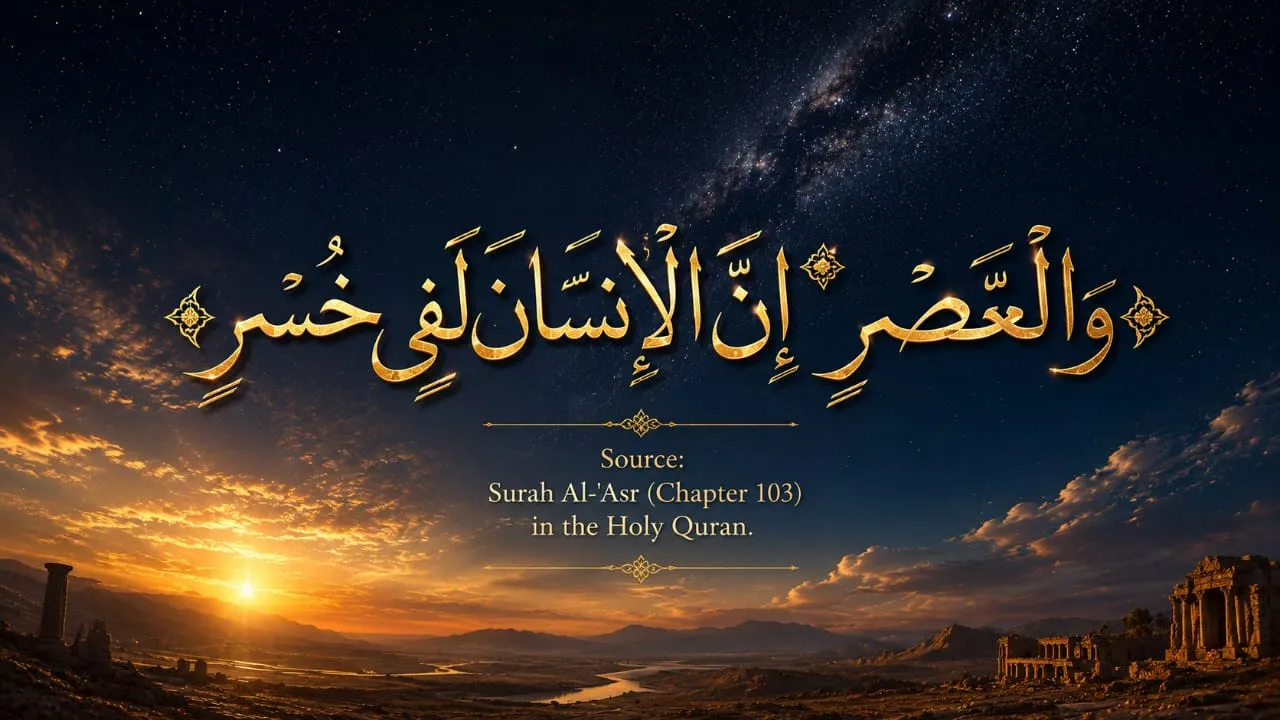
Surah Al-‘Asr (Chapter 103) addresses the universal human crisis of existential loss by swearing an oath by time itself. It establishes that humanity is inherently in bankruptcy unless anchored by four actionable pillars: faith, righteous deeds, advising one another to truth, and advising one another to patience.
Every morning, millions of busy professionals, students, and diaspora families wake up with a quiet, gnawing panic. You check your phone, watch the clock race forward, and realize another day has vanished into a blur of deadlines, screens, and endless responsibilities. Despite working harder than ever, you feel spiritually drained, intellectually scattered, and profoundly unfulfilled.
This is not just modern burnout. It is a spiritual deficit. In a fast-paced secular society, time is treated as a currency to be spent on worldly gains, leaving your eternal account completely bankrupt.
The remedy was revealed over 1,400 years ago in three concise verses of the Holy Quran. Let us break down how Surah Al-‘Asr serves as your ultimate tactical blueprint to reverse this spiritual loss and transform every passing second into eternal profit.
Linguistic Masterclass: The Anatomy of Surah Al-‘Asr
Surah Al-‘Asr uses extreme Arabic grammatical emphasis—including an oath particle, the emphatic particle Inna, and the prefix La—to declare that every human being is experiencing absolute spiritual deficit unless protected by four active saving habits.
To truly understand why this chapter shook the companions of Prophet Muhammad (PBUH) to their core, we must examine the precise mechanics of the Arabic text.
Arabic Text & Multilingual Translations
- Arabic Text: وَالْعَصْرِ ۙ إِنَّ الْإِنسَانَ لَفِي خُسْرٍ
- Transliteration: Wal-asr. Inna al-insana lafi khusr.
- English Translation: “By time, indeed, mankind is in loss.”
- Urdu Translation: “زمانے کی قسم، بےشک انسان سراسر خسارے میں ہے۔”
- Hindi Translation: “समय की कसम, वास्तव में मनुष्य घाटे में है।”
The word khusr is borrowed from trade, meaning bankruptcy or losing your initial capital. Allah does not say humanity might lose; He uses universal phrasing to show that without a deliberate intervention, human life naturally depreciates like a melting block of ice.
Explore more foundational verses on spiritual growth and patience through our detailed guide on Surah Al-Asr Analysis. For a broader understanding of how the Quran addresses human struggles, read our piece on the complete Islamic guide to overcoming modern anxiety.
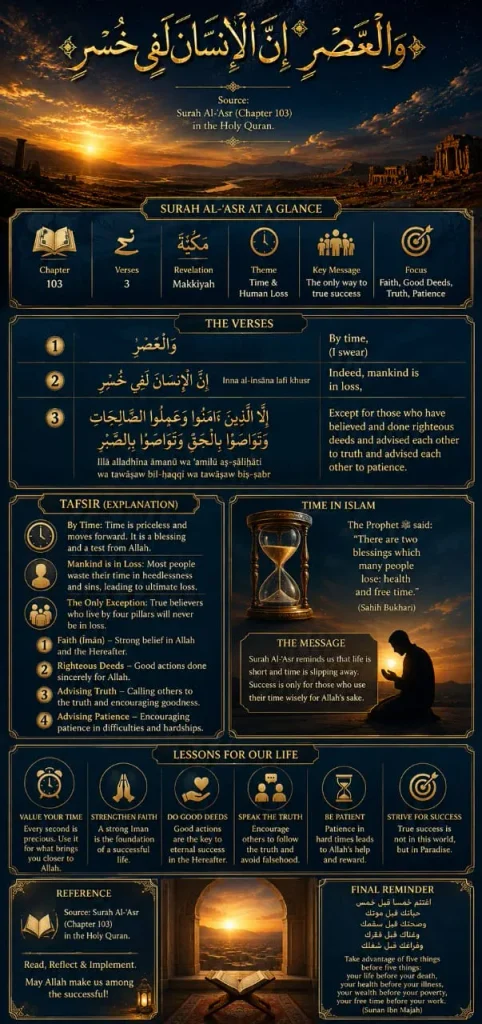
The Four-Part Formula to Reverse Time Bankruptcy
The antidote to spiritual loss outlined in Verse 3 consists of four daily pillars: genuine faith (Iman), consistent righteous deeds (Amal Salih), mutual encouragement toward truth (Haqq), and steadfast perseverance (Sabr).
Allah immediately follows the alarming diagnosis of loss with an exact, non-negotiable four-step framework for salvation:
| Surah Al-‘Asr Pillar | Core Islamic Concept | Actionable Sunnah (Daily Application) |
| 1. Iman | True Faith (Belief) | Renewing your internal connection with Allah through sincere, daily remembrance, such as practicing the morning and evening Azkar. |
| 2. Amal Salih | Righteous Deeds | Elevating your obligatory worship with voluntary acts of devotion, like learning how to pray Tahajjud namaz in the quiet hours before dawn. |
| 3. Tawasaw bil-Haqq | Recommending Truth | Advising family and peers with divine wisdom, often by sharing Hadiths about the Quran’s benefits for anxiety and modern struggles. |
| 4. Tawasaw bis-Sabr | Recommending Patience | Demonstrating steadfast endurance during trials and utilizing prophetic Duas for anxiety and depression when overwhelmed. |
| The Ultimate Outcome | Spiritual Stability | By mastering these four pillars, you achieve profound heart serenity—the exact state promised in the verse Allazina Amanu Wa Tatmainnal Quloob. |
Authentic Hadith & Scholarly Context
The Companions of the Prophet (PBUH) valued Surah Al-‘Asr so deeply that they would not part ways until they recited it to each other, recognizing it as a complete summary of Islamic teachings.
Imam Al-Tabarani records that whenever two companions of the Prophet Muhammad (PBUH) met, they would not separate until one of them recited Surah Al-‘Asr to the other, then gently greeted him.
Furthermore, Imam Shafi’i famously stated:
“If the people only pondered upon this Surah, it would be sufficient for them.”
To protect your daily routine from time bankruptcy, ensure you maintain your obligatory prayers by studying guides like how to perform zuhr namaz rakat step by step guide and keeping your heart aligned with remembrance through astaghfirullah hallazi la ilaha illallah wa atubu ilaih.
(People Also Ask)
Allah swears by time (Al-Asr) to highlight that human life, history, and every passing second represent the ultimate capital gifted to humanity, making its stewardship the primary measure of success or failure.
The four conditions are having true faith (Iman), performing righteous deeds (Amal Salih), counseling one another to truth (Haqq), and counseling one another to patience (Sabr).
Professionals can combat time bankruptcy by anchoring their work breaks around prayer, protecting their daily spiritual habits, and using short moments for sincere dhikr and reflection.
Take the next step in your spiritual journey and strengthen your daily connection with the Quran by reading our detailed breakdown on the longest verse in the quran surah baqarah 282.

1 thought on “Wal asri innal insana lafi khusr – Surah al-‘asr (chapter 103)”