You wake up, grab your phone, and immediately face a flood of conflicting opinions, endless distractions, and moral compromises. Whether you are a college student dealing with peer pressure, a professional facing ethical dilemmas at work, or a diaspora parent raising children in a secular environment, staying grounded feels impossible. The sheer volume of daily choices causes deep decision fatigue.
The solution is not a productivity hack. It is a 1,400-year-old spiritual habit loop designed to reset your focus 17 times a day. By deeply understanding Surah Al-Fatiha, Verse 6, you anchor yourself to the ultimate truth, filtering out the noise and securing your steps in this life and the next.
What is Siratal Mustaqeem?
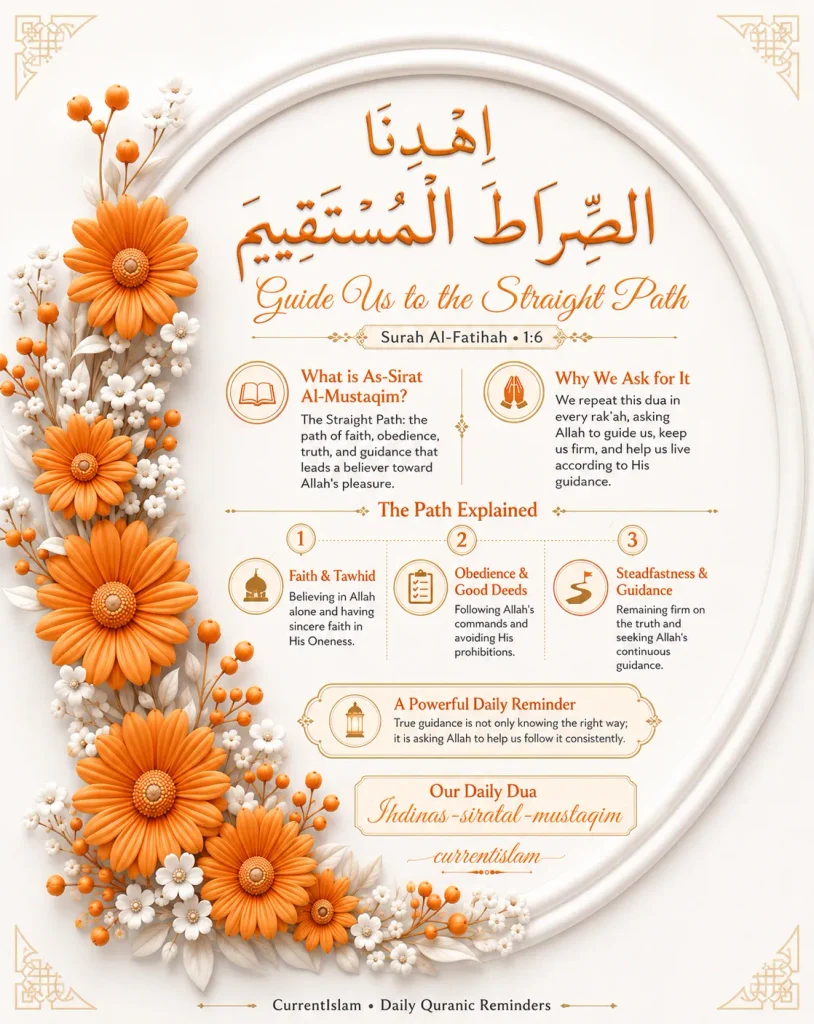
Siratal Mustaqeem refers to the straight, clear, and uncompromising path of Islam that leads directly to Allah’s pleasure and Paradise. It represents a balanced life of faith and righteous actions, free from extremes, innovations, and moral deviations.
To understand this concept, we must look at the exact words revealed to Prophet Muhammad (PBUH).
Surah Al-Fatiha (1:6)
- Arabic Text: اهْدِنَا الصِّرَاطَ الْمُسْتَقِيمَ
- Transliteration: Ihdinas-siratal mustaqeem
- English Translation: Guide us to the straight path.
- Urdu Translation: ہمیں سیدھا راستہ دکھا۔
- Hindi Translation: हमें सीधा रास्ता दिखा।
The Linguistic Breakdown of the Path
The phrase consists of two profound Arabic words.
- Sirat: This does not just mean a trail. In classical Arabic, a sirat is a wide, established highway designed to accommodate massive groups of people. It is meant for the entire Muslim Ummah.
- Mustaqeem: Derived from the root word for standing upright. It means a path that is perfectly balanced, with absolutely no crookedness or deviation.
Before we ask for this guidance, we first praise Allah in the opening verses, which you can read about in our complete guide to the Surah Fatiha transliteration and meaning. Once we establish who God is, we declare our total reliance on Him by understanding the meaning of Iyyaka Na’budu wa Iyyaka Nasta’een. Only then do we ask for the ultimate prize: guidance.
Why Surah Al-Fatiha Verse 6 is the Ultimate Habit Loop
Verse 6 is the only unconditionally mandatory supplication in Islam. Muslims recite it at least 17 times daily during obligatory prayers. This constant repetition acts as a spiritual habit loop, continuously realigning the believer’s mindset away from worldly distractions and back toward divine purpose.
Human beings are forgetful. A working professional might start the day with good intentions but face ethical compromises by noon. By the time Dhuhr (afternoon) prayer arrives, reciting Ihdinas-siratal mustaqeem serves as a hard reset. This repetition is a highly effective Islamic guide to overcoming modern anxiety, pulling you out of temporary stress and placing your focus on eternity.
The Prophetic Visualization of the Path
Prophet Muhammad (PBUH) provided a brilliant visual explanation of this concept to his companions, perfectly illustrating the core beliefs of the Islamic religion.
Hadith on the Straight Path (Musnad Ahmad)
- Arabic Text: خَطَّ لَنَا رَسُولُ اللَّهِ صَلَّى اللَّهُ عَلَيْهِ وَسَلَّمَ خَطًّا ثُمَّ قَالَ هَذَا سَبِيلُ اللَّهِ
- Transliteration: Khatta lana Rasulullahi (SAW) khattan thumma qala: Hatha sabilullah.
- English Translation: The Messenger of Allah (PBUH) drew a straight line for us and said: “This is the path of Allah.” He then drew lines to its right and left and said, “These are paths, on every one of which is a devil calling to it.”
- Urdu Translation: رسول اللہ صلی اللہ علیہ وسلم نے ہمارے لیے ایک سیدھا خط کھینچا اور فرمایا: یہ اللہ کا راستہ ہے۔ پھر اس کے دائیں اور بائیں لکیریں کھینچیں اور فرمایا: یہ وہ راستے ہیں جن پر شیطان بلاتا ہے۔
- Hindi Translation: अल्लाह के रसूल (PBUH) ने हमारे लिए एक सीधी रेखा खींची और कहा: “यह अल्लाह का रास्ता है।” फिर उन्होंने इसके दाएँ और बाएँ रेखाएँ खींचीं और कहा: “ये वे रास्ते हैं जिन पर शैतान बुलाता है।”
Practical Ways to Walk the Straight Path Today
Walking the straight path requires combining daily prayers with active moral choices. It involves protecting your environment from negative influences, seeking beneficial knowledge, maintaining honest income, and consistently asking Allah for firmness of heart through authentic supplications.
If you are a student surrounded by a hyper-secular culture, or a parent trying to implement practical Islamic parenting tips for confidence, the “straight path” requires daily maintenance. You cannot walk it passively. You must understand the correct etiquette of how to make dua to ask for continuous guidance.
Here is a practical breakdown of how to implement this spiritual habit loop into your routine:
The Bridge Over Hellfire: The Metaphysical Sirat
In Islamic eschatology, Siratal Mustaqeem is a physical bridge suspended over the fires of Hell. Every soul must cross it on the Day of Judgment to reach Paradise. The ease and speed of crossing are entirely determined by how firmly a person walked the metaphorical straight path in this world.
What we practice as a spiritual habit loop in this life becomes a physical reality in the next. Islamic texts describe this bridge as being thinner than a hair and sharper than a sword. For those who were steadfast—who prioritized their prayers, treated others with justice, and avoided major sins—they will cross it in the blink of an eye. For those who allowed the distractions of the world to pull them onto the branching paths of the devil, the crossing will be terrifyingly difficult.
Every time you recite verse 6 of Surah Al-Fatiha, you are literally asking Allah to make your physical steps across that bridge easy.
FAQs:
While you should strive for focus (Khushu), losing concentration does not invalidate your prayer. Acknowledge the distraction and immediately bring your mind back to the meaning of the words.
Islam is community-focused. By saying “Guide us” (Ihdina), you are praying for the entire global Muslim community. This eradicates selfishness and unites the believers in mutual care.
Yes. The Quran explicitly states that the final, uncorrupted message brought by Prophet Muhammad (PBUH) is the absolute straight path accepted by Allah.
If your daily actions align with the Quran and the authentic Sunnah, and you feel remorse and quickly repent when you make a mistake, these are strong signs that Allah is keeping you on the path.
Next Steps for Your Spiritual Journey
Reciting Surah Al-Fatiha is just the beginning. To truly secure your footing in this life and ensure an easy transition into the next, you must pair this foundational habit with comprehensive prayers. Deepen your daily practice and read another post on the most powerful dua for success in this world and the hereafter.

1 thought on “Ihdinas siratal mustaqim — Guide us to the straight path”