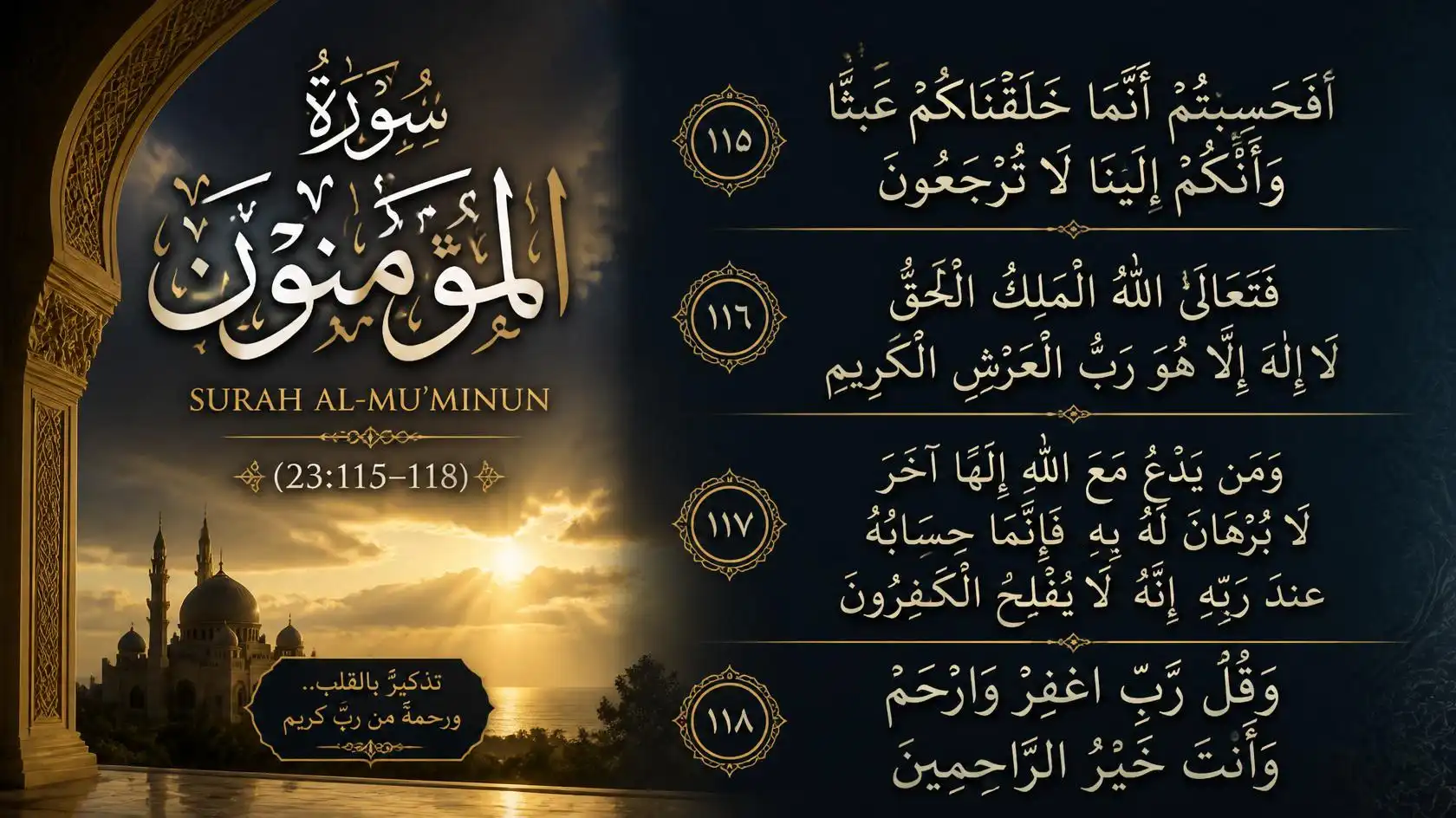
The last 4 ayat of Surah Al-Mu’minun (Quran 23:115–118), beginning with Afahasibtum annama khalaqnakum ‘abathan, are Makkan verses located in Juz (Para) 18 that affirm human purpose, exalt Allah as the True Sovereign, reject polytheism, and close with a prophetic prayer for forgiveness and mercy.
Quick Answer: Surah Al-Mu’minun (23:115–118) at a Glance
- Location in Quran: Chapter 23 (Surah Al-Mu’minun), Verses 115 to 118, located at the end of Para (Juz) 18, Manzil 4, Ruku 6.
- Core Message: Allah did not create you without purpose (‘abathan). Because you will return to Him, anchor your heart in His Sovereignty (Al-Malik Al-Haqq) and ask for His forgiveness and mercy (Rabbi ighfir warham).
- Sunnah Practice: Widely recited by the early Muslims (Salaf) for deep reflection, relief from spiritual heaviness, and Ruqyah (spiritual healing and protection from harm).
Table of Contents
- Why Do These 4 Verses Matter When Life Feels Draining?
- What Are the Last 4 Ayat of Surah Muminoon in Arabic, English, Urdu, and Hindi?
- What Is the Word-by-Word Meaning of Afahasibtum Annama Khalaqnakum?
- What Does Classical Tafsir Say About Surah Al-Mu’minun 23:115–118?
- What Are the Authentic Benefits and Wazifa of Surah Muminoon Last 4 Ayat?
- How Can You Practice “The 4-Verse Purpose Reset” Tonight?
- What Common Mistakes Should You Avoid When Reciting These Verses?
- Frequently Asked Questions (FAQ)
These four verses directly cure spiritual burnout by answering the quiet fear that your daily struggles, unseen pain, and exhaustion have no meaning. They remind your heart that Allah created you with deliberate wisdom and ends every test with His forgiveness and mercy.
You wake up to your phone alarm, rush through a long commute, answer endless messages, pay bills, and collapse into bed—only to repeat the exact same cycle tomorrow. When you are carrying a quiet health struggle, family stress, or emotional exhaustion as a Muslim in the West, a heavy question creeps into your chest: Is this all my life is?
When that emptiness sets in, reading a generic self-help tip does not reach the soul. You need an anchor from your Creator. In Surah Al-Mu’minun (23:115–118), Allah addresses that exact feeling of aimlessness head-on. Instead of leaving you in despair, these closing verses pull you out of mental fog, ground you in a comprehensive Islamic guide to overcoming anxiety, and hand you a ten-word prophetic prayer that softens the hardest trial.
[SCHOLAR ANECDOTE: “Whenever a young professional or university student sits across from me feeling completely crushed by burnout, I ask them to pause and read Surah Al-Mu’minun, Verse 115 aloud. Watching their shoulders drop when they realize that ‘abathan means Allah never created a single sleepless night or quiet struggle of theirs in vain—and that they can end the day simply asking, ‘Rabbi ighfir warham’—is one of the most powerful shifts I witness in spiritual counseling.”]
The last four verses of Surah Al-Mu’minun span Ayah 115 to Ayah 118 in Chapter 23 (Para 18) of the Holy Quran. Below is the complete, vowel-marked Arabic text alongside accurate Roman transliteration and verified English, Urdu, and Hindi translations.
Verse 115 (Quran 23:115)
- Transliteration: Afahasibtum annama khalaqnakum ‘abathan wa annakum ilayna la turja’un.
- English Translation (Sahih International): “Then did you think that We created you uselessly and that to Us you would not be returned?”
- English Translation (The Clear Quran – Dr. Mustafa Khattab): “Did you then think that We had created you without purpose, and that you would never be returned to Us?”
Verse 116 (Quran 23:116)
- Transliteration: Fata’ala Allahu al-Maliku al-Haqqu la ilaha illa Huwa Rabbu al-‘Arshi al-Karim.
- English Translation (Sahih International): “So exalted is Allah, the Sovereign, the Truth; there is no deity except Him, Lord of the Noble Throne.”
Verse 117 (Quran 23:117)
- Transliteration: Wa man yad’u ma’a Allahi ilahan akhara la burhana lahu bihi fa-innama hisabuhu ‘inda Rabbihi innahu la yuflihu al-kafirun.
- English Translation (Sahih International): “And whoever invokes besides Allah another deity for which he has no proof – then his account is only with his Lord. Indeed, the disbelievers will not succeed.”
Verse 118 (Quran 23:118)
- Transliteration: Wa qul Rabbi ighfir warham wa Anta khayru ar-rahimin.
- English Translation (Sahih International): “And, [O Muhammad], say, ‘My Lord, forgive and have mercy, and You are the best of the merciful.'”
Understanding each Arabic word transforms your recitation from a mechanical habit into a direct conversation with Allah. This breakdown shows how the Arabic roots move from questioning human assumptions (hasibtum) to affirming divine mercy (rahimin).
Classical scholars like Imam Ibn Kathir and Imam Al-Qurtubi explain that these verses dismantle the illusion that human beings are left neglected without moral accountability. They also complete a remarkable ring composition with the opening verse of Surah Al-Mu’minun.
1. The Meaning of ‘Abathan (Verse 115)
Right before this passage (23:112–114), people on the Day of Judgment admit that their entire life on Earth felt like “a day or part of a day.” Allah then asks: “Did you then think that We created you ‘abathan (uselessly)?”
In Tafsir Ibn Kathir, the word ‘abathan (in vain / play) means being created without wisdom, command, prohibition, or eternal reward. When you understand the true purpose of human creation explained in Surah Adh-Dhariyat (51:56)—which is to know and worship Allah—you realize that not a single tear, illness, or effort in your life is wasted.
2. Why Allah Calls Himself Al-Malik Al-Haqq (Verse 116)
Because creating humans for nothing would contradict divine wisdom, Verse 116 immediately declares: “So exalted is Allah, the Sovereign, the Truth.” Worldly titles, jobs, and status vanish, but Allah is the True King whose justice guarantees that every wrong will be made right. He is the Lord of the Noble Throne (Al-‘Arsh Al-Karim), a title that pairs majesty with generosity, just as believers rely upon the Lord of the Mighty Throne during moments of distress.
3. The Ring Composition of Falah (Success) in Verse 117
Look at how Surah Al-Mu’minun begins and ends:
- Verse 1: “Qad aflaha al-mu’minun” (“Certainly will the believers succeed.”)
- Verse 117: “Innahu la yuflihu al-kafirun” (“Indeed, the disbelievers will not succeed.”)
Notice the phrase “la burhana lahu bihi” (“for which he has no proof”). Classical grammarians point out that this is a universal description: no false god, superstition, or worldly idol ever has any proof (burhan) behind it.
4. Why Forgiveness Comes Before Mercy in Verse 118
Even after living a purposeful life of faith, a believer never becomes arrogant. Allah commands the Prophet ﷺ to close the chapter with the Rabbi ighfir warham supplication. Scholars note that Maghfirah (forgiveness—covering and wiping away sins) is requested before Rahmah (mercy—receiving divine grace), because removing spiritual harm comes before receiving spiritual elevation.
These verses are classical texts for Ruqyah (spiritual healing), protection from unseen harm, and relief from anxiety. However, honest scholarship requires separating the undisputed power of the Quranic text from weak (Da’if) chains of narration in some hadith reports.
The Famous Narration of Abdullah ibn Mas’ud (RA)
In Musnad Ahmad, Tafsir Ibn Kathir, and Tafsir Al-Qurtubi (via Ibrahim al-Nakha’i and Abu Sadiq), it is reported that Abdullah ibn Mas’ud (RA) passed by a man who was afflicted with a severe illness (or spiritual affliction). Ibn Mas’ud recited the last four verses of Surah Al-Mu’minun (23:115–118) into the man’s ear, and he was immediately cured. When this was mentioned to the Prophet ﷺ, he asked what Ibn Mas’ud had recited, and then said:
“By the One in Whose hand is my soul, if a man with certainty (yaqin) were to recite them over a mountain, it would crumble.” (Cited in Tafsir Ibn Kathir under 23:115 and Musnad Abu Ya’la).
Scholarly Grading & Honesty Check: While classical scholars like Ibn Kathir and Al-Qurtubi cite this narration to highlight the immense weight of these verses, hadith specialists (including Shaykh Al-Albani in Silsilat al-Ahadith al-Da’ifah [exact hadith number in Silsilah Da’ifah and Musnad Ahmad edition]) classify the chain of transmission (isnad) of this specific story as weak (Da’if) due to interruptions and weak narrators in the chain.
Why Scholars Still Recommend Reciting Them for Ruqyah and Relief
Even when a specific story’s chain is weak, the entire Quran is a healing (Shifa) by consensus (Quran 17:82). Classical and contemporary scholars affirm reciting Surah Al-Mu’minun 23:115–118 for:
- Protection from Black Magic (Sihr) and Evil Eye (Hasad): Verse 116–117 affirms absolute Tawhid (monotheism) and shatters the false authority of jinn or magicians. You can pair these verses with the prophetic dua for protection from black magic.
- Physical Illness and Pain (Shifa): Alongside seeking qualified medical treatment, reciting these verses over oneself or a sick loved one is a time-tested practice alongside other Quranic verses for physical healing.
- Existential Anxiety and Heavy Thoughts (Waswasa): Reciting Verse 115 aloud interrupts intrusive thoughts of hopelessness.
Important Health Disclaimer: Quranic recitation (Ruqyah) and dua are powerful spiritual remedies that complement—and never replace—professional medical or psychological care. Always consult a licensed physician or mental health professional for physical or clinical conditions.
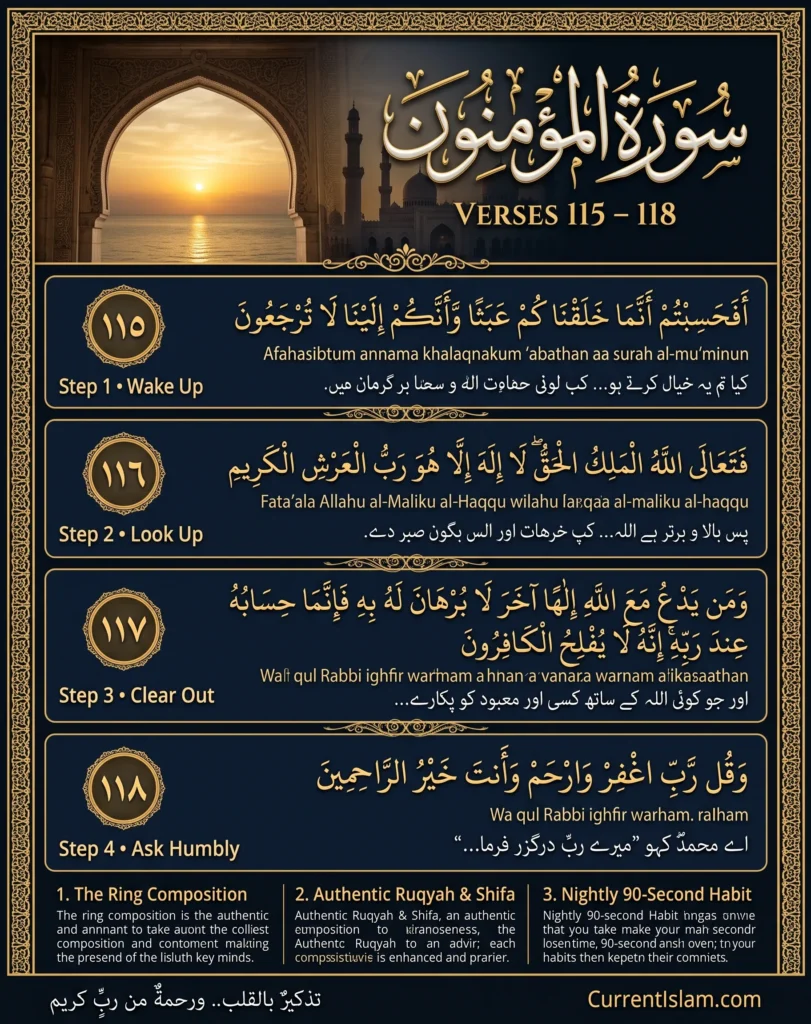
You do not need unverified 100-count rituals to benefit from these verses. “The 4-Verse Purpose Reset” is a 90-second Sunnah-aligned habit you can practice after obligatory prayers or before sleep to realign your heart.
The 4-Verse Purpose Reset Framework
| Step | Verse Focus | Internal Shift | Action (Takes 90 Seconds Total) |
| 1. Wake Up | Verse 115 (‘Abathan) | From “My stress is pointless” to “My life has eternal purpose.” | Recite 23:115 slowly, remembering that Allah sees every unseen struggle you carry. |
| 2. Look Up | Verse 116 (Al-Malik Al-Haqq) | From fearing people/circumstances to trusting the True King. | Recite 23:116 and release control of your workplace, finances, or health to the Lord of the Noble Throne. |
| 3. Clear Out | Verse 117 (La burhana lahu) | From superstition and anxiety to pure Tawhid. | Recite 23:117, cutting off reliance on anything besides Allah. |
| 4. Ask Humbly | Verse 118 (Rabbi ighfir warham) | From self-reliance to receiving forgiveness and mercy. | Recite 23:118 three times from the heart, asking Allah to forgive your shortcomings and cover you with mercy. |
Western-Life Application: Practicing When You’re the Only Muslim in the Room
- Before a High-Stakes Meeting or Exam: Sitting at your desk in London, New York, or Chicago when imposter syndrome hits, whisper Verse 116–118 under your breath. Your boss or professor is not Al-Malik Al-Haqq—Allah is.
- During a Draining Commute: Instead of doom-scrolling on the train or in traffic, listen to a slow 3x audio recitation to reset your nervous system before walking through your front door.
- At Bedtime (“Start Tonight” Routine): Pair these four verses with the last two verses of Surah Baqarah and your authentic morning and evening adhkar.
Use this interactive tracker tonight to build your daily habit:
The biggest mistake is treating these verses like a magic spell while ignoring their meaning. Mispronouncing key Arabic letters or following invented repetition counts can also strip the practice of its spiritual beauty.
- Treating It as a Lucky Charm Without Reflection (Tadabbur): Verse 115 literally warns against mindless, purposeless action (‘abath). Reciting a verse against mindlessness in a mindless way misses the core gift of the passage.
- Obsessing Over Unverified Numbers: Many viral posts insist you must read these verses exactly 41, 70, or 313 times at a specific minute for a wish to come true. There is no authentic Prophetic limit—reciting them once, three times, or seven times with presence of heart (Hudur al-Qalb) and certainty (Yaqin) is far better.
- Mispronouncing
'Abathan(عَبَثًا) andHaqq(حَقّ): Ensure you pronounce the deep throat letter ‘Ayn (ع) and the soft Tha (ث) in ‘abathan, and the sharp throat Ha (ح) in Al-Haqq.
Surah Muminoon last 4 ayat PDF
FAQs:
1. Which Para (Juz) is the last 4 ayat of Surah Muminoon in?
The last four verses of Surah Al-Mu’minun (23:115–118) are located at the very end of Juz (Para) 18 (specifically at the conclusion of Surah 23, right before Surah An-Nur begins in Juz 18).
2. What is the exact meaning of Afahasibtum annama khalaqnakum ‘abathan?
It translates to: “Then did you think that We created you uselessly (without purpose), and that to Us you would not be returned?” It is a rhetorical question from Allah reminding humanity that life has a noble purpose and eternal accountability.
3. Can I read Surah Muminoon last 4 ayat for someone who is sick?
Yes. Reciting Quranic verses over a sick person (or over water/olive oil for them to use) as Ruqyah is permissible and practiced by the righteous predecessors (Salaf), provided it is done alongside proper medical treatment.
4. Why do reciters often repeat these 4 verses 3 times?
Repeating supplications and Ruqyah verses three times follows the general Prophetic Sunnah of repeating important prayers and words three times for emphasis, focus, and memorization (as established in Sahih Muslim.
5. Is Rabbi ighfir warham wa Anta khayru ar-rahimin from the Quran?
Yes. It is the exact text of Surah Al-Mu’minun, Verse 118 (and also appears in a slightly longer form in Verse 109 of the same Surah). Although culturally famous in South Asia as the “First Ashra Dua of Ramadan,” it is an eternal Quranic verse for every day of the year.
6. Can women recite these verses during menstruation for protection?
According to many scholars (particularly within the Maliki, Hanbali, and contemporary fatwa councils), a menstruating woman may recite Quranic verses from memory or a digital screen with the intention of Dhikr (remembrance), Dua, and Ruqyah (protection). In strict Hanafi fiqh, she can recite Verse 118 specifically with the intention of Dua (Rabbi ighfir warham) and listen to the full four verses.
Download Your Free Printable Pocket Guide
Want to keep these verses on your phone or bedside table for your nightly routine? Download the Surah Muminoon Last 4 Ayat PDF (Arabic, Transliteration, English, Urdu & Hindi)
Next Steps in Your Spiritual Journey
- Step 1 (Immediate Relief): Read our Rabbi ighfir warham supplication guide to master the final verse of this Surah.
- Step 2 (Daily Shield): Pair these verses with our complete guide on protection from black magic.
- Step 3 (Long-Term Peace): Bookmark our master hub, the Islamic guide to overcoming anxiety, for evidence-based spiritual resilience.
Last reviewed on October 17, 2026 by Shahab Khan: insert Shahab Khan’s formal Islamic studies credentials and institution].
