
Tera Naam Khwaja Moinuddin” is a manqabat, a poem in praise of a saint, as distinct from a naat, which praises the Prophet ﷺ. It is linked to Khwaja Moinuddin Chishti Ajmeri (rahmatullah alayh), the Chishti Sufi master buried in Ajmer, India. Several different pieces share this title, and many voices have sung them.
You may have heard it at a gathering and wanted the exact words, only to find a different poet’s name on every site, and lines that change from page to page. This page explains what the piece is, what it says, and how to find a text you can trust. It also gives a simple method for reciting it with understanding and respect.
Quick Answer
- Form: manqabat, not a naat.
- Theme: devotion to Khwaja Garib Nawaz, the generosity of his door, and longing to visit Ajmer.
- Poet and source: Read the full text from a licensed source.
Is it a naat or a manqabat?
It is a manqabat, not a naat. A naat praises only the Prophet ﷺ, while a manqabat praises a saint or companion. This piece addresses Khwaja Moinuddin Chishti (rahmatullah alayh), so calling it a manqabat is correct.
Websites often label manqabats as naats. That misleads readers and places the page in the wrong search category. A reader looking for praise of the Prophet ﷺ will not find it here. For genuine naats, see the list of famous naats.
Who wrote it, and who sings it?
Several pieces share this title, so the poet may differ for each. The poet writes the words and the qawwal (a qawwali singer) or reciter performs them. Naming a poet without verification is wrong, so this page marks it.
A simple rule helps: the name on a video is usually the performer’s. The poet’s name comes from the diwan (a poet’s collected works), the book or the publisher. When a recording credits only a singer, treat the poet as unknown until a printed source confirms it.
Variant texts are also common. A line may differ between a printed edition and a live recording, and singers sometimes add or drop couplets. Once a source is chosen, state which edition or recording this page follows.
Who was Khwaja Moinuddin Chishti?
Khwaja Moinuddin Chishti (rahmatullah alayh) was a major Sufi master of the Chishti order. By tradition he died in Ajmer in 1236 CE, where his shrine stands. He is called Garib Nawaz (“kind to the poor”) and Sultan-ul-Hind (“sovereign of India”).
The title Garib Nawaz explains the core idea of songs in his name: a door from which no one returns empty-handed. The Ajmer shrine is known for its communal kitchen and for visitors of many faiths, which is why the name carries a shared memory across the subcontinent.
The Chishti order is known for humility, service to the poor and the use of music and poetry in devotion. That background shapes how a manqabat to him is written: the speaker is a petitioner at the door, never a person of rank.
What are the main themes?
Such manqabats usually carry four ideas: the blessing of the name, the generosity of the door, longing to visit, and the humility of the devotee. Their centre is one aim: seeking Allah’s mercy through love for a saint.
- Repeating the name. In Sufi practice, repetition settles a word in the heart. In qawwali it draws the listener into the refrain until the audience is part of the performance.
- The beggar’s stance. The singer calls himself a petitioner, never an owner. This is a mark of Chishti etiquette.
- Longing and separation. Distance from Ajmer is treated as a spiritual state, not only a practical problem.
- Generosity of the door. The shrine is imagined as a court that opens first to the poor, the traveller and the broken-hearted.
What does it mean, in plain words?
Without quoting the text, the meaning can be summarised in four movements. First, the speaker says the saint’s name and treats the name itself as a comfort. Second, the speaker describes the saint’s door as open to everyone, especially the poor. Third, the speaker admits need and asks for a share of that generosity. Fourth, the speaker expresses a wish to stand at the shrine in Ajmer.
A line-by-line explanation (tashreeh) belongs here once the licensed text is confirmed. It should use plain language and should link a line to a Quran verse or hadith only when a reliable source states the connection.
Why do scholars differ on lines that “ask for help”?
Some scholars permit asking Allah through a saint as an intermediary (tawassul). Others forbid it and stress asking Allah directly. Each side argues from evidence. This page does not issue a ruling. It explains the difference.
For the basics, see what is Dua-e-Tawassul. Any Quran evidence must carry [TRANSLATION: Urdu and English edition] and any hadith must carry. Until then, do not call any verse or hadith the source of this piece.
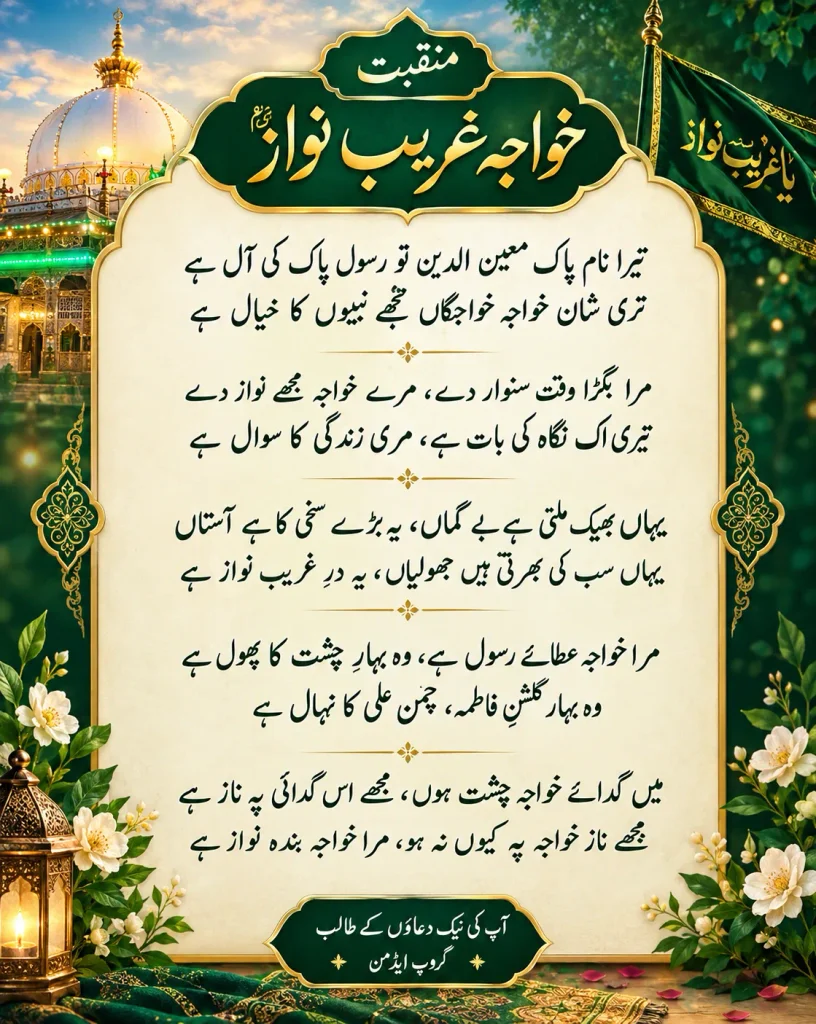
How do you recite a manqabat? The “Jano, Samjho, Parho” method
Check the source first, then understand the meaning, then recite with respect. Begin with durood shareef, keep the voice gentle and pronounce each word with care. Memorise two couplets at a time. This order is called Jano, Samjho, Parho (Know it, Understand it, Recite it).
- Jano (Know). Find the poet and source, and match your text against a reliable edition.
- Samjho (Understand). Look up the hard words (see the glossary below). A manqabat recited with understanding moves people more.
- Parho (Recite). Begin with durood shareef. Keep the voice natural and avoid forced emotion. Opening a gathering with a naat such as Ya Nabi Salam Alaika keeps the order graceful.
Practice tips
- Listen to one reliable recording, then read the text slowly without music.
- Practise the refrain first, because it is repeated most.
- Record yourself and compare the pronunciation of Arabic and Persian words.
When is it recited?
People recite manqabats at Urs gatherings (the death anniversary of a saint), on Fridays, at home gatherings and at school events. The Urs of Khwaja Moinuddin Chishti is commonly observed in the month of Rajab. See the list of Islamic months. Scholars differ on such gatherings, so consult a scholar of your own school.
Common mistakes
- Calling a manqabat a naat.
- Treating the qawwal as the poet.
- Mixing the text of two different pieces with the same title.
- Writing down words by ear without checking. Words often change when transcribed from listening.
Difficult words and terms
| Term | Meaning | Root language |
|---|---|---|
| Manqabat | A poem in praise of a saint, companion or member of the Prophet’s family | Arabic |
| Naat | A poem in praise of the Prophet ﷺ | Arabic |
| Hamd | A poem in praise of Allah | Arabic |
| Qawwali | A devotional music form with a lead singer and chorus | Arabic root, South Asian form |
| Qawwal | A qawwali singer | Arabic root |
| Diwan | A poet’s collected works | Persian |
| Tawassul | Seeking nearness to Allah through an intermediary | Arabic |
| Urs | The anniversary of a saint’s death, observed at the shrine | Arabic |
| Garib Nawaz | Kind to the poor; a title of Khwaja Moinuddin Chishti | Persian and Urdu |
| Dargah | A saint’s shrine | Persian |
| Tashreeh | A line-by-line explanation of a poem | Arabic |
Naat, manqabat, hamd and qawwali compared
| Form | Addressed to | Example or note |
|---|---|---|
| Hamd | Allah | |
| Naat | The Prophet ﷺ | Meetha Meetha Hai Mere Muhammad ﷺ Ka Naam |
| Manqabat | A saint, companion or Ahl al-Bayt | This page |
| Qawwali | Any text | A style of singing, not a literary form |
Frequently asked questions
Will I find the full lyrics here?
No. Full text is published only when the poet’s rights have lapsed or permission is held. This page gives meaning and context, plus a link to a licensed source for the authentic text.
Who wrote Tera Naam Khwaja Moinuddin?
Several pieces share the title, so the answer depends on the version. Check the diwan, book or publisher credit, and do not rely on the singer’s name.
Is it a naat?
No. A naat praises the Prophet ﷺ. This piece praises Khwaja Moinuddin Chishti (rahmatullah alayh), so it is a manqabat.
Is it recited only at the Urs?
No. The Urs is the most prominent occasion, but devotees also recite it at home gatherings and in private remembrance. Follow your scholar’s guidance on when and how.
Where is the shrine?
The shrine is in Ajmer, Rajasthan, India. Before travelling, check the official dargah committee website for current timings and instructions.
What if my text differs from another version?
Variant texts of one piece are common. Note the edition or recording you follow, and report differences through the contact line below so they can be corrected.
“`
