
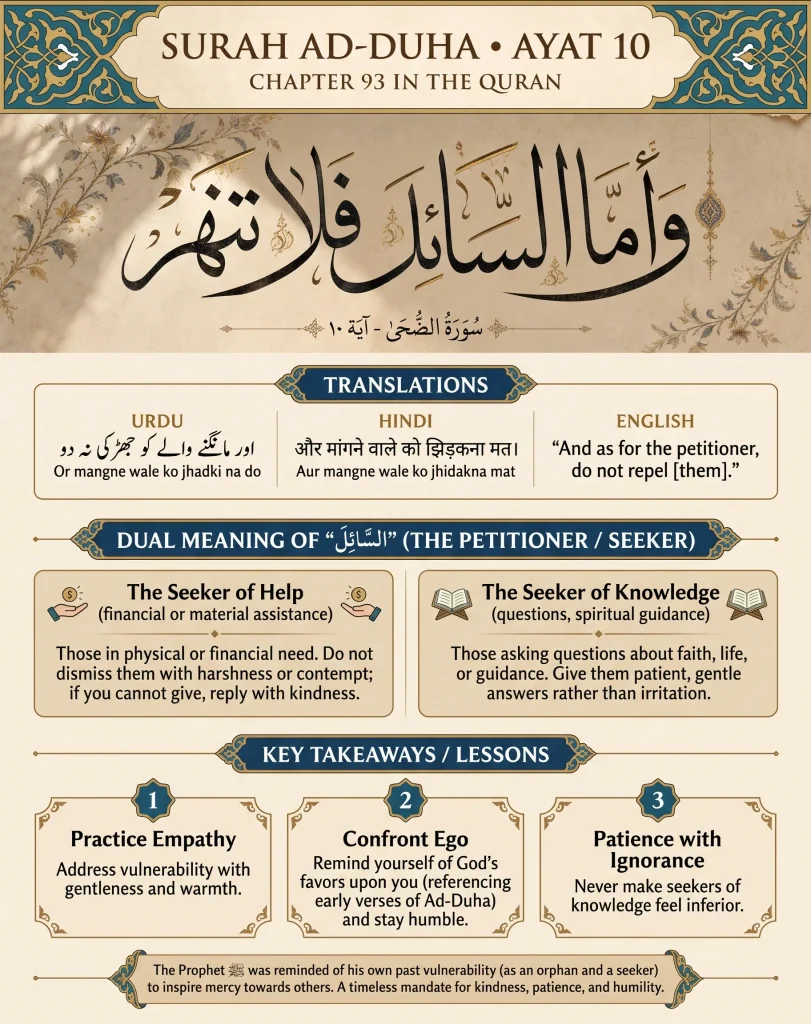
Surah Ad-Duha Ayat 10 teaches Muslims to treat people who ask for help with kindness, patience, and dignity. The verse says, “And as for the petitioner, do not repel [him].” It reminds believers that a person’s request should not become an excuse to humiliate, insult, or harshly dismiss them.
In this guide, you will learn the Arabic text of Surah Ad-Duha 93:10, its transliteration, English meaning, word-by-word explanation, tafsir, practical lessons, and how to apply this Quranic teaching in everyday life.
What Does Wa Ammas-Sā’ila Fa-Lā Tanhar Mean?
Arabic:
وَأَمَّا السَّائِلَ فَلَا تَنْهَرْ
Transliteration: Wa ammas-sā’ila fa-lā tanhar.
English translation: “And as for the petitioner, do not repel [him].” — Sahih International translation
Urdu Translation:
اور مانگنے والے (یا سوال کرنے والے) کو جھڑکی نہ دو (بلکہ نرمی سے پیش آؤ یا کچھ دے دو)۔
Hindi Translation:
अनुवाद: और जो मांगने वाला (या सवाल करने वाला) हो, उसे झिड़कना मत।
Surah: Ad-Duha (The Morning Brightness)
Surah number: 93
Ayah number: 10
Main lesson: Treat people who ask for help with kindness and dignity, even when you cannot fulfil their requests.
1. Surah Ad-Duha Ayat 10 in Arabic
The complete Arabic text of the verse is:
وَأَمَّا السَّائِلَ فَلَا تَنْهَرْ
This short Quranic verse carries an important message about human dignity and compassionate behaviour. It teaches that a person who approaches you with a request should not be treated with unnecessary harshness.
2. Transliteration of Surah Ad-Duha Ayat 10
Wa ammas-sā’ila fa-lā tanhar.
For easier reading, the verse may be divided into three parts:
- Wa ammas-sā’ila — And as for the petitioner
- Fa-lā — Then do not
- Tanhar — Repel, rebuke, or speak harshly to
Transliteration is a reading aid, not a substitute for learning the Arabic pronunciation. Readers who are learning Quranic recitation should listen to a qualified reciter and check the Arabic text.
3. English Translation and Meaning
A widely used English rendering of Surah Ad-Duha Ayat 10 is:
“And as for the petitioner, do not repel [him].”
The word petitioner refers to someone who asks or seeks something. Depending on the context and classical tafsir, this can include a person asking for material assistance or someone seeking knowledge and guidance.
The verse does not mean that every request must be granted. Rather, it teaches Muslims not to respond with cruelty, humiliation, or unnecessary harshness.
A person may be unable to give money, provide a service, or answer a question. Even then, they can try to respond honestly and respectfully.
The central message is simple: when someone asks you for something, protect their dignity, even if you cannot provide what they need.
4. Word-by-Word Meaning of Wa Ammas-Sā’ila Fa-Lā Tanhar
| Arabic | Transliteration | English meaning |
|---|---|---|
| وَ | Wa | And |
| أَمَّا | Ammā | As for |
| السَّائِلَ | As-sā’ila | The petitioner or one who asks |
| فَـ | Fa | Then, so |
| لَا | Lā | Do not |
| تَنْهَرْ | Tanhar | Repel, rebuke, or speak harshly to |
The phrase as-sā’il refers to a person who asks for something. The final word, tanhar, conveys a forceful rejection or rebuke. Together, the verse instructs the believer not to treat the petitioner harshly.
5. Tafsir of Surah Ad-Duha Ayat 10
To understand this verse properly, it helps to read it alongside the surrounding verses and the explanations offered by recognised Quran commentators.
Tafsir of Ibn Kathir
In his commentary on Surah Ad-Duha, Ibn Kathir discusses the instruction concerning the petitioner in relation to kindness and humility. The verse teaches that a person who asks should not be treated with arrogance or harshness.
This guidance is particularly important when someone approaches another person in a vulnerable position. A request may involve financial assistance, or it may involve a desire to learn or understand something.
The lesson is not that every request must be fulfilled. Rather, the person responding should avoid turning a moment of need into an opportunity to embarrass or belittle someone.
Tafsir of Al-Sa‘di
Tafsir al-Sa‘di explains the verse as guidance against rebuking or harshly dismissing the person who asks. If someone can help, they should do so according to their ability. If they cannot help, they should still respond with good manners.
This interpretation offers a practical way to apply the verse: combine generosity with respectful communication.
For further study, readers can consult Tafsir Ibn Kathir and Tafsir al-Sa‘di.
6. How Ayat 9–11 Explain the Meaning of Ayat 10
Surah Ad-Duha Ayat 10 is part of a connected passage. The surrounding verses provide important context.
Surah Ad-Duha Ayat 9
فَأَمَّا الْيَتِيمَ فَلَا تَقْهَرْ
This verse instructs the Prophet Muhammad ﷺ not to oppress or mistreat the orphan.
Surah Ad-Duha Ayat 10
وَأَمَّا السَّائِلَ فَلَا تَنْهَرْ
This verse instructs him not to repel or harshly rebuke the petitioner.
Surah Ad-Duha Ayat 11
وَأَمَّا بِنِعْمَةِ رَبِّكَ فَحَدِّثْ
This verse instructs him to speak of the blessings of his Lord.
Together, these verses connect gratitude for Allah’s blessings with compassionate treatment of vulnerable people. The orphan should not be mistreated, the petitioner should not be harshly dismissed, and Allah’s blessings should be acknowledged.
This theme also connects with Surah Ad-Duha Ayat 4, which discusses the Hereafter being better than the first life. Reading related verses can help readers understand the broader message of the surah rather than studying each verse in isolation.
7. Does Surah Ad-Duha Ayat 10 Mean You Must Give Everyone Money?
No. The verse does not require a person to fulfil every request regardless of their circumstances.
A person may have limited resources, may be unable to provide the requested help, or may need to assess whether a request is appropriate. The essential instruction is to avoid unnecessary harshness and preserve the dignity of the person asking.
For example:
- If someone asks for financial help and you can reasonably assist, consider helping.
- If you cannot give money, explain your situation politely.
- If someone asks a question, answer respectfully when possible.
- If you cannot provide an answer, acknowledge the request rather than mocking the person.
- If a request is inappropriate or unsafe, set a clear boundary without humiliating the person.
Kindness does not require abandoning sound judgement. It means responding with compassion while remaining honest about your abilities and responsibilities.
8. Practical Lessons from Wa Ammas-Sā’ila Fa-Lā Tanhar
Lesson 1: Protect human dignity
A person who asks for help may already feel uncomfortable or vulnerable. Mocking their circumstances can deepen their distress. The Quranic instruction encourages believers to avoid adding unnecessary pain.
Lesson 2: Speak with kindness
Words can either comfort or wound. A respectful response can preserve a relationship, reduce embarrassment, and demonstrate good character.
Lesson 3: Help according to your ability
When you can provide appropriate assistance, do so sincerely. Help may involve money, food, useful information, guidance, or connecting someone with a suitable source of support.
Lesson 4: Refuse respectfully when necessary
You may not always have the resources or knowledge a person needs. A polite explanation is better than an insulting dismissal.
Lesson 5: Remember your own dependence on Allah
Every person experiences need at different times in life. Remembering our own limitations can help us become more patient and less judgmental toward others.
9. Connection Between Surah Ad-Duha and Surah Al-Ma‘un
Surah Ad-Duha Ayat 10 is not the only Quranic passage that addresses the treatment of people in need. Surah Al-Ma‘un also criticises behaviour that disregards vulnerable people and neglects assistance.
Read our related guide to Surah Al-Ma’un and its message about helping people in need.
These passages encourage readers to look beyond outward expressions of faith and consider how faith influences everyday conduct. Compassion, responsibility, and respect for others are important parts of a believer’s character.
Helping People Through Charity
Financial support is one way to help people facing hardship, but it should be understood within the wider framework of Islamic teachings on charity and responsibility.
For related reading, explore the hadith on zakat in Sahih al-Bukhari. This topic complements the discussion of helping others, although the obligations and conditions of zakat should be studied separately from the specific instruction in Surah Ad-Duha Ayat 10.
10. How to Apply This Verse in Daily Life
You can turn the message of this verse into a practical habit by following these steps whenever someone asks for help.
- Pause before responding. Avoid reacting out of irritation or impatience.
- Listen to the request. Give the person an opportunity to explain what they need.
- Consider your ability to help. Decide whether you can offer appropriate assistance.
- Respond respectfully. If you can help, do so sincerely. If you cannot, explain your limitations politely.
- Protect the person’s privacy. Do not unnecessarily expose or ridicule their circumstances.
- Reflect on your behaviour. Ask yourself whether your response showed patience and good manners.
These steps are a practical application of the verse, not a separate religious ruling. They can help make its message part of everyday interactions at home, work, school, and in the community.
11. Related Dua for Beneficial Knowledge
The petitioner mentioned in discussions of this verse may include someone seeking knowledge. Muslims who want to develop their understanding of Islam can also explore the dua asking Allah for beneficial knowledge.
Read our guide to the dua “Allahumma inni as’aluka ilman nafi‘an”.
Seeking beneficial knowledge and responding respectfully to those who ask questions are related aspects of a thoughtful approach to learning. However, this dua is a related resource rather than a direct quotation from Surah Ad-Duha Ayat 10.
Readers can also explore our collection of short ayat of the Quran for further study and reflection.
12. Frequently Asked Questions About Surah Ad-Duha Ayat 10
What is Surah Ad-Duha Ayat 10 in Arabic?
Surah Ad-Duha Ayat 10 is وَأَمَّا السَّائِلَ فَلَا تَنْهَرْ. It instructs the Prophet Muhammad ﷺ not to repel or harshly rebuke the petitioner.
What is the transliteration of Wa Ammas-Sā’ila Fa-Lā Tanhar?
The transliteration is Wa ammas-sā’ila fa-lā tanhar. It is a reading aid for the Arabic verse, whose meaning is that the petitioner should not be harshly dismissed.
What does Wa Ammas-Sā’ila Fa-Lā Tanhar mean in English?
It means, “And as for the petitioner, do not repel [him],” according to the Sahih International rendering. The verse teaches respectful treatment of those who ask for help.
What does the word As-Sā’il mean?
As-sā’il means the person who asks or petitions. In discussions of this verse, it can refer to someone seeking material assistance or, in some interpretations, someone seeking knowledge.
Does this verse mean Muslims must give money to every beggar?
No. The verse does not mean every request must be granted. It teaches against harsh rejection and encourages a respectful response, whether or not a person can provide the requested help.
What is the main lesson of Surah Ad-Duha Ayat 10?
Its central lesson is to treat people who ask for help with dignity and kindness. Believers should avoid unnecessary humiliation, respond respectfully, and assist others according to their abilities and circumstances.
How is Ayat 10 connected to Ayat 9 and Ayat 11?
Ayat 9 warns against mistreating the orphan, Ayat 10 instructs against harshly rebuking the petitioner, and Ayat 11 encourages speaking of Allah’s blessings. Together, these verses connect gratitude with compassionate conduct.
Conclusion: Practise the Kindness Taught in Surah Ad-Duha
Surah Ad-Duha Ayat 10, Wa Ammas-Sā’ila Fa-Lā Tanhar, offers a lasting reminder about the way believers respond to people who approach them with a request.
The verse does not demand that every request be fulfilled. It calls for something fundamental: do not make another person’s need a reason to humiliate them. When you can help, help according to your ability. When you cannot, respond with honesty and good manners.
By applying this teaching in everyday life, Muslims can make their interactions more compassionate and respectful.
May Allah help us understand the Quran, practise its guidance, and treat others with kindness and dignity. Ameen.
