Quick Answer
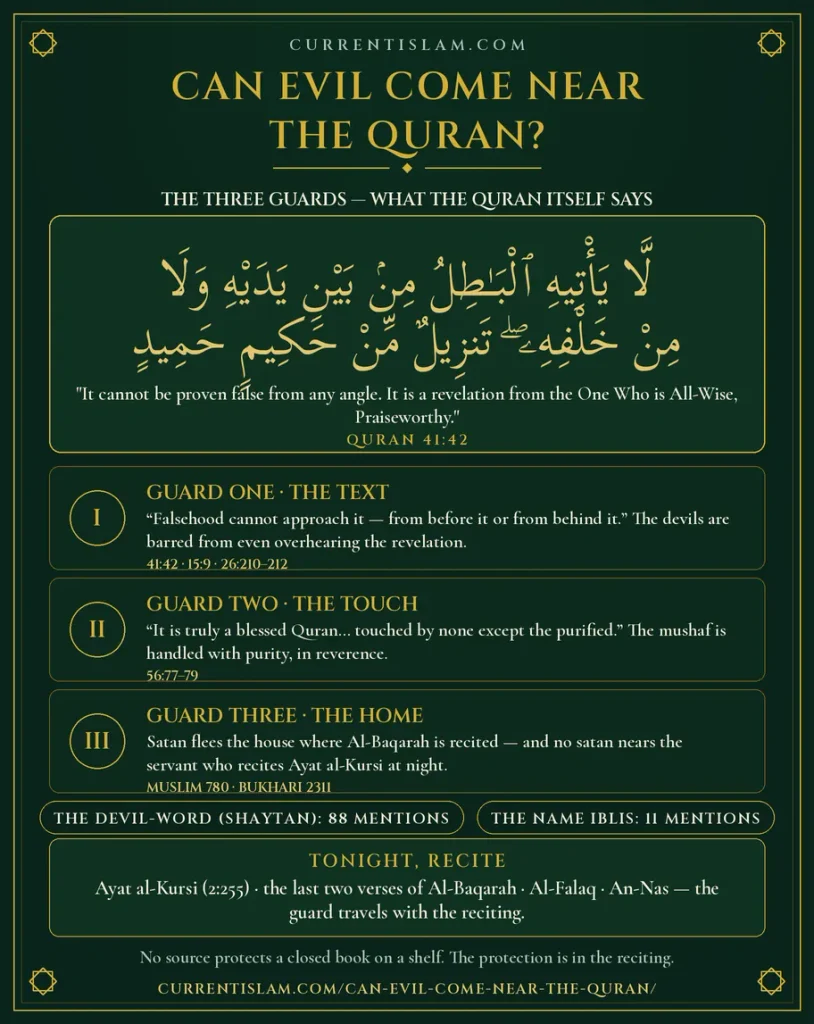
- The words: No. “Falsehood cannot approach it from before it or from behind it” (Quran 41:42), and Allah says He sent the Reminder down and He Himself guards it (15:9).
- The touch: The Quran in its well-preserved Record is “touched by none except the purified” (56:79). For a printed mushaf, the majority practice is to make wudu (ablution) before touching it.
- Your home: Satan runs away from the house in which Surah Al-Baqarah is recited (Sahih Muslim 780), and no satan comes near the one who recites Ayat al-Kursi before sleep until morning (Sahih al-Bukhari 2311).
Contents
- Can evil corrupt or change the Quran’s words? — The First Guard: The Text
- Can Shaytan touch the Quran? — The Second Guard: The Touch
- Can evil come near a home where the Quran is recited? — The Third Guard: The Home
- How many times is the devil mentioned in the Quran?
- Does a Quran on the shelf protect the house by itself?
- The Three Guards at a glance
- Start tonight: the Guard-Your-Home routine
- The Quran in an ordinary day
- Questions people ask
A reader wrote with a question she had carried since childhood: she had always heard that evil cannot come near the Quran. Her mushaf (the printed copy of the Quran) sits on the highest shelf in her home, and she wanted to know two things. Is the house protected because the Book is in it? And could a devil, or a jinn (an unseen being created from smokeless fire), touch it?
The Quran is the book Muslims believe Allah revealed to the Prophet Muhammad ﷺ over twenty-three years, preserved in Arabic as a recited word and a written text. It is really three questions, with three different answers, each stated in the sources. Evil cannot reach the Book’s words. Evil never handled the Book on its way down. And evil does not stay in a home where the Book’s words are recited.
Can evil corrupt or change the Quran’s words? — The First Guard: The Text
No. Allah describes this Book as one falsehood cannot approach from before it or from behind it (41:42), states that He sent the Reminder down and He Himself guards it (15:9), and says the devils neither brought it down nor can even overhear it (26:210-212).
لَّا يَأْتِيهِ ٱلْبَـٰطِلُ مِنۢ بَيْنِ يَدَيْهِ وَلَا مِنْ خَلْفِهِۦ ۖ تَنزِيلٌ مِّنْ حَكِيمٍ حَمِيدٍ
La ya’tihi al-batilu min bayni yadayhi wa la min khalfih; tanzilun min Hakimin Hamid.
English (Khattab, The Clear Quran): “It cannot be proven false from any angle. ˹It is˺ a revelation from the ˹One Who is˺ All-Wise, Praiseworthy.” (Quran 41:42)
Urdu (Jalandhari):
اس پر جھوٹ کا دخل نہ آگے سے ہوسکتا ہے نہ پیچھے سے۔ (اور) دانا (اور) خوبیوں والے (خدا) کی اُتاری ہوئی ہے
| Arabic | Transliteration | Meaning |
|---|---|---|
| لَّا يَأْتِيهِ | la ya’tihi | falsehood does not come to it |
| ٱلْبَٰطِلُ | al-batil | falsehood, everything false and corrupt |
| مِنۢ بَيْنِ يَدَيْهِ | min bayni yadayhi | from before it, from in front of it |
| وَلَا مِنْ خَلْفِهِۦ | wa la min khalfihi | and not from behind it |
| تَنزِيلٌۭ | tanzil | a revelation sent down |
| مِّنْ حَكِيمٍ حَمِيدٍۢ | min Hakimin Hamid | from the All-Wise, the Praiseworthy |
Read the shape of the sentence. It closes every direction: from before it and from behind it — from any side, in any age, by addition or by removal. Al-batil covers every falsehood that could be pushed into the text. And the next verse names the Guardian Himself.
إِنَّا نَحْنُ نَزَّلْنَا ٱلذِّكْرَ وَإِنَّا لَهُۥ لَحَـٰفِظُونَ
Inna nahnu nazzalna adh-dhikra wa inna lahu la-hafizun.
English (Khattab): “It is certainly We Who have revealed the Reminder, and it is certainly We Who will preserve it.” (Quran 15:9)
Urdu (Jalandhari):
بےشک یہ (کتاب) نصیحت ہمیں نے اُتاری ہے اور ہم ہی اس کے نگہبان ہیں
The guarding was active while the words were coming down. The Makkan charge was that devils brought the Prophet ﷺ this Book. The Quran answers it directly:
وَمَا تَنَزَّلَتْ بِهِ ٱلشَّيَـٰطِينُ وَمَا يَنۢبَغِى لَهُمْ وَمَا يَسْتَطِيعُونَ إِنَّهُمْ عَنِ ٱلسَّمْعِ لَمَعْزُولُونَ
Wa ma tanazzalat bihi ash-shayatin; wa ma yanbaghi lahum wa ma yastati’un; innahum ‘ani as-sam’i la-ma’zulun.
English (Khattab): “It was not the devils who brought this ˹Quran˺ down: it is not for them ˹to do so˺, nor can they, for they are strictly barred from ˹even˺ overhearing ˹it˺.” (Quran 26:210-212)
Urdu (Jalandhari):
اور اس (قرآن) کو شیطان لے کر نازل نہیں ہوئے یہ کام نہ تو ان کو سزاوار ہے اور نہ وہ اس کی طاقت رکھتے ہیں وہ (آسمانی باتوں) کے سننے (کے مقامات) سے الگ کر دیئے گئے ہیں
The jinn say the same about themselves, describing the sky after the Prophet ﷺ was sent:
وَأَنَّا لَمَسْنَا ٱلسَّمَآءَ فَوَجَدْنَـٰهَا مُلِئَتْ حَرَسًا شَدِيدًا وَشُهُبًا وَأَنَّا كُنَّا نَقْعُدُ مِنْهَا مَقَـٰعِدَ لِلسَّمْعِ ۖ فَمَن يَسْتَمِعِ ٱلْـَٔانَ يَجِدْ لَهُۥ شِهَابًا رَّصَدًا
Wa anna lamasna as-sama’a fa-wajadnaha muli’at harasan shadidan wa shuhuba. Wa anna kunna naq’udu minha maqa’ida lis-sam’; fa-man yastami’i al-ana yajid lahu shihaban rasada.
English (Khattab): “˹Earlier˺ we tried to reach heaven ˹for news˺, only to find it filled with stern guards and shooting stars. We used to take up positions there for eavesdropping, but whoever dares eavesdrop now will find a flare lying in wait for them.” (Quran 72:8-9)
Urdu (Jalandhari):
اور یہ کہ ہم نے آسمان کو ٹٹولا تو اس کو مضبوط چوکیداروں اور انگاروں سے سے بھرا پایا اور یہ کہ پہلے ہم وہاں بہت سے مقامات میں (خبریں) سننے کے لئے بیٹھا کرتے تھے۔ اب کوئی سننا چاہے تو اپنے لئے انگارا تیار پائے
Ibn Kathir, commenting on these verses, explains that filling the sky with guards was among the ways Allah protected the revelation itself. The picture agrees from every side: the devils did not bring the Book, could not overhear it, and cannot alter a word of it now.
Can Shaytan touch the Quran? — The Second Guard: The Touch
Not the Book itself. Its preserved Record is touched by none except the purified (56:79), whom most commentators read as the angels. For the printed mushaf, the majority practice, built on this verse and the Prophet’s written instruction, is wudu before touching it.
إِنَّهُۥ لَقُرْءَانٌ كَرِيمٌ فِى كِتَـٰبٍ مَّكْنُونٍ لَّا يَمَسُّهُۥٓ إِلَّا ٱلْمُطَهَّرُونَ
Innahu la-Qur’anun karim, fi kitabin maknun, la yamassuhu illa al-mutahharun.
English (Khattab): “That this is truly a noble Quran, in a well-preserved Record, touched by none except the purified ˹angels˺.” (Quran 56:77-79)
Urdu (Jalandhari):
کہ یہ بڑے رتبے کا قرآن ہے (جو) کتاب محفوظ میں (لکھا ہوا ہے) اس کو وہی ہاتھ لگاتے ہیں جو پاک ہیں
Who are the purified? Most commentators read them as the angels, and the Record as al-Lawh al-Mahfuz, the Preserved Tablet with Allah. On this reading, the verse guards the revelation’s journey: the only hands that carried this Book between heaven and the Prophet ﷺ were pure ones. No devil touched it on the way down — exactly what 26:210-212 said from the other side.
Other commentators read the words as a command for people: none should touch the Quran except one who is pure — the same words the Prophet ﷺ wrote in his instruction sent with Amr ibn Hazm. On that basis, the majority practice across the schools is wudu before touching a printed mushaf. Reading from memory or a phone screen is a separate question scholars discuss.
So can a devil touch your mushaf? The verses answer something higher. Evil never handled this Book before it reached us, and the Book is approached with the same reverence: clean hands, a settled heart, and words recited, not merely stored.
Can evil come near a home where the Quran is recited? — The Third Guard: The Home
Recitation changes the house. Satan runs away from the house in which Surah Al-Baqarah is recited (Sahih Muslim 780). And whoever recites Ayat al-Kursi when going to bed has a guard appointed by Allah, and no satan comes near him until morning (Sahih al-Bukhari 2311).
The Prophet ﷺ said: “Do not make your houses as graveyards. Satan runs away from the house in which Surah Baqara is recited.” (Sahih Muslim 780)
The Ayat al-Kursi report is closer still, because it uses our question’s very word: near. Abu Hurayra was guarding the Ramadan charity food when a thief came three nights running. On the third night the thief bargained for his release: recite Ayat al-Kursi (the Verse of the Throne, 2:255) at bedtime, and Allah will appoint a guard over you, and no satan will come near you until morning. The Prophet ﷺ confirmed the words were true, then told him who the prisoner had been: “It was Satan.” (Sahih al-Bukhari 2311)
ٱللَّهُ لَآ إِلَـٰهَ إِلَّا هُوَ ٱلْحَىُّ ٱلْقَيُّومُ ۚ لَا تَأْخُذُهُۥ سِنَةٌ وَلَا نَوْمٌ ۚ لَّهُۥ مَا فِى ٱلسَّمَـٰوَٰتِ وَمَا فِى ٱلْأَرْضِ ۗ مَن ذَا ٱلَّذِى يَشْفَعُ عِندَهُۥٓ إِلَّا بِإِذْنِهِۦ ۚ يَعْلَمُ مَا بَيْنَ أَيْدِيهِمْ وَمَا خَلْفَهُمْ ۖ وَلَا يُحِيطُونَ بِشَىْءٍ مِّنْ عِلْمِهِۦٓ إِلَّا بِمَا شَآءَ ۚ وَسِعَ كُرْسِيُّهُ ٱلسَّمَـٰوَٰتِ وَٱلْأَرْضَ ۖ وَلَا يَـُٔودُهُۥ حِفْظُهُمَا ۚ وَهُوَ ٱلْعَلِىُّ ٱلْعَظِيمُ
Allahu la ilaha illa Huwa, al-Hayyu al-Qayyum; la ta’khudhuhu sinatun wa la nawm; lahu ma fi as-samawati wa ma fi al-ard; man dha alladhi yashfa’u ‘indahu illa bi-idhnih; ya’lamu ma bayna aydihim wa ma khalfahum; wa la yuhituna bi-shay’in min ‘ilmihi illa bi-ma sha’; wasi’a kursiyyuhu as-samawati wa al-ard; wa la ya’uduhu hifzuhuma; wa Huwa al-‘Aliyyu al-‘Azim.
English (Khattab): “Allah! There is no god ˹worthy of worship˺ except Him, the Ever-Living, All-Sustaining. Neither drowsiness nor sleep overtakes Him. To Him belongs whatever is in the heavens and whatever is on the earth. Who could possibly intercede with Him without His permission? He ˹fully˺ knows what is ahead of them and what is behind them, but no one can grasp any of His knowledge—except what He wills ˹to reveal˺. His Seat encompasses the heavens and the earth, and the preservation of both does not tire Him. For He is the Most High, the Greatest.” (Quran 2:255)
Urdu (Jalandhari):
خدا (وہ معبود برحق ہے کہ) اس کے سوا کوئی عبادت کے لائق نہیں زندہ ہمیشہ رہنے والا اسے نہ اونگھ آتی ہے نہ نیند جو کچھ آسمانوں میں اور جو کچھ زمین میں ہیں سب اسی کا ہے کون ہے جو اس کی اجازت کے بغیر اس سے (کسی کی) سفارش کر سکے جو کچھ لوگوں کے روبرو ہو رہا ہے اور جو کچھ ان کے پیچھے ہوچکا ہے اسے سب معلوم ہے اور وہ اس کی معلومات میں سے کسی چیز پر دسترس حاصل نہیں کر سکتے ہاں جس قدر وہ چاہتا ہے (اسی قدر معلوم کرا دیتا ہے) اس کی بادشاہی (اور علم) آسمان اور زمین سب پر حاوی ہے اور اسے ان کی حفاظت کچھ بھی دشوار نہیں وہ بڑا عالی رتبہ اور جلیل القدر ہے
Notice the pattern. The protection follows recitation: the words are spoken in the house, and the house changes; the verse is spoken at bedtime, and the night is guarded. This is why the protection surahs are recited, not framed — Al-Baqarah, its last two verses at night, sufficient for the one who recites them (Sahih al-Bukhari 5009), and the Mu’awwidhatayn, Al-Falaq and An-Nas, which name the enemy directly: “from the evil of the lurking whisperer— who whispers into the hearts of humankind—” (114:4-5). The full Manzil collection gathers these verses and more into one sitting of protection recitation: see our complete Manzil Dua guide.
How many times is the devil mentioned in the Quran?
Eighty-eight times, by word count. Counting every form of the devil-word across the Arabic text — al-Shaytan (Satan), ash-Shayatin (the devils) and attached forms like ‘his devils’ — gives eighty-eight occurrences. His personal name, Iblis, is a separate word and appears eleven times (first at 2:34).
We counted it directly from the Arabic text because this number circulates online with no method attached. The count covers the devil-word in all its forms — al-Shaytan, ash-Shayatin, and attached forms such as “his devils” (2:14); Iblis is a different word, counted separately. Here are the names and titles the Quran itself uses, each with a verse you can check:
| Name or Title | Meaning | Where it Appears |
|---|---|---|
| Iblis | His personal name, used from his refusal to bow to Adam | 2:34 and ten further places — 11 in total |
| Al-Shaytan | “The Satan”, the title used for his work against people | Throughout; e.g. 2:36, 2:168 |
| Al-Waswas al-Khannas | The lurking whisperer, who slips in and withdraws | 114:4 |
| Ar-Rajim | The cast-out, accursed one, paired with his name in refuge prayers | 3:36 |
| Shaytan Marid | A rebellious devil, kept from the heavens | 37:7 |
| Qarin | The companion-devil assigned to one who turns away from the Reminder | 43:36 |
Lists online often promise “7 names of shaitan”, but no revealed list fixes that number. The table is what the text itself gives — one name, five titles, each verifiable in its verse. Anything beyond it is a compiler’s arrangement.
Does a Quran on the shelf protect the house by itself?
No source we could verify says so. Every protection report ties the guarding to recitation: Al-Baqarah recited in the house, Ayat al-Kursi recited before sleep. The Book’s own words are guarded absolutely (41:42). For a home, the described protection is spoken and lived, not stored.
Two true things are often merged into one untrue one. The Book itself is guarded absolutely — no evil reaches its words — and your mushaf deserves reverence: a clean place, a high place, handled with wudu. But no verse or sound report says the physical book radiates protection over a house it is never opened in. Every protection report we verified is about recitation.
A warning points the other way. “And whoever turns a blind eye to the Reminder of the Most Compassionate, We place at the disposal of each a devilish one as their close associate” (43:36, Khattab). The danger is not a devil strong enough to defeat the Book. It is a person distant enough from the Book for the devil to move in as a companion. Distance, not the devil’s power, is the risk. The reported refuge duas are gathered in our guide to the dua for protection from black magic and evil eye gathers the reported refuge duas in one place, and Fallahu Khairun Hafizan (12:64) is the verse for handing a feared matter over to Allah’s guarding.
One more honesty note. Recitation for protection is ruqyah, seeking refuge and healing through the Quran’s words. Ruqyah sits alongside medical care, never instead of it: the Quran calls its verses a healing (17:82) and still expects you to take the means of treatment, a balance our article on Surah Al-Isra ayat 81-82 for healing keeps that balance.
The Three Guards at a glance
| Guard | Question | Source | What it means |
|---|---|---|---|
| The Text | Can evil change the Quran’s words? | 41:42; 15:9; 26:210-212; 72:8-9 | No. Falsehood cannot approach it; Allah guards it; devils neither brought it nor overhear it |
| The Touch | Can evil touch the Quran? | 56:77-79 | The preserved Record is touched only by the purified; the mushaf is handled with wudu in reverence |
| The Home | Can evil stay where it is recited? | Muslim 780; Bukhari 2311; Bukhari 5009 | Satan flees a house of Al-Baqarah; no satan nears the one who recites Ayat al-Kursi at bedtime |
Print the card below and keep it inside your mushaf’s front cover — the whole article in one page.
THE THREE GUARDS CARD
- ☐ The Text is guarded — falsehood cannot approach it (41:42)
- ☐ The Touch is guarded — wudu before the mushaf (56:79)
- ☐ The Home is guarded by recitation — not by storage
- Tonight: Ayat al-Kursi once before sleep (2:255) · Last two verses of Al-Baqarah (2:285-286) · Al-Falaq and An-Nas
- This week: Al-Baqarah recited in the home, a portion after one prayer each day
- 7-night tracker: Night 1 ☐ · Night 2 ☐ · Night 3 ☐ · Night 4 ☐ · Night 5 ☐ · Night 6 ☐ · Night 7 ☐
Start tonight: the Guard-Your-Home routine
Start with what is reported, in this order. Before sleep, recite Ayat al-Kursi once, slowly, knowing what it says — the recitation tied to the promise that no satan comes near you until morning. Then recite the last two verses of Surah Al-Baqarah, which the Prophet ﷺ said are sufficient for whoever recites them at night. Finish with Surah Al-Falaq and Surah An-Nas, the two refuge surahs; Al-Falaq alone names the harms people fear most, down to the envier when he envies. Across the week, give the house its share of Al-Baqarah — a page or two after one daily prayer is enough to begin — and the verse of healing in Surah Al-Isra (17:82) explains why these words carry weight in a home.
The Quran in an ordinary day
None of this needs a special room or a free afternoon. The mushaf opens after Fajr for two minutes before the house wakes. The commute becomes listening time, and a verse heard on the train is the one that returns at a hard moment in the office. In the family group chat, one person sends the day’s verse with its meaning. At work or school, where you may be the only Muslim in the room, the guard you carry is not an object on display. It is words you know, recited quietly before the meeting, the exam, sleep. The protection the sources describe is carried in the chest, not only kept on the shelf.
Questions people ask
Near the Book, no; near a careless reader, the Quran itself warns of it. Falsehood cannot approach the Quran’s words (41:42) and devils are barred from even overhearing it (26:212). But whoever turns away from the Reminder is assigned a devil as a companion (43:36).
He never handled it. The Quran came down through pure carriers only: its preserved Record is ‘touched by none except the purified’ (56:79), read by most commentators as the angels, and the devils are ‘strictly barred from even overhearing it’ (26:212) as it descended.
They say themselves that they cannot, not anymore. In Surah Al-Jinn they report finding the sky filled with stern guards and shooting stars, their old eavesdropping posts watched by a flare lying in wait (72:8-9). Ibn Kathir counts this guarding among the ways the revelation was protected.
For touching a printed mushaf, the majority practice is yes: make wudu first, following 56:79 as a command together with the Prophet’s written instruction that none touch the Quran except one who is pure. Reading from memory, or listening, does not involve touching the mushaf.
The reported core is small and strong. Surah Al-Baqarah, from whose recited house Satan flees (Muslim 780); Ayat al-Kursi at bedtime (Bukhari 2311); Al-Baqarah’s last two verses at night (Bukhari 5009); and Al-Falaq with An-Nas, the two refuge surahs. Manzil gathers these and more.
Eighty-eight times for the devil-word family. We counted every occurrence of al-Shaytan, ash-Shayatin and their attached forms across the full Arabic text: eighty-eight. The name Iblis appears eleven times separately, and the Quran also addresses him by titles such as al-Waswas al-Khannas, the lurking whisperer (114:4).
Not by itself, in any source we could verify. The reports tie protection to recitation: a house where Al-Baqarah is recited (Muslim 780), a sleeper who recites Ayat al-Kursi (Bukhari 2311). Keep the mushaf with reverence, certainly — then open it, because the guard described is in the reading.
Follow the reported order. Ayat al-Kursi (2:255) once before sleep, the recitation after which no satan comes near you until morning (Bukhari 2311). Then Al-Baqarah’s last two verses (2:285-286), called sufficient for the night (Bukhari 5009). Then Al-Falaq and An-Nas, the two surahs of refuge.
Next step:
Read the verses in their gathering: the Manzil Dua collects the protection verses of the Quran into one sitting, with full text and meaning. For the refuge duas themselves, continue with the dua for protection from black magic and evil eye and the dua for bad eye (nazar ki dua).
Last reviewed: 7 November 2026 · Author: Shahab Khan · Reviewed by: Atif khan.
Download PDF (English & Urdu)