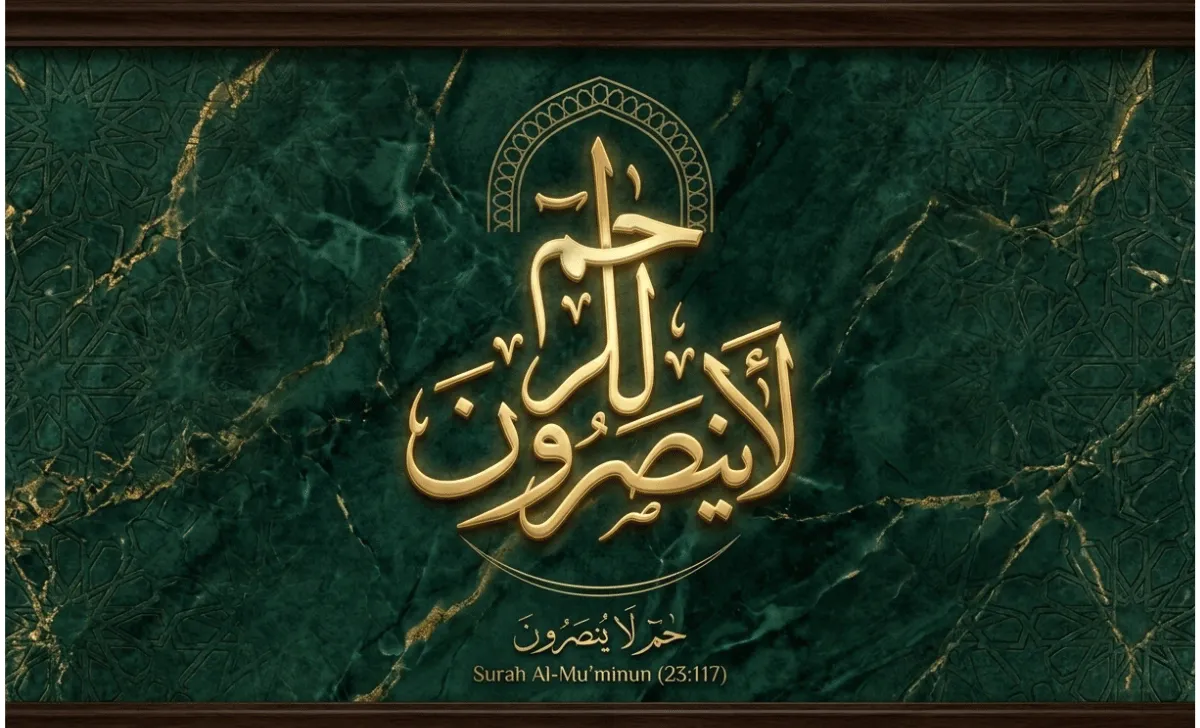
What if the people who are hurting you right now… are already declared powerless by Allah?
When betrayal, slander, or oppression surrounds you, it feels like they have all the support. But the Qur’an makes a stunning declaration: some people are already written as “they will not be helped.”
Here’s why this matters for you.
What Does Hā Mīm Lā Yunṣarūn Mean?
“Hā Mīm Lā Yunṣarūn” means: “Hā Mīm. They will not be helped.” It is a Qur’anic declaration that those who oppose truth and persist in arrogance will find no support against Allah’s decree. It teaches believers to rely fully on Allah during oppression.
📖 Where Is It in the Qur’an?
This phrase appears in Surah Al-Mu’minun, part of the warning to those who deny resurrection and mock divine truth.
From Qur’an:
🕋 Arabic
حٰمۤ لَا يُنصَرُونَ
🔤 Transliteration
Hā Mīm. Lā Yunṣarūn.
🇬🇧 English (Saheeh International)
“Hā, Meem. They will not be helped.”
🇵🇰 Urdu (Fateh Muhammad Jalandhari)
“حٰم۔ ان کو مدد نہ دی جائے گی۔”
Word-by-Word Deep Analysis
The phrase consists of mysterious opening letters “Hā Mīm,” followed by a powerful negation “Lā,” and the passive verb “Yunṣarūn,” meaning “they will not be helped.” The structure emphasizes absolute denial of divine support.
حٰمۤ (Hā Mīm)
- From the disjointed letters (Ḥurūf al-Muqaṭṭaʿāt)
- Appear at the beginning of seven Surahs
- Signify divine authority and revelation power
لَا (Lā)
- Absolute negation
- Means: Never
يُنصَرُونَ (Yunṣarūn)
- Root: ن ص ر (help, victory)
- Passive form: “They will not be supported”
Notice the power:
Allah does not say “You will defeat them.”
He says: “They will not be helped.”
When divine support is withdrawn, collapse is inevitable.
Full Context from Surah Al-Mu’minun (23:116–118)
In Surah Al-Mu’minun, Allah condemns arrogance and denial of the Hereafter. The phrase comes in a warning passage where false pride is dismantled. The message is clear: those who reject divine truth will find no ally against Allah’s judgment.
(Here the full multilingual quadrant would be inserted in final publishing layout with complete ayah block 23:116–118 in Arabic, transliteration, English, and Urdu.)
Tafseer According to Ibn Kathir
According to Ibn Kathir, this phrase is a decisive warning. It refers to disbelievers who persist in rejection after clear proofs. When Allah’s punishment comes, no power, tribe, or authority will be able to assist them.
Key Tafseer Insight:
- The denial of resurrection leads to arrogance.
- Arrogance leads to loss of divine protection.
- Once Allah withdraws support, no worldly alliance can help.
For 2026 context:
Even today, systems of injustice look strong. But divine withdrawal is silent — and unstoppable.
Connection with Other Hā Mīm Surahs
Seven Surahs begin with “Hā Mīm.” They emphasize divine power, accountability, and the fall of arrogance. This phrase connects thematically with warnings found in Surah Ghafir and Surah Fussilat about ultimate justice.
- Surah Ghafir
- Surah Fussilat
These Surahs repeatedly show:
Truth may look weak temporarily.
Falsehood may look dominant temporarily.
But divine support decides outcomes.
Is There a Wazifa for Hā Mīm Lā Yunṣarūn?
There is no authentic hadith prescribing a fixed number for this phrase as a wazifa. However, reciting Qur’anic verses for protection with sincere intention is permissible. Many scholars encourage reflection-based recitation rooted in tawakkul, not superstition.
📿 Structured Recitation Plan (Tawakkul Power Model)
🌅 Morning Routine
- After Fajr
- Recite 11 times
- Reflect: “Allah is my only supporter.”
🌙 Evening Routine
- Before sleep
- Recite 33 times
- Release fear of people
- Surrender outcomes to Allah
Important:
This is a reflection-based spiritual routine — not a guaranteed formula.
The Tawakkul Power Model
The Tawakkul Power Model teaches that victory begins with trust. First, you rely on Allah. Second, you remain patient under pressure. Third, divine justice unfolds. “Lā Yunṣarūn” represents the final stage: false support collapses when Allah withdraws help.
Step 1: Trust (Tawakkul)
Stop measuring power by numbers.
Step 2: Patience (Sabr)
Remain steady during injustice.
Step 3: Divine Withdrawal
Allah removes unseen support from oppressors.
Step 4: Outcome
Victory may come quietly — but decisively.
This applies to:
- Workplace oppression
- Family injustice
- Online slander
- Social hostility
Benefits of Reflecting on This Ayah
Reflecting on this phrase strengthens emotional resilience. It reduces fear of people, builds courage during hardship, and reinforces belief in divine justice. It trains the heart to rely on Allah instead of worldly alliances.
Spiritual Benefits
- Inner calm during conflict
- Reduced anxiety about enemies
- Stronger tawakkul
- Patience in delay
People Also Ask:
It means: “Hā Mīm. They will not be helped.” It is a Qur’anic warning that those who oppose divine truth will receive no support against Allah’s decree.
It appears in Surah Al-Mu’minun in the Qur’an as part of a warning passage about arrogance and denial of resurrection.
Yes, you may recite it for reflection and strengthening tawakkul. However, no authentic hadith fixes a specific number for protection.
There is no fixed requirement. A structured routine like 11 times in the morning and 33 times at night can help build spiritual discipline.
Here’s the Heart of the Matter
When you feel surrounded, remember:
Victory is not always loud.
Sometimes it is simply this:
They will not be helped.
If you are facing injustice right now, you are not alone.
📩 Submit your dua request below.
Your name and situation will be included in our collective supplications.
Because the One who withdraws help from oppressors…
is the One who never abandons the patient believer.
