Have you ever whispered a dua asking Allah for forgiveness… yet wondered which Quranic supplication truly captures the heart of repentance?
One beautiful dua recited by the believers in the Qur’an is:
“Rabbana Innana Amanna Faghfir Lana Warhamna.”
It is short, powerful, and deeply emotional. In just a few words, believers declare their faith, their need for forgiveness, and their hope for Allah’s mercy.
Here’s why this dua matters for you: it reflects the Spiritual Habit Loop of a believer — Iman → Istighfar → Mercy → Jannah.
Let’s look at the heart of this beautiful verse.
Meaning of Rabbana Innana Amanna Faghfir Lana Warhamna
“Rabbana Innana Amanna Faghfir Lana Warhamna” is a powerful Quranic dua from Surah Aal-Imran (3:16). In this supplication, believers declare their faith in Allah and ask Him to forgive their sins and grant them mercy. It represents sincere repentance and hope for Allah’s mercy.
Arabic
رَبَّنَا إِنَّنَا آمَنَّا فَاغْفِرْ لَنَا ذُنُوبَنَا وَقِنَا عَذَابَ النَّارِ
Transliteration
Rabbana innana amanna faghfir lana dhunubana wa qina ‘adhaban-nar
English Translation (Saheeh International)
“Our Lord, indeed we have believed, so forgive us our sins and protect us from the punishment of the Fire.”
Urdu Translation (Fateh Muhammad Jalandhari)
“اے ہمارے رب! ہم ایمان لا چکے ہیں، پس ہمارے گناہ بخش دے اور ہمیں دوزخ کے عذاب سے بچا لے۔”
Which Surah Contains This Dua?
The dua “Rabbana Innana Amanna Faghfir Lana” appears in Surah Aal-Imran, Ayah 16 (3:16). The verse describes the qualities of true believers who have deep faith, patience, sincerity, and devotion to Allah. It highlights their constant supplication for forgiveness and protection from Hellfire.
Arabic Verse (Surah Aal-Imran 3:16)
الَّذِينَ يَقُولُونَ رَبَّنَا إِنَّنَا آمَنَّا فَاغْفِرْ لَنَا ذُنُوبَنَا وَقِنَا عَذَابَ النَّارِ
Transliteration
Alladhina yaquluna rabbana innana amanna faghfir lana dhunubana wa qina ‘adhaban-nar
English Translation
“Those who say: Our Lord, indeed we have believed, so forgive us our sins and protect us from the punishment of the Fire.”
Urdu Translation
“وہ لوگ جو کہتے ہیں: اے ہمارے رب! ہم ایمان لے آئے ہیں، پس ہمارے گناہ معاف فرما اور ہمیں دوزخ کے عذاب سے بچا۔”
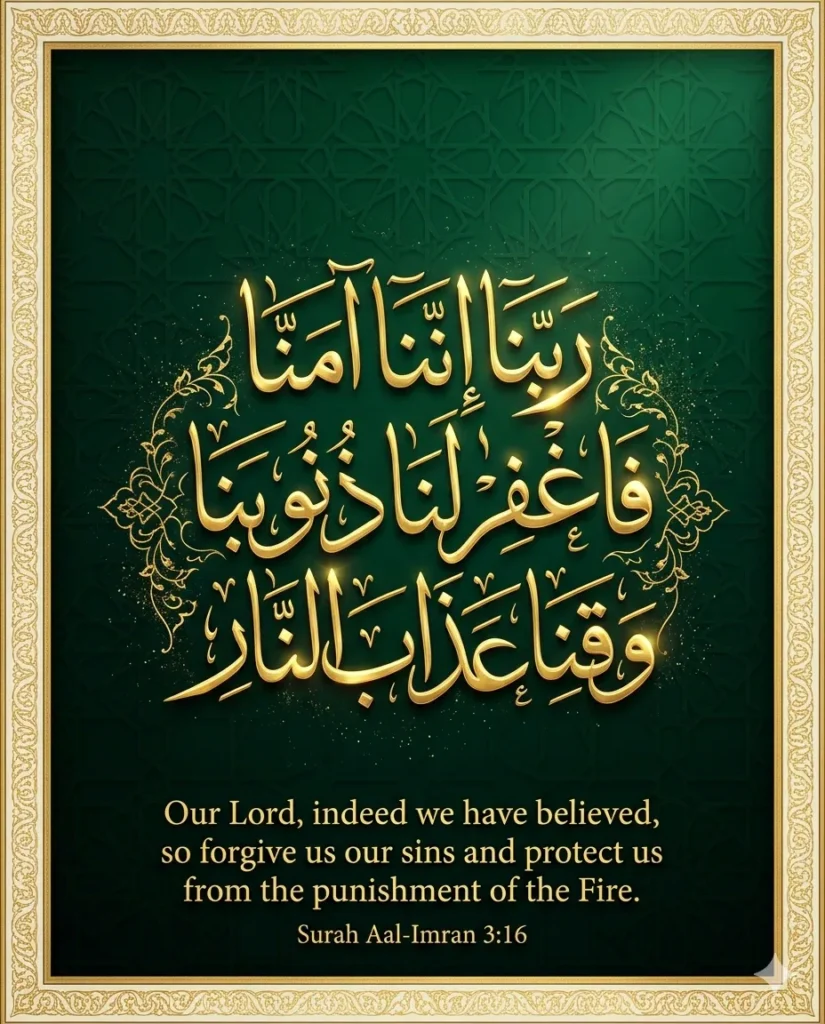
Word-by-Word Meaning
The phrase “Rabbana Innana Amanna Faghfir Lana” contains a powerful declaration of faith followed by a humble request for forgiveness. Each word carries deep meaning that reflects the believer’s relationship with Allah — acknowledging His lordship, affirming faith, and seeking mercy.
Rabbana (رَبَّنَا)
Meaning: Our Lord
A believer begins the dua by recognizing Allah as the ultimate caretaker and sustainer.
Innana (إِنَّنَا)
Meaning: Indeed we
This word emphasizes certainty and sincerity in the statement.
Amanna (آمَنَّا)
Meaning: We have believed
The believers openly declare their faith in Allah and His guidance.
Faghfir (فَاغْفِرْ)
Meaning: So forgive
After affirming faith, they immediately ask Allah for forgiveness.
Lana (لَنَا)
Meaning: For us
The dua is made collectively, reflecting the unity of the Ummah.
Dhunubana (ذُنُوبَنَا)
Meaning: Our sins
A believer recognizes their mistakes and turns to Allah in humility.
Wa Qina (وَقِنَا)
Meaning: And protect us
This shows that forgiveness alone is not enough — believers also ask for protection from punishment.
Adhaban-Nar (عَذَابَ النَّارِ)
Meaning: The punishment of the Fire
The ultimate goal of the believer is salvation in the Hereafter.
Tafsir of Surah Aal-Imran 3:16
According to classical tafsir, this verse describes the sincere believers who constantly turn to Allah with humility. They acknowledge their faith but still seek forgiveness because true believers never rely solely on their deeds — they rely on Allah’s mercy.
Explanation from Classical Scholars
Tafsir Ibn Kathir
Ibn Kathir explains that these believers combine faith with humility. Even though they believe sincerely, they still ask Allah for forgiveness because no one is free from mistakes.
This demonstrates the mindset of a true servant of Allah.
The Characteristics of These Believers
The surrounding verses describe believers who are:
• Patient
• Truthful
• Devout
• Charitable
• Seeking forgiveness before dawn
These qualities reflect a life of constant spiritual awareness.
The Spiritual Habit Loop in This Dua
The dua “Rabbana Innana Amanna” reflects a powerful spiritual cycle: believers declare their faith, seek forgiveness for their shortcomings, receive Allah’s mercy, and hope for Paradise. This pattern forms a spiritual habit loop that strengthens a Muslim’s relationship with Allah.
The Spiritual Habit Loop
1. Iman (Faith)
The believer says:
“Innana Amanna” — We have believed.
Faith is the foundation of the entire journey.
2. Istighfar (Seeking Forgiveness)
Immediately after faith comes repentance:
“Faghfir Lana” — Forgive us.
This reminds us that believers constantly return to Allah.
3. Mercy (Rahmah)
Allah’s mercy is greater than our sins.
When a servant sincerely repents, Allah opens the doors of forgiveness.
4. Jannah (Paradise)
The final goal of the believer is:
“Wa Qina Adhaban-Nar”
Protection from Hell and entry into Paradise.
Why This Matters for Your Life
Every believer struggles with mistakes.
But Islam teaches something powerful:
Your sins do not define you. Your repentance does.
When you say this dua sincerely, you are following the path of the believers described in the Qur’an.
Making This Dua a Daily Wazifa
Many scholars encourage Muslims to regularly recite Quranic duas because they contain the most complete supplications. Reciting “Rabbana Innana Amanna Faghfir Lana Warhamna” daily reminds believers to renew their faith, seek forgiveness, and ask Allah for protection from Hellfire.
Simple Daily Routine
You can recite this dua:
After Fajr prayer
After Maghrib prayer
Before sleep
Even repeating it 3–10 times daily can help keep your heart connected to Allah.
Understanding the Purpose of Our Creation
Repentance and worship are deeply connected.
Allah created humans with a purpose — to worship Him and seek His closeness.
If you want to understand this deeper, read about Wama Khalaqtul Jinna Wal Insa Illa Liya Budun, which explains the purpose of human creation in Islam.
When believers understand this purpose, their duas become more sincere.
When a Believer Turns to Allah
There is something beautiful in the Quran.
When a believer sincerely returns to Allah, Allah makes their path easier.
This is explained in Fasanuyassiruhu Lil Yusra, where Allah promises ease for those who strive for righteousness.
Repentance opens the door to that ease.
People Also Ask:
It means:
“Our Lord, we have believed, so forgive us our sins and protect us from the punishment of the Fire.”
This dua appears in Surah Aal-Imran, Ayah 16 (3:16).
Yes. It is a Quranic supplication made by sincere believers asking Allah for forgiveness and protection from Hellfire.
Yes. Many scholars encourage reciting Quranic duas regularly because they are the most comprehensive and blessed supplications.
The Heart of This Dua
Here’s the beautiful reality:
A believer admits their faith.
A believer admits their weakness.
A believer asks Allah for mercy.
And Allah loves those who return to Him.
So the next time you raise your hands in dua, whisper these words:
Rabbana Innana Amanna Faghfir Lana Wa Qina Adhaban-Nar
Because sometimes the most powerful prayers are also the simplest.

1 thought on “Dua for Forgiveness- Rabbana Innana Amanna Faghfir Lana”