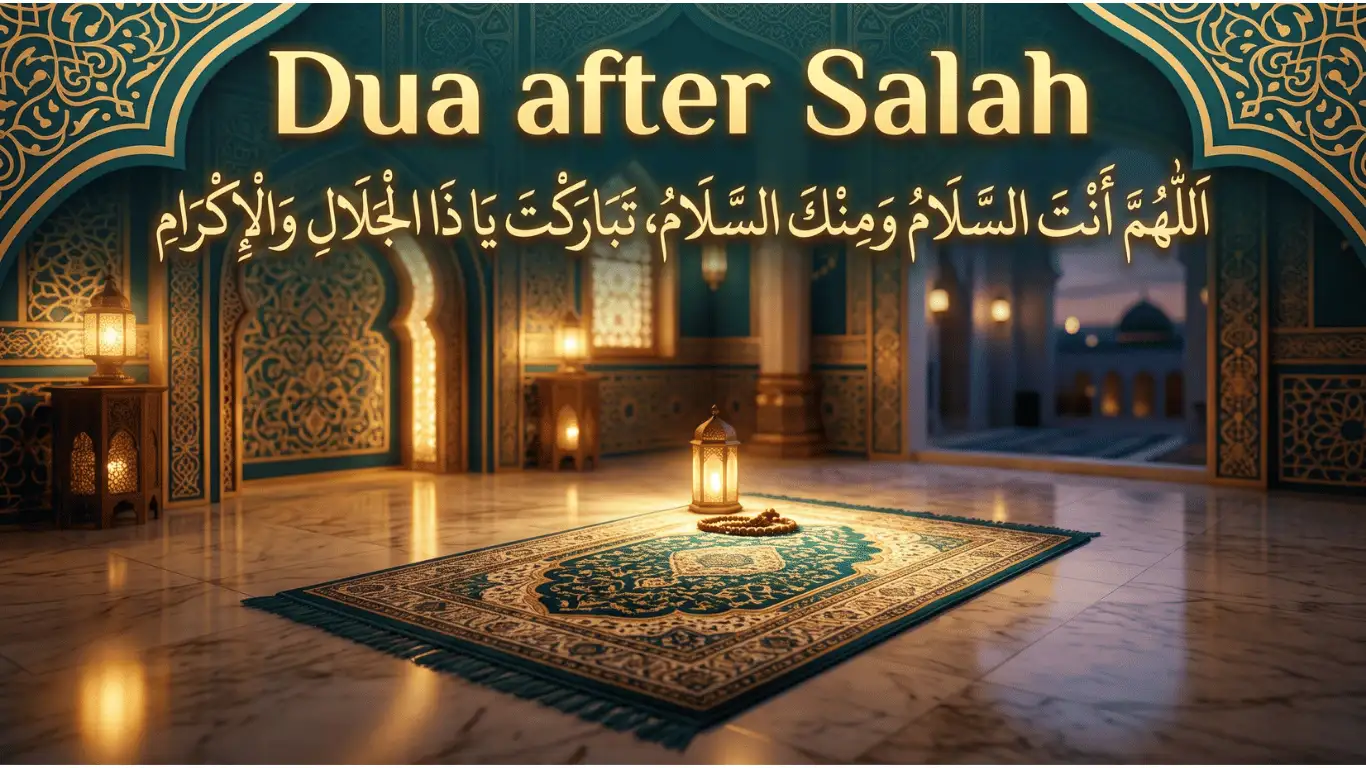
You fold your prayer mat, but your heart is still racing. You just finished your Salah, yet your mind is already stressing about an unread email, a looming university exam, or your kids screaming in the next room. You say “salam” to the right and left, and immediately reach for your phone.
Sound familiar? Treating prayer like a mechanical checklist item leaves us feeling completely disconnected. We pray, but we do not feel peace.
The fix is not forcing yourself to sit on the mat for an hour. The fix is a 10-second Sunnah—a highly potent micro-transformation that acts as a spiritual anchor before you step back into the chaos of the world.
What is the Best Dua After Salah?
The best dua after salah is saying “Astaghfirullah” three times, followed directly by “Allahumma antas-salam wa minkas-salam, tabarakta ya dhal-jalali wal-ikram.” This specific supplication grounds your heart and seeks divine peace immediately following the completion of an obligatory prayer.
Here is the exact multilingual breakdown of this powerful invocation:
- Arabic Text: اللَّهُمَّ أَنْتَ السَّلَامُ وَمِنْكَ السَّلَامُ، تَبَارَكْتَ يَا ذَا الْجَلَالِ وَالْإِكْرَامِ
- Transliteration: Allahumma antas-salam wa minkas-salam, tabarakta ya dhal-jalali wal-ikram.
- English Translation: “O Allah, You are As-Salam (The Source of Peace), and from You is all peace. Blessed are You, O Possessor of Majesty and Honor.”
- Urdu Translation: اے اللہ، تو ہی سلامتی والا ہے، اور تیری ہی طرف سے سلامتی ہے۔ تو بڑی برکت والا ہے، اے جلال اور اکرام والے۔
- Hindi Translation: हे अल्लाह, आप ही शांति के स्रोत हैं, और आप ही से शांति है। आप बहुत बरकत वाले हैं, हे महिमा और सम्मान वाले।
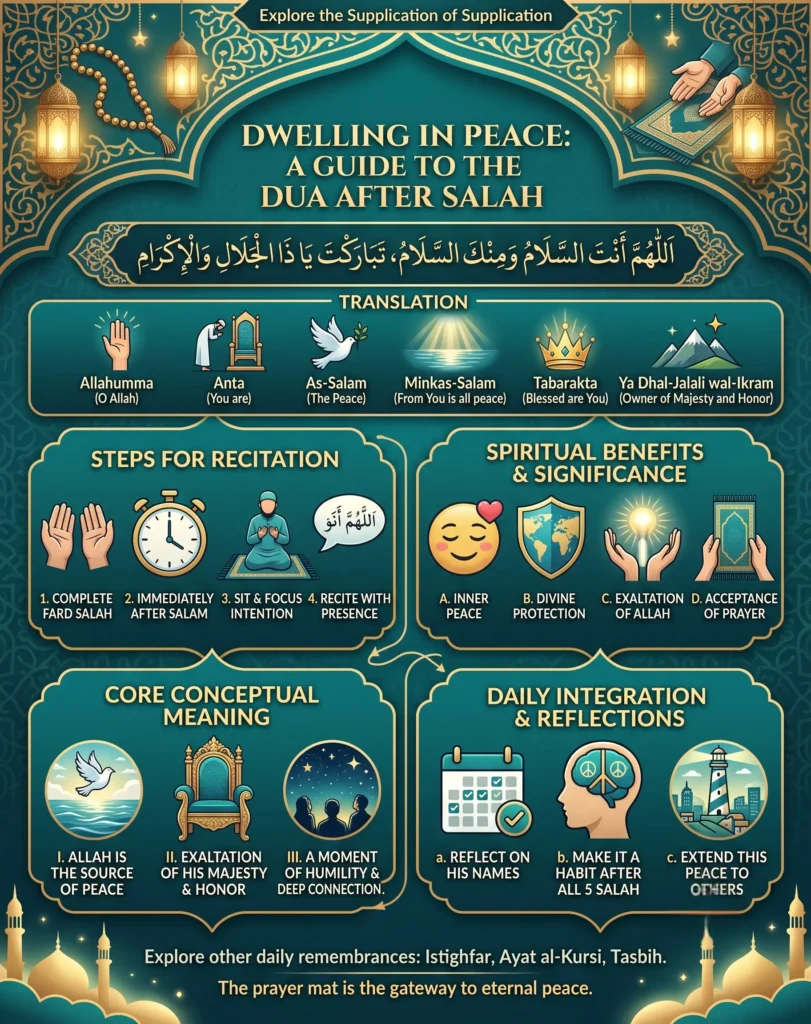
The Authentic Source: Sahih Muslim 591
Prophet Muhammad (PBUH) consistently practiced this specific dhikr. According to authentic hadith narrations recorded in Sahih Muslim, the Prophet would ask for forgiveness three times before reciting this dua for peace, creating a perfect spiritual transition into daily life.
The companion Thawban (May Allah be pleased with him) narrated:
“Whenever the Messenger of Allah (ﷺ) finished his prayer, he would beg forgiveness three times and then he would say: ‘Allahumma Antas-Salam, wa minkas-Salam, Tabarakta ya Dhal-Jalali wal-Ikram.'” (Sahih Muslim, Book 5, Hadith 170)
This is the standard we must benchmark ourselves against. It is not just about the words; it is about the sequence.
The Psychology of the 90-Second Spiritual Reset
This micro-transformation works because it actively downloads divine tranquility into your nervous system. By calling upon As-Salam (The Source of Peace), you build an immediate psychological shield against digital overwhelm, time poverty, and daily anxiety.
Why is this so effective for modern Muslims? When you finish praying, you are transitioning from a sacred sanctuary back into the demands of the Dunya (worldly life).
If you immediately open a work app, your brain spikes in cortisol. You lose the sakinah (tranquility) you just built. But if you stop for exactly 10 seconds to recite this dua after prayer, you intentionally command your nervous system to regulate itself using the ultimate source of calm. You are reminding your brain that God is the author of peace, not your inbox.
Why We Say “Astaghfirullah” First
Seeking forgiveness immediately after worship compensates for our lack of focus. It admits our human flaws during the prayer itself, shifting our mindset away from arrogance and opening our hearts to receive complete mercy and absolute inner peace.
We often wonder, “Why ask for forgiveness after doing a good deed like prayer?”
Here is why this matters for your daily routine: Our prayers are rarely perfect. We think about lunch, we plan our meetings, and our focus slips. By saying Astaghfirullah three times, we wipe the slate clean. We say, “O Allah, my prayer was flawed, but You are Flawless (As-Salam). Please accept it.”
The Sunnah Sequence: Your Daily Habit Loop
The ideal Sunnah sequence involves a simple habit loop: seek forgiveness for distractions during worship, affirm God’s absolute perfection, and mentally shift your focus from worldly stress to complete Tawakkul (trust and reliance on God).
To help you visualize this micro-transformation, here is the exact step-by-step breakdown of how to spend your first 90 seconds after Salah.
| Action Step | Exact Timing | Arabic Dhikr | Core Benefit / Psychological Payoff |
| Step 1: The Reset | Immediately after Tasleem | Astaghfirullah (3x) | Clears guilt from distracted thoughts; admits human imperfection. |
| Step 2: The Anchor | Right after seeking forgiveness | Allahumma antas-salam… | Downloads divine peace (sakinah) directly into your stressed mind. |
| Step 3: The Praise | Following the Anchor | Subhanallah (33x), Alhamdulillah (33x), Allahu Akbar (33x) | Realigns your worldview. Reminds you that God is bigger than your deadlines. |
| Step 4: The Shield | Before standing up | Ayat al-Kursi | Provides absolute spiritual protection until the time of the next prayer. |
Expanding Your Worship: Linking Key Adhkar
Building a resilient spiritual routine requires layering small, intentional habits. Pairing your post-prayer adhkar with supplications before worship and specific prayers for your daily provisions creates a comprehensive shield of mindfulness throughout your day.
Your mental clarity does not just start when you finish Salah. It is a continuous loop of remembrance.
Before you even step on the prayer mat, you set the foundation. Reciting the Dua after wudu purifies your physical and spiritual state, prepping your brain for focus.
When you hear the call to prayer echoing from your phone app or local masjid, responding with the Dua after adhan aligns your intentions with eternal success.
And finally, when you step off the mat to face your career, bills, or studies, you pair your newfound peace with the Dua for rizq. This combination ensures you operate strictly on Tawakkul and Sabr, knowing your provisions are handled by the Most High.
Finding Ultimate Peace: The Quranic Perspective on Dhikr
The Quran explicitly states that true emotional stability and anxiety relief come exclusively from remembering God. Surah Ar-Ra’d verse 28 confirms that human hearts find their ultimate rest only through the consistent remembrance of Allah.
Let’s break down the exact meaning of this verse to understand why post-prayer dhikr is heavily emphasized.
- Arabic Text: الَّذِينَ آمَنُوا وَتَطْمَئِنُّ قُلُوبُهُم بِذِكْرِ اللَّهِ ۗ أَلَا بِذِكْرِ اللَّهِ تَطْمَئِنُّ الْقُلُوبُ
- Transliteration: Allatheena amanoo watatma’innu quloobuhum bithikri Allahi ala bithikri Allahi tatma’innu alquloob.
- English Translation: “Those who have believed and whose hearts have rest in the remembrance of Allah. Unquestionably, by the remembrance of Allah hearts are assured.” (Surah Ar-Ra’d 13:28)
- Urdu Translation: جو لوگ ایمان لائے اور ان کے دل اللہ کے ذکر سے اطمینان پاتے ہیں۔ سن لو! اللہ کے ذکر ہی سے دلوں کو اطمینان ملتا ہے۔
- Hindi Translation: जो लोग ईमान लाए और जिनके दिल अल्लाह के ज़िक्र से शांति पाते हैं। सुन लो! अल्लाह के ज़िक्र से ही दिलों को शांति मिलती है।
You cannot outwork anxiety. You cannot out-scroll stress. True rest only comes when you tie your heart to the Flawless Source of Peace.
Dua after Salah PDF
People Also Ask
The exact, authentic dua to read after salah is saying “Astaghfirullah” three times, and then reciting: “Allahumma antas-salam wa minkas-salam, tabarakta ya dhal-jalali wal-ikram.” This was the consistent practice of the Prophet Muhammad (PBUH) after obligatory prayers.
It is a highly emphasized Sunnah (recommended practice) to recite this dua after prayer, specifically immediately following the five obligatory (Fard) prayers. While not mandatory for the Salah to be valid, skipping it means leaving immense spiritual rewards on the table.
Yes, if you cannot read Arabic, reciting the transliteration or the English translation is completely acceptable. God understands all languages. However, gradually learning the original Arabic pronunciation is highly encouraged to connect directly with the exact words of the Prophet (PBUH).
Stop rushing off your prayer mat. Master this micro-transformation today.
Want to build a completely distraction-free prayer routine?
👇 [Click Here to Download Our Free PDF Guide: The 90-Second Spiritual Habit Loop] 👇
Save this actionable cheat sheet to your phone or print it directly for your prayer area.

1 thought on “Dua after salah — Allahumma antas-salam wa minkas-salam”