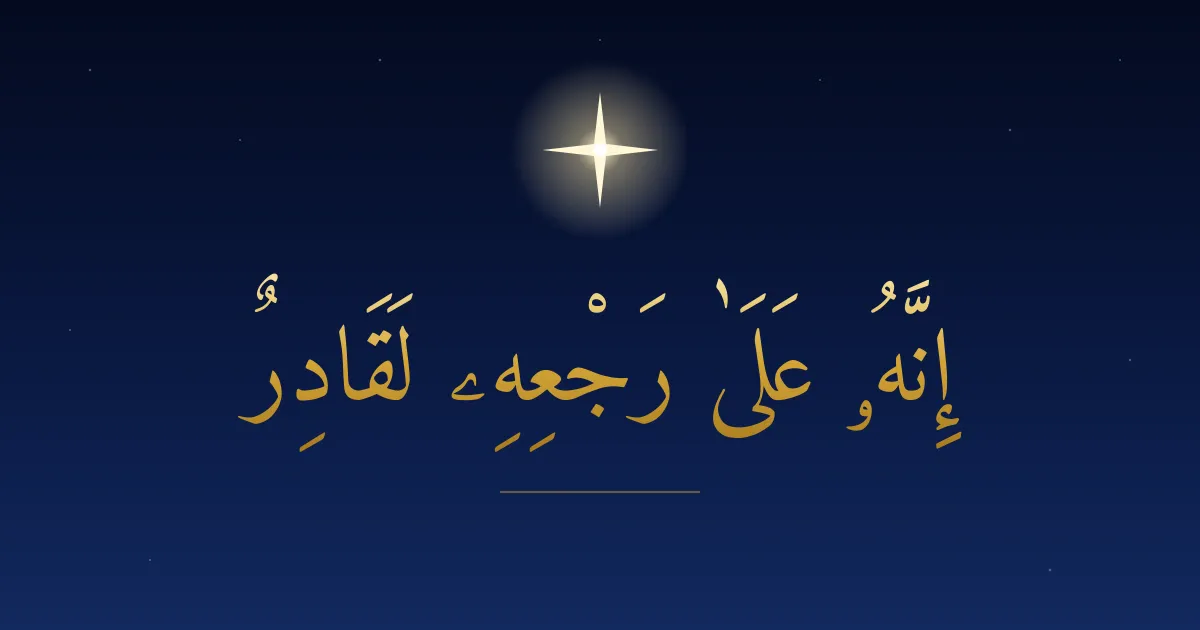
You are at a graveside, or beside a hospital bed, or looking at a message that will never be answered. Someone is gone. One question sits heavy in your chest: can anything come back?
Innahu ala raj’ihi la qadir (innahu ʿalā rajʿihi laqādir) is Quran 86:8, from Surah At-Tariq. A surah is a chapter of the Quran. The verse means, “Indeed, He [Allah] is able to return him [to life].” It answers that question calmly.
This guide explains what the verse means, what it does not mean, and how to hold it in a 90-second pause. It is part of our Ayat Insights library.
Quick Answer
- Meaning: Allah, who created you from a drop of fluid, is able to raise you again after death.
- Context: Ibn Kathir reads it as proof of the Resurrection.
- Use: It is a statement of Allah’s power, not a dua (a personal prayer of asking) or a wazifa with a fixed count. Reflect on it, then ask Allah in your own words.
In this guide
- What does it mean?
- What is the context?
- Is it a dua or a wazifa?
- How can it steady you?
- How do you live it in the West?
- What do people get wrong?
- Frequently asked questions
- What should you do next?
What does “innahu ala raj’ihi la qadir” mean?
It means, “Indeed, He [Allah] is able to return him [to life].” The “him” is the human being described in the previous verses. The verse says the One who made you from a drop of fluid can bring you back after death.
إِنَّهُ عَلَىٰ رَجْعِهِ لَقَادِرٌ
Innahu ʿalā rajʿihi laqādir
“Indeed, He [Allah] is able to return him [to life].”
Quran, Surah At-Tariq (86), verse 8. Translation: Saheeh International.
| Arabic | Transliteration | Meaning |
| إِنَّهُ | innahu | indeed He |
| عَلَىٰ | ʿalā | over, upon |
| رَجْعِهِ | rajʿihi | his return |
| لَقَادِرٌ | laqādir | surely able |
The word rajʿ means a return, a going back. The same root appears in verse 11, where Allah swears by “the sky which returns [rain].” Ibn ʿAbbas said rajʿ there means rain, as Ibn Kathir reports.
![Educational infographic for Quran 86:8, Surah At-Tariq[cite: 2]. It displays the Arabic text, transliteration, a four-part word-by-word breakdown, a three-step "90-Second Return Pause" guide, and an illustration of rain falling on dry earth referencing Quran 86:11](https://currentislam.com/wp-content/uploads/2026/09/quran-86-8-surah-at-tariq-infographic-488x1024.webp)
What is the context of Surah At-Tariq 86:8?
Surah At-Tariq is a Makkan chapter of 17 verses. Verses 5 to 7 tell the reader to look at where he came from. Verse 8 draws the conclusion: the One who began your creation can repeat it. Verses 9 and 10 describe the Day of Judgment.
Makkan means revealed in Makkah, before the Hijrah (the Prophet’s ﷺ move to Madinah). Quran.com’s introduction, adapted from Ibn Ashur, calls it a chapter proving the Resurrection.
Ibn Kathir, a 14th-century scholar of tafsir (Quran explanation), reads verse 5 as a reminder of how weak our origin is. His point is simple: whoever can begin creation can repeat it. He links this to Quran 30:27, where Allah says repeating creation is easier for Him.
The Prophet ﷺ also named this surah when he corrected Muʿadh ibn Jabal for making a congregational prayer too long. He said reciting surahs like At-Tariq and Ash-Shams would have been enough (Sunan an-Nasaʾi, narrated by Jabir).
Is “innahu ala raj’ihi la qadir” a dua or a wazifa?
No. Its wording is a statement from Allah, not a request. No authentic report gives it a set count, timing, or power to bring back a spouse or missing person. Read it for its real meaning, then ask Allah directly in your own words.
Wanting someone back is human. Asking Allah for help is right. Prophet Yaqub (peace be upon him) held on to hope for Yusuf for many years and told his sons not to despair of Allah’s relief (Quran 12:87). Read more about Prophet Yaqub’s hope.
But a wazifa (a routine of repeated recitation) with a promised result needs a sound source. None is known for this verse. A report attributed to Ubayy ibn Kaʿb promises rewards as many as the stars for reciting At-Tariq. Hadith scholars widely reject it as fabricated.
If grief or fear feels too heavy, please talk to a doctor or counselor. Dua complements professional care. It never replaces it.
How can this verse steady you in grief or fear?
Use it as a pause, not a formula. When grief or worry hits, remember your origin, say the verse slowly with its meaning, then make dua. The 90-Second Return Pause gives you a repeatable path from panic to trust. Do it once tonight.
Think of it as a habit loop. The cue is the moment grief, fear, or doubt hits. The routine is the pause below. The reward is steadiness from remembering who holds every return.
The 90-Second Return Pause
This is a suggested routine, not a reported Sunnah practice.
- Look back (30 seconds). Remember verses 5 to 7. You began as a drop of fluid. Allah carried you from there to here.
- Say it (30 seconds). Recite 86:8 slowly. Then say its meaning in your own language.
- Turn to Him (30 seconds). Ask Allah in your own words: mercy for the one who died, patience for a loss, or courage for a fear.
This is tawakkul (trusting Allah while still doing your part) in small form. Read more about trusting Allah with effort.
Start tonight: after Isha (the night prayer), sit for 90 seconds and do the three steps once. Tomorrow, pair it with your morning wake-up dua, which thanks Allah for giving us life after He caused us to die (Sahih al-Bukhari).
Save it: get the printable Return Pause card.
How do you live this verse as a Muslim in the West?
Use it in the small moments: a hospital corridor, a delayed flight home, a funeral where you are the only Muslim. Say the meaning quietly. When a coworker asks what you believe happens after death, this verse gives a calm, simple answer.
On your commute. Put your phone away for 90 seconds and do the pause.
At work. If a coworker asks about death, you can say: “We believe the One who created us can return us, and that we are accountable.”
Far from family. Make dua for reunion. Then take permissible (halal) steps too: call, write, and visit when you can. That balance is tawakkul.
What do people get wrong about 86:8?
Most mistakes come from treating a statement of Allah’s power as a formula. The table below separates common claims from what the sources support. Use it as a quick check before you share or repeat a claim about this verse.
| Common claim | What the sources support | Basis |
| “It is a dua.” | It is a statement from Allah about His power. Make dua separately. | Wording of 86:8; Ibn Kathir |
| “Recite it a set number of times to bring someone back.” | No authentic report gives a count, timing, or result. | Scholar review |
| “Reciting At-Tariq earns rewards like the stars.” | The report attributed to Ubayy ibn Kaʿb is widely rejected as fabricated. | Hadith grading |
| “Dua replaces medical or mental health care.” | Dua complements professional care and never replaces it. | Health note above |
FAQs:
What does innahu ala raj’ihi la qadir mean in English?
It means, “Indeed, He [Allah] is able to return him [to life].” It is Quran 86:8. “Him” refers to the human being. The verse teaches that Allah, who created people from a drop of fluid, can raise them again after death.
Which surah and verse is innahu ala raj’ihi la qadir?
It is Surah At-Tariq, chapter 86 of the Quran, verse 8. Surah At-Tariq is a Makkan chapter with 17 verses. Its opening oath is by the sky and the night-comer, a piercing star. Verses 5 to 10 explain human origin, resurrection, and the Day when secrets are examined.
Can I recite innahu ala raj’ihi la qadir to bring someone back?
You can recite the verse and reflect on it, but no authentic report gives it power to bring a person back. Ask Allah directly in your own words. Also take the permissible steps available to you, such as contacting them or seeking family or professional help.
Is innahu ala raj’ihi la qadir about resurrection?
Yes. Ibn Kathir explains it as Allah’s ability to repeat a person’s creation and raise him for the final abode. His reasoning is simple: whoever can begin creation can repeat it. Verses 9 and 10 then describe that Day, when secrets are examined and no helper remains.
What does rajʿihi mean in Arabic?
Rajʿihi means “his return.” It comes from the Arabic root r-j-ʿ, meaning to go back or return. The same root appears in verse 11, where the sky is described as returning rain. Ibn ʿAbbas said rajʿ there means rain, as Ibn Kathir reports.
What should I say after reading innahu ala raj’ihi la qadir?
There is no fixed reply in the sources. Reflect on the meaning, then make dua in your own words. For loss, many Muslims say “Inna lillahi wa inna ilayhi rajiʿun” (Quran 2:156), meaning “We belong to Allah, and to Him we return.”
What should you do next?
Do the 90-Second Return Pause tonight. Then read one companion guide this week. Keep your dua honest and specific, and keep doing the practical things that lie in your hands. Allah’s power is the reason to keep hoping and acting.
Next steps, in order:
