Have you ever stared at the ceiling at 2 AM, utterly exhausted from making the exact same dua for months, wondering if your voice even matters anymore? When you are stuck in what feels like a spiritual waiting room, the silence can be deafening. The human mind naturally assumes that a lack of an immediate answer means we have been ignored, rejected, or simply forgotten. But the Quran offers a profound pattern-interrupt to this anxiety.
Let’s look at the heart of the issue and how a single, five-word phrase can entirely shift your perspective on delayed prayers.
What Does Wa Ma Kana Rabbuka Nasiya Mean?
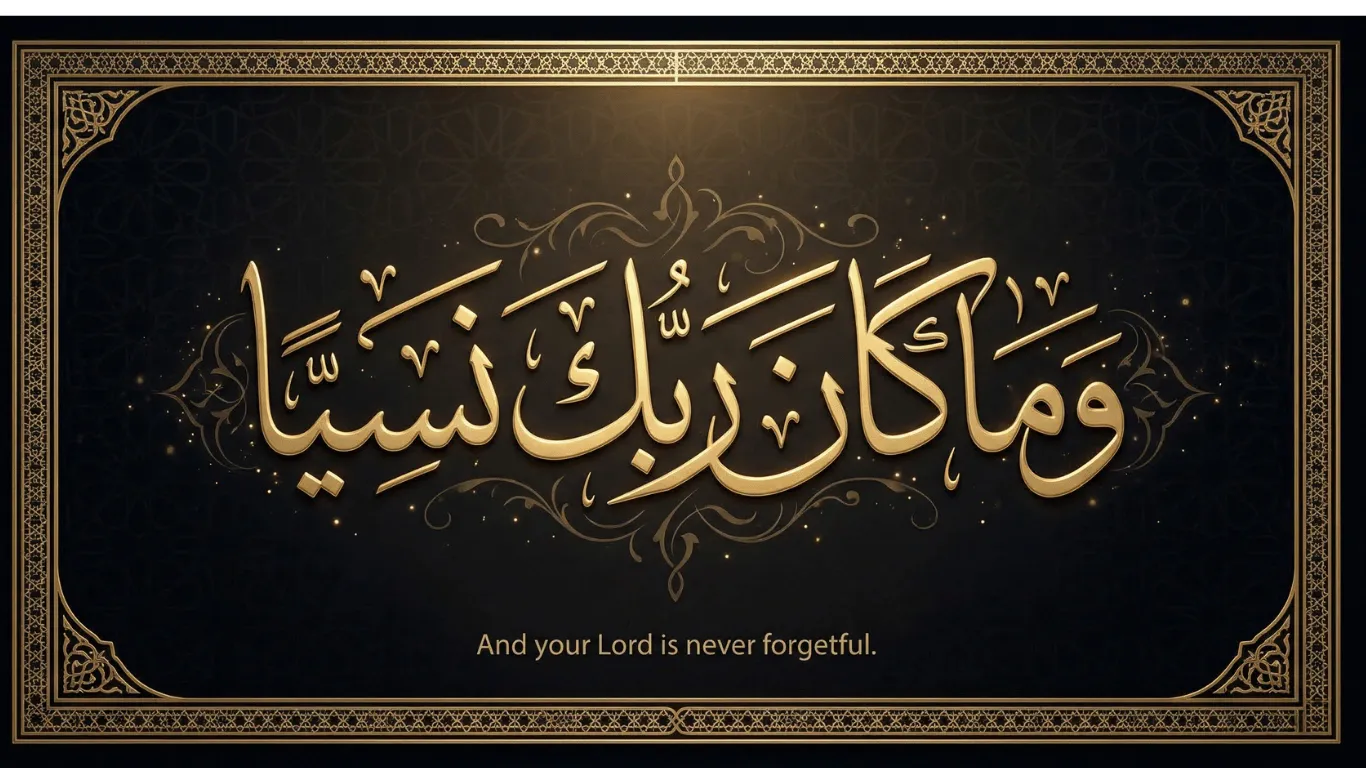
“Wa ma kana rabbuka nasiya” is a powerful Arabic phrase from Surah Maryam, verse 64 in the Quran. It translates to “And your Lord is never forgetful.” This verse serves as a divine reassurance that God perfectly remembers your every prayer, tear, and struggle.
To truly internalize this, we need to look at the exact wording provided in the primary text.
Primary Proof: Surah Maryam (19:64)
- Arabic Original: وَمَا كَانَ رَبُّكَ نَسِيًّا
- Transliteration: Wa ma kana rabbuka nasiya.
- English (Saheeh International): “And your Lord is never forgetful.”
- Urdu (Fateh Muhammad Jalandhari): ” اور تمہارا پروردگار بھولنے والا نہیں۔”
When we break this down word-by-word, the intimacy of the Arabic becomes clear. The word Rabbuka does not just mean “The Lord”—it means Your Sustainer, Your Caretaker. The word Nasiya doesn’t just mean a temporary lapse in memory; it is an intensive form meaning entirely incapable of being forgetful. Your silent sacrifices are permanently recorded.
The Context Behind the Verse: The Anxiety of Silence
The verse “your Lord is never forgetful” was revealed when the Prophet Muhammad experienced a long, agonizing pause in divine revelation. It was sent to comfort him, proving that a delay in God’s response is an intentional choice, not abandonment.
Classical mufassirun (exegetes), including Imam Ibn Kathir, explain the Asbab al-Nuzul (context of revelation) regarding this verse. There was a period where the Angel Jibril (Gabriel) did not bring revelation to the Prophet (ﷺ) for several weeks. The Prophet (ﷺ) experienced deep distress, and the polytheists of Makkah began to taunt him, claiming his God had forsaken him.
When Jibril finally descended, it was with this profound reassurance from Surah Maryam. This exact sentiment is mirrored beautifully in another powerful reassurance given to the Prophet (ﷺ).
Primary Proof: Surah Ad-Duha (93:3)
- Arabic Original: مَا وَدَّعَكَ رَبُّكَ وَمَا قَلَىٰ
- Transliteration: Ma wadda’aka rabbuka wa ma qala.
- English (Saheeh International): “Your Lord has not taken leave of you, [O Muhammad], nor has He detested [you].”
- Urdu (Fateh Muhammad Jalandhari): “تمہارے پروردگار نے نہ تو تم کو چھوڑ دیا ہے اور نہ (تم سے) ناراض ہوا ہے۔”
Here’s why this matters for you: If the absolute best of creation experienced the heavy anxiety of divine silence, your feelings of spiritual fatigue are valid. However, you must recognize that this silence is a deliberate phase of your growth, not a punishment.
💡 Related Insight To further ease the anxiety of waiting and protect your heart from negative whispers, explore the divine command of sending Salawat as an active, daily cure for spiritual fatigue.
The Spiritual Habit Loop: Surviving the “Barzakh of Waiting”
The spiritual habit loop transforms the painful anxiety of waiting into an active state of worship. Instead of panicking over unanswered prayers, believers use this waiting period to build trust, understanding that divine timing is perfectly engineered for their ultimate benefit.
In 2026, we are conditioned for instant gratification. If a webpage takes three seconds to load, we refresh it. We bring this same rushed energy to our dua, expecting Amazon-Prime-level delivery speeds from the Creator of the Heavens. When the answer is delayed, we enter a painful “Barzakh of Waiting”—a limbo state where Waswas (doubts) thrive.
We can break this cycle by shifting our mindset from a passive “waiting mode” to an active “trust mode” (Tawakkul). This requires understanding the mechanics of how God actually processes a dua, as outlined in authentic tradition.
Primary Proof: The Three Responses to Dua (Sahih Muslim)
- Arabic Original: مَا مِنْ مُسْلِمٍ يَدْعُو بِدَعْوَةٍ لَيْسَ فِيهَا إِثْمٌ وَلَا قَطِيعَةُ رَحِمٍ إِلَّا أَعْطَاهُ اللَّهُ بِهَا إِحْدَى ثَلَاثٍ: إِمَّا أَنْ يُعَجِّلَ لَهُ دَعْوَتَهُ، وَإِمَّا أَنْ يَدَّخِرَهَا لَهُ فِي الْآخِرَةِ، وَإِمَّا أَنْ يَصْرِفَ عَنْهُ مِنَ السُّوءِ مِثْلَهَا
- Transliteration: Ma min muslimin yad’u bidawatin laysa fiha ithmun wa la qati’atu rahimin illa a’tahullahu biha ihda thalath: imma an yu’ajjila lahu da’watahu, wa imma an yaddakhiraha lahu fil-akhirati, wa imma an yasrifa ‘anhu minas-su’i mithlaha.
- English (Saheeh International): “There is no Muslim who calls upon Allah, without sin or cutting family ties, but that Allah will give him one of three answers: He will either hasten the response, store it up for him in the Hereafter, or divert an equivalent evil away from him.”
- Urdu (Fateh Muhammad Jalandhari): “کوئی بھی مسلمان جب ایسی دعا کرتا ہے جس میں گناہ یا قطع رحمی نہ ہو، تو اللہ اسے تین چیزوں میں سے ایک ضرور عطا فرماتا ہے: یا تو اس کی دعا فوراً قبول کر لیتا ہے، یا اسے اس کے لیے آخرت میں ذخیرہ کر دیتا ہے، یا اس کے برابر کوئی برائی اس سے دور کر دیتا ہے۔”
Knowing this framework entirely removes the fear of being forgotten. Your prayer is currently being processed in one of these three ways.
💡 Next Step in Your Journey When you fully internalize this active trust and stop rushing the decree, you prepare your heart for the ultimate reward. Discover the guarantee of manifest victory and divine timing to see exactly how patience yields the greatest openings.
People Also Ask:
The phrase “wa ma kana rabbuka nasiya” means “And your Lord is never forgetful.” It is a direct translation from Surah Maryam, verse 64, serving as a reminder that God intimately remembers your actions, prayers, and struggles.
The phrase “your Lord is never forgetful” is located in Surah Maryam, which is the 19th chapter of the Quran. Specifically, it is found at the end of verse 64.
Allah delays the answer to a dua to build your patience, elevate your spiritual rank, or protect you from unseen harm. Islamic tradition states that delayed prayers are either stored for the Hereafter or used to avert a future disaster.
You practice Tawakkul by maintaining your daily prayers, avoiding complaints, and actively trusting that God’s timeline is better than yours. Replacing anxiety with consistent, positive action is the core of true reliance on God.
Your Next Action Step: Master the Waiting Period
Understanding the theology is only the first half of the equation; practically implementing it during a season of intense anxiety is where the real work begins. You need a daily system to keep your heart anchored when the wait feels unbearable.
