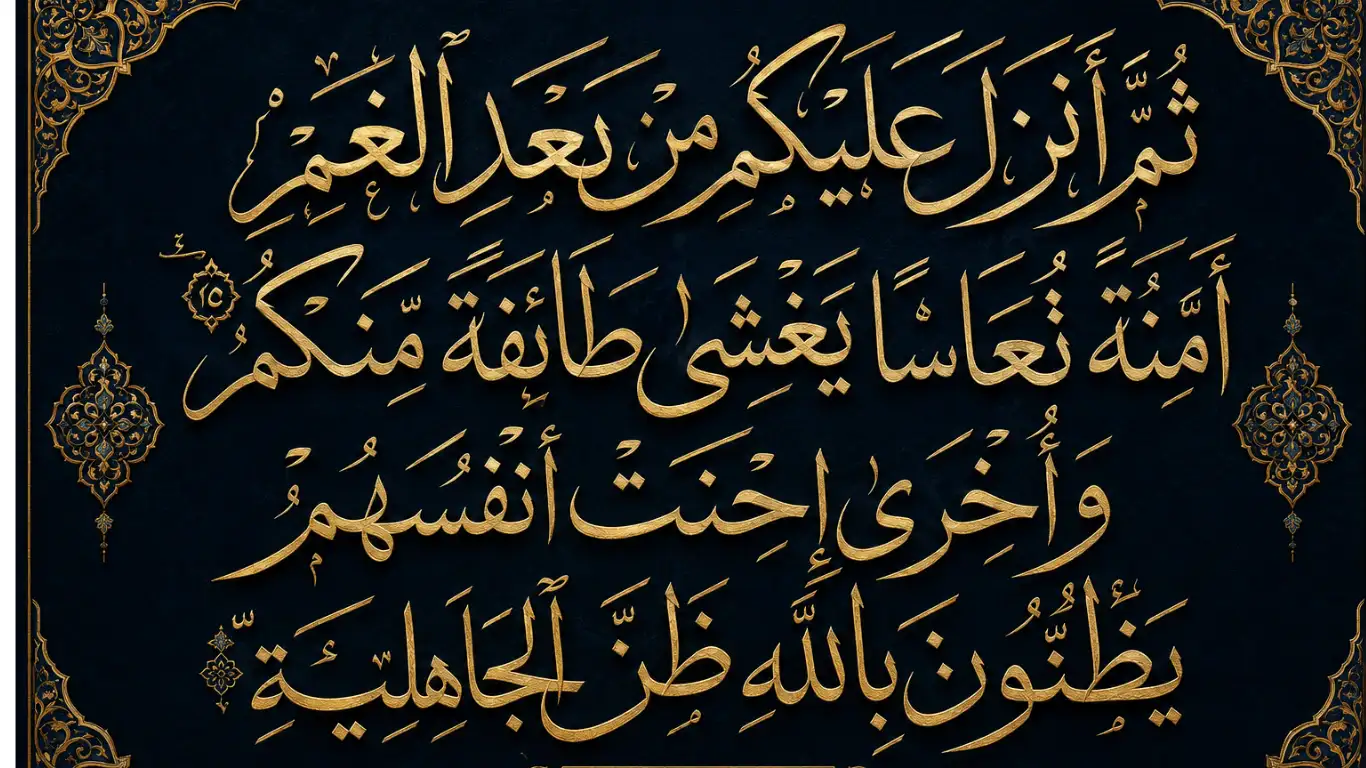
Have you ever felt that gut-wrenching fear grip your heart during a job crisis, where every thought spirals into “What if I lose everything?” Surah Al Imran Ayat 154 speaks directly to that moment, revealing how Allah transforms overwhelming distress into divine tranquility through a simple, miraculous drowsiness that steadies the soul.
Word-by-Word Breakdown
Surah Al Imran Ayat 154 begins with “Thumma” (then), signaling a divine transition from hardship to relief, revealed during the Battle of Uhud when believers faced panic after initial setbacks. The key phrase “anzala alaykum min ba’dil ghammi amanatan nu’asa” breaks down as: “anzala” (He sent down), “alaykum” (upon you), “min ba’di” (after), “al-ghammi” (the distress/grief), “amanatan” (security/peace), “nu’asa” (drowsiness). This drowsiness wasn’t mere fatigue but a supernatural calm that protected one group of believers from self-doubt, while others fixated on personal safety.
Multilingual Quadrant:
Surah Al Imran Ayat 154 – Complete Quadrant
| Language | Text |
|---|---|
| Arabic | ثُمَّ أَنزَلَ عَلَيْكُمْ مِنْ بَعْدِ الْغَمِّ أَمَنَةً نُّعَاسًا يَغْشَىٰ طَائِفَةً مِنْكُمْ ۖ وَأُخْرَىٰ إِحْنَتْ أَنْفُسُهُمْ يَظُنُّونَ بِاللَّهِ ظَنَّ الْجَاهِلِيَّةِ |
| Transliteration | Thumma anzala ‘alaykum min ba’dil ghammi amanatan nu’āsan yaghshā tā’ifatan-minkum wa ukhrá iḥnat anfusuhum yaẓunnūna billāhi ẓannal-jāhiliyyah |
| English (Saheeh International) | Then He sent down upon you from after the distress, security – a drowsiness [overcoming] a party of you – while another party worried about themselves and thought about Allah other than the truth – the thought of those of ignorance. |
| Urdu (Fateh Muhammad Jalandhari) | پھر غم کے بعد تم پر سکون اتارا جو تم میں سے ایک گروہ پر غلبہ پا گیا اور دوسرا گروہ اپنے نفسوں کی فکر میں مفتون ہوا اور اللہ کے بارے میں جاہلیت کا گمان کرنے لگا. |
Ibn Kathir explains this as Allah’s mercy distinguishing the faithful from those harboring Jahiliyyah-like doubts, drawing from the Sahaba’s experiences at Uhud.
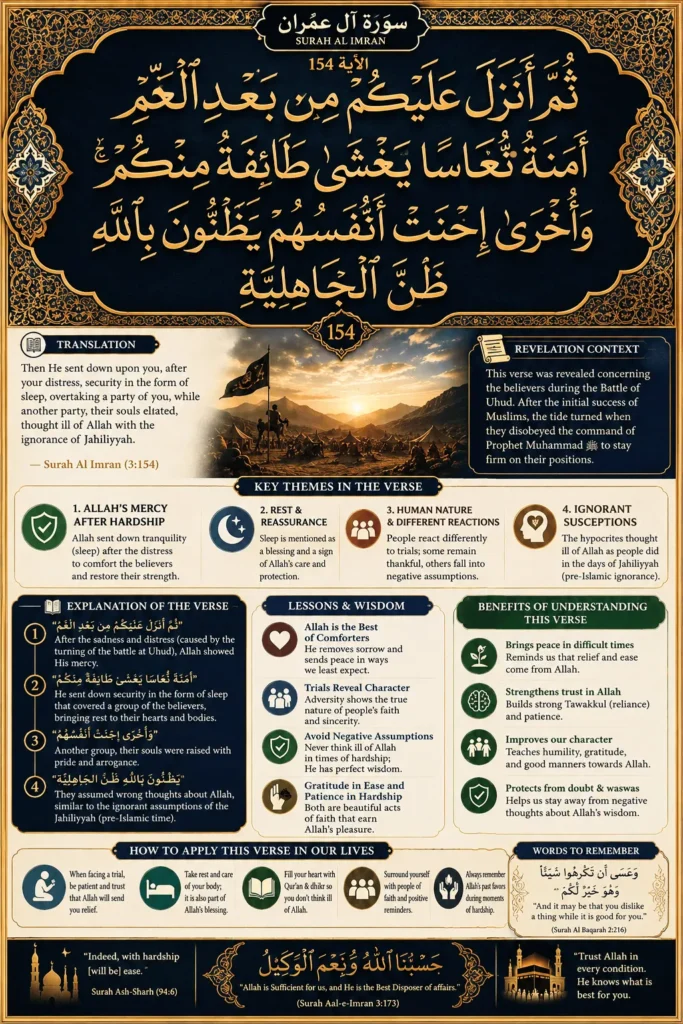
Historical Context and Quranic Reference
This verse descends from the Battle of Uhud in 3 AH, where rumors of the Prophet’s death caused mass grief among Muslims. Revealed in Surah Al Imran (The Family of Imran), the third chapter of the Quran with 200 verses, it addresses the believers’ split reactions post-rumor—serene trust versus ignorant fear. Its importance lies in teaching resilience: true faith brings Allah’s “amanah” even amid chaos, as seen when drowsiness shielded the steadfast while others panicked.
For deeper ties to divine authority, explore how Allah grants honor to whom He wills in Watu Izzu Mantasha: Surah Imran’s Lesson on Divine Control.
Tafseer by Classical Scholars
The verse contrasts spiritual maturity: one group receives protective drowsiness as a sign of divine favor, per Ibn Kathir, who cites the Prophet noting only the faithful slept amid Uhud’s turmoil. Imam Nawawi and others link it to tawakkul, where self-concern leads to Jahiliyyah thoughts like “If only we had control”. Modern tafseer applies it to 2026 stresses—corporate layoffs or global unrest—urging recitation to invoke that same tranquility.
Related Hadith and Quranic Links
No direct Sahih Hadith narrates this verse’s revelation, but Bukhari (Vol. 4, Book 52, Hadith 280) describes Uhud’s drowsiness as a miracle for believers, aligning with the ayah’s account. Cross-references include Surah Al Anfal 8:11 (“He cast drowsiness upon you”) for Badr’s similar mercy, reinforcing the pattern of divine security post-grief.
Wazifa for Job and Daily Benefits
Recite Surah Al Imran Ayat 154 101 times daily after Fajr for job stability, as it dispels anxiety and invites Allah’s amanah during interviews or promotions. Benefits include reduced overthinking, career breakthroughs, and inner peace—many report opportunities flowing after consistent practice. Start with wudu, face Qibla, and end with Salawat for amplified barakah.
The Spiritual Habit Loop: Recite → Feel drowsiness-like calm → Act with trust → Witness results. Pair it with Subhana Rabbika: Surah As-Saffat’s Closing Dua for Protection for full-cycle resilience.
Surah Al Imran ayat 154 pdf
People Also Ask
It means a divinely induced drowsiness symbolizing tranquility that overcame the faithful at Uhud.
Reciting 101 times daily eases job stress, opens doors, and replaces fear with confidence.
Indirect via Uhud narrations in Bukhari, confirming the miracle of sleep amid battle.
It equips modern believers to handle anxiety with faith, turning grief into security.
Try this wazifa today—share your experience in the comments below, and subscribe for weekly Quranic strategies tailored to real-life victories.
