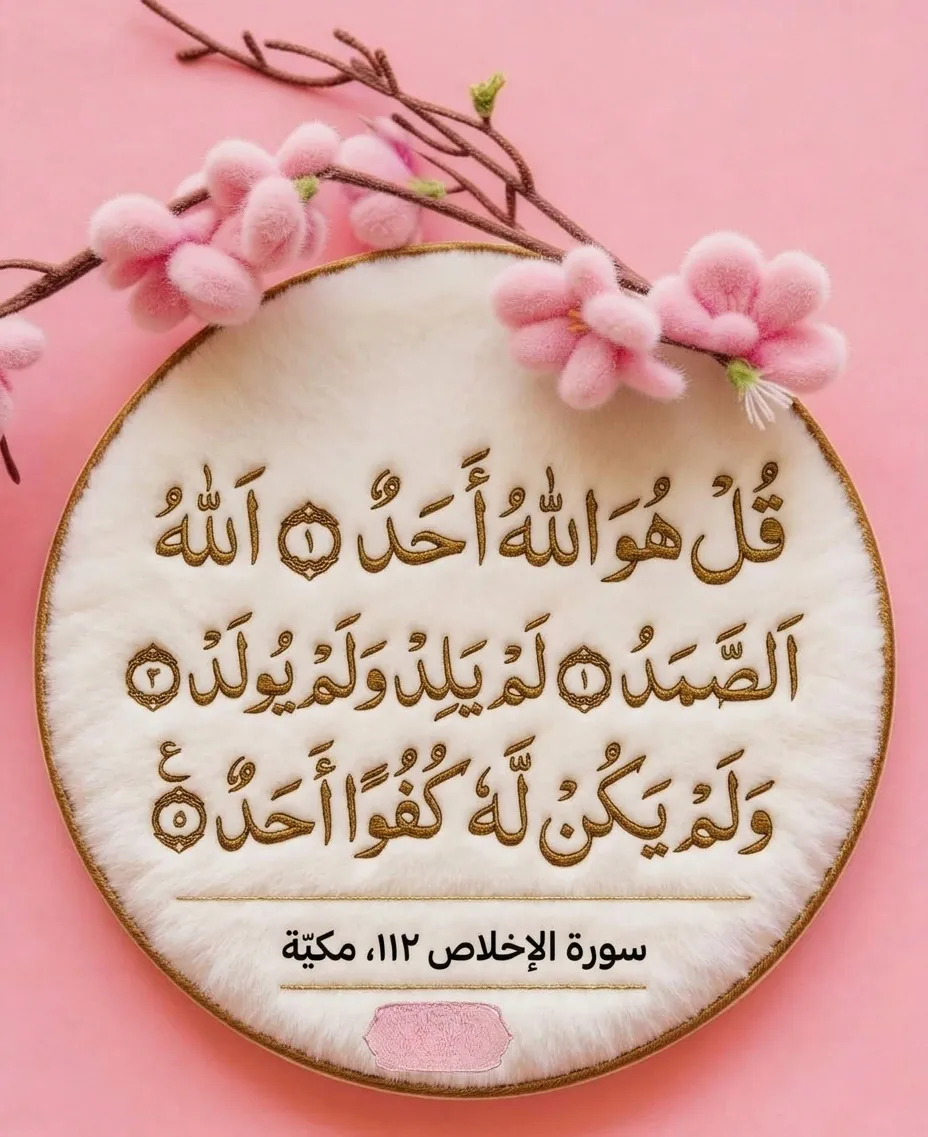
What if the most powerful statement in your daily spiritual routine is just four short verses?
Surah Ikhlas — a tiny chapter of the Qur’an — is known to be equal in weight to one‑third of the entire Qur’an.
For an Urdu‑speaking Muslim in Pakistan, this surah is not just a prayer; it is your daily reset button for Tawhid.
What is Surah Ikhlas? (Qur’anic Reference)
Surah Ikhlas, also called Qul Huwa Allahu Ahad, is the 112th Surah of the Qur’an. It explains the pure oneness of Allah in four short verses. Muslims recite it in daily prayers, and it is one of the most important chapters of Tawhid.
Where this verse comes from
- Surah: 112, Meccan, very short.
- Place in Qur’an: After Surah Faatir and before Surah Al‑Falaq.
- Theme: Pure Tawhid, no partner, no son, no equal.
Via the Multilingual Quadrant, present the full Surah Ikhlas in this format under this heading:
Arabic
قُلْ هُوَ اللَّهُ أَحَدٌ
اللَّهُ الصَّمَدُ
لَمْ يَلِدْ وَلَمْ يُولَدْ
وَلَمْ يَكُن لَّهُ كُفُوًا أَحَدٌ
Transliteration
Qul huwa Allahu Ahad
Allahu as‑Samad
Lam yalid wa lam yulad
Wa lam yakun lahu kufuwan ahad
English (Saheeh International)
Say, “He is Allah, [who is] One,
Allah, the Eternal Refuge.
He neither begets nor is born,
Nor is there to Him any equivalent.”
Urdu (Fateh Muhammad Jalandhari)
کہہ دو کہ وہ اللہ ایک ہے
اللہ بے نیاز ہے
نہ اس کی کوئی اولاد ہے اور نہ وہ کسی کی اولاد ہے
اور نہ ہی کوئی اس کا ہمسر ہے
Urdu Translation & Word‑by‑Word Meaning
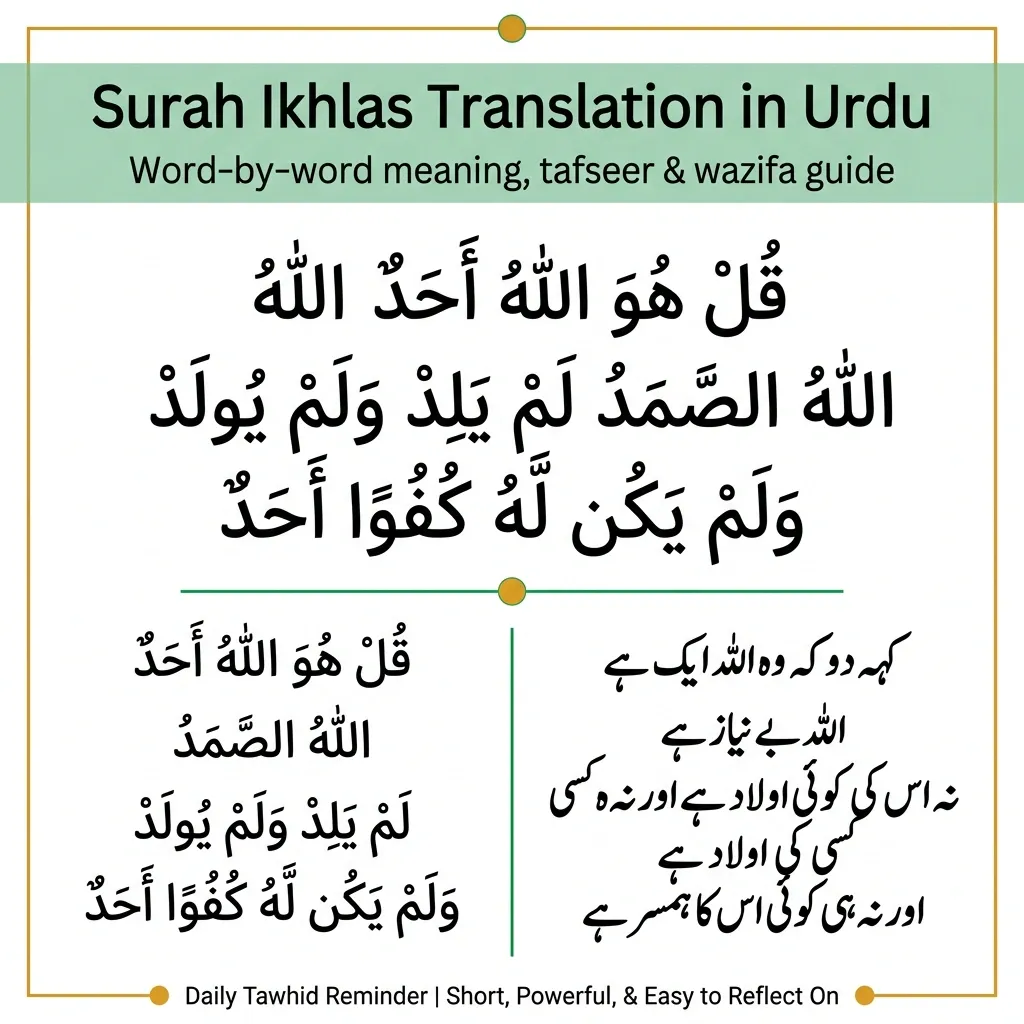
Surah Ikhlas in Urdu is usually translated as:
کہہ دو کہ وہ اللہ ایک ہے، اللہ بے نیاز ہے، نہ اس کی کوئی اولاد ہے اور نہ وہ کسی کی اولاد ہے، اور نہ ہی کوئی اس کا ہمسر ہے
Each word in Arabic carries a deep meaning about Allah’s oneness and uniqueness.
Word‑by‑word breakdown (Urdu‑style)
- قُلْ → “کہہ دو”:
Allah commands the Prophet ﷺ (and by extension, every Muslim) to announce this reality. - هُوَ اللَّهُ → “وہ اللہ”:
The pointer to the One True God. - أَحَدٌ → “ایک” (one):
Not “one out of many,” but the only true deity, without partner or equal. - اللَّهُ الصَّمَدُ → “اللہ بے نیاز/صَمَد”:
He is the One on whom all creation depends, yet He needs nothing from anyone. - لَمْ يَلِدْ وَلَمْ يُولَدْ → “نہ اس کی اولاد ہے نہ وہ کسی کی اولاد ہے”:
Direct refutation of belief in an “Allah’s son” and of any idea that Allah was born. - كُفُوًا أَحَدٌ → “کوئی اس کا ہمسر نہیں”:
No one can match Allah in essence, power, knowledge, or lordship.
Here’s why this matters for you: when you read this in daily reflection, you are not just reciting words — you are rehearsing the core of your faith.
Tafseer of Surah Ikhlas (Scholarship Depth)
Classical scholars like Ibn Kathir and Imam Nawawi explain Surah Ikhlas as a complete declaration of Allah’s oneness. It removes any idea of partners, sons, or equals. Modern scholars in 2026 still call it the “Surah of Tawhid” because it fits the heart of Islamic belief in four lines.
Classical tafseer highlights
- Oneness (Ahad):
Ibn Kathir notes that “Ahad” here means Allah is the only true God, and all creation is His creation. - As‑Samad (Eternal Refuge):
Scholars say this includes all meanings of needlessness, sovereignty, and final dependence of creation. - No begetting / no being begotten:
This rejects not only the idea of a “son” but also the idea that Allah has any family or lineage.
Let’s look at the heart of the issue: this surah is not just for Tarawih or Fard prayers; it’s a daily creed (aqeedah) exercise.
Surah Ikhlas in Hadith (Loving Ikhlas & Entering Jannah)
The Prophet Muhammad ﷺ said that Surah Ikhlas is equal in weight to one‑third of the Qur’an. He also praised those who love this surah and promised them Jannah. Scholars use these hadith to highlight its central role in daily worship.
Must‑present hadith (with Multilingual Quadrant format)
Hadith 1: Equal to one‑third of the Qur’an
Arabic (Bukhari):
عَنْ عَائِشَةَ رَضِيَ اللَّهُ عَنْهَا أَنَّ رَسُولَ اللَّهِ ﷺ قَالَ
“قُلْ هُوَ اللَّهُ أَحَدٌ تَعْدِلُ ثُلُثَ الْقُرْآنِ
Transliteration:
ʿAn ʿĀʾishah raḍiya Allāhu ʿanhā anna Rasūl Allāh ﷺ qāla:
“Qul huwa Allāhu ahad taʿdil thulutha al‑Qur’ān.”
English (Saheeh Bukhari paraphrase):
Say: “He is Allah, [who is] One” is equal in weight to one‑third of the Qur’an.
Urdu (Fateh Muhammad Jalandhari style):
“کہہ دو کہ وہ اللہ ایک ہے” کا ثواب ایک تیسرا قرآن کے برابر ہے۔
This hadith explains why many Muslims recite Surah Ikhlas with such focus in daily prayers.
Hadith 2: Loving Surah Ikhlas and entering Jannah
Arabic:
عَنْ أَبِي سَعِيدٍ الْخُدْرِيِّ رَضِيَ اللَّهُ عَنْهُ أَنَّ النَّبِيَّ ﷺ قَالَ
“وَالَّذِي نَفْسِي بِيَدِهِ لَمَا سُمِّيَتْ بِإِخْلَاصٍ إِلَّا لِإِخْلَاصِ التَّوْحِيدِ فِيهَا
Transliteration:
Wa alladhi nafsī bi‑yadīh, lamā sammiyat bi‑Ikhlas illā li‑Ikhlas al‑Tawḥīd fīhā.
English (paraphrase):
By the One in Whose Hand is my soul, it was not named Ikhlas except for the purity of Tawhid contained in it.
Urdu:
اس ذات کی قسم جس کے ہاتھ میں میری جان ہے، اس کو اس لیے “اخلاص” کہا گیا ہے کہ اس میں توحید کی صفائی موجود ہے۔
Modern scholars connect this hadith to the idea that loving Surah Ikhlas is loving the core of Tawhid, which leads to Jannah.
Connect this section with your rule by adding, in the Tafseer or Hadith section:
“If you want to explore how Allah is the Light of the heavens and the earth, Read how Allah is the Light of the heavens and the earth.”
The Spiritual Habit Loop:
Surah Ikhlas fits perfectly into a “Spiritual Habit Loop”: a simple daily habit that builds a strong sense of Tawhid in your heart. Reciting it each morning or evening can become your minimum daily Tawhid practice, more powerful than many long, complicated rituals.
How to turn Ikhlas into a habit
- Cue (trigger):
After Fajr, after Maghrib, or before sleep. - Routine (action):
Recite Surah Ikhlas 3 or 7 times, followed by reflection on its meaning. - Reward (feeling):
A sense of inner calm, clarity of faith, and closeness to Allah.
- There is general encouragement in hadith to recite and love Surah Ikhlas, but no specific, authentic ruling for “exactly 100 times” or “1000 times a day.”
- Scholars warn against treating unproven wazifa numbers as compulsory.
So for your readers, the smart approach is:
- Choose a flexible, sustainable number (e.g., 7, 10, 21) that you can repeat daily without stress.
- Focus more on understanding the meaning than on chasing higher numbers.
Wazifa of Surah Ikhlas (How Many Times & Benefits)
Many people use Surah Ikhlas as a wazifa for protection, forgiveness, and ease in life. Common numbers heard are 3, 7, 10, 21, 100, or 1000 times, but authentic hadith only emphasize loving and reciting it, not fixing exact counts. Scholars advise focusing on sincerity more than numbers.
How many times to recite?
- Minimal daily habit: 3–7 times after Fajr and Maghrib.
- Protection / relief wazifa: 21 or 40 times with sincere dua, not as a magic formula.
- About high numbers (100/1000):
Benefits of reciting Surah Ikhlas
- Spiritual:
- Strengthens Tawhid in the heart.
- Helps remove shirk and doubt.
- Psychological:
- Potential worldly effects (via dua):
- Some narrations mention that daily recitation brings protection from poverty, fear, and hardship, but this should be seen as a blessing of sincere worship, not a guaranteed formula.
In the Benefits / Wazifa section,
“If you are reciting Ikhlas for anxiety or difficulty, you can also combine it with Rabbish‑Rahli‑Sadri; Learn how Rabbish‑Rahli‑Sadri can ease anxiety and difficulty.”
Practical Application for Urdu‑Speaking Muslims (Rawalpindi & Pakistan)
For an Urdu‑speaking Muslim in Pakistan, Surah Ikhlas can be a daily backbone of faith: short enough to memorize with children, deep enough to correct beliefs about Allah. Use it as a morning or evening routine, not just for wazifa, but as a daily renewal of your Tawhid.
Here’s a simple daily Ikhlas routine:
- After Fajr:
- 3 times Surah Ikhlas + short reflection in Urdu.
- After Maghrib:
- 3 times Surah Ikhlas + 1–2 moments of silence thinking about Allah’s oneness.
Keep a small notebook or journal where you write, in Urdu, one line from Ikhlas and its meaning each day. This turns the Spiritual Habit Loop from theory into practice.
People Also Ask:
The common Urdu translation is:
“کہہ دو کہ وہ اللہ ایک ہے، اللہ بے نیاز ہے، نہ اس کی کوئی اولاد ہے اور نہ وہ کسی کی اولاد ہے، اور نہ ہی کوئی اس کا ہمسر ہے.”
Each Arabic word points to Allah’s oneness, self‑sufficiency, lack of offspring, and no equal.
Surah Ikhlas is exactly that: four short verses that cover the core of Tawhid. Reciting them daily with understanding can become the most powerful part of your spiritual routine.
Yes. Hadith explain that reciting Surah Ikhlas carries reward equal to one‑third of the Qur’an, which is why it is so important in daily worship and personal reflection.
True. For Urdu speakers in Pakistan, Surah Ikhlas acts as a daily reminder of Allah’s oneness, helping you reset your beliefs and focus on pure Tawhid in both worship and normal life.
Surah Ikhlas, also called Qul Huwa Allahu Ahad, is the 112th Surah of the Qur’an. It explains the pure oneness of Allah in four short verses and is one of the most important chapters about Tawhid.
Surah: 112, Meccan, very short.
Place: After Surah Al‑Falaq (113) and before Surah Al‑Nas (114).
Theme: Pure Tawhid, no partner, no son, no equal.
When you read Surah Ikhlas in daily reflection, you are not just reciting words; you are rehearsing the core of Islamic belief (Tawhid) and strengthening your heart’s connection with Allah.
قُلْ → “کہہ دو” (command to announce).
هُوَ اللَّهُ احَدٌ → “وہ اللہ ایک ہے” (Allah is the only true God).
اللَّهُ الصَّمَدُ → “اللہ بے نیاز/صَمَد” (self‑sufficient, the One all creation depends on).
لَمْ يَلِدْ وَلَمْ يُولَدْ → “نہ اس کی کوئی اولاد ہے اور نہ وہ کسی کی اولاد ہے” (no son, never born).
وَلَمْ يَكُن لَّهُ كُفُوًا أَحَدٌ → “نہ ہی کوئی اس کا ہمسر ہے” (no one is His equal).
Classical scholars like Ibn Kathir and Imam Nawawi explain it as a complete declaration of Allah’s oneness: no partner, no son, no equal. It rejects all ideas of divine family or partners and is called the “Surah of Tawhid.”
Hadith in Bukhari says that “Qul Huwa Allahu Ahad” is equal to one‑third of the Qur’an in reward.
Another hadith says the Prophet ﷺ praised those who love Surah Ikhlas and linked that love to Jannah.
Spiritual: Strengthens Tawhid and removes shirk and doubt.
Psychological: Short, calming, and easy to remember.
Worldly (via dua): Some narrations mention protection from poverty, fear, and hardship, but this is seen as a blessing of sincere worship, not a magic formula.
There is general encouragement in hadith to recite and love Surah Ikhlas, but no authentic ruling for exact numbers like 100 or 1000 times a day. Scholars suggest a flexible, sustainable number such as 3–21 times with sincere dua.
Dua / Wazifa Request Form
If you are struggling with anxiety, family issues, or spiritual doubts, you can use Surah Ikhlas as part of your daily prayers. To get personalized guidance, you can submit a dua/wazifa request form for personal issues and let an Islamic scholar help you design a practical, halal‑aligned plan.
Below this, place a short paragraph plus button‑style text:
You are not alone in your struggle.
Fill out our Dua/Wazifa Request Form so we can support you with tailored advice based on Qur’an and Sunnah.
