
You’re caught in the daily grind, overwhelmed by professional anxieties, and searching for a moment of profound spiritual stillness. You have likely heard the stories of Darood Mahi—the legendary salawat passed down through generations, said to protect against the fiercest of worldly trials. But beyond the folklore, what is the actual spiritual reality of this recitation? Let’s strip away the confusion and look at how sending blessings upon the Prophet (ﷺ) can anchor your heart and transform your mindset in an age of constant distraction.
What is Darood Mahi?
Darood Mahi is a culturally popular Islamic supplication (salawat) recited primarily in South Asia to send blessings upon the Prophet Muhammad (ﷺ). It is widely used as a wazifa for protection, peace of mind, and relief from extreme worldly difficulties.
Here’s why this matters. The name “Mahi” translates to “fish” in Urdu and Persian. Traditional folklore tells the story of a fisherman who caught a fish that would not burn or cook over a fire. According to the legend, the fish had miraculously been protected from the fire because it spent its life resting in the water near a man who constantly recited a specific salawat. While traditional practitioners looking for authentic clarity should know that this specific backstory is not found in classical Hadith collections, the profound spiritual weight of sending blessings upon the Prophet (ﷺ) is an absolute, undeniable reality in Islam.
The core of the Darood emphasizes phrases like allahumma salli ala muhammad wa ala ali muhammad khair ul khaliqi, honoring the Prophet as the best of creation. When you recite it, you are stepping away from a chaotic world and aligning yourself with a divine tradition.
The Text of Darood Mahi and Multilingual Meaning
Arabic Text:
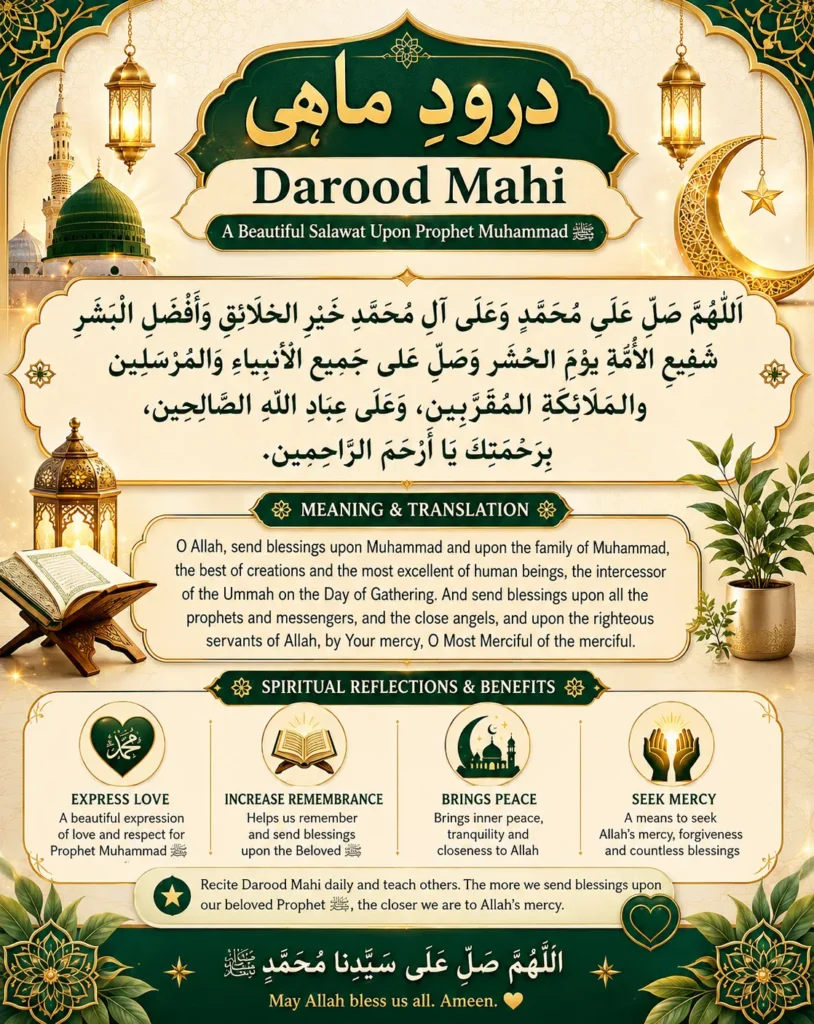
اَللّٰهُمَّ صَلِّ عَلَى مُحَمَّدٍ وَّعَلَى آلِ مُحَمَّدٍ خَيْرِ الْخَلَائِقِ وَأَفْضَلِ الْبَشَرِ، شَفِيْعِ الْأُمَّةِ يَوْمَ الْمَحْشَرِ، وَصَلِّ عَلَى جَمِيْعِ الْأَنْبِيَاءِ وَالْمُرْسَلِيْنَ، وَالْمَلَائِكَةِ الْمُقَرَّبِيْنَ، وَعَلَى عِبَادِ اللّٰهِ الصَّالِحِيْنَ، بِرَحْمَتِكَ يَا أَرْحَمَ الرَّاحِمِيْنَ
Transliteration: Allahumma salli ‘ala Muhammadin wa ‘ala aali Muhammadin khayril khala’iqi wa afdalil bashar, shafi’il ummati yawmal mahshar, wa salli ‘ala jami’il anbiya’i wal mursalin, wal mala’ikatil muqarrabin, wa ‘ala ‘ibadillahis salihin, birahmatika ya arhamar rahimin.
English Translation: O Allah, send blessings upon Muhammad and upon the family of Muhammad, the best of creations and the most excellent of human beings, the intercessor of the Ummah on the Day of Gathering. And send blessings upon all the prophets and messengers, and the close angels, and upon the righteous servants of Allah, by Your mercy, O Most Merciful of the merciful.
Urdu Translation:
اے اللہ! حضرت محمد (صلی اللہ علیہ وسلم) اور ان کی آل پر درود نازل فرما، جو تمام مخلوقات میں سب سے بہتر اور انسانوں میں سب سے افضل ہیں، جو حشر کے دن امت کی شفاعت کرنے والے ہیں۔ اور تمام انبیاء و مرسلین، اور مقرب فرشتوں، اور اللہ کے نیک بندوں پر بھی درود نازل فرما، اپنی رحمت کے صدقے، اے سب سے بڑھ کر رحم فرمانے والے۔
Hindi Translation: ऐ अल्लाह! मुहम्मद (सल्लल्लाहु अलैहि व सल्लम) और मुहम्मद की आल पर रहमतें नाज़िल फ़रमा, जो तमाम मखलूकात में बेहतरीन और इंसानों में सबसे अफ़ज़ल हैं, जो क़यामत के दिन उम्मत की शिफ़ाअत (सिफ़ारिश) करने वाले हैं। और तमाम अंबिया व मुरसलीन, और मुकर्रब फ़रिश्तों, और अल्लाह के नेक बंदों पर रहमतें नाज़िल फ़रमा, अपनी रहमत के सदक़े, ऐ सबसे बढ़कर रहम फ़रमाने वाले।
The Authentic Roots of Salawat in the Quran
While the specific origin story of Darood Mahi is folklore, the act of sending blessings (salawat) is a direct divine command. Reciting it daily brings immense spiritual transformation, mental clarity, and divine protection.
Arabic Text:
إِنَّ اللَّهَ وَمَلَائِكَتَهُ يُصَلُّونَ عَلَى النَّبِيِّ ۚ يَا أَيُّهَا الَّذِينَ آمَنُوا صَلُّوا عَلَيْهِ وَسَلِّمُوا تَسْلِيمًا
Transliteration: Innallaha wa mala’ikatahu yusalluna ‘alan-nabiyyi, ya ayyuhal-ladhina amanu sallu ‘alayhi wa sallimu taslima.
English Translation: “Indeed, Allah confers blessing upon the Prophet, and His angels [ask Him to do so]. O you who have believed, ask [Allah to confer] blessing upon him and ask [Allah to grant him] peace.” (Surah Al-Ahzab 33:56)
Urdu Translation:
بیشک اللہ اور اس کے فرشتے نبی پر درود بھیجتے ہیں۔ اے ایمان والو! تم بھی ان پر درود اور خوب سلام بھیجا کرو۔
Hindi Translation: बेशक अल्लाह और उसके फ़रिश्ते नबी पर दुरूद भेजते हैं। ऐ ईमान वालो! तुम भी उन पर दुरूद और ख़ूब सलाम भेजा करो।
Classical scholars, including Imam Ibn Kathir in his renowned Tafseer, highlight that this verse was revealed to elevate the status of the Prophet (ﷺ) in the heavens before the angels. When you send blessings upon him, you are participating in an action that Allah and His angels are already doing. This is where true spiritual clarity is found.
This becomes important when you look at the Hadith of Ubayy bin Ka’b (Radi Allahu Anhu). When Ubayy asked the Prophet (ﷺ) what would happen if he dedicated all his supplication time to sending salawat, the Prophet (ﷺ) responded: “Then your problems will be solved and your sins will be forgiven“ (Tirmidhi).
Daily Islamic Transformation: The Spiritual Habit Loop
The modern relevance framework of reciting Darood is about mental grounding. It interrupts the cycle of anxiety and overthinking. Regular recitation shifts your focus from your immediate worldly problems to eternal divine mercy.
For young professionals, burnout is a massive pain point. We wake up to screens, rush through traffic, and deal with relentless demands. Building a “Spiritual Habit Loop” using salawat acts as a pattern interrupt.
- The Cue: Feeling a spike in anxiety or entering your commute.
- The Routine: Silently reciting Darood Mahi (or any authentic salawat).
- The Reward: A physiological and spiritual reset, lowering stress and securing divine reward.
You don’t need a secluded cave to practice this. The beauty of the Digital Sunnah is integrating remembrance into the spaces where life happens—in the office, on the train, or while waiting in line. For believers looking to expand their daily spiritual practices, exploring texts like Darood Muqadas can provide additional avenues for peace. Similarly, understanding the immense historical virtues of Darood-e-Lakhi helps build a comprehensive approach to daily Islamic transformation.
Darood Mahi Wazifa and Practical Benefits
To practice the Darood Mahi wazifa, traditional practitioners recommend reciting it regularly after Fajr or Isha prayers. Consistency is more valuable than high numbers, anchoring your heart against daily stressors.
How many times should you recite it? Depending on the spiritual tradition, people often recite it 11, 41, or 100 times. However, Islamic scholarship emphasizes that the quality of your presence matters far more than a specific numerical target.
Now let’s connect this to daily life. The traditional benefits associated with this wazifa include:
- Protection: Guarding one’s heart from the “fires” of jealousy, workplace toxicity, and spiritual despair.
- Barakah (Blessing): Opening doors in sustenance and career growth.
- Mental Clarity: Quieting the mind before making major life or business decisions.
When you sit on your prayer mat after Fajr, rather than immediately reaching for your smartphone to check emails, spend five minutes sending blessings upon the Prophet (ﷺ). You are effectively telling your heart that divine pleasure is a higher priority than worldly demands.
People Also Ask
The main benefits of Darood Mahi include deep spiritual peace, mental clarity, and protection from life’s severe difficulties. Traditional practitioners also believe it helps in resolving financial blockages and securing safety from visible and invisible harm.
For a general wazifa, practitioners often recite it 11, 41, or 100 times daily, usually after Fajr or Isha prayers. However, authentically, any amount of sincere salawat is highly rewarded by Allah, provided it is done with consistency and a focused heart.
The story of the fish being saved from the fire is a cultural legend and is not found in any authentic Hadith collections (like Bukhari or Muslim). However, while the origin story is folklore, the actual Arabic text of sending blessings upon the Prophet (ﷺ) is spiritually valid and beneficial.
Yes, you can recite any salawat, including Darood Mahi, from memory without wudu. However, being in a state of wudu brings more barakah (blessings) and is highly recommended when engaging in any focused wazifa.
Ready to build a consistent spiritual routine?
Start your journey toward daily Islamic transformation and mental clarity by downloading our comprehensive PDF Wazifa Guide. It contains step-by-step instructions, authentic references, and structured routines to help you easily integrate these powerful recitations into your busy modern life. Download it today and anchor your heart in peace.
