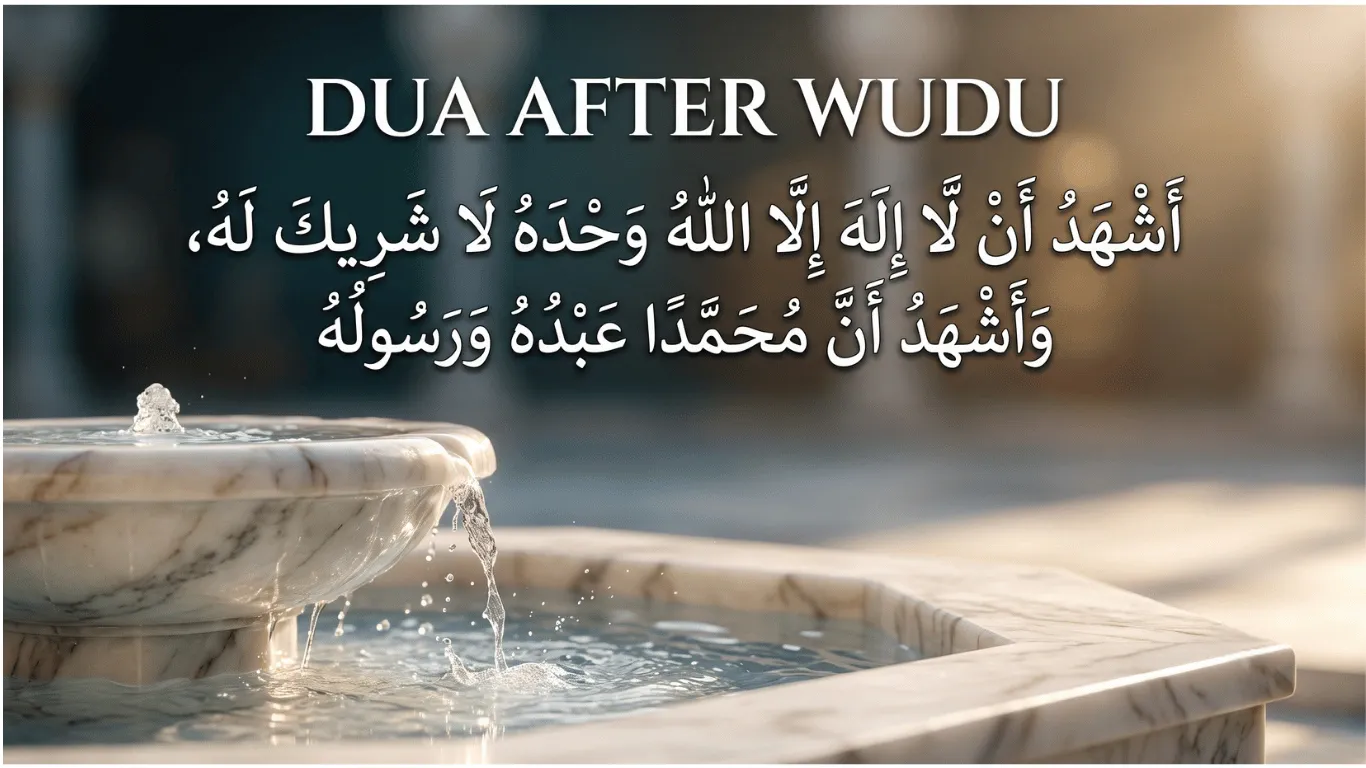
When you wake up in New York at 6 AM and feel overwhelmed before your day even starts, or face the damp chill of a London morning at 7 AM GMT, this ancient dua from Prophet Muhammad (PBUH) becomes your first weapon against anxiety. Transforming a routine physical wash into a profound spiritual anchor, the supplication recited after ablution is a cornerstone of daily Islamic mindfulness.
As a Muslim living in a secular society, protecting your inner peace requires more than just physical hygiene. It requires a deliberate spiritual habit loop. By integrating this specific dua into your daily rhythm, you turn a simple bathroom sink into a space of ultimate spiritual renewal.
What Is the Dua After Wudu in English and Arabic?
The dua after wudu is a powerful two-part supplication. It begins with the Shahadah (the declaration of faith) to affirm God’s absolute oneness, followed immediately by a specific prayer asking Allah to make you among those who constantly repent and keep themselves physically and spiritually pure.
Part 1: The Declaration of Faith (Shahadah)
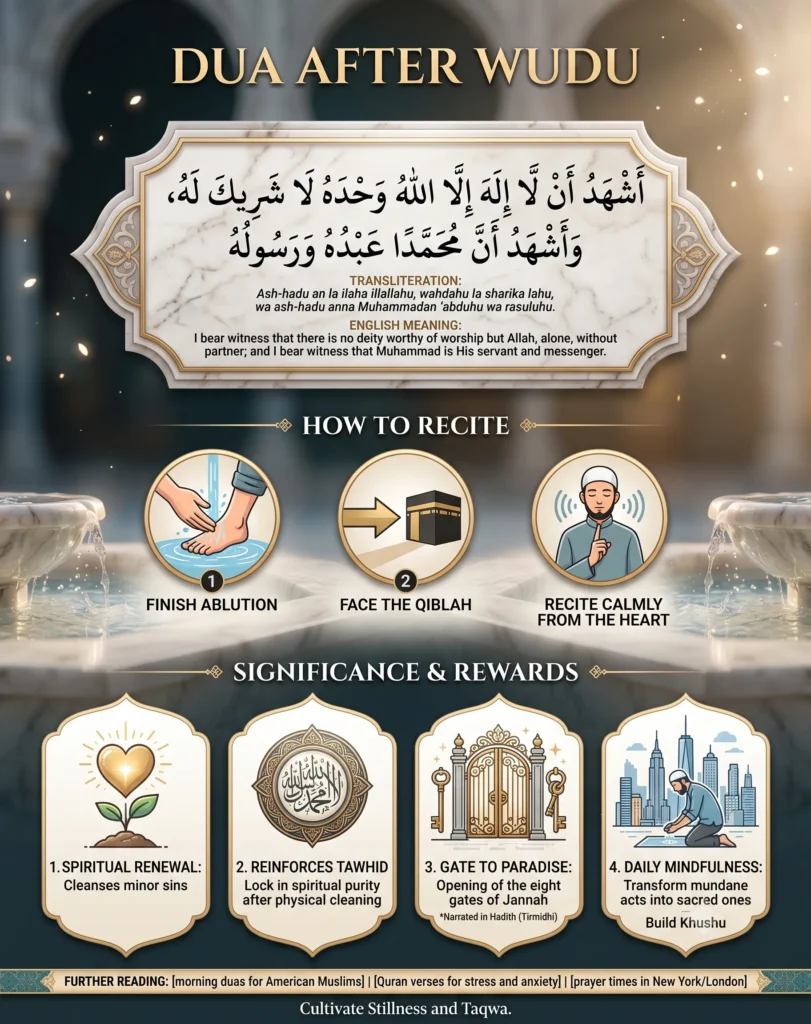
- Arabic Text: أَشْهَدُ أَنْ لَا إِلَٰهَ إِلَّا ٱللَّٰهُ وَحْدَهُ لَا شَرِيكَ لَهُ، وَأَشْهَدُ أَنَّ مُحَمَّدًا عَبْدُهُ وَرَسُولُهُ
- Transliteration: Ash-hadu an la ilaha illallahu, wahdahu la sharika lahu, wa ash-hadu anna Muhammadan ‘abduhu wa rasuluhu.
- English Translation: I bear witness that there is none worthy of worship except Allah, alone, without partner, and I bear witness that Muhammad is His servant and Messenger.
- Urdu Translation: میں گواہی دیتا ہوں کہ اللہ کے سوا کوئی معبود نہیں، وہ اکیلا ہے، اس کا کوئی شریک نہیں، اور میں گواہی دیتا ہوں کہ محمد (صلی اللہ علیہ وسلم) اس کے بندے اور رسول ہیں۔
Part 2: The Supplication for Purity
- Arabic Text: اللَّهُمَّ اجْعَلْنِي مِنَ التَّوَّابِينَ وَاجْعَلْنِي مِنَ الْمُتَطَهِّرِينَ
- Transliteration: Allahummaj’alni minat-tawwabina waj’alni minal-mutatahhireen.
- English Translation: O Allah, make me of those who repent and make me of those who purify themselves.
- Urdu Translation: اے اللہ! مجھے توبہ کرنے والوں میں سے بنا دے اور مجھے پاکیزہ رہنے والوں میں سے بنا دے۔
Let’s understand the real meaning of this Arabic verse. The first section ensures that as the water washes away physical dirt, the affirmation of Tawhid (monotheism) washes away the spiritual contamination of associating anything with God. The second section perfectly balances human vulnerability with discipline.
How Many Times to Recite This Dua?
According to the Sunnah, you should recite this complete dua one time immediately after finishing your wudu. Doing so opens the eight gates of Paradise, allowing the believer to enter through whichever one they choose, as recorded in authentic Islamic narrations.
The immense reward for this singular recitation is documented in Sahih Muslim (Book 2, Hadith 234a) and Jami at-Tirmidhi (Hadith 55). The Prophet Muhammad (PBUH) guaranteed that whoever perfects their ablution and utters these exact words will have the gates of Jannah opened for them. You do not need to repeat it three or seven times; a single, mindful recitation fulfills the Sunnah.
Why This Matters for Western Muslims
Building a spiritual habit loop connects a physical trigger—like washing with cool water—to a psychological reward. Reciting this dua after wudu shifts your brain from worldly stress to divine reliance, serving as a mindful pause before you step onto the prayer mat or walk out the door.
Here’s why this matters for you. Human beings are creatures of habit. When you link a verbal affirmation to a physical action, you ground your nervous system. The act of splashing water on your face stimulates the vagus nerve, naturally lowering your heart rate. When you pair that biological calm with the words “make me of those who repent,” you are actively shedding the psychological weight of your mistakes.
Now let’s connect this to daily life at your office or school. Whether you are taking a midday break in a high-rise in downtown Chicago (CST) or rushing out of a university library in Manchester (GMT) to catch the afternoon prayer, stepping into the restroom to perform wudu creates an immediate sanctuary. Reciting the dua grounds your chaotic thoughts, reminding you that ultimate success belongs to Allah, not your pending deadlines.
For further reading on integrating faith into your busy schedule, [read our full guide on morning duas for American Muslims].
Visualizing the Spiritual Journey
Quran Verse for Purity and Stress Relief
The foundation of this dua comes directly from the Quran. Surah Al-Baqarah highlights that Allah’s love is specifically directed toward those who constantly seek forgiveness and prioritize purification, offering immense emotional comfort and stress relief to the believer.
- Arabic Text: إِنَّ اللَّهَ يُحِبُّ التَّوَّابِينَ وَيُحِبُّ الْمُتَطَهِّرِينَ
- Transliteration: Innallaha yuhibbut-tawwabeena wa yuhibbul-mutatahhireen.
- English Translation: Indeed, Allah loves those who are constantly repentant and loves those who purify themselves. (Surah Al-Baqarah, 2:222)
- Urdu Translation: بیشک اللہ توبہ کرنے والوں سے محبت کرتا ہے اور پاکیزہ رہنے والوں سے محبت کرتا ہے۔
Classical scholars provide profound insights into this verse. In his authoritative tafseer, Ibn Kathir explains that Tawwabin refers to those who return to Allah seeking forgiveness after committing a sin, no matter how many times they stumble. Mutatahhireen refers to those who purify themselves from major and minor impurities, both physically and morally.
This becomes important when you look at your morning routine in New York or London. You are bound to make mistakes during the day—an argument with a colleague, a moment of impatience in traffic, or a lapse in focus. The Quranic guarantee here is that Allah actively loves those who utilize the mechanism of repentance. You do not have to be flawless; you just have to be willing to cleanse yourself and start again.
To explore more about managing daily pressures through scripture, [learn more about Quran verses for stress and anxiety].
The 90-Second Transformation
You do not need a quiet mosque to experience the benefits of this practice. The entire process of wudu, followed by this specific dua, takes roughly 90 seconds.
If you are a professional working in Los Angeles (PST) taking a quick break for Dhuhr, or a student in Toronto preparing for Asr, this 90-second window is your reset button. Looking up at the mirror, acknowledging your Creator, and asking for ongoing internal and external purity transforms a mandatory ritual into an active conversation with God. It bridges the gap between the material demands of the West and the spiritual requirements of your faith.
Keep a digital tracker on your phone, or mentally anchor the recitation to the sensation of drying your hands. Over time, the physical cue of a towel will automatically trigger the words of the Shahadah in your heart.
Always ensure you know exactly when to apply these practices by keeping track of the daily schedule; [check out our prayer times in New York and London] to optimize your routine.
People Also Ask:
The primary dua for waking up translates to: “All praise is for Allah who gave us life after having taken it from us and unto Him is the resurrection.” While the wudu dua is recited in the bathroom, the waking up dua is meant to be the very first thing uttered upon opening your eyes in bed.
You only need to recite the complete dua after wudu once. The Sunnah emphasizes the quality, sincerity, and presence of mind during that single recitation rather than repetition.
Yes, before starting work, many Muslims recite the dua for beneficial knowledge and provision: Allahumma inni as’aluka ‘ilman naafi’an, wa rizqan tayyiban, wa ‘amalan mutaqabbalan (“O Allah, I ask You for beneficial knowledge, good provision, and acceptable deeds”). Reciting this immediately after your morning wudu perfectly sets the tone for a productive workday.
Prophet Muhammad (PBUH) stated, “O Allah, bless my nation in their early mornings.” He emphasized that starting the day with purification, prayer (Fajr), and remembrance establishes a protective barrier and guarantees divine barakah (blessing) across all daily activities.
Surah Ar-Ra’d (13:28) states: “Verily, in the remembrance of Allah do hearts find rest.” Coupling the physical cooling effect of wudu with the verbal remembrance of Allah is one of the most effective, scientifically supported Islamic methods for immediately reducing acute anxiety and restoring mental clarity.

1 thought on “Dua after wudu – Ashhadu an la ilaha illallah wa ashhadu anna”