
ou step into the Grand Mosque of Mecca. The sheer scale of the crowds, the heat, and the immense physical pressure of completing your circumambulation can trigger sudden overwhelm. You are here to connect with Allah, but the physical exhaustion of walking miles on marble makes it hard to focus. This is a common, silent struggle for modern Muslims navigating the pilgrimage.
The solution lies in a specific, grounding Sunnah. By anchoring your physical exhaustion into the spiritual habit loop of praying two Rakat behind Maqam e Ibrahim, you shift from survival mode to profound tranquility. Let’s break down the exact history and practice of this sacred station so you can how to perform Umrah according to Sunnah with absolute confidence.
What is Maqam e Ibrahim? (A Sacred Stone in the Grand Mosque of Mecca)
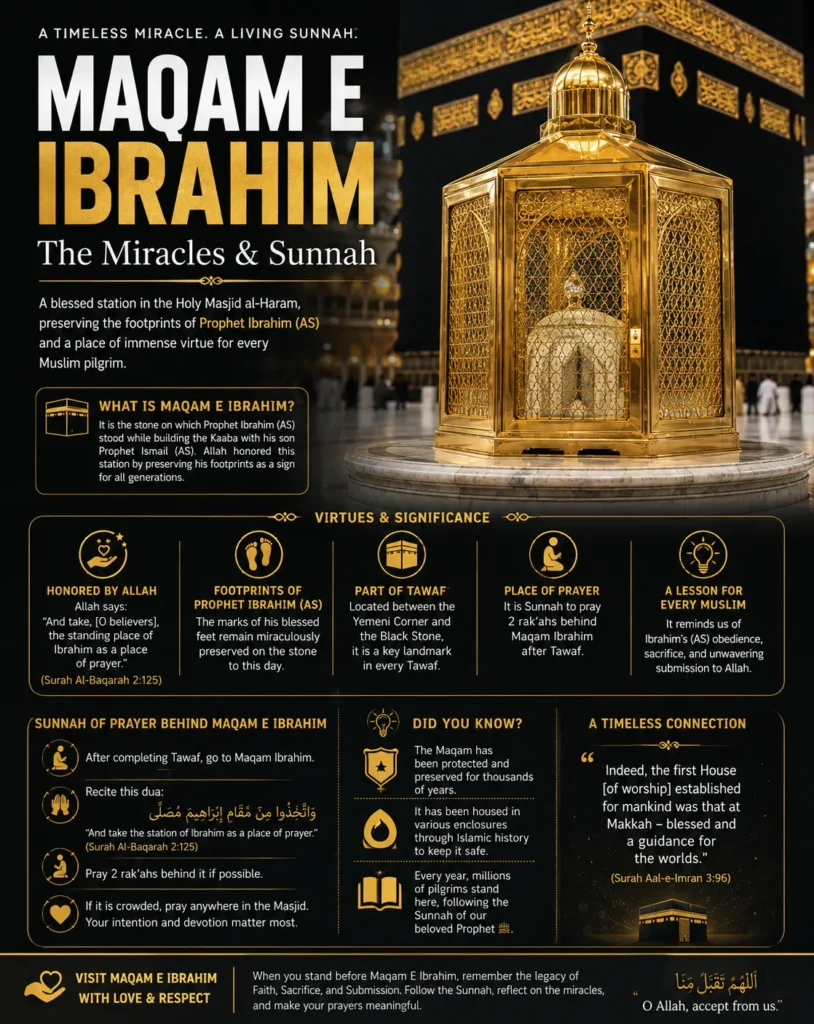
Maqam e Ibrahim is a sacred square stone housed within a golden and brass enclosure inside the Grand Mosque of Mecca, Saudi Arabia. It bears the miraculous, deeply imprinted footprints of Prophet Ibrahim (AS) from the time he built the Holy Kaaba.
To truly understand the core foundations of the Islamic faith, we must look at the physical remnants of our history. Maqam e Ibrahim (The Station of Abraham) is not a grave or a shrine. It is a historical artifact of pure devotion. Located just a few meters east of the Kaaba, this stone served as the literal foundation block for Prophet Ibrahim (AS) as he fulfilled the divine command to reconstruct the House of Allah alongside his son, Prophet Ismail (AS).
Today, a stunning hexagonal golden and crystal casing protects the stone. While you cannot touch the stone itself, the glass allows pilgrims to witness the distinct impressions of the Prophet’s feet, encased in silver to preserve their shape through the centuries.
The Historical Miracles of the Stone
The primary miracle of Maqam e Ibrahim is that solid rock temporarily softened like clay to capture Prophet Ibrahim’s footprints. Historically, it also miraculously levitated, acting as an ancient scaffold that allowed him to build the higher walls of the Kaaba.
When Prophet Ibrahim (AS) and Ismail (AS) were raising the foundations of the Kaaba, the walls eventually grew too high for Ibrahim to reach. He needed a platform. Ismail brought him a large, unhewn stone.
When Ibrahim (AS) stood upon it, the stone miraculously began to rise and fall, functioning like a modern automated scaffold, allowing him to place stones perfectly around the perimeter. As a mark of divine acceptance, Allah caused the rigid rock beneath his feet to soften, capturing his footprints forever. This physical imprint remains a timeless testament to his profound Sabr (patience) and Tawakkul (absolute reliance on Allah).
The Quranic Command: Why We Pray Behind Maqam e Ibrahim
We pray behind Maqam e Ibrahim because Allah explicitly commands it in Surah Al-Baqarah, Ayat 125. This establishes a direct spiritual link between the believer’s Tawaf and the legacy of Prophet Ibrahim’s absolute submission to the Creator.
The instruction to pray here is not merely a cultural tradition; it is a direct divine decree. When Umar ibn al-Khattab (RA) asked the Prophet Muhammad (PBUH) if they should take the station of Ibrahim as a place of prayer, this exact verse was revealed to confirm his profound intuition.
Arabic Text:
وَاتَّخِذُوا مِنْ مَقَامِ إِبْرَاهِيمَ مُصَلًّى
Transliteration: Wattakhizu min maqami Ibrahima musalla
English Translation: And take, [O believers], from the standing place of Abraham a place of prayer.
Urdu Translation:
اور مقام ابراہیم کو جائے نماز بنا لو۔
Hindi Translation: और इब्राहीम के खड़े होने की जगह को नमाज़ पढ़ने की जगह बना लो।
Integrating the 2 Rakat into Your Tawaf
The best way to complete your Tawaf is to immediately transition into a two-Rakat prayer behind the Maqam. This spiritual habit loop physically grounds you, completing the exertion of walking with the peaceful submission of prostration, exactly as Prophet Muhammad (PBUH) did.
Human psychology thrives on habit loops: a cue, a routine, and a reward. In the context of Umrah, your Tawaf (seven circuits around the Kaaba) is the cue. The routine is reciting the masnoon Hajj and Umrah ki dua while walking, followed by praying the two Rakat of Sunnah prayer behind the Maqam. The reward is the profound psychological reset and spiritual elevation that follows.
Here is why this matters for your daily routine. When you automate this process, you stop worrying about logistics and start focusing on intention.
Which Surahs Did the Prophet (PBUH) Recite Here?
According to authentic Hadith, Prophet Muhammad (PBUH) recited Surah Al-Kafirun in the first Rakat and Surah Al-Ikhlas in the second Rakat when praying behind Maqam e Ibrahim. This perfectly balances the rejection of polytheism with the oneness of Allah.
Sahih Muslim (1218) records that Jabir bin Abdullah (RA) narrated the Prophet’s (PBUH) exact method. He walked to the Maqam, recited the verse from Surah Al-Baqarah, positioned himself so the Maqam was between him and the Kaaba, and prayed.
If you struggle with Arabic memorization, mastering Surah Ikhlas with English transliteration before your trip is a high-yield micro-transformation that ensures your prayer perfectly aligns with the Sunnah.
Frequently Asked Questions About Maqam e Ibrahim
Pilgrims often ask if females can pray behind the Maqam, if the footprints are visible, and what to do during heavy crowds. You can pray anywhere in the Mataf if space is tight, and yes, the silver-encased footprints remain distinctly visible today.
Yes, women are entirely permitted to pray here. However, the Mataf (circumambulation area) is heavily crowded. Islam prioritizes safety and modesty over praying in an exact geographic coordinate.
The Sunnah is highly accommodating. If the area directly behind the enclosure is dangerously congested, you are permitted to pray your two Rakat anywhere else within the Masjid al-Haram. The validity of your Tawaf remains completely intact.
Yes. Over thousands of years, the exact anatomical details (like toe marks) have smoothed out due to centuries of early Muslims touching the stone for blessings (a practice now prevented by the glass). However, the deep, dual impressions of his feet remain clearly visible through the protective casing.
Your Next Steps for a Perfect Pilgrimage
Understanding the history of these sacred artifacts is the key to experiencing the true, life-changing benefit of performing Umrah. When you look at the golden enclosure, you are not just looking at metal and stone; you are looking at the enduring legacy of a father and son who built the center of the Islamic world with nothing but their hands and absolute trust in their Creator.
After completing this prayer, you will find yourself expressing gratitude with Alhamdulillahi Rabbil Alamin with an entirely new level of sincerity.
To ensure you are fully prepared for every step of this journey—from entering Ihram to the final cutting of the hair—read our complete Umrah 2026 guide for first-time pilgrims right now. Plan your logistics today so your heart can focus purely on worship tomorrow.

1 thought on “Maqam e Ibrahim: The History, Miracles, and Significance in Umrah”