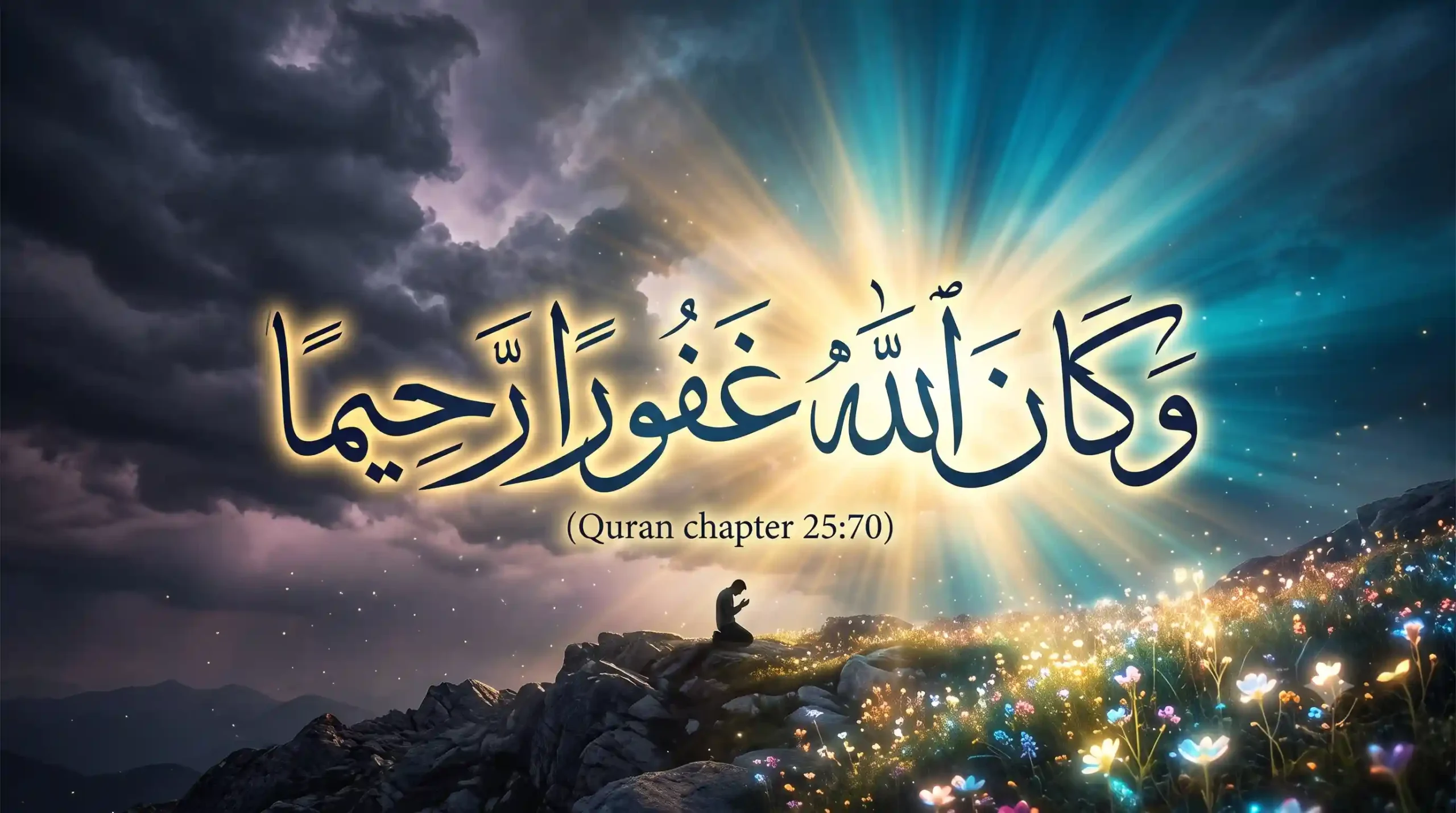
You wake up with a heavy heart. Whether you are a college student juggling academic pressures, a working professional navigating corporate stress, or a parent trying to raise righteous children in a secular society, guilt has a unique way of piling up. We remember our past mistakes, our missed prayers, and our private sins. This internal weight often creates a barrier, making us feel disconnected from our Creator and convinced we are entirely beyond repair.
But the Creator’s mercy operates completely differently than human logic. The profound assurance found in the phrase wakanallahu gafurun rahima is your exact proof that divine pardon is absolute.
Let us break down the exact meaning of this verse and how understanding the attributes of Ghafoor and Raheem can completely rewire your spiritual habit loop, turning deep regret into ultimate peace.
What Does Wakanallahu Gafurun Rahima Mean?
The phrase “wakanallahu gafurun rahima” translates to “And Allah is Ever-Forgiving, Most Merciful.” It is a foundational Quranic decree confirming that Allah continuously conceals human sins (Ghafoor) and actively showers believers with unending compassion and grace (Raheem), regardless of their past mistakes.
To truly grasp the power of this phrase, we must look at the morphology of the Arabic words. When the Quran states that Allah is Oft-Forgiving and Most Merciful, it specifically uses the words Al-Ghafoor and Ar-Raheem.
- Ghafoor (غَفُور): Derived from ghafara, meaning to cover, protect, or shield. Allah does not just forgive the sin; He covers it up so you are not humiliated by it in this world or the next.
- Raheem (رَحِيم): Derived from rahmah (mercy). This represents a specialized, continuous mercy directed at the believers.
When you seek sincere repentance, Allah applies Ghafoor to wipe the slate clean, and then applies Raheem to bless you moving forward.
Surah Al Furqan Ayat 70: The Verse That Erases the Past
Surah Al Furqan Ayat 70 is a revolutionary verse detailing that when a person repents, believes, and does righteous deeds, Allah does not merely erase their sins. He actually converts those past bad deeds into good deeds, concluding with the promise that He is Forgiving and Merciful.
This verse was revealed to Prophet Muhammad (PBUH) as a direct comfort to those who had committed grave sins before accepting Islam. According to classical scholars like Ibn Kathir, this verse applies to anyone who returns to Allah with a broken, sincere heart.
Multilingual Translation of Chapter 25:70
Arabic Text:
إِلَّا مَن تَابَ وَآمَنَ وَعَمِلَ عَمَلًا صَالِحًا فَأُولَٰئِكَ يُبَدِّلُ اللَّهُ سَيِّئَاتِهِمْ حَسَنَاتٍ ۗ وَكَانَ اللَّهُ غَفُورًا رَّحِيمًا
Transliteration: Illa man taba wa amana wa’amila ‘amalan salihan fa ulaika yubaddilullahu sayyi’atihim hasanat, wakanallahu gafurun rahima.
English Translation: “Except for those who repent, believe and do righteous work. For them Allah will replace their evil deeds with good. And ever is Allah Forgiving and Merciful.”
Urdu Translation:
مگر جو توبہ کر لے اور ایمان لے آئے اور نیک عمل کرے، تو ایسے لوگوں کی برائیوں کو اللہ نیکیوں سے بدل دے گا۔ اور اللہ بہت بخشنے والا، بے حد رحم کرنے والا ہے۔
Hindi Translation: सिवाय उन लोगों के जो तौबा कर लें, ईमान लाएं और नेक अमल करें। तो ऐसे लोगों की बुराइयों को अल्लाह नेकियों में बदल देगा। और अल्लाह बहुत क्षमाशील, अत्यंत दयावान है।
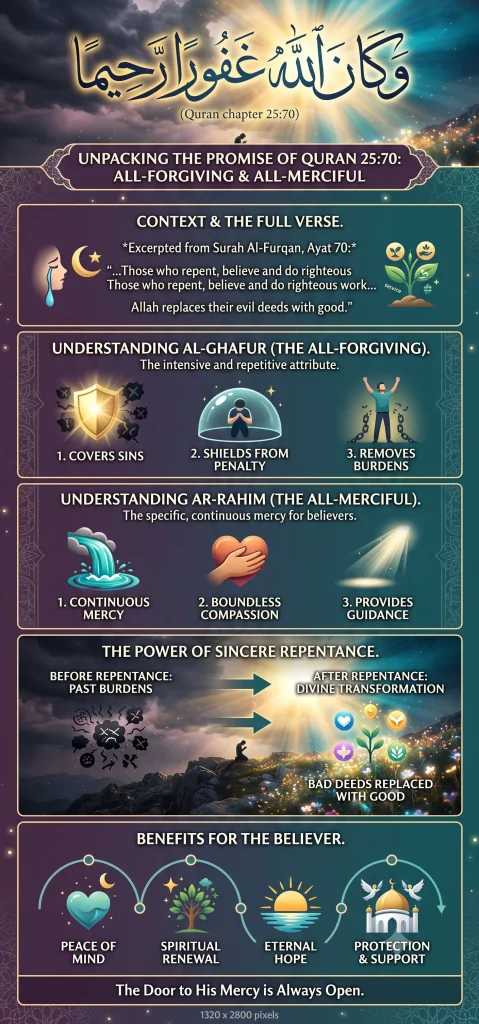
Converting Sins to Good Deeds
Here is why this matters for your daily routine. Many Muslims struggle with the lingering anxiety of past mistakes. But Surah Al Furqan ayat 70 introduces a concept that defies human logic: Yubaddilullahu sayyi’atihim hasanat (Allah replaces their evil deeds with good).
If you committed a sin, felt deep regret, and utilized the dua of Prophet Yunus to cry out in the darkness of your own mistakes, that very regret becomes a vehicle for reward. The pain of guilt is transformed into high-ranking good deeds.
This requires immense Tawakkul (reliance on God) and Sabr (patience). You must trust that wakanallahu gafurun rahima is not just a poetic phrase, but a binding divine promise.
Core Differences Between Ghafoor and Raheem
While both names relate to Allah’s grace, Ghafoor is the act of concealing and forgiving past wrongs, protecting the believer from punishment. Raheem is the active delivery of continuous blessings, love, and spiritual provision following that forgiveness.
How to Apply Chapter 25:70 in Your Daily Life
You do not need to be a scholar to implement the reality of wakanallahu gafurun rahima. You can build a simple “Spiritual Habit Loop” into your busy schedule.
- The 90-Second Morning Reset: Before checking your phone, sit on your prayer mat for just 90 seconds. Acknowledge your shortcomings. Recite standard Quranic duas for forgiveness to trigger the Ghafoor attribute before you face the world.
- Pair Regret with Action: Surah Al Furqan Ayat 70 conditions forgiveness on doing “righteous work” (amalan salihan). If you backbite, immediately donate a dollar to charity. If you miss a prayer, pray the next one early and read a page of the Quran.
- Family Supplication: Right after the famous verse of replacement, the Quran guides us on household peace. Make it a habit to recite Surah Furqan Ayat 74 to ask Allah for spouses and children who will be a comfort to your eyes.
FAQs:
The phrase means “And Allah is Ever-Forgiving, Most Merciful.” It is a recurring Quranic statement assuring believers that God’s primary nature is to forgive sins and bestow continuous mercy on those who sincerely seek it.
Surah Al-Furqan, Chapter 25, Verse 70 explicitly states that for those who repent, believe, and do righteous deeds, Allah will replace their evil deeds with good deeds.
Allah forgives all sins through sincere repentance (Tawbah). You must stop the sin, feel genuine remorse, resolve never to return to it, and ask for forgiveness. If the sin involved harming others, you must also seek their forgiveness or make restitution.
Yes. Understanding that Allah covers your flaws and replaces them with good acts serves as a powerful spiritual dua for anxiety and depression, lifting the heavy psychological burden of past guilt.
Your Next Step Toward Absolute Peace
The phrase wakanallahu gafurun rahima is a lifelong guarantee from your Creator. You are not defined by your worst moments; you are defined by your ability to turn back to Him. To take this spiritual habit a step further and completely secure your daily peace of mind, read our complete guide to master the most powerful supplications for forgiveness. Implement these exact prophetic words today and watch your heavy heart transform into total tranquility.

1 thought on “Surah al furqan ayat 70 – Wakanallahu gafurun rahima”