Waking up with a heavy chest is a reality for many of us. You check your phone, look at endless emails, think about family expectations, and instantly feel overwhelmed. College students face crushing academic pressure, while working professionals and diaspora parents struggle to balance cultural identities with demanding careers. We often try to fix this exhaustion with quick distractions or temporary fixes, but the mental fatigue always returns. The Quran offers a profound, permanent remedy for this exact feeling: wastainu bisabri wa salat.
What Does Wastainu Bisabri Wa Salat Mean?
The phrase “Wastainu bisabri wa salat” translates directly to “Seek help through patience and prayer.” It is a divine instruction from Allah in Surah Al-Baqarah, commanding believers to use active emotional restraint (Sabr) and consistent spiritual connection (Salah) as their primary tools to overcome life’s hardships.
This powerful command appears twice in the second chapter of the Quran, establishing a foundation for Islamic mental fortitude. Let’s look closely at the exact verses.
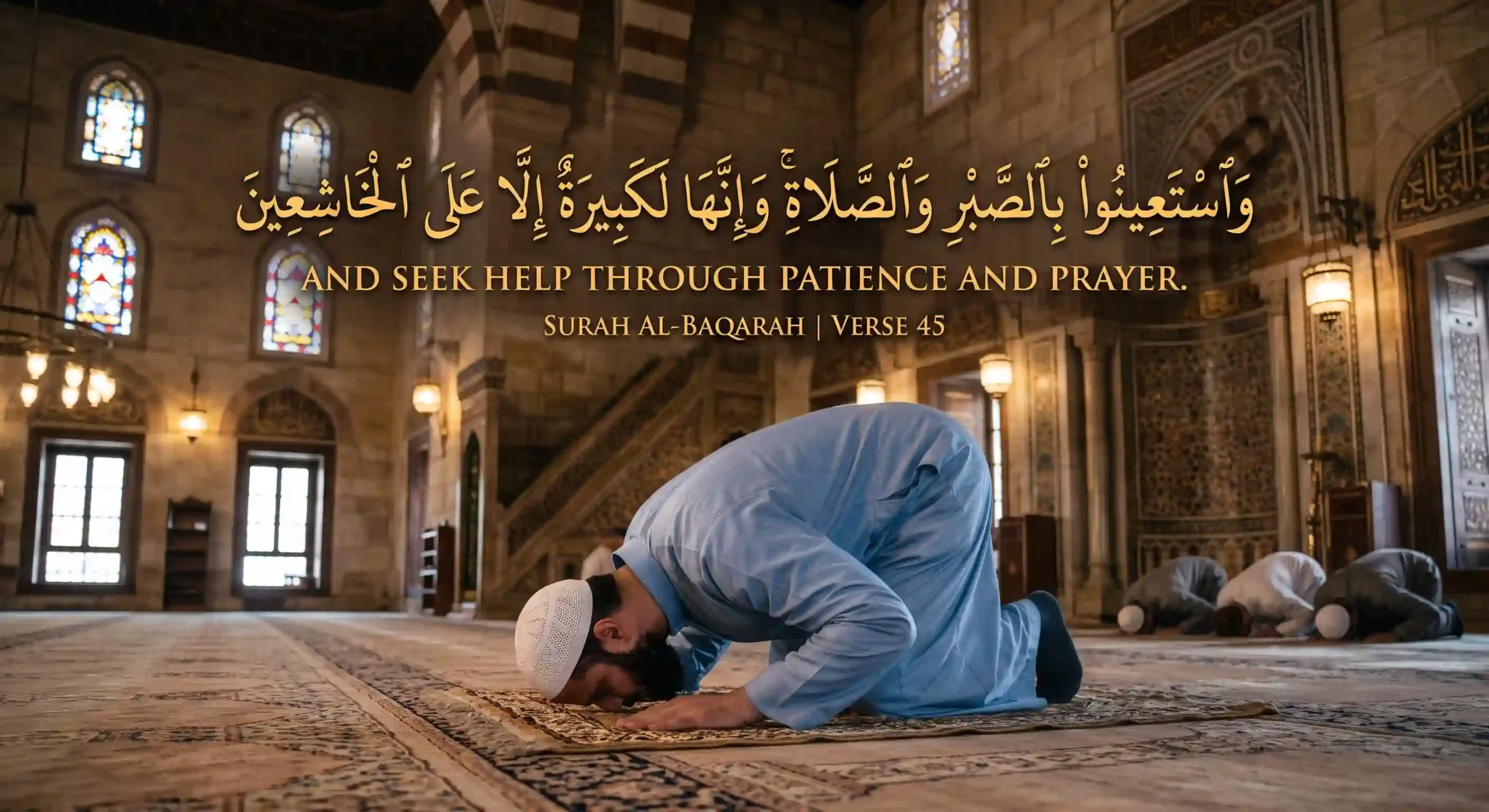
Surah Al-Baqarah Verse 45
- Arabic Text: وَاسْتَعِينُوا بِالصَّبْرِ وَالصَّلَاةِ ۚ وَإِنَّهَا لَكَبِيرَةٌ إِلَّا عَلَى الْخَاشِعِينَ
- Transliteration: Wasta’eenu bis-sabri was-salah; wa innaha lakabeeratun illaa ‘alal-khaashi’een.
- English Translation: And seek help through patience and prayer, and indeed, it is difficult except for the humbly submissive.
- Urdu Translation: اور صبر اور نماز سے مدد طلب کرو، اور بے شک یہ (نماز) بھاری ہے مگر ان پر جو عاجزی کرنے والے ہیں۔
- Hindi Translation: और सब्र और नमाज़ से मदद मांगो, और बेशक यह (नमाज़) भारी है मगर उन पर जो विनम्र हैं।
Surah Al-Baqarah Verse 153
- Arabic Text: يَا أَيُّهَا الَّذِينَ آمَنُوا اسْتَعِينُوا بِالصَّبْرِ وَالصَّلَاةِ ۚ إِنَّ اللَّهَ مَعَ الصَّابِرِينَ
- Transliteration: Yaa ayyuhal-lazeena aamanus-ta’eenu bis-sabri was-salah; innal-laaha ma’as-saabireen.
- English Translation: O you who have believed, seek help through patience and prayer. Indeed, Allah is with the patient.
- Urdu Translation: اے ایمان والو! صبر اور نماز سے مدد لو، بے شک اللہ صبر کرنے والوں کے ساتھ ہے۔
- Hindi Translation: ऐ ईमान वालों! सब्र और नमाज़ से मदद लो, बेशक अल्लाह सब्र करने वालों के साथ है।
Part 2: Mosque Photograph (Men in Sujood with Verse
How Sabr and Salah Work Together
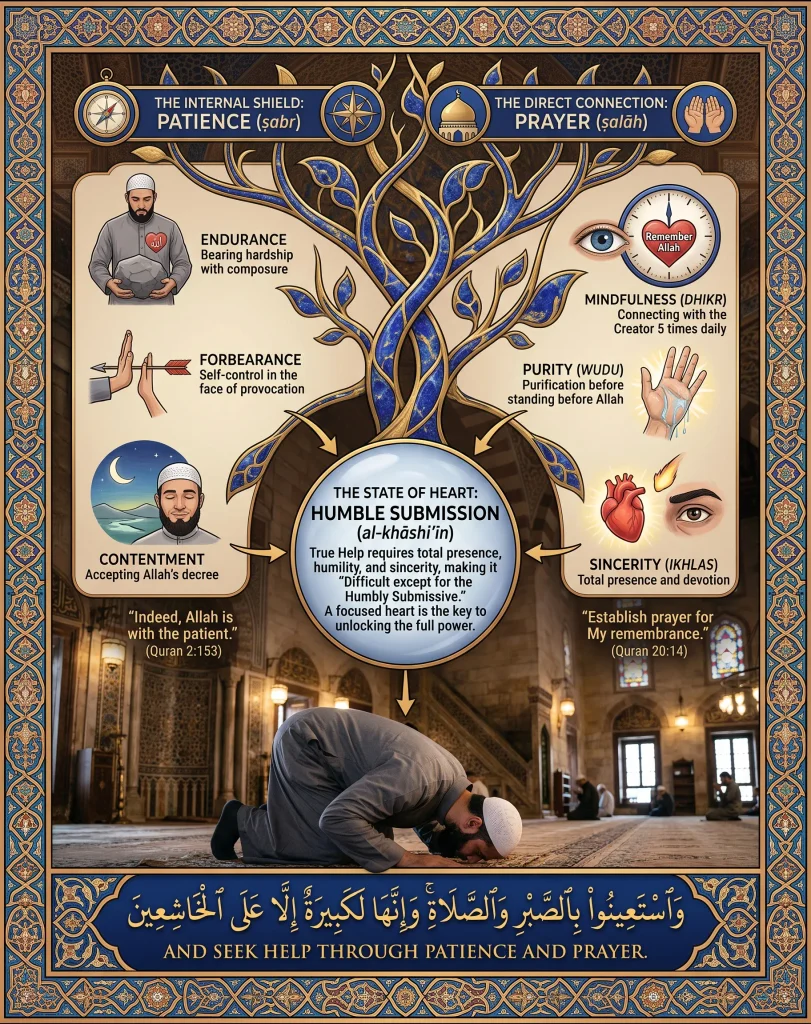
Sabr acts as the physical endurance required to face worldly struggles, while Salah acts as the metaphysical fuel that replenishes your energy. Together, they form a perfect spiritual habit loop that prevents psychological burnout and aligns your heart with Allah’s will.
Many Western Muslims misunderstand patience. We think of it as simply waiting for a bad situation to end. In classic Islamic theology, particularly in the Tafseer of Ibn Kathir, Sabr is an active, dynamic state. It is the willpower to tie down your impulses when your lower self panics. When life hits you hard, you must remember the Quranic principle of Wasbir ala ma asabaka (be patient over what befalls you).
However, human willpower is finite. If you only use Sabr, you will eventually burn out, become bitter, or fall into despair. This is exactly why Allah pairs it with prayer. Salah is your anchor. It forces you to pause your worldly hustle, face the Qibla, and surrender your anxieties to the Creator. If you struggle to maintain your five daily prayers, making a constant Dua for Salah is the first step to rebuilding this spiritual habit.
When you combine the endurance of Sabr with the divine connection of Salah, you embody the promise that Innallaha ma sabireen (Indeed, Allah is with the patient).
The Sunnah of Seeking Help Through Prayer
Prophet Muhammad (PBUH) practically demonstrated this verse throughout his life. He did not let stress consume him.
- Arabic Text: كَانَ النَّبِيُّ صَلَّى اللَّهُ عَلَيْهِ وَسَلَّمَ إِذَا حَزَبَهُ أَمْرٌ صَلَّى
- Transliteration: Kaana an-Nabiyyu sallallahu ‘alayhi wa sallam izaa hazabahu amrun sallaa.
- English Translation: Whenever a matter distressed him, the Prophet (PBUH) would pray. (Sunan Abi Dawud 1319)
- Urdu Translation: جب بھی نبی کریم ﷺ کو کوئی پریشانی پیش آتی تو آپ ﷺ نماز پڑھتے۔
- Hindi Translation: जब भी नबी करीम (स.अ.व.) को कोई परेशानी पेश आती तो आप (स.अ.व.) नमाज़ पढ़ते।
Micro-Transformations for Western Muslims
You can apply “Wastainu bisabri wa salat” through micro-transformations: pausing for 90 seconds before reacting to bad news (Sabr) and immediately performing two Rakat of Nafl prayer (Salah) to process emotional distress safely.
But how do we apply this at work or school? When a university professor gives you an unfair grade, or your boss sends a stressful email, your first instinct is frustration.
- Hold the Reaction (Sabr): Silence your tongue. Take a deep breath. Acknowledge that the situation is a test. Remind yourself La tahzan inna allaha maana (Do not grieve, indeed Allah is with us).
- Make Wudu and Pray (Salah): Step away from your desk. The physical act of Wudu washes away anger. Stand for a short prayer. In your Sujood, recite a dua for ease in difficulty.
This micro-transformation shifts you from panic to peace. You stop relying on your own limited strength and start trusting the Almighty, declaring Hasbunallahu wa ni’mal wakeel (Allah is sufficient for us, and He is the best disposer of affairs).
A Practical Comparison
Frequently Asked Questions
Verse 153 teaches believers that they are never alone in their struggles. By instructing us to use “Wastainu bisabri wa salat,” Allah guarantees His divine companionship, stating clearly that He is always by the side of those who practice patience.
When practicing Sabr, reciting a specific mushkil waqt ki dua (prayer for hardship) helps calm the mind. Invoking Allah by His beautiful names and asking for ease turns your pain into an act of worship.
While clinical treatment is highly encouraged in Islam, the combination of patience and prayer creates a profound spiritual safety net. Regular Salah introduces mindfulness and grounding, making it a vital spiritual dua for anxiety and depression when facing the pressures of modern society.
The beauty of the Quran is its practical application to our very real human problems. You do not have to carry the weight of the world on your shoulders. Tie your camel, do your best, and lean heavily on patience and prayer.
If you are looking for more actionable ways to protect your peace of mind and build a resilient Islamic mindset, read our comprehensive guide on The Complete Islamic Guide to Overcoming Modern Anxiety.
