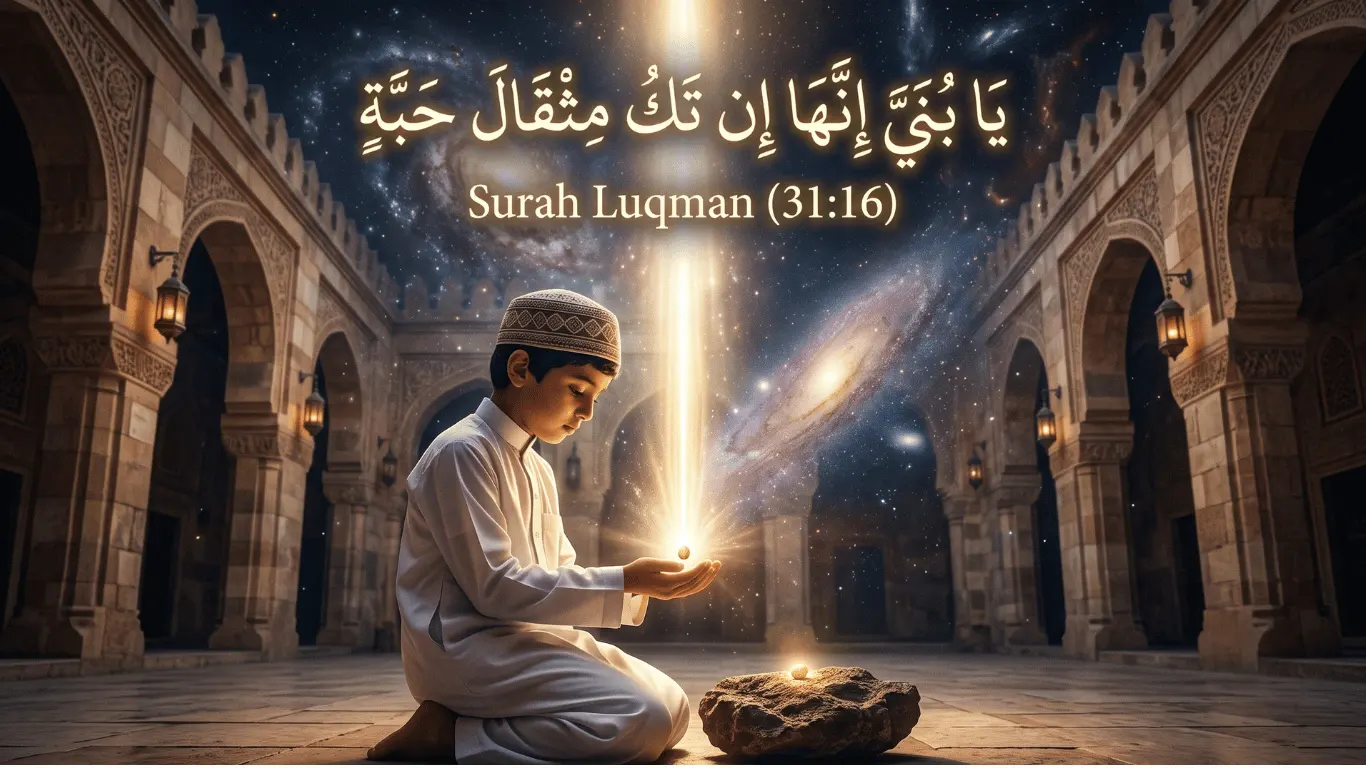
Have you ever done something completely in secret—a hidden good deed or a private sin—and thought, “No one will ever know”?
In an age where we are constantly worried about digital privacy, surveillance, and what others think of us, the Quran offers a profound reality check. It comes in the form of a father’s gentle advice to his son, found in Surah Luqman (Quran 31:16).
This single verse, beginning with the tender words “Ya bunayya innaha” (O my son, indeed it…), shatters the illusion of secrecy and builds the ultimate foundation for personal integrity.
The Verse (Surah Luqman 31:16) “O my son! If it be (an action) equal to the weight of a grain of mustard seed, and though it be hidden in a rock, or in the heavens or in the earth, Allah will bring it forth. Verily, Allah is Subtle, Well-Aware.”
The complete text for Surah Luqman, Verse 16 (31:16), including the original Arabic, pronunciation (transliteration), and translations in English, Urdu, and Hindi.
Arabic Verse
يَا بُنَيَّ إِنَّهَا إِن تَكُ مِثْقَالَ حَبَّةٍ مِّنْ خَرْدَلٍ فَتَكُن فِي صَخْرَةٍ أَوْ فِي السَّمَاوَاتِ أَوْ فِي الْأَرْضِ يَأْتِ بِهَا اللَّهُ ۚ إِنَّ اللَّهَ لَطِيفٌ خَبِيرٌ
Pronunciation (Transliteration)
Yā bunayya innahā in taku mithqāla ḥabbatin min khardalin fatakun fī ṣakhratin aw fī as-samāwāti aw fī al-arḍi ya’ti bihā Allāhu, inna Allāha laṭīfun khabīr.
English Translation
“O my son! If it be (an action) equal to the weight of a mustard seed, and though it be hidden in a rock, or in the heavens or in the earth, Allah will bring it forth. Verily, Allah is Subtle, Well-Aware.”
Urdu Translation (اردو)
اے میرے پیارے بیٹے! بے شک اگر وہ (کوئی عمل) رائی کے دانے کے برابر ہو، پھر وہ کسی چٹان کے اندر ہو یا آسمانوں میں یا زمین میں، اللہ اسے بھی (قیامت کے دن) نکال لائے گا۔ بے شک اللہ بڑا باریک بین اور پوری خبر رکھنے والا ہے۔
Hindi Translation (हिंदी)
ऐ मेरे बेटे! अगर कोई कर्म (या चीज़) राई के दाने के बराबर भी हो, और वह किसी चट्टान के भीतर या आसमानों में या ज़मीन में (छिपी) हो, तो अल्लाह उसे भी सामने ले आएगा। निस्संदेह अल्लाह बड़ा सूक्ष्मदर्शी (हर बारीकी को जानने वाला) और पूरी ख़बर रखने वाला है।
Here is why this ancient advice is exactly what our modern hearts need to hear.
1. The Ultimate Metaphor: A Mustard Seed in a Solid Rock
To teach a young mind about the infinite knowledge of God, Luqman the Wise doesn’t use complex philosophical terms. He uses a cinematic, mind-bending visual.
Think of a mustard seed (mithqala habbatin min khardalin). It is virtually weightless. If you drop it, it makes no sound. It is the universal symbol for something completely insignificant.
Now, imagine that microscopic seed trapped deep inside a solid rock (fi sakhratin). It is plunged in darkness, sealed off from the world, utterly invisible to the human eye. Add to this the vast, endless expanse of the heavens and the earth.
Luqman tells his son: Even if your deed is that small, and buried that deep, across the vastness of the universe… Allah will bring it forth. Because Innallaha ala kulli shayin qadeer (Allah has power over all things), nothing is lost to His sight.
2. Al-Latif: The Subtle Knower
The verse ends perfectly by calling Allah Latif (Subtle) and Khabir (Well-Aware).
God’s knowledge isn’t just broad; it is microscopic. He knows the hidden intentions behind your public smiles. He knows the quiet tear you shed at night. Just as we learn from verses like Allahu Latifun bi ibadihi (Allah is Subtle with His servants), this attribute is both a warning and a massive comfort.
If you do a hidden good deed—like moving a sharp object off the road, or making a silent prayer for a stranger—you might feel unappreciated. But the Latif sees it. That mustard seed of goodness will be brought forth on the Day of Judgment to tip your scales.
3. The Antidote to Secret Sins
While this verse brings hope to the righteous, it is also the ultimate cure for hypocrisy.
Before giving this advice, Luqman started by establishing the absolute core of faith: the warning against Shirk in Surah Luqman verse 13. Once the belief in One God is set, the next step is Muraqabah—the constant awareness that you are being watched.
When we internalize Ya bunayya innaha, our private lives begin to match our public personas. The temptation to commit secret sins fades when you realize there is no such thing as “offline” or “incognito mode” with the Creator. If you slip, this is the exact moment to turn back and use the most powerful Duas for forgiveness.
4. Parenting with “Ya Bunayya”
Notice the delivery. Luqman doesn’t shout. He doesn’t threaten. He says, Ya bunayya—”O my beloved little son.”
He couples a terrifyingly vast theological concept with immense parental warmth. This teaches us that Islamic discipline and moral training should be rooted in love and psychological safety, not fear and intimidation. By connecting his child directly to Allah rather than societal expectations, Luqman equips his son with an internal moral compass that will guide him long after his parents are gone.
In a world full of external pressures, anchoring your heart to the reality of this verse is one of the most effective ways for overcoming modern anxiety. It frees you from the exhaustion of performing for people, leaving you with only One gaze to worry about.
