It’s 11:40 p.m. Your inbox is still open, tomorrow’s deadline is heavy, and one question keeps looping: what if this goes wrong?
In a culture that says “hustle harder” and treats uncertainty as a personal failure, that weight feels lonely. You pray Isha, then you scroll. The worry stays.
Prophet Muhammad ﷺ gave his grandson a short answer for exactly this feeling. It is a dua that asks Allah to guide you, protect you, and take charge of your affairs.
What Is the Allahummahdini Fiman Hadait Dua?
Allahummahdini fiman hadait is the Prophetic dua that Hasan ibn Ali (may Allah be pleased with him) learned from Prophet Muhammad ﷺ for Witr. It asks Allah for guidance, well-being, protection, blessing, and safety from harmful decrees, and is commonly recited as Dua e Qunoot.
Arabic:
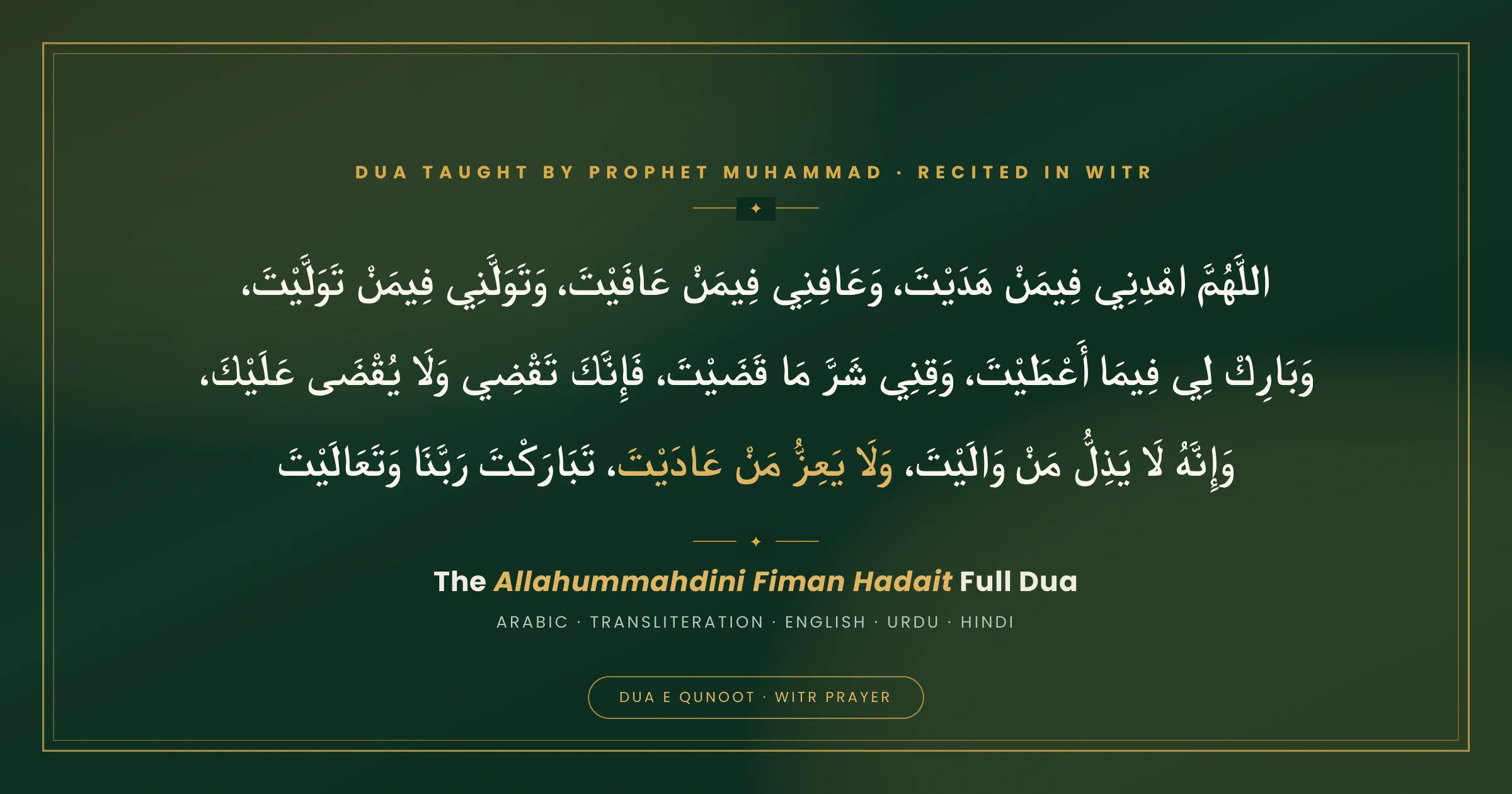
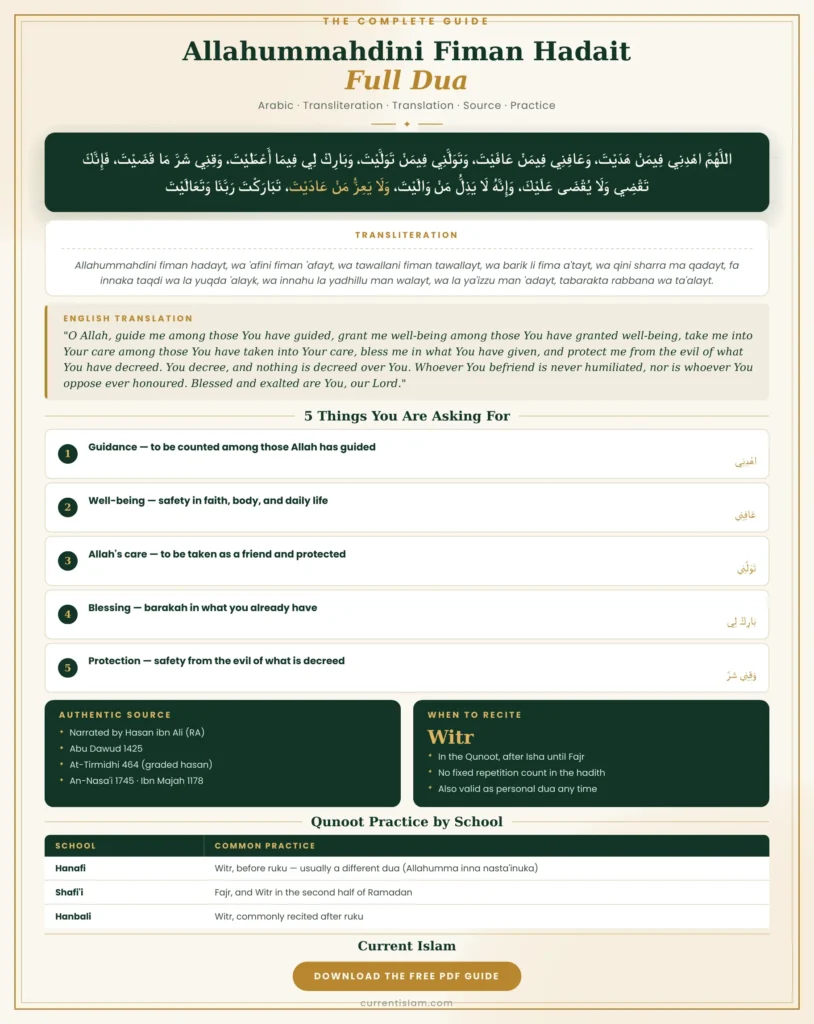
اللَّهُمَّ اهْدِنِي فِيمَنْ هَدَيْتَ، وَعَافِنِي فِيمَنْ عَافَيْتَ، وَتَوَلَّنِي فِيمَنْ تَوَلَّيْتَ، وَبَارِكْ لِي فِيمَا أَعْطَيْتَ، وَقِنِي شَرَّ مَا قَضَيْتَ، فَإِنَّكَ تَقْضِي وَلَا يُقْضَى عَلَيْكَ، وَإِنَّهُ لَا يَذِلُّ مَنْ وَالَيْتَ، [وَلَا يَعِزُّ مَنْ عَادَيْتَ]، تَبَارَكْتَ رَبَّنَا وَتَعَالَيْتَ
Transliteration: Allahummahdini fiman hadayt, wa ‘afini fiman ‘afayt, wa tawallani fiman tawallayt, wa barik li fima a’tayt, wa qini sharra ma qadayt, fa innaka taqdi wa la yuqda ‘alayk, wa innahu la yadhillu man walayt, [wa la ya’izzu man ‘adayt], tabarakta rabbana wa ta’alayt.
English: O Allah, guide me among those You have guided. Grant me well-being among those You have granted well-being. Take me into Your care among those You have taken into Your care. Bless me in what You have given. Protect me from the evil of what You have decreed. You decree, and nothing is decreed over You. Whoever You befriend is never humiliated, [nor is whoever You oppose ever honoured]. Blessed and exalted are You, our Lord.
Urdu:
اے اللہ! مجھے ان لوگوں میں ہدایت دے جنہیں تو نے ہدایت دی، مجھے ان میں عافیت دے جنہیں تو نے عافیت دی، مجھے اپنی سرپرستی میں لے لے جن کو تو نے اپنی سرپرستی میں لیا، جو کچھ تو نے مجھے دیا اس میں برکت دے، اور جس چیز کا تو نے فیصلہ کیا اس کے شر سے مجھے بچا۔ بے شک تو فیصلہ کرتا ہے اور تیرے اوپر فیصلہ نہیں کیا جاتا، اور جسے تو دوست رکھے وہ ذلیل نہیں ہوتا۔ اے ہمارے رب! تو بابرکت اور بلند ہے۔
Hindi: ऐ अल्लाह! मुझे उन लोगों में हिदायत दे जिन्हें तूने हिदायत दी, मुझे उनमें आफ़ियत दे जिन्हें तूने आफ़ियत दी, मुझे अपनी सरपरस्ती में ले ले जिनको तूने अपनी सरपरस्ती में लिया, जो कुछ तूने मुझे दिया उसमें बरकत दे, और जिस चीज़ का तूने फ़ैसला किया उसके शर से मुझे बचा। बेशक तू फ़ैसला करता है और तेरे ऊपर फ़ैसला नहीं किया जाता, और जिसे तू दोस्त रखे वो ज़लील नहीं होता। ऐ हमारे रब! तू बरकत वाला और बुलंद है।
The bracketed phrase is explained in the grading section below.
Word-by-Word Meaning: What Each Request Really Asks For
Each phrase makes one clear request: hidayah (guidance), ‘afiyah (well-being), tawalli (Allah’s protective care), barakah (blessing), and protection from the evil of qadar (divine decree). Together they cover your beliefs, health, relationships, wealth, and deepest fears in a single breath.
Let’s break down the exact meaning:
- Ihdini (اهدِني): from the root h-d-y, “guide me.” You ask for guidance to keep going, not only to start.
- ‘Afini (عافِني): from ‘-f-w. It covers health, safety, and freedom from harm in faith and daily life.
- Tawallani (تولَّني): from w-l-y. It means “be my Wali,” close to me and in charge of my affairs.
- Qini (قِني): from w-q-y, “shield me.”
- Taqdi (تقضي): from q-d-y, “to decree.” Only Allah decrees, and nothing is decreed over Him.
Is It Authentic? The Hadith Source and Grading
Yes. Hasan ibn Ali reported it, and it appears in Abu Dawud (1425), at-Tirmidhi (464, graded hasan), an-Nasa’i (1745), and Ibn Majah (1178). One closing phrase, “nor is honoured whoever You oppose,” is found in al-Bayhaqi’s narration and is discussed separately by scholars.
Arabic: عَلَّمَنِي رَسُولُ اللَّهِ ﷺ كَلِمَاتٍ أَقُولُهُنَّ فِي الْوِتْرِ
Transliteration: ‘Allamani Rasulullahi ﷺ kalimatin aquluhunna fil-witr.
English: The Messenger of Allah ﷺ taught me words to say in Witr.
Urdu: رسول اللہ ﷺ نے مجھے چند کلمات سکھائے جو میں وتر میں پڑھوں۔
Hindi: रसूलुल्लाह ﷺ ने मुझे कुछ कलिमात सिखाए जो मैं वित्र में पढ़ूँ।
This dua is in the four Sunan collections, not in Sahih al-Bukhari or Sahih Muslim. Hadith numbers vary by edition, so check your own copy.
Why This Dua Is Your Strongest Shield Against Anxiety
A powerful dua for anxiety about the unknown is one that admits Allah decides outcomes. This dua trains tawakkul (reliance on God) by asking for protection while accepting qadar. Believers pair it with sabr (patience), trusting that whoever Allah befriends is never truly humiliated.
Anxiety spikes when we try to control outcomes we can’t control. Psychologists call this a mismatch of “locus of control.” This dua splits the load: you do the asking, and Allah does the deciding. Research on religious coping links prayer and trust in God with lower distress in many studies, though results vary. Dua is never a replacement for professional mental-health care.
The last lines echo a Quranic truth:
Arabic:
قُلِ اللَّهُمَّ مَالِكَ الْمُلْكِ تُؤْتِي الْمُلْكَ مَن تَشَاءُ وَتَنزِعُ الْمُلْكَ مِمَّن تَشَاءُ وَتُعِزُّ مَن تَشَاءُ وَتُذِلُّ مَن تَشَاءُ ۖ بِيَدِكَ الْخَيْرُ ۖ إِنَّكَ عَلَىٰ كُلِّ شَيْءٍ قَدِيرٌ
Transliteration: Qul illahumma malikal-mulki tu’til-mulka man tasha’u wa tanzi’ul-mulka mimman tasha’u wa tu’izzu man tasha’u wa tudhillu man tasha’u, bi-yadikal-khayr, innaka ‘ala kulli shay’in qadir.
English: Say: “O Allah, Owner of all sovereignty, You give it to whom You will and take it from whom You will. You honour whom You will and humble whom You will. All good is in Your hand. You have power over all things.” (Surah Aal-Imran 3:26)
Urdu:
کہہ دیجیے: اے اللہ! بادشاہی کے مالک! تو جسے چاہے بادشاہی دیتا ہے اور جس سے چاہے چھین لیتا ہے، جسے چاہے عزت دیتا ہے اور جسے چاہے ذلت دیتا ہے، تیرے ہاتھ میں بھلائی ہے، بے شک تو ہر چیز پر قادر ہے۔
Hindi: कहो: ऐ अल्लाह! बादशाही के मालिक! तू जिसे चाहे बादशाही देता है और जिससे चाहे छीन लेता है, जिसे चाहे इज़्ज़त देता है और जिसे चाहे ज़िल्लत देता है, तेरे हाथ में भलाई है, बेशक तू हर चीज़ पर क़ादिर है।
Ibn Kathir explains that this verse places dominion, honour, and humiliation in Allah’s hands alone. That is why the dua’s ending can steady you at work, at school, or in the middle of the night. If this theme speaks to you, see our 7-Day Ya Azizu Action Plan for confidence rooted in dignity.
How to Build the Habit: Sunnah Count, Timing and Wazifa
Recite it during the Qunoot of Witr, after Isha and before dawn. The hadith sets no repetition count. Shafi’i practice also includes it in Fajr’s second rak’ah. Follow your own school and scholar, and recite slowly enough to understand each request.
Here is why this matters for your daily routine: a dua you never memorise stays a screenshot. Use a simple habit loop.
- Cue: you finish Isha and stand for Witr.
- Craving: you want the day’s worry off your chest.
- Response: a 30-second dua, recited slowly.
- Reward: you sleep having handed the outcome to Allah.
How Do I Memorise the Allahummahdini Fiman Hadait Dua in 5 Nights?
Learn one request per night for five nights, then recite all five together. Each request is a short phrase, so you can memorise it in about two minutes. On busy days, read the English meaning once before bed.
| Night | Arabic Phrase | Transliteration | What You Are Asking For |
|---|---|---|---|
| Night 1 | اللَّهُمَّ اهْدِنِي فِيمَنْ هَدَيْتَ | Allahummahdini fiman hadayt | Guidance (hidayah) |
| Night 2 | وَعَافِنِي فِيمَنْ عَافَيْتَ | Wa ‘afini fiman ‘afayt | Well-being (‘afiyah) |
| Night 3 | وَتَوَلَّنِي فِيمَنْ تَوَلَّيْتَ | Wa tawallani fiman tawallayt | Allah’s protective care (tawalli) |
| Night 4 | وَبَارِكْ لِي فِيمَا أَعْطَيْتَ | Wa barik li fima a’tayt | Blessing in what you have (barakah) |
| Night 5 | وَقِنِي شَرَّ مَا قَضَيْتَ | Wa qini sharra ma qadayt | Protection from the evil of what is decreed. Then recite all five requests together. |
Allahummahdini Fiman Hadait Dua at a Glance: Where, When and Why
Recite it in the Qunoot of Witr, any time after Isha until Fajr. The hadith gives no fixed count. Its main benefit is guidance and protection paired with trust in Allah’s decree (tawakkul).
| Dua or Verse | Where to Recite | Repetition Count | Best Timing | Main Benefit |
|---|---|---|---|---|
| Allahummahdini fiman hadait | Qunoot of Witr prayer | No fixed count in the hadith | After Isha until Fajr | Guidance, protection and trust in Allah’s decree |
| Surah Aal-Imran 3:26 (supporting verse) | Personal dua | Any number | Any time | Reminder that honour comes from Allah |
When Do the Four Schools Recite Dua e Qunoot?
: The Hanafi school recites Qunoot in Witr, the Shafi’i school in Fajr and in Witr during the second half of Ramadan, the Hanbali school in Witr, and the Maliki school in Fajr. Practice varies, so follow your own scholar.
| School of Thought | Prayer and Position | Commonly Recited Dua |
|---|---|---|
| Hanafi | Witr, before ruku in the third rak’ah | Allahumma inna nasta’inuka (this dua is also valid) |
| Shafi’i | Fajr (second rak’ah, after ruku); Witr in the second half of Ramadan | Allahummahdini fiman hadait |
| Hanbali | Witr, commonly after ruku | Allahummahdini fiman hadait |
| Maliki | Fajr, commonly before ruku and recited quietly | Varies by scholar |
Rulings differ within each school. Ask a qualified scholar or your local imam.
allahummahdini fiman hadait full dua pdf
FAQs:
What is the dua for guidance and well-being in Witr?
The dua is Allahummahdini fiman hadait, taught by Prophet Muhammad ﷺ to his grandson Hasan. It asks Allah for guidance, well-being, protection, blessing, and safety from harmful decrees. Muslims recite it in the Qunoot of Witr, and many also make it a nightly habit.
Who taught this dua, and to whom?
Prophet Muhammad ﷺ taught it to his grandson Hasan ibn Ali (may Allah be pleased with him). Hasan reported that the Prophet gave him these words to say in Witr. Four Sunan collections record the narration: Abu Dawud, at-Tirmidhi, an-Nasa’i, and Ibn Majah.
Can I recite it outside of prayer?
Yes. Dua is always allowed, so you may recite it after any prayer, before sleep, or whenever you feel uncertain. Its primary Sunnah context is Witr, so keep that as your anchor and add it as personal dua whenever needed.
Is it the same as Dua e Qunoot?
It is one authentic Dua e Qunoot, not the only one. Many South Asian Hanafis recite Allahumma inna nasta’inuka in Witr, while other schools favour this dua. Both are recognised, so follow your imam’s practice and ask a qualified scholar if unsure.
Can I say it in English if I don’t know Arabic?
Outside prayer, yes: dua in any language is accepted. Inside prayer, scholars advise learning the Arabic, and rulings differ by school. Start by memorising one phrase a night, read the meaning daily, and ask your imam about your own situation.
Keep going: read our complete guide to Dua e Qunoot and Witr prayer and morning duas for American Muslims.
Take it with you: Download the free PDF of this dua with Arabic, transliteration, and translations, then read it once tonight after Isha.
