
Quick Answer:
- The Purpose: This supplication asks Allah to soften a specific person’s heart, usually recited when facing stubborn parents, a difficult spouse, or a harsh authority figure.
- The Method: Replace the word fulan with the actual name of the person you are praying about (e.g., “Allahumma layyin qalba Ahmad”).
- The Origin: While the exact wording is a traditional supplication rather than a direct Quranic verse, it is rooted in authentic Islamic theology, drawing from the miracle of Prophet Dawud (David) ﷺ in Surah Saba.
You are standing in front of a brick wall. You have tried explaining. You have tried staying silent. You have tried bringing in mediators. But the person you are dealing with—whether a parent refusing a halal marriage, a spouse shutting down, or a boss making your life miserable—refuses to yield. Their heart feels like stone.
The emotional exhaustion of dealing with unreasonable stubbornness can break a person. You feel powerless because you cannot control another human being’s emotions.
But as Muslims, we believe that while we cannot control hearts, we have direct access to the One who does. The spiritual remedy for an immovable person is to hand the situation over to the Creator of that person. The allahumma layyin qalbi fulan full dua is a powerful, traditional supplication used by Muslims globally to ask Allah for this exact divine intervention.
What is the Full Dua in Arabic, English, Urdu, and Hindi?
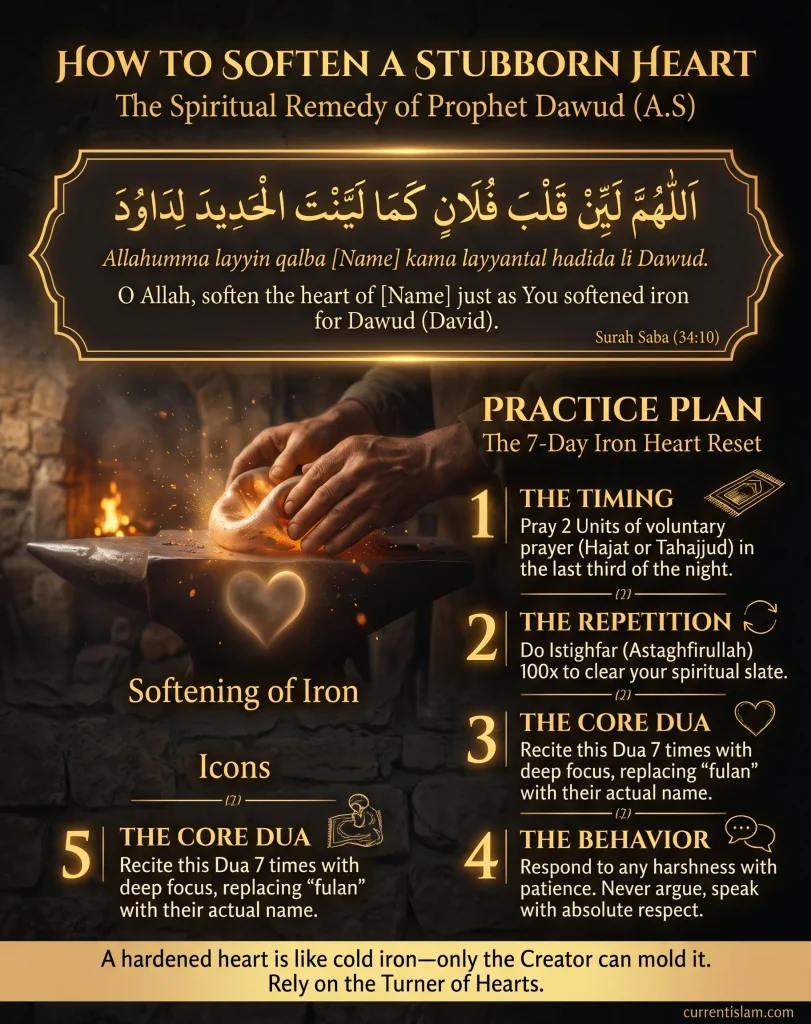
The complete supplication asks Allah to soften a specific person’s heart just as He miraculously softened iron for Prophet Dawud ﷺ. You replace “fulan” with the person’s name.
allahumma layyin qalbi fulan in arabic:
kama layyantal hadida li Dawud.”
- Urdu Meaning: “اے اللہ، [نام] کے دل کو نرم کر دے جیسا کہ تو نے داؤد کے لیے لوہے کو نرم کیا تھا۔”
- Hindi Meaning: “ऐ अल्लाह, [नाम] के दिल को नरम कर दे जैसा कि तूने दाऊद के लिए लोहे को नरम किया था।”
- Source: Traditional Islamic supplication derived from the concepts in Surah Saba (34:10)
Word-by-Word Arabic Breakdown
Understanding exactly what you are saying transforms a repetitive chant into a sincere conversation with Allah.
| Arabic Word | Transliteration | English Translation | Grammatical Note |
| اللَّهُمَّ | Allahumma | O Allah | An intimate, direct call to God. |
| لَيِّنْ | Layyin | Soften / Make gentle | A command form (used as a plea to Allah). |
| قَلْبَ | Qalba (or Qalbi) | The heart of | Note: Commonly pronounced “qalbi” due to South Asian influence, but proper Arabic grammar dictates “qalba”. |
| فُلَانٍ | Fulan | So-and-so | Replace this with the person’s actual name. |
| كَمَا | Kama | Just as / Like | Sets up the comparison. |
| لَيَّنْتَ | Layyanta | You softened | Acknowledging Allah’s past miracle. |
| الْحَدِيدَ | Al-Hadida | The iron | Refers to the rigid, hard metal. |
| لِدَاوُدَ | Li Dawud | For Dawud (David) | The Prophet who could mold iron with his bare hands. |
Is This Dua from the Quran or Hadith?
The specific sentence “Allahumma layyin qalbi fulan” is not found in the Quran or authentic Hadith collections. It is a man-made supplication (dua mashroo’) built upon authentic Quranic verses and Prophetic teachings about Allah’s control over human hearts.
The Quranic Root: The Miracle of Prophet Dawud
The core metaphor of this dua comes from Surah Saba. Allah gave Prophet Dawud ﷺ the physical miracle of molding cold iron with his bare hands to create armor.
“…And We made iron pliable for him.” (Quran 34:10) : Saheeh International]
The spiritual logic is simple: If Allah can make solid metal soft and flexible without fire, He can easily make a rigid, angry human heart gentle and receptive. We see similar profound truths about life and death throughout the Quran; just as you might read Surah fatir ayat 22 to understand that the spiritually living and the spiritually dead are not equal, a heart alive with Allah’s mercy behaves differently than a hardened one.
The Hadith Root: Hearts Between the Fingers of Allah
The Prophet Muhammad ﷺ taught that human emotions are entirely subject to divine will.
“Verily, the hearts of all the sons of Adam are between the two fingers out of the fingers of the Compassionate Lord as one heart. He turns that to any (direction) He likes.” (Sahih Muslim 2654)
When you recite this dua, you are acting on this exact hadith. You are asking the Turner of Hearts to shift a specific person’s feelings from anger to peace.
The Spiritual and Psychological Benefits
Reciting this dua does more than just ask for a favor; it changes your internal state.
- Releases Anxiety: When you face an impossible boss or an angry spouse, your cortisol spikes. By reciting this dua, you transfer the burden of control to Allah. You admit you cannot change them, which brings immediate psychological relief.
- Prevents Destructive Arguments: Instead of screaming back at a stubborn parent, reciting this dua silently forces you into a state of patience (sabr).
- Renews Tawakkul: It reminds you of the grand scale of Allah’s power. If you want to reflect further on your purpose and Allah’s power, reading Afahasibtum annama khalaqnakum grounds you in the reality that nothing in your life is random or without meaning.
How to Practice: The 7-Day Iron Heart Reset
To maximize the impact of this dua, practice the “7-Day Iron Heart Reset.” This involves reciting the dua after obligatory prayers, maintaining absolute politeness with the person, and giving hidden charity.
If you are facing an urgent crisis—like a court date, a major argument, or a final conversation with your parents about marriage—use this structured routine.
- The Timing: Pray two units of voluntary prayer (Tahajjud or Hajat) in the last third of the night.
- The Repetition: Say Astaghfirullah 100 times to clear your own spiritual slate. Then, recite a Hadith — Allahumma hasibni hisaban yasira to ask Allah for an easy reckoning for yourself.
- The Core Action: Recite Allahumma layyin qalba [Name of Person] kama layyantal hadida li Dawud 7 times with deep focus. Visualize their anger melting like wax.
- The Physical Rule: For 7 days, you must not argue with this person. Speak only with absolute respect. Let Allah do the work. If they yell, remain silent and recite the dua in your head.
Save this checklist:
- [ ] Pray 2 Rakaat of Hajat.
- [ ] Do Istighfar 100x.
- [ ] Recite the Dua 7x using their real name.
- [ ] Respond to their harshness with silence or kindness today.
Common Mistakes and Misconceptions
People often treat duas like magic spells. This leads to disappointment and weak faith.
- Mistake 1: Forcing Haraam Relationships. You cannot use this dua to make someone fall in love with you outside of a halal context. Dua is an act of worship; it cannot be used to facilitate a sin.
- Mistake 2: Ignoring Your Own Faults. You cannot oppress your spouse, refuse to apologize, and then read this dua expecting them to forgive you magically. You must tie your camel. Fix your behavior first.
- Mistake 3: Impatience. Knowing the Total Ayat in Quran takes time and dedication; similarly, seeing a change in someone’s deeply held beliefs or emotions requires patience. Allah answers in His timing, not yours.
Direct Confrontation vs. The Sunnah Approach
| Approach | The Action | The Result | The Spiritual Reality |
| Direct Confrontation | Arguing, begging, shouting. | Ego defense; the person’s heart hardens further. | Relies only on human effort. |
| The Sunnah Approach | Silence, excellent manners, reciting the Dua. | De-escalation; space for the person to reflect. | Relies on the Turner of Hearts. |
Frequently Asked Questions
What is the dua for someone to accept your marriage proposal?
The allahumma layyin qalbi fulan dua is widely used for this. Simply insert the name of the parents or the person you wish to marry (in a halal manner) and ask Allah to soften their hearts towards the union.
Can I recite this in English?
Yes. Allah understands all languages. Saying “O Allah, soften their heart” carries the exact same weight as the Arabic, provided your intention and sincerity are present.
How many times should I read this wazifa?
There is no fixed Sunnah number for this specific wording. Reciting it 3, 7, or 100 times is a matter of personal focus, not a religious requirement. Consistency is more important than the exact count.
Do I say “Qalbi” or “Qalba”?
In strict Arabic grammar, because the word “heart” is the object of the verb “soften,” it takes a fatha and is pronounced qalba. However, if you mistakenly say qalbi, Allah judges by your sincere intention, not your grammatical perfection.
Will this dua work immediately?
Sometimes Allah shifts a heart overnight. Other times, He tests your patience for months to elevate your rank. Continue making the dua and ensure your own behavior towards the person is flawless.
Can I use this for my boss at work?
Absolutely. Whenever you are facing someone who holds authority over you and is acting unjustly or rigidly, you can recite this before walking into their office or a meeting.
Next Steps on Your Journey
To deepen your reliance on Allah and improve your daily spiritual habits, explore these related guides:
- Read Next: Find peace in understanding the profound promises made in Surah Teen.
(Last reviewed: [25/10/2026] by Shahab Khan)
